

After driving 12 hours from Prince Edward Island to Hartford, Connecticut, I picked up someone at the airport that I met on the Internet. And he has offered me a place to stay near Yale University.
While this sounds like the setup to one of those brilliantly lit, chiclet-toothed, winning-smile Christmas horror films that Hallmark makes. But it is all okay. This face-on-the-screen newfound friend is Derek Holder, host and producer of The Plunge Podcast. More of this anon.

The reason I am at Yale is because of the final event in the George MacDonald Bicentennial celebration. I missed most of the events, but I was very pleased to be at the June GeoMac200 conference at Wheaton, Illinois. It was truly brilliant, and I was allowed to share a bit about MacDonald and L.M. Montgomery in her sesquicentennial—check out Maud150 posts, news, and events online. My talk there was titled
“George MacDonald’s Spiritual Theology of the Imagination and the Prophetic Critique of Anne of Green Gables.”
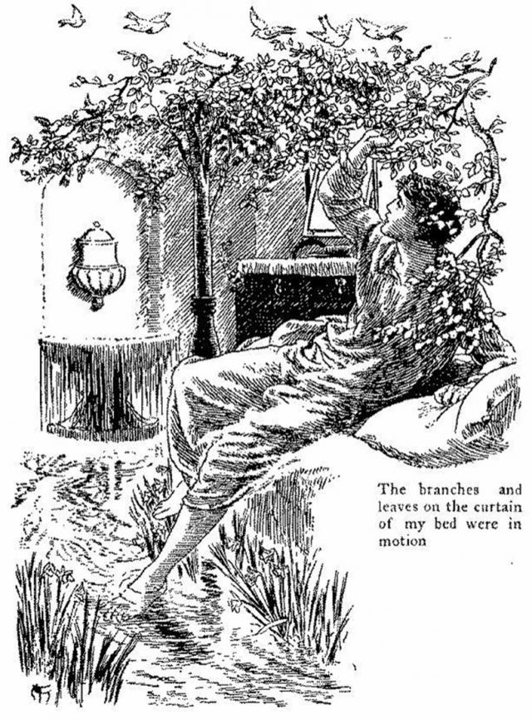
It was, I’m afraid, a grander title than my performance bore out.
I missed the other key event of the year, the conference at St. Andrews. But thanks to some small changes in the fabrics of space and time, I found I was able to attend this conference at Yale, “The Genius of George MacDonald.” Then I was asked to share some ideas about MacDonald’s natural imagination, creation theology, environmental vision and the like. I had been playing with a particular idea that rhymed with this theme, so I pitched the title, “Passports to the Geography of Fairyland: Experimental Field Notes on George MacDonald’s Socio-ecological Imaginary.”
Again, it is a grander promise than I could possibly keep, but I am looking forward to the talk tomorrow morning.
And now I am here!
And as I just now found out, you can be here too! At least in the virtual sense. You can register here for a $10 USD for the livestream. I’ve added conference details below. More later.

“A Scot of genius” wrote G.K. Chesterton; “the greatest genius of this kind whom I know,” declared C.S. Lewis. For the nineteenth-century intellectual George MacDonald, the title of ‘genius’ applies not merely to the works of fantasy for which he is now most remembered. A veritable polymath, MacDonald made a significant impact on the intelligentsia of his era, engaging with writers and social reformers from John Ruskin, Lewis Carroll, and Mark Twain, to Matthew Arnold, Octavia Hill, and Josephine Butler. His ideas fundamentally shaped much contemporary thinking on faith and imagination in disciplines as diverse as literature, philosophy, theology, natural science, education, social justice, visual art, theatre, and even music.
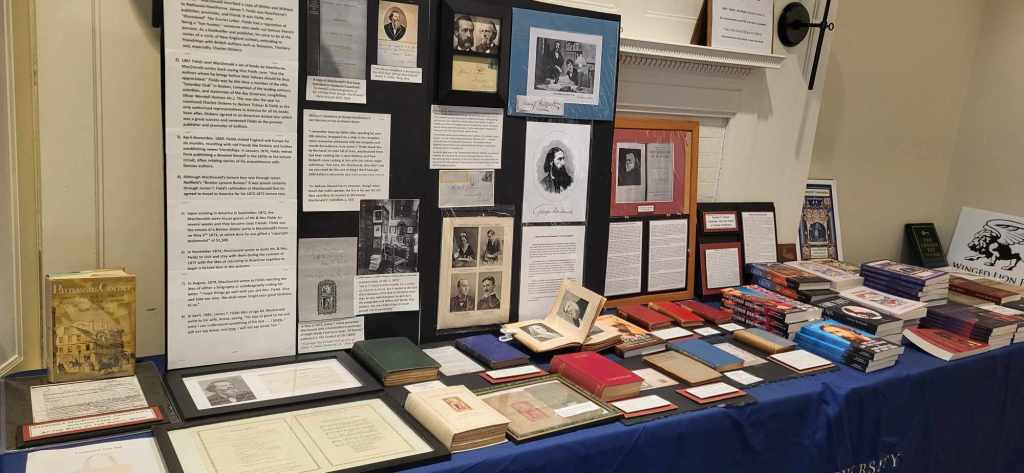
In 2023 Dr Marilyn Piety of Drexel University envisaged an academic conference that would bring discussion and examination of MacDonald’s work — and its significance — back into wider discourse. Her conversations with Dr David Mahan of the Rivendell Institute at Yale University resulted in this gathering, in the very bicentenary month of MacDonald’s birth. Yale’s Beinecke Rare Book & Manuscript Library holds the world’s largest collection of MacDonald materials, as will be showcased. In their keynote Drs Amanda Vernon and Kirstin Jeffrey Johnson will explore the import of these holdings in redressing errors and oversights in MacDonald scholarship, as well as providing ongoing revelations of the breadth and depth of MacDonald’s impact on his culture-changing contemporaries, and reflections on how his vocational praxis is perhaps more relevant now than ever. Scholars from a number of fields have gathered to analyze and discuss the significance and implications of MacDonald’s thinking and praxis. Dr Chelle Stearns has arranged an historic evening concert to examine — and experience — MacDonald’s revolutionary text Phantastes: A Faerie Romance for Men & Women through responsive pieces by Gustav Holst, J.A.C. Redford, and Eric Paździora, and readings by Malcolm Guite. We hope that this conference will invoke yet further attentio into the wide-ranging work and legacy of this generative man of letters and of action.
Conference Schedule

Friday 13 December
8:30–Arrival and Coffee
9:00 — Welcome
David Mahan and Marilyn Piety
9:15 — Keynote: “A Genius for Then and Now: George MacDonald’s Generative Relationality”
Amanda Vernon and Kirstin Jeffrey Johnson
10:15 — Walk to Beinecke
10:30 — Beinecke Tour
12:00 — Lunch
14:00 — MacDonald, Science, and Pedagogy Science, and Pedagogy
MacDonald’s lifelong interest in science and his work as a pedagogue offer a framework for this panel. The first paper considers MacDonald’s embrace of the imagination as an instrument for apprehending reality, which heals a deep-seated cultural split between science and wonder. The second paper examines the connections between George MacDonald’s approach to formative education and that of A.J. Scott.
1. Kerry Magruder, “George MacDonald and the Scientific Imagination.”
2. Brian A. Williams, “Master and Disciple: A.J. Scott & George MacDonald on Education as Formation.”
15:00 — Coffee Break/Free Time
16:00 — MacDonald and Theology
This panel examines MacDonald’s complex relationship with Calvinist theology. The papers address this subject from various angles, as they explore, respectively, the relationship between MacDonald’s ‘holy imagination’ and Calvin’s ‘epistemic restraint,’ the role of the emotions in religious experience, and atonement theology.
1. Justin Bailey, “‘Great Souled, but Hard Hearted’: George Macdonald and John Calvin.”
2. Julie Canlis, “Soul-schism & Calvinism: MacDonald and the role of the emotions in religious experience.”
3. Trevor Hart, “‘Love working life through affliction and death’: MacDonald’s post-Calvinian account of the atonement.”
17:30 — Dinner (not provided, but we will try to organize groups)
19:30 — Lyrical Evening: “Phantastes: A Musical Journey Through the Land of Faerie”
In Marquand Chapel, Yale Divinity School
Featuring: pianist Benjamin Harding, soprano Juliet Andrea Papadopoulos, poet and scholar Malcolm Guite, composer JAC Redford, composer Eric Paździora, and concert organizer Chelle Stearns
(Concert sponsored by private donors, Templeton Honors College at Eastern University, and the Marquand Chapel Team at Yale Institute of Sacred Music)
Saturday 14 December
8:30 — Arrival and Coffee
9:00 — MacDonald Amongst the Philosophers
This panel places MacDonald in conversation with Classical and existentialist philosophers. The first paper considers MacDonald’s use of classical sources (including Plato, Epictetus, Euclid, and Virgil), and the second offers a comparative examination of Kierkegaard’s and MacDonald’s readings of the Greek New Testament.
1. Laurie Wilson, “Joining the Intellect and the Imagination: George MacDonald and the Classics.”
2. Marilyn Piety, “Ad Fontes: Kierkegaard and MacDonald on ‘Original Christianity.’”
10:00 — Coffee Break
10:30 — MacDonald and The Natural World
This panel considers MacDonald’s interest in the ecological. The first paper offers an excursion into MacDonald’s socio-ecological imaginary, before the second explores MacDonald’s impact on the Victorian artist-missionary Lilias Trotter and highlights their mutual understanding of nature as a window into divine truth.
1. Brenton Dickieson, “Passports to the Geography of Fairyland: Experimental Field Notes on George MacDonald’s Socio-ecological Imaginary.”
2. Jennifer Trafton, “Reading God’s Picture-Book: MacDonald’s Influence on Lilias Trotter’s Spiritual Vision.”
11:30 — Lunch and Free Time
1:00 — MacDonald the Steward of British Lit
This panel examines MacDonald in light of his work as a literary scholar. The first paper considers MacDonald’s engagement with Middle English poems in his anthology of religious lyrical poetry, England’s Antiphon.
The second paper examines MacDonald’s work on Shakespeare, and demonstrates his significance and relevance to Shakespeare studies both in his age and ours.
1. Karl Persson, “A Bridge Between Antiquarian Scholarship and Popular Piety George MacDonald’s Curation of Middle English Poetry in England’s Antiphon”
2. Joe Ricke, “‘Second only to the Bible’: George MacDonald, Shakespeare Scholar”
14:00 — Coffee into Breakout Groups
15:30 — Round Table
David Mahan, Malcolm Guite, Kirstin Jeffrey Johnson, and Amanda Vernon
17:00 — Thank-yous and Farewells



 A Pilgrim in Narnia
Congratulations, Brenton! Break a leg with your presentation 🙂 If I were there, I would hang with you and Malcom Guite…
Dana
LikeLike
Well, the presentation went pretty well. But out of the pan and into the father. I drove straight from New Haven to Charlottetown (12 hours or so) because my father-in-law became ill. He passed away a couple of days later. So I’m a little late on the reply.
LikeLike
My belated condolences to you all!
LikeLike
Golly, Brenton. Well done. This is an eye-opener. Of course I was familiar with George Macdonald as a writer (“Phantastes”, “Lilith”, “The Light Princess” and others), and theologian (many published sermons), and as a kind of guru for C.S. Lewis, and friend of Lewis Carroll.
But Macdonald making important contributions to Music, and to Science; and literary critic on Shakespeare and Middle English poetry; and existential philosopher; and Education, and Art …
There is obviously far more to Macdonald than his current Wikipedia page indicates.
Polymath? Matthew Arnold (underrated as only-a-poet), John Ruskin (underrated as only-an-art-critic), and Mark Twain (a bigger thinker than his famous novels might suggest) … obviously Macdonald had (in modern terms) network connections that put him amongst major thinkers.
Let’s hope that Macdonald’s big and wide achievements can become far better known.
Thanks, obviously, also, to your major works of scholarship!!
LikeLike
Many a year ago, we had someone at the Oxford Lewis Society who had worked with letters by MacDonald which were at Yale, but I got quite out of touch… Does anyone know if any of these letters of his have been published, or if there are any plans in the works to publish any?
LikeLike
Hi David, it is clear that George MacDonald is in a bit of an ascendency. But I haven’t heard anything about the letters. It’s one of my favorite things to read, so I look forward to it
LikeLike
Well done, Brenton. Clearly there is far more to George Macdonald than his current Wikipedia article reveals. I hope some of the contributors to this conference can strengthen the article, and begin to show Macdonald a so much more than a spiritual and literary guru for C.S. Lewis, a friend of Lewis Carroll, and the author of some remarkable fantasy novels, notably “Lilith” and “Phantastes”.
I suspect that in Macdonald’s many essays and sermons, and letters (?), there is hitherto unsuspected evidence of Macdonald’s contribution to science, ecology, music, literary scholarship, and theology.
Something similar happens with, for example, Matthew Arnold, who is commonly regarded as a notable poet of a small number of popular anthologised poems, with the rest of his diverse work only known to specialists.
I look forward to hearing more, especially, of your own work on Macdonald, and Montgomery. I assume there is clear evidence that she knew and valued Macdonald’s work?
LikeLike
Fantastic schedule and scholars!! Oh to be a fly on a wall. Blessings abundant. Lori
LikeLike
Thanks Lori, it was a lot of fun!
LikeLike
@jagough49: Unfortunately, I can’t seem to embed reply to your great comments. Yes! GMD is underrated. He was friends with John Ruskin and there were a few polymaths in that circle who are just being discovered now. It was an eye-opening conference!
LikeLike