I think for most of us the appearance of books in a bookstore is a completely magical process. We know that somewhere—perhaps in a building behind the store, or on a fantasy island with high speed wireless internet—authors are suffering through scripts and editors are marking up copy and printers are checking ink levels. But when it comes to the process of writing we are almost entirely ignorant, except when one of these authors give us a peek into their world, like Stephen King in On Writing or Anne Lamott in Bird by Bird—two authors whose books arrive in their publisher’s hands in radically different ways. These books, far from
  taking the mystery out of the writing process, for me, anyway, simply add to the mystique.
So I thought that I would give the step-by-step process of writing in my newest project, beginning with the prewriting stage.
I am a veteran of the International 3 Day Novel Contest (3DNC), having earned my survival sticker four years running. The 3DNC was just this past Labour Day, and yet I find myself in the situation where I am ready to launch into another writing project. This time it is NaNoWriMo, the National Novel Writing Month. Unlike 3DNC, where contestants strap themselves to laptops and mainline caffeine for 72 hours straight, NaNoWriMo is an entire month set aside to write a single project. In 3DNC 500-600 contestants pay to have their work judged, and about 2/3s finish a novel in the weekend; in NaNoWriMo, a quarter of million—that’s right, 250,000 aspiring authors writing simultaneously!—sign up for  the challenge and 30,000-40,000 writers succeed in producing a novel of at least 50,000 words. It’s pretty intense.
Besides being a sucker for punishment, why do I do this to myself? With 3DNC there is a free sticker and a chance of being published, but with NaNoWriMo there is only the glory of personal success. If it isn’t the prize, what is it?
My chief goal with NaNoWriMo 2012 is to produce a good first draft of a novel that’s been cooking in my cranium for a few weeks. I’ve gained with the 3DNC the confidence and experience to know that I can  produce a full-length novel. Of the four years I’ve done 3DNC, though, only one of those drafts has been worth pursuing to the next level. My hope is that my NaNoWriMo experience will provide me with something I can work toward publication.
To do these contests well—and to write well in general, I believe—a lot rides on the prewriting. This happens in different ways, but this new project is as typical as it gets for me.
C.S. Lewis once said that his Narnia stories “began with a picture.” In his case it was the picture of a fawn in the woods on a snowy day carrying packages. Over the years that this image was in his head,  other elements appeared, the story grew, Lewis found form and he wrote.
In my case the story also began with a picture. I was sitting in church on September 28th and I imagined an old woman holding a glass ball up to the flame of a candle and seeing in the orb the entire life of a young woman. It was that picture—the woman’s old, calloused fingers holding up to the light a marble which betrayed the soul of another—that caused me to reach for my journal. I do all of my prewriting in a leather journal my wife bought me Christmas of 2003. It is filled with lecture notes, scratched poems, prayers, doodles, complaints, sermon outlines, and book and story ideas.
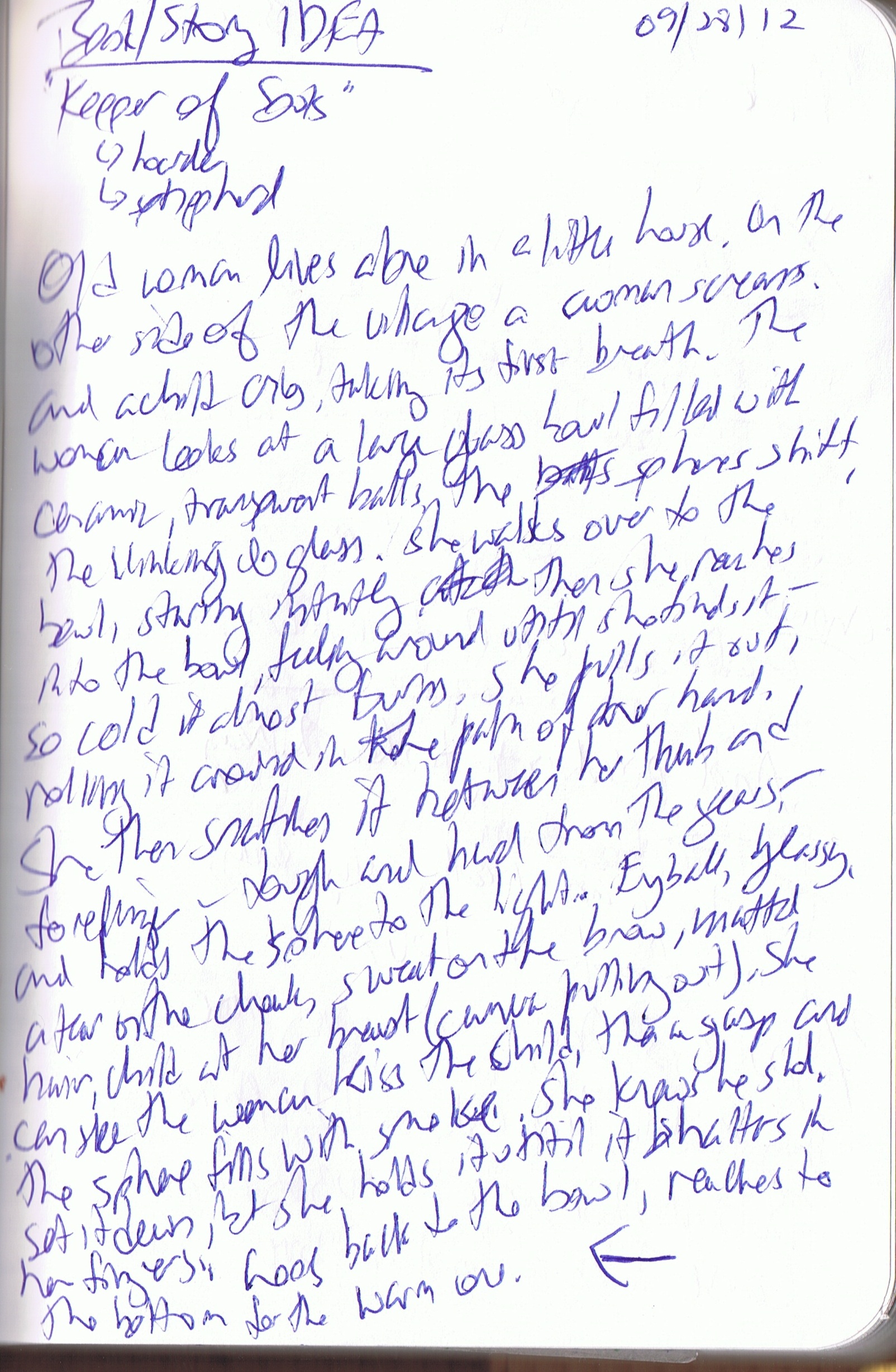
As the image filled my imagination—and as my good friend preached on without me—the picture became a scene. I sketched in my journal (in the picture here–if you click on the picture it will go full size) the scant details of a woman who lives alone in an old house in a small village. The old lady hears a woman scream, then a child take her  first breath. The old woman walks over to her mantle where a large glass bowl is filled with the transparent orbs (one for each villager, I would later discover). She reaches into the bowl, feeling around until she finds one of the spheres that is so cold it almost burns. She pulls it out, rolls it between her thumb and forefinger, and then holds it up to the flame. She sees a glassy, vacant eye in the sphere, then a tear running down a cheek, and then sweaty hair on a forehead. As she watches the orb she sees the whole woman, naked with a shivering child on her breast. The mother kisses her child, and then gasps. The marble fills with smoke, and the old woman holds it until shatters in her fingers.
This next part I captured in my journal with a single sentence—I was anxious to get as many details out as I could, writing in short form that I would remember later. The old woman heard the orbs in the glass bowl rustle, and she moved to the mantle once more. She reached into the bowl until she found the warmest sphere. She pulled it out, rolling it on her palm for a moment before holding it up to the light. The old woman is a Soul Keeper, and with each of these spheres sees the entire lives—past, present, and future—of each of the villagers. When she holds up this sphere, however, she sees nothing but the present: the child squirming in her dead mother’s arms. She has no future.
Mad with the idea of a Soul Keeper, I sketched out some notes beneath a story idea from a few days earlier.
The newborn girl is not just any girl, but a child of Promise. She is to be sacrificed, but not as a saviour. The village is cursed, beginning hundreds of years earlier as the empire first broke in upon  it. In each generation, a child in the village has been murdered. A Jewish boy was mobbed on Good Friday, an innocent Gypsy was executed for theft, a young girl was accused of Witchcraft and burned, a Catholic was killed in riots, a Protestant girl was ravaged by Communists—in each century the village has invested itself in the blood of those that are different, set apart.
What the villagers don’t know is that the curse requires that one of the normal village children—the innocent children of the tacit or active murdering parents—is taken in exchange for one of the murdered “others.” The Soul Keeper’s shoulders droop as she observes the child with no future. She regrets that she must be Soul Keeper in a generation of the Exchange.
The woman’s hut is filled with the tools of her craft. On the same mantle there is a vase filled with feathers—each one a secret, which, when the feather is carved into a quill, can be used to write the secret in the Soul Keeper’s great book. There is a small box of buttons—each  one a covenant of two people in the village. There is a metal box of pebbles, representing the sins of the villagers (later this became bits of charcoal, which the Soul Keeper can sketch out in her book). The old woman sits beside the fire, sewing together pieces of lace—the lace is the love between the men and women of the village, and she does her best to sew back together lovers torn apart. As she sits by the fire, she is covered with a patchwork quilt, which, if anyone could see the village from the mountains, is the aerial image of the village, and changes as the season change and houses are built and the river rises and falls.
The story is quite young at this point—maybe ten or fifteen minutes old. But even at this point I know about the Curse, and the Exchange, and that at some point the Soul Keeper will break the rules. I also know that there is a stranger without a glass ball—presumably without a soul. A few days later I added Revelation 5:8, “they were holding golden bowls of incense, which are the prayers of the saints.” I’m still not sure whether there will be a literal golden bowl or not, but I put it on the list just in case. Over the week, I allow the story to rest in my head, giving it space to find form and make connections. I still don’t know the genre of the story, let alone where it will go.
The next weekend I began to work out the details (as you can see in the next picture). I wrote out more clearly the tools of the woman’s Soul Keeping. I also wrote out the list of murdered children, adding one more: either an Idiot child (autistic or mentally handicapped) or a  gay kid. In red I asked the question, “who is the dark figure? A sphere-less stranger who comes to collect the Promised Child?” In green below that is the development of that idea over a couple of weeks, so that the stranger is the original murderer (a General), now Death who collects souls, but comes to the town as the Preacher.
I began to realize how important the connection between the Preacher (without a sphere) and the Soul Keeper was, and began writing out their story on the right side of the page (below). The Soul Keeper (still unnamed) knows that the Preacher is important somehow, but she cannot see her own story like she can see the others. Her own story was “all mist and shadow. Her role as Keeper was all she knew.”
I also began to perceive the parallel relationship between the Promise Child and the Other—both to be born in the same time. These two relationships change the structure of the curse: 1)  the Promise Child comes into relationship with the Soul Keeper, who in turn loves the little girl; 2) the Promise Child and the Other become friends—something that hasn’t happened before.
I still haven’t named the story. I try different names: Keeper of Prayers; Prayers of the Saints; Pearl of Great Price; Shepherd of Souls; Life in Glass; Life in Flame; God in Our Skin. None of these are right, though Prayers of the Saints, Shepherd of Souls, and Life in Flame are possibilities. I am still waiting for this to come to me.
One of my realizations about this tale is that it is a Death story. In the form of this fictional world (see below), Death is a character. The Preacher is a Death character. As I did extensive research into death—see the right of this picture—the passage in 1 Corinthians 15:26 resonated in my brain, “the last enemy that shall be  defeated is Death.” Throughout the story, as we move to the death of the Promised Child and the Other, Death appears to the Soul Keeper in her imagination.
I also did some research on Gypsies (we call them Romani now). I know all the other victims well, having researched and taught on religious and anti-religious violence. The research on gypsies was great fun, and revealed all kinds of deep links to the story that I hope emerge as I write.
A few days later, I began to do some writing, sketching out scenes. Here is a picture of one of the scenes—a crucial scene between the  Preacher and the Soul Keeper. I’ll only share one of the pages—if you can read my handwriting, well done, but the next page shows crucial shifts in the story.
Comfortable that I had a story, I began to feel the form. This Soul Keeper story seemed to me a legend, perhaps a myth, and probably a Faerie Tale. I began to throw myself into that mental form, drawing from the work of George MacDonald, C.S. Lewis (more his nonfiction than fiction), J.R.R. Tolkien (The Hobbit, specifically) and especially Holly Black. Paulo Coehlo’s village in The Devil and Miss Prym is an influence, but I intentionally avoided his stock, moralistic characters and his parable-type writing. Though I like their moods of darkness and melancholy, I avoided too John Connolly, Stephen King, and Lemony Snickett, where the mood almost becomes a character in the story. I also chose to exorcise any element of satire–especially the character of Death–so Terry Pratchett was pushed to the side.
As I thought through form, the characters and setting needed to come. As you can see from the picture, I began to name the Soul Keeper. She is neither a witch, nor a saint, nor a goddess, nor a fairy, but all of these. Some fairy names came up—Fay, Morgan or Morgana—but none stuck. Similarly, the goddess names were unsatisfactory (Thea and Danaë) and the witch names fell flat (Dryicge  and Nona). “Angela” seemed too obvious, and too Latin—I was going for more Celtic, Saxon and English sounds. I finally settled upon Bridit/Brigid, a character of Celtic lore who is both a goddess and a saint. She is a woman of poetry and things that go high up (fire, mountains, prayers). Moreover, she is two-faced, both beautiful and ugly. Brigid (as I decided) is a rich name.
The Girl (Promised Child) became Christina (little Christ one) to allow that ambiguity of sacrifice to land home. I decided on an Idiot Boy—I thought a self-reflectively gay child too old for my characters, too obvious to today’s culture, and out of step with the voice of the story (though Holly Black does it reasonably well). I also find that authors are using gay characters for commercial reasons, and I wanted to avoid that. The Idiot’s name, though he is called “Boy” by most, I have named here as Solomon. I like that Solomon was a wise character and his name means “peace.” I changed it to Theron later–a derivative of “weeping one” in Old English–but I’m not sure I’ve chosen well.
This page shows me playing with names for the glass spheres, including a Milton quote: “sun’s lucent orb.” I develop a couple more characters and remain unsuccessful in naming the story. I also ask the question of the Villain—why hadn’t I thought of it before? It could be the Preacher, but I was doubtful that was right.
This page, though brief, was a full week of work sketched out.
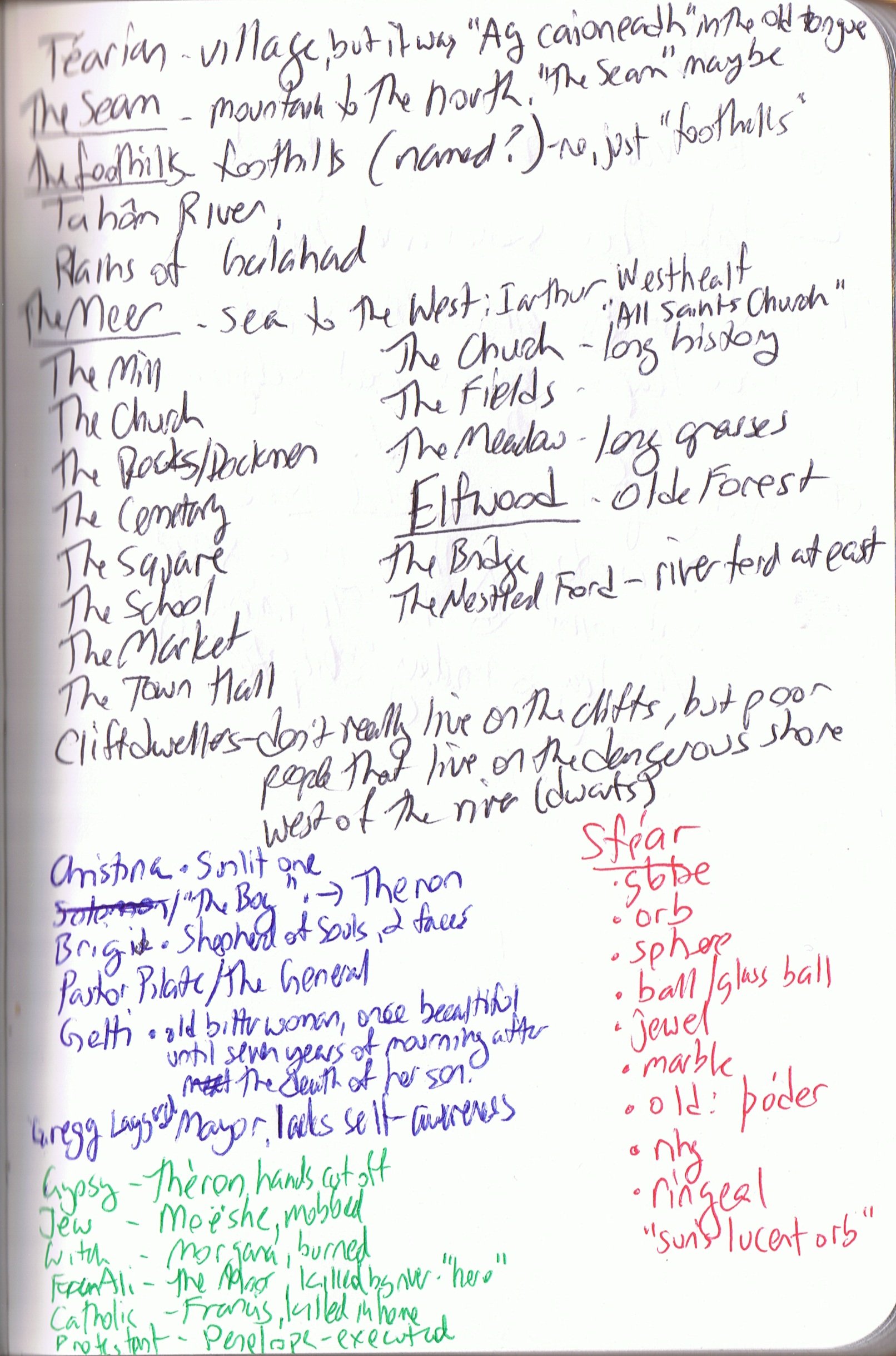
Next came the setting and the outline. I still don’t have an outline—just a smattering of scenes (the right side of the picture). But the village really came into being for me. I began with Ramah, the weeping village of biblical prophecy where the children were martyred by Herod. I love that idea, but hated the ring of “Ramah.” It ends weakly, with a breath. So I finally  chose “Téarian,” an old word for “tears.” “Ramah” may still end up in the title, but Téarian is clearly the village’s name.
I soon began to see that the village was landlocked: a river village like the one I grew up in, penned in by great plains to the East, mountains to the North, an enchanted forest to the South, and the sea to the East. The River Tahôm—Hebrew for “the Deep” in Genesis 1, and reminiscent of the Rhine where the slaughter of Jews during the crusades began—was where the Children of the Curse are lost as they are exchanged for the murder of the Others. The children, in my mind, return to the chaos when they are exchanged.
I had to translate the ideas of the village into geographical form, so I sketched out (very badly) a map of the village. Out of this map came the locations for the village—church, mill, docks with their Docksmen, the cliffs with the Cliffdwellers, the market, and the Town Hall where a key scene takes place. I named the mountain range to the North “The Seam.” I thought I was stealing Christopher Paolini’s term for the mountains that lead Eragon to his destiny, but he calls those hills The Spine. I actually took the name (apparently) from The Hunger Games. In any case, “The Seam” is the line between Téarian and the real world outside the village. I’ve named the Olde Forest “Elfwood,” as the people believe they are enchanted by the Good People (who aren’t, of course, good). I’ve named the endless flatlands to the East the “Plains of Galahad” to capture an Arthurian feel (and Galahad is, of course, the biblical Gilead which shows up everywhere in literature). The sea to the East is simply “The Meer,” a misspelling of an older Celtic word (perhaps where we get the French, la mer), but mostly chosen because it sounded right.
Finally, the map and this character list create a kind of cheat sheet. I won’t have time to look things up in the writing, so I’ve done the research here and print out this sheet so I can look things up quickly. There are a few changes, including the technical name for the orbs: Sféar. It doesn’t look like much, but this cheat sheet is most of what I need for the entire project and contains in short form my research and preparation.
This note is hardly a tutorial—either for succeeding in NaNoWriMo or as a template for prewriting. It is simply what I do. It is fun, and shows the layers in an author’s work, but it is really just my sketching of thoughts down at bedtime and the in between times of life (including church, apparently). As the story developed, I kept my notebook with me most of the time, so much of what I sketched has come almost accidentally. Yet I’ve intentionally shaped the process—this story in once sense seems to come to me from beyond, but it is also my story.
I feel strong about the prewriting. There are three things that I am timid about going into this challenge. The first two fears are programmatic fears. First, I don’t have a real outline. I usually have a strong outline and follow it, but this time I have a smattering of  scenes. Second, I am not sure I can finish the book in 50,000 words. I know that I can write 50,000 words in a month, but this story feels like 80,000 words, and I don’t think I can do that in a month. Plus, I want them to be good words—I am not rushing on this project, but taking my time to write well. We’ll see how that goes.
My third fear is really the writer’s fear as he or she sits at the edge of a project. I may fail. I may write and it is bad. Or, worse I think, I may write and what comes out is a fair story, something that causes readers to shrug and move on. That would be deadly.
But I cannot control the outcome. I can’t peak around the corner. Instead, I’m going to launch in. I don’t know if this story will magically appear in bookstores in 3-4 years, but I do know that if I don’t write it, it will never be sold.
So here I go.
You can follow my progress on twitter. My handle is @BrentonDana.
I believe in open access scholarship. Because of this, since 2011 I have made A Pilgrim in Narnia free with nearly 1,000 posts on faith, fiction, and fantasy. Please consider sharing my work so others can enjoy it.
Like this:
Like Loading...

 vol. 1), I was struck by the casual tone of his experience. On Remembrance Day in Canada, we consider the weight of the soldiers’ sacrifices for freedom. Often in tearful recollection, we hear the stories of those who have fought and died before us. Sometimes it is good, though, to hear the detached, reflective view–the stepping away from the moment to see the war in its stark horror through the eyes of a teenager who simply wants to get to university, and then reflecting on the moment years later.
 about the quality of bookshops in the region—not the things I’d be most concerned about if I was marching to “the war to end all wars.”
 respite at Le Tréport would be a watershed experience of the war. Just two weeks later, he was back on the front line, and would look fondly back at “the old peaceful trench warfare I knew before Le Treport” (March 5, 1918). In his memoir, Surprised by Joy, Lewis would describe his war experience:
 Although this paragraph is only a hint of what he experienced, it is detailed enough for us to see the change that occurred in the man during a single winter when he was twenty.


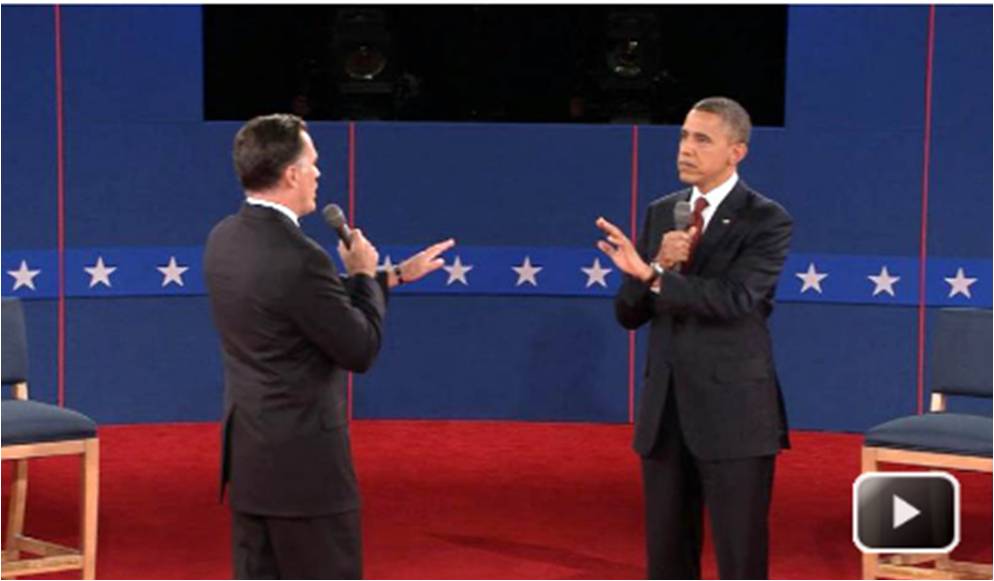
 Lenin’s dentist, and Romney is the bastard son of Ayn Rand. Obama hates people who love freedom and Romney hates people who aren’t rich–which adds up to a lot of people! The 99% are, apparently, 100% sure of their positions.
 I would like to offer a caution to Christians on this path, however. If you are authentically invested in your Christian faith, you will vote (or volunteer for a candidate, or run for office) in such a way that you express your Christian worldview. You may find a party or candidate that best reflects your understanding of faith as it works out in your community. As you do this, though, do not forget what is “the most important part.”
 In today’s partisan culture, we could easily make some substitutions for Patriotism and Pacifism: Left and Right, Conservative and Liberal, Progressive and Traditional, Republican and Democrat. Any of these dichotomies can threaten to come to the centre of our faith-perspective, with commitment to these expressions being essential to our Christian practice. Screwtape paints a picture of what it looks like when one makes these extremes central to faith, when we make our Cause “the most important part” of our faith:
 Now that seems to dominate. American Christians: I encourage you to choose well, not least because the entire world will experience the benefits and deficits of your choice. But as you choose, remember that your choice is the expression of your faith, and not the determinant of it.