Shedding Light on Lost Manuscripts: A Review of Charlie Starr’s “Light”

           It was by instinct that I went to the Wade archive for C.S. Lewis this past summer. I didn’t know what I would find, and when I got there the project I had proposed pretty much fell flat. But as I began to work in the archive, as I handled unknown letters and obsolete drafts and long-forgotten manuscripts, I got the bug. I found something interesting, ideas crashed together in my mental universe, and I soon found I was on a journey of discovery, sleuthing like a detective through historical obscurities as I collected clues until I began to form a picture of “what really happened.” Once you have this bug, you will find it almost incurable.

It is precisely this kind of process that led Dr. Charlie W. Starr, professor of English at Kentucky Christian University, to his new book, Light: C.S. Lewis’s First and Final Short Story. In 2010 he read the handwritten manuscript of a lost C.S. Lewis story and soon found himself drawn in to an intellectual journey through an historical mystery.

I have talked here about C.S. Lewis’ short story, “Light,” which is a version of “The Man Born Blind” (1977). Both extant versions of the story emerged in mysterious circumstances. “The Man Born Blind” was saved from a bonfire and kept secret for fifteen years; “Light” was unknown previous to the mid-1980s, when it appeared to a British bookseller and subsequently sold to American collector Dr. Edwin Brown, who donated it to the Lewis and Inklings collection at Taylor University. Light: C.S. Lewis’s First and Final Short Story is the result of Starr’s detective work in this intriguing mystery.

Light consists of three different movements. First, Starr publishes (for the first time, I believe), the entire short story, “Light,” as it appears in the Brown manuscript. He not only publishes a polished, final text, however, but also gives a parallel publication of “The Man Born Blind”—the first version of this story, he argues—next to “Light,” with all of the revisions in between. The result is that we can see the process of how “The Man Born Blind,” possibly a revision of a much earlier story, becomes “Light” through a series of stylistic changes. Starr draws attention to these revisions in extensive footnotes and a summary chapter, and makes a convincing case that Lewis’ revisions not only produced a smoother story, but drew attention to a particular theme.

Second, Starr offers us the entire story of how the manuscripts appeared, the processes of their authentication, and the possible solutions to a dozen problems that dominate the mystery. Not all questions are answered, but Starr—schooling himself in historical detective work as he goes—helps us understand Lewis’ writing process by looking at how he wrote in notebooks, the kinds of pens and inks he used, the development of his handwriting style, and even how he sketched out story outlines, revised poems, and made essay and lecture notes. In this section he, quite convincingly dates “The Man Born Blind” to 1944 or the first half of 1945, with “Light” following not long after. Beyond the sheer nerd-ness in this section—my favourite section!—Starr’s work offers us tentative templates with which to undertake an extensive process of dating Lewis’ manuscripts.

Third, Starr undertakes an interpretation of the short story. I believe this is the first substantial reading of “The Man Born Blind” that takes into account “Light,” even though the Brown manuscript of “Light” has been available at Taylor University for years. What is intriguing about Starr’s work is that he does not offer a single, integrated interpretation of “Light,” but looks at it from a number of angles, including Lewis’ discussions with Owen Barfield (for whom the original story may have been written), Lewis’ theories of how we know what we know (epistemology), and Lewis’ central idea of “longing,” which he variously calls “joy” or “sehnsucht.” In the end, Starr argues, this short story draws our attention to the theme of “light”—a concept in Lewis that, though often forgotten, is absolutely central to his work. Starr’s reading of “Light” within Lewis’ writings draws together the various sermons, stories, and essays into a coherent whole.

The first two movements are important from an historical perspective and add much to Lewis scholarship. They are also a lot of fun, which is why they were the focus of his lecture at the Frances White Ewbank Colloquium at Taylor University in June and in his interview with William O’Flaherty. I think, though, that the third movement is actually his most important work. If the picture Starr paints of Lewis’ epistemology is accurate, it means a reorientation of how we understand Lewis’ philosophical standpoint. Starr admits to his tentative conclusions about the difficult—and admittedly strange—story that is “A Man Born Blind”/”Light,” but if he is correct in his interpretation, “light” is a theme that is worth further consideration. I wonder sometimes if Starr takes Lewis’ Platonic starting point too far. I am not yet qualified to offer a substantial critique, but I felt less secure of Starr’s reading of Lewis in this particular area.

Anyone who reads this book is going to have to accept the piebald nature of the work. Light has two audiences—C.S. Lewis fans and literary scholars—and thus has two very different voices, each used variously throughout. In the introduction and the second movement, where Starr describes the story of the lost and found manuscripts, he is naturally very casual in his approach, telling the detective story much as he would tell it to a friend. He also takes this casual tone in the footnotes to his parallel publication of the story revisions. The casual tone and accessible language highlight the jarring difference in the academic tone in the other chapters of the book, mainly the third movement (interpretation) and in the technical description of the manuscripts.

I would encourage the potential reader not to be fooled by these shifts in tone. A narrative voice in parts is not an indication of a lack of scholarship. The book is footnoted well throughout, and the interpretive section is up to the standard of academic discourse. I think the tone, personally, is a little too casual, but the fun-to-read sections will suit part of that target audience well.

While an excellent book overall, Starr’s work is not without fault. I’d like to highlight two areas of concern—both missed opportunities more than hardcore critiques—and ask a question that comes out of a third concern.

One blemish in an otherwise skillful book is Charlie Starr’s treatment of “redaction criticism.” Redaction criticism is a method of literary study that looks at how authors shape the various sources they use when they are writing. It is often used in biblical studies, and might ask why there are two Creation stories (Genesis 1-2) or two Noah stories (Genesis 6-8) or two different Sermons of Jesus on the Mount or Plain (Matthew 5-7 and Luke 6). As we study the gospels, it seems like Mark is the oldest, and that Matthew and Luke use Mark as a source—Luke specifically says he has used good sources (1:1-4), and they both copy Mark word for word in many places, making only minor changes in others.

There are places, though, that Matthew and Luke share material that Mark doesn’t have—like the Sermon on the Mount/Plain. Where did that material come from? Matthew was a disciple, so he may have witnessed it, but Luke wasn’t. Either Luke copied Matthew—which doesn’t seem likely—or they both used another source in their research, a source we no longer have. Bible scholars call that source “Q,” and while there is speculative and unhelpful work in this field, and while we argue over what Q was like and whether it was a written document or an oral tradition or even a number of sources, we mostly agree that it is a logical necessity.
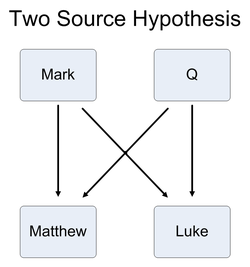
Starr, however, launches into this world of biblical literary criticism with unrestrained disdain. “By the beginning of summer, 2011, an idea was creeping into my head which I did my best to keep from taking seriously” (33). This idea is that there may be a Q-like document for the “Light” story. Considering this idea, Starr admits that “I’m not a biblical scholar.” (33), but that the “Q” hypothesis is a “crack pot” theory.

Quite apart from Q being a “crack pot” idea, a Q document for this short story is a really intriguing hypothesis. We have two extant documents: “The Man Born Blind” (MBB) and “Light,” both from WWII (1944-45), with evidence there was also a story from the late 1920s. If that is the case, we have, by logical necessity, two basic options:

  1. Lewis wrote the WWII-story based on his memory of the 1920s story.
  2. Lewis revised the WWII-era story from a draft of his 1920s story.

There may also be a draft between the 1920s and WWII editions.

If #2 is the case, that Lewis is revising an older story, we have three basic options:

  1. Older story → MBB → Light
  2. Older story → Light → MBB
  3. Both Light and MBB use the same older version in different ways

Option #3 is the “Q” option. It is an important theoretical option for MBB/Light as it is for the gospels. I think that Starr could have made greater mileage in this area if he had seriously presented this option, worked through the background, and considered all the ramifications. As it turns out, I think that Starr has conclusively demonstrated that MBB is a previous generation of “Light,” so if there was an earlier story, then “The Man Born Blind” came from that story, and was revised into “Light.”

My second critique has to do with the allegation of forgery “in the late 80s” (1) that is hinted at but not dealt with directly. Starr notes that Kathryn Lindskoog levels the charge and that her arguments have been “thoroughly refuted” (20). Starr is exceptionally detailed in his footnotes, leaving trails for academics to follow and new paths for fans to explore. On this point, however, Starr is surprisingly vague: he does not say here where Lindskoog makes her claims, or where she has been refuted. He also fails to mention that literally dozens of Lewis scholars, writers, and academics participated in the charge of forgery. These are strange lacunae in an otherwise tight book.

I am relatively new to the C.S. Lewis studies world, but one thing that I have picked up is general distaste for Lindskoog’s work among many people involved in the conversation. I suspect that Charlie Starr shares that distaste and thus has relegated the forgery conversation to a vague footnote. I have no concern to defend her here, but to point out that in skipping over this key aspect of the manuscript history, Starr misses an opportunity to strike a blow at the heart of Lindskoog’s claims.

Dr. Starr has convincingly shown that these manuscripts are indeed not forgeries. In the case of “The Man Born Blind,” it is written in Lewis’ handwriting, using the character of pen and kind of ink Lewis used, and is preceded and followed in a bound notebook by pre-published material found in various parts of Lewis’ corpus. Moreover, the revisions in the manuscript are suggestive of the “Light” manuscript which surfaces some years later. While a forgery is still faintly possible, the extensive nature of the hoax is just so elaborate that it pushes us beyond reasonable doubt. Skipping the Lindskoog claim, and using the hyperbolic “thoroughly refuted”—I know of no response to the claim of one of those at the bonfire that it never happened, for example—and Starr misses a key opportunity.

This second critique leads to a question that puzzles and intrigues me: in a mystery involving hidden and found manuscripts and claims of forgery, is it problematic to include at the heart of the investigation the person who found the manuscript and is the target of the charge of forgery? Walter Hooper, lifelong literary executor of Lewis’ estate and compiler-author of so many key Lewis resources, was the one who rescued the MBB manuscript from the flames, kept it quiet for fifteen years, and then published it in 1977. And it is Walter Hooper who is the mark for Kathryn Lindskoog’s accusations of forgery. Yet Hooper is absolutely key to Starr’s investigation, as he critiques Starr’s conclusions and offers suggestions in person and by email. Does this kind inquiry require more distance than Starr gave it?

It is a genuine question. One of my issues with offering critique within C.S. Lewis studies is how connected everyone is. Walter Hooper has even been kind enough to help me along the way, and I’ve sat at the same dinner table as Charlie Starr—though the roast beast was more memorable than anything I said, I’m sure. My critiques in this review are pretty minor: one thing that Starr chose to leave out, and another he chose not to take seriously—both at his own peril, I believe. I suspect that Charlie Starr will be okay with whatever critique I offer, and may even respond, but I feel implicated within an international circle of scholars that is at once extremely helpful and concurrently limiting. I am used to a more detached and much more challenging academic environment. I leave the question open, if anyone can enlighten me.

Minor criticisms and my ponderous question aside, Light: C.S. Lewis’s First and Final Short Story is a great book. It is academically rigorous, offers interpretive suggestions that may challenge our understanding of Lewis’ work, and gives us tools to engage in a large-scale reconsideration of Lewis’ manuscripts, writing processes, and development of thought. It is an absolutely essential book.

More than that, it is a lot of fun to read. The bifurcated nature of the writing may cause fans to stumble a bit in the epistemological conversation, but hard-won paths are typically worth the climb. To me, Light: C.S. Lewis’s First and Final Short Story by Dr. Charlie Starr is one of the necessary Lewis volumes of the year. A word of fair warning though: this book is likely to expose in certain readers that inclination to Lewis geekery and archival mysteries that has infected me and Charlie Starr and myriads of others. Ignore this caution at your own peril.

Posted in Reflections, Reviews | Tagged , , , , , , , , , , | 43 Comments

The Surprising Danger of Light

Years ago I remember watching the Val Kilmer film At First Sight. I’ve attached the trailer below; it is a basic boy-meets-girl story with an intriguing premise. A fifty-year-old man has been blind since childhood, but is offered sight through a revolutionary new medical procedure. The operation is a success, but the results are startling. The man has no interpretive lens for understanding light–the stimuli are startling and overwhelming. As material objects before him come to light, he has to slowly learn to appreciate depth, colour, shadow, and distance. As the man struggles to live within his newly lit world, he is uncertain whether sight is a blessing or a curse.

The film is based upon neurologist Oliver Sacks’ New Yorker story, “To See and Not See,” a story that challenged the popular understanding of sight. But I wonder if the roots for the story run deeper.

From the fickle fates of history, two C.S. Lewis manuscripts have emerged of the same unpublished short story. One, bound in a notebook rescued from a bonfire by Walter Hooper, was published in 1977 under the title “The Man Born Blind.” In the aftermath of this publication–and in the context of heated accusations of forgery–a second version of the story appeared. A manuscript in Lewis’ hand of the story “Light” appeared in British bookseller circles in the mid-1980s and was purchased by American collector Edwin W. Brown. While the two versions are quite similar, we have not had access to “Light” until Professor Charlie Starr published it in his excellent book Light: C.S. Lewis’s First and Last Short Story,with the full manuscript history (see my review here).

While I do not find the story of Light/The Man Born Blind to be Lewis’ best work–there may be a reason they were never published in his lifetime–the premise is intriguing. A man named Robin, blind from birth, has been given sight through a revolutionary new medical procedure. Robin is able to appreciate his new world, and within weeks he has begun to read and to take walks on his own. What he doesn’t understand, though, is the concept of “light.”

Through his life, he had read poetry about light, and could only imagine the richness of the experience. Consistently he heard how people talked about light: “you are standing in my light,” or “what lovely light on the hill over there.” But when he looked around him, he could not see this thing they called “light.” He asked his wife about it, and after her initial confusion, she pointed to the lightbulb in the ceiling. But this pale source of light was not what Robin meant: he yearned for light, the substance that poets and loved ones described to him his whole life. His wife cannot understand, though, and begins to think he is mad.

Eventually, Robin begins to despair.

“He was beginning to suspect that most of the un-blind were in the same position. What one heard among them was probably mere parrot-like repetition of a rumour–a rumour concerning something which the very few, the great poets and prophets, had really seen and known. Somewhere it must exist. Perhaps not in England–perhaps only rare deposits of it existed, far away to the East in deserts or high mountains” (Charlie Starr, Light, 8).

Robin begins to obsess over the idea of “light.” He knows he cannot bring it up with his wife or his doctors–they would not understand, and might commit him to an asylum. So Robin takes what seems to be an innocent walk, but what is reall a determined search to find light.

“[Perhaps] he would never see it. But if he did–ah yes, if–he would dive into its very heart, give all himself away to it, drink, drink, drink it till he died drinking” (8).

Robin walks into the early morning, searching for “light” as the sun rises and burns away the mist. He finally comes to an artist painting a canyon landscape. Robin doesn’t understand what the man is up to–visual art would be a complete mystery to him, of course, not least the production of that art. Curious, he asks the man what he is doing.

“‘Doing?’ said the stranger with a certain light-hearted savagery. ‘Doing? I’m trying to catch light, if you want to know. Damn it.’

“‘Good God! So am I,’ said Robin.

“‘Oh–you know too, do you?’ said the man…. “And yet this is the only sort of day when you can see light–solid light–light you could drink in a cup or swim in! Look at it!'” (8).

Robin did look. He saw that “the fog was at death grips with the sun,” a “bath of vapour” unfolding “itself in ever widening spirals towards them.” Robin saw the “light” he desired all along, and as he promised, he threw himself into it. Literally.

Robin jumped into the canyon and fell through the morning fog to his death.

“From a new-made and rapidly vanishing rift in the fog beneath him there came up no cry but only a sound so sharp and definite that you would hardly expect it to have been made by the fall of anything so soft as a human body: that, and the momentary rattling of a dislodged stone” (9).

The macabre ending aside–obviously Lewis is doing something in the world of word pictures with this story–the entire set up is intriguingly similar to Sacks’ own short story. I find it unlikely that Sacks was influenced by this virtually unknown story–even though the main character in Sacks’ story is called “Virgil,” one of Lewis’ most-quoted poets. Sacks’ imagination about how one would experience sight comes from his neurological work, from his direct experience in the field. At best, Lewis’ naive picture of man gaining the “gift” of sight to discover it only as a curse is a curious, but accidental imagination of a writer in his study some decades before science could give him hints about the matter. Rehabilitation of the blind who receive sight is often a lengthy process.

There is one story, however, that I can’t help wonder if it haunts behind them both. One cannot think of “revolutionary medical procedures” without thinking of the word “miracle.” Jesus did a number of healings in the gospels, but one of them stands out from among the rest:

Mark 8:22 They came to Bethsaida, and some people brought a blind man and begged Jesus to touch him. 23 He took the blind man by the hand and led him outside the village. When he had spit on the man’s eyes and put his hands on him, Jesus asked, “Do you see anything?”

24 He looked up and said, “I see people; they look like trees walking around.”

25 Once more Jesus put his hands on the man’s eyes. Then his eyes were opened, his sight was restored, and he saw everything clearly. 26 Jesus sent him home, saying, “Don’t even go into the village.”

We don’t know this un-blind man’s story. I suspect he told someone–it would be obvious to anyone who knew him. But what is fascinating is how this story hints at the gap between “miracle” and “healing” in the two 2oth century stories above. The healing story is probably told here in Mark to remind us that the often perplexed disciples need a second touch in order to see Jesus’ strange purposes. Importantly, though, this story addresses the blind man’s perceptual struggles, and Jesus performs a second healing that brings together healing and miracle. Jesus heals him in such a way that he can “see light.” The disciples, by contrast, take a little longer.

The biblical blind man’s story does not end as it does in Lewis’ or Sacks’ stories. In At First Sight, sight is a curse and blindness tempts again. In “Light,” Robin never comes to grips with what light really is–it is, after all, not something that can be easily “gripped.” I can’t imagine any of the three scenarios, really, but what they all remind me is that there is a clear difference between “seeing” and “being able to see.”

Posted in Reflections | Tagged , , , , , , , , , | 3 Comments

The Absence of Presence: C.S. Lewis’ Strained Relationship with his Father

I have written another blog on the death of C.S. Lewis’ mother and the haunting role it played in his life. Quite apart from the absence of his mother, her dead led to an unexpected consequence: a strain in his relationship with his father. I thought it would be enlightening to quote some parts of Lewis’ memoir, Surprised by Joy, where he talks about his father. The reader will have to decide whether Lewis is speaking with a hint of humour in causal reflection—which I suppose—or with a bitter recollection of his lost relationships in his own old age. I’ve left a part of chapter 8, “Release,” as it is written, with a very few explanatory notes.

All began, as I have said, with the fact that our father was out of the house from nine in the morning till six at night. From the very first we built up for ourselves a life that excluded him. He on his part demanded a confidence even more boundless, perhaps, than a father usually, or wisely, demands.

One instance of this, early in my life, had far-reaching effects. Once when I was at Oldie’s [boarding school] and had just begun to try to live as a Christian I wrote out a set of rules for myself and put them in my pocket. On the first day of the holidays, noticing that my pockets bulged with all sorts of papers and that my coat was being pulled out of all shape, he plucked out the whole pile of rubbish and began to go through it. Boylike, I would have died rather than let him see my list of good resolutions. I managed to keep them out of his reach and get them into the fire. I do not see that either of us was to blame; but never from that moment until the hour of his death did I enter his house without first going through my own pockets and removing anything that I wished to keep private.

A habit of concealment was thus bred before I had anything guilty to conceal. By now I had plenty. And even what I had no wish to hide I could not tell. To have told him what Wyvern or even Chartres was really like would have been risky (he might write to the Headmaster) and intolerably embarrassing. It would also have been impossible; and here I must touch on one of his strangest characteristics.

My father—but these words, at the head of a paragraph, will carry the reader’s mind inevitably to Tristram Shandy. On second thoughts I am content that they should. It is only in a Shandean spirit [i.e., farcical] that my matter can be approached. I have to describe something as odd and whimsical as ever entered the brain of Sterne; and if I could, I would gladly lead you to the same affection for my father as you have for Tristram’s.

And now for the thing itself.

You will have grasped that my father was no fool. He had even a streak of genius in him. At the same time he had—when seated in his own arm chair after a heavy midday dinner on an August afternoon with all the windows shut—more power of confusing an issue or taking up a fact wrongly than any man I have ever known. As a result it was impossible to drive into his head any of the realities of our school life, after which (nevertheless) he repeatedly enquired. The first and simplest barrier to communication was that, having earnestly asked, he did not “stay for an answer” or forgot it the moment it was uttered. Some facts must have been asked for and told him, on a moderate computation, once a week, and were received by him each time as perfect novelties.

But this was the simplest barrier. Far more often he retained something, but something very unlike what you had said. His mind so bubbled over with humour, sentiment, and indignation that, long before he had understood or even listened to your words, some accidental hint had set his imagination to work, he had produced his own version of the facts, and believed that he was getting it from you. As he invariably got proper names wrong (no name seemed to him less probable than another) his textus receptus was often almost unrecognizable.

Tell him that a boy called Churchwood had caught a field mouse and kept it as a pet, and a year, or ten years later, he would ask you,

 “Did you ever hear what became of poor Chickweed who was so afraid of the rats?”

For his own version, once adopted, was indelible, and attempts to correct it only produced an incredulous

“Hm! Well, that’s not the story you used to tell.”

Sometimes, indeed, he took in the facts you had stated; but truth fared none the better for that. What are facts without interpretation? It was axiomatic to my father (in theory) that nothing was said or done from an obvious motive. Hence he who in his real life was the most honourable and impulsive of men. and the easiest victim that any knave or imposter could hope to meet became a positive Machiavel when he knitted his brows and applied to the behavior of people he had never seen the spectral and labyrinthine operation which he called “reading between the lines.” Once embarked upon that, he might make his landfall anywhere in the wide world: and always with unshakable conviction.

“I see it all”—”I understand it perfectly”—”It’s as plain as a pikestaff,”

he would say; and then, as we soon learned, he would believe till his dying day in some deadly quarrel, some slight, some secret sorrow or some immensely complex machination, which was not only improbable but impossible. Dissent on our part was attributed, with kindly laughter, to our innocence, gullibility, and general ignorance of life. And besides all these confusions, there were the sheer non sequiturs when the ground seemed to open at one’s feet.

“Did Shakespeare spell his name with an e at the end?” asked my brother.

“I believe,” said I—but my father interrupted:

“I very much doubt if he used the Italian calligraphy at all.”

A certain church in Belfast has both a Greek inscription over the door and a curious tower.

“That church is a great landmark,” said I, “I can pick it out from all sorts of places—even from the top of Cave Hill.”

“Such nonsense,” said my father, “how could you make out Greek letters three or four miles away?”

One conversation, held several years later, may be recorded as a specimen of these continual cross-purposes. My brother had been speaking of a reunion dinner for the officers of the Nth Division which he had lately attended.

“I suppose your friend Collins was there,” said my father.

B. Collins? Oh no. He wasn’t in the Nth, you know.

F. (After a pause.) Did these fellows not like Collins then?

B. I don’t quite understand. What fellows?

F. The Johnnies that got up the dinner.

B. Oh no, not at all. It was nothing to do with liking or not liking. You see, it was a purely Divisional affair. There’d be no question of asking anyone who hadn’t been in the Nth.

F. (After a long pause.) Hm! WelL I’m sure poor Collins was very much hurt.

There are situations in which the very genius of Filial Piety would find it difficult not to let some sign of impatience escape him.

I would not commit the sin of Ham. Nor would I, as historian, reduce a complex character to a false simplicity. The man who, in his armchair, sometimes appeared not so much incapable of understanding anything as determined to misunderstand everything, was formidable in the police court and, I presume, efficient in his office. He was a humourist, even on occasion, a wit….

The hours my father spent at home were thus hours of perplexity for us boys. After an evening of the sort of conversation I have been describing one felt as if one’s head were spinning like a top. His presence put an end to all our innocent as well as to all our forbidden occupations. It is a hard thing—nay, a wicked thing—when a man is felt to be an intruder in his own house.

And yet, as Johnson said, “Sensation is sensation.” I am sure it was not his fault, I believe much of it was ours; what is certain is that I increasingly found it oppressive to be with him. One of his most amiable qualities helped to make it so. I have said before that he “conned no state”; except during his Philippics he treated us as equals. The theory was that we lived together more like three brothers than like a father and two sons. That, I say, was the theory. But of course it was not and could not be so; indeed ought not to have been so. That relation cannot really exist between schoolboys and a middle-aged man of overwhelming personality and of habits utterly unlike theirs. And the pretense that it does ends by putting a curious strain on the juniors. Chesterton has laid his finger on the weak point of all such factitious equality: “If a boy’s aunts are his pals, will it not soon follow that a boy needs no pals but his aunts?”

That was not of course the (question for us; we wanted no pals. But we did want liberty, if only liberty to walk about the house. And my father’s theory that we were three boys together actually me that while he was at home we were as closely bound to his presence as if the three of us had been chained together; and all our habits were frustrated.

Thus if my father came home unexpectedly at midday having allowed himself an extra half-holiday, he might if it were summer find us with chairs and books in the garden. An austere parent of the formal school would have gone in to his own adult occupations. Not so my father. Sitting in the garden? An excellent idea. But would not all three of us be better on the summer seat? Thither after he had assumed one of his “light overcoats,” we would go. (I do not know how many overcoats he had; I am still wearing two of them.) After sitting for a few minutes, thus clad, on a shadeless seat where the noonday sun was blistering the paint, he not unnaturally began to perspire.

“I don’t know what you two think,” he would say, “but I’m finding this almost  too hot. What about moving indoors?”

That meant an adjournment to the study, where even the smallest chink of open window was rather grudgingly allowed. I say “allowed,” but there was no question of authority. In theory, everything was decided by the general Will.

“Liberty Hall, boys, Liberty Hall,” as he delighted to quote. “What time would you like lunch?”

But we knew only too well that the meal which would otherwise have been at one had already been shifted, in obedience to his lifelong preference, to two or even two-thirty; and that the cold meats which we liked had already been withdrawn in favor of the only food our father ever voluntarily ate—hot butcher’s meat, boiled, stewed or roast . . . and this to be eaten in mid-afternoon in a dining room that faced south. For the whole of the rest of the day, whether sitting or walking, we were inseparable; and the speech (you see that it could hardly be called conversation) the speech with its cross purposes with its tone (inevitably) always set by him continued intermittently till bedtime.

I should be worse than a dog if I blamed my lonely father for thus desiring the friendship of his sons; or even if the miserable return I made him did not to this day lay heavy on my conscience…. I could not “be myself” while he was at home. God forgive me, I thought Monday morning, when he went back to his work, the brightest jewel in the week.

Posted in Memorable Quotes | Tagged , , , , , | 12 Comments

The Narnia Code: A Pre-Review to a Key Idea

I know, I know: there is no such thing as a pre-review. But I’m stuck between two pressing realities. Facing me is the fact that Michael Ward’s argument in Planet Narnia and The Narnia Code is absolutely key to how people are thinking about reading Narnia these days. His basic thesis is that the seven books of the Chronicles of Narnia are created with a guiding principle, and that C.S. Lewis kept this principle hidden from his friends and readers. This guiding principle is the medieval view of the cosmos with seven personalized planets; each of these planets, with its meanings and mythologies, have informed each of Chronicles.

His work has been called a “masterpiece in its own right” (Times Literary Supplement) and “Brilliantly conceived. Intellectually provocative. Rhetorically convincing” (Christianity and Literature)–that’s a lot of full-stop compliments. Not only acclaimed, this work has its detractors. In polite company I have heard it called “an idea stretched thin” and a neatly made “Procrustean bed.” Anything that splits readers into such impressively different camps is bound to be worth a read.

Beyond the excitement of a new, divisive thesis, Ward’s analysis truly begins a new era of reading Narnia. Whether we disagree with Ward’s thesis or take it up full force, we must reckon with. And for me, personally, his work may inform my research on the Ransom Trilogy–books that are certainly guided by the medieval cosmology that Ward claims shapes the entire Narniad.

The second reality–if you haven’t forgotten that I am in a kind of dilemma–is that I don’t have Ward’s books on the schedule to read until next May. My bedside reading pile threatens to collapse on me as it is, so I do not think I can slip in two more books. This Christmas I may get a chance to read the popular level version of the thesis, The Narnia Code. I know that I won’t be satisfied on the thesis, though, until I have seen the detailed work in the Oxford academic publication, Planet Narnia. So May 2013 it is.

However, I am not left entirely in the threshold between time and space. Michael Ward has discussed each chapter of his work in detail on William O’Flaherty’s podcast. O’Flaherty teams up with poet and professor Dr. Holly Ordway to interview Ward about his ideas. It is a discussion of allies–Ordway in particular is a hard-won convert to the Ward thesis–but the interviewers give Ward space to demonstrate his argument with evidence from the books. In 13 short podcasts (15-20) minutes each, Ward lays out his thesis, chapter by chapter, and responds to listener questions.

In the months until I can full assess Ward’s thesis on my own, I am content with this discussion–which I’ve gone through twice on my mp3 player while in the garden or on the treadmill.  True, it is a kind of a tease, but I think this discussion will satisfy Lewis critics and fans, and hopefully whet their appetites to dig in deeper.

Posted in News & Links, Reviews | Tagged , , , , , , , , | 8 Comments

Friendship Facing Forward

Our national broadcaster recently had a show about colossally bad first dates. There were your classic stories, from the lack of a spark to the instantaneous stalker. One of the stories was of a guy who asked a girl out to a concert in another city. He decided for their first date to drive her three hours from Calgary to Edmonton, go to an outdoor concert, and drive the three hours back.

Needless to say, it was a disaster.

It began well. They were fully engaged in conversation on the way there. As he was looking at her, talking, he bumped into the car in front of him. Late for the concert, in the freezing cold—it is Edmonton, after all—they found their seats a mile away from the stage. They huddled in the brisk wind as miniature figures danced to rock music on the stage far below. Defeated and exhausted, they made their way to the car, fought traffic, and pulled back onto the highway. About halfway through the drive—late at night, after a long date—they ran out of gas. They put their four-way flashers on, pulled off the road to make a phone call, and were promptly hit by a truck, hurtling them hundreds of feet toward their destination.

They both lived, miraculously, but needless to say it was a quiet drive back to Calgary—him in the back seat of her mother’s car, in the middle of the night, while she stared out the window in the darkness.

Granted, this is an unusually bad date. But I don’t know what the guy was thinking at all. You don’t go for a six-hour drive on a first date. It’s just the wrong thing to do. Going on a drive, two adults staring ahead through a bug-smeared windshield, is fraught with first date dangers: lulls in conversation, awkward silences, permanent disagreements, and, apparently, traffic violations. There was no second date.

There is a principle, I think, in the drive together. C.S. Lewis talked about friendship in his book The Four Loves. Set apart from other expressions of love, friendship is unique in its disposition. The natural posture of lovers is “face to face,” Lewis argued, but friends walk “side by side; their eyes look ahead” (Lewis, The Four Loves, 98). Driving together—especially long drives on the highway—is simply the wrong posture for lovers; it is the posture of friendship.

This is how it has always been with my friends, facing forward on a journey together.

I know people that are users—they leverage themselves in relationship to get what they need. Even when it is done generously, reciprocally, that isn’t friendship in the way I mean. My best friends now are people of power in their own worlds—quite disparate worlds—but leveraging that friendship is an idea so foreign to me. Friendship, according to Lewis, must be “free without qualification,” (111) by necessity it is free from “need,” full of a casual disinterest in the actual relationship. We simply walk beside each other in life. Friendship yokes us together, like oxen paired to plow a field. As Lewis says,

“You will not find the warrior, the poet, the philosopher or the Christian by staring in his eyes as if he were your mistress: better fight beside him, read with him, argue with him, pray with him” (104).

This is why I think the metaphor of “pilgrim” is so important to one’s life: we are on a journey, walking beside others who share our destinations, who dream our deepest dreams, who are willing to risk in the same crushed hope. Like the pilgrims on the road to Emmaus, we may even forget what our fellow pilgrim looks like, even as “our hearts burned within us while he talked with us on the road.” We get lost in lovers’ eyes, but with friends we may even forget to look as we point our faces down the shared road. This is the nature of friendship facing forward.

Posted in Reflections | Tagged , , , , , , , , | 11 Comments