“A Curious Synchronicity: Religious Studies as Inquiry-Based Learning in Higher Education”: My Newly Published Teaching Essay

I am pleased to announce that I have a new chapter out in a book on Teaching and Learning: “A Curious Synchronicity: Religious Studies as Inquiry-Based Learning in Higher Education,” pp. 232-249 in Applying Inquiry-Based Learning in Higher Education Across Disciplines, edited by Beth Archer-Kuhn, Stacey L. MacKinnon, and Natalie Beltrano in Cambridge Scholars Press, 2025. It is an academic book, so a little pricey. Thus, I would appreciate it if you could ask your local research university to purchase or otherwise make this text available for their libraries. Also, please share this note with anyone you think might be interested (like Religious Studies scholars, theologians, and curious teachers who love students). As regular readers know, I love teaching, and I have been enjoying researching the hows, whys, and wherefores of the craft (what we call pedagogy).

I’ll provide a little background about my own piece and an excerpt, including the Table of Contents. First, though, I wanted to talk about what we mean by Inquiry-Based Learning in Higher Education (IBL-HE).
Inquiry-Based Learning in Higher Education (IBL-HE)

Since 2015, I have been a core member of the University of Prince Edward Island Inquiry Studies team, led by Stacey L. Mackinnon. In this course, we work to reorient students’ understanding of their role by inviting them to be the pilots of their university (and lifelong) education. We do this by curating a curiosity-driven, student-centred, teacher-supported environment of collaboration and openness. Rather than being the experts in a discipline, we provide students with the frameworks and tools they need to see themselves in this new light.

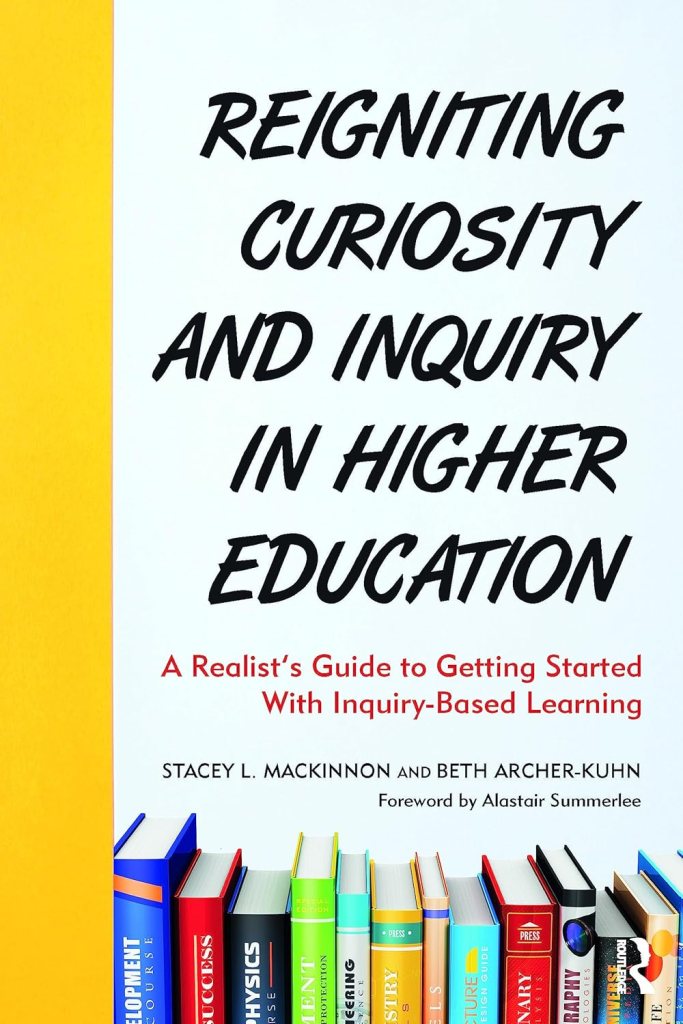
Stacey MacKinnon and her University of Calgary colleague, Beth Archer-Kuhn, are the leading scholars in IBL-HE. In Reigniting Curiosity and Inquiry in Higher Education: A Realist’s Guide to Getting Started with Inquiry-Based Learning (2022), Stacey and Beth introduce the 8-fold structure of fundamentals in IBL-HE: 1) Fostering a Curiosity Mindset; 2) Being Student Driven; 3) Focusing on Collaboration; 4) Balancing Content and Process; 5) Scaffolding Choices; 6) Reflecting and Self-Reflecting; 7) Managing New Learning; and 8) Expecting to Learn from Students. Current cohorts of Inquiry Studies are receiving this training as part of an IBL research project where students choose their research question, develop a research plan and methodology, and even choose how to share their discoveries. I have included a more detailed description of the 8 Fundamentals at the bottom of this note
Around this concept, a number of scholars throughout the world have been experimenting with IBL in the university and college curriculum. Beth and Stacey decided to follow up their groundbreaking framework with a series of essays on these IBL-HE experiences across (and sometimes within seemingly odd combinations of) the various academic disciplines. Natalie Beltrano joined Beth and Stacey on the editorial team, the foreword is written by Peter Felton and Josh Caulkins, and other contributors include Oluwakemi Adebayo, Nadia Delanoy, Ryan Drew, Sahar Esmaeili, Noor Fatima, Cari Gulbrandsen, Lavender Xin Huang, Mohammad Keyhani, Erika Kustra, Robin Mueller, Rosemary Polegato, Tomas Shivolo, Charlene VanLeeuwen, Justine Wheeler, and yours truly, of course.

Here is the book’s abstract, and you can find a PDF of the forematter at the bottom of this post:
Applying Inquiry-Based Learning Across Disciplines in Higher Education (2025)

This dynamic collection of voices re-imagining and fostering curiosity, collaboration, creativity and critical thinking expands across Canada to include work from Namibia. From AI integration and digital literacy in professional programs of business and social work to music, social sciences, science, social psychology, and religious studies, this book showcases the many unique ways that Inquiry-Based Learning (IBL) has transformed students into active investigators. Dive into chapters that explore communities of practice, student self and peer assessment, and navigation into real-world applications of IBL in public spaces, professional ethics and applications outside of academia. These real theories to practice stories, research-informed strategies, and transformative tools expand across disciplines. Perfect for new and experienced educators, facilitators, and academic leaders, this is your guide to student empowerment across higher education through self-directed learning that sticks. It’s not just about asking better questions, it’s about changing how we think, teach, and learn.

“A Curious Synchronicity: Religious Studies as Inquiry-Based Learning in Higher Education” by Brenton D.G. Dickieson

I had a lot of fun with this chapter. I wrote it in its very rough form in about a week during the summer of 2024–after a year or two of serious research and observation and while I was recovering from an illness. My chapter makes a good introduction to IBL-HE, but it also argues for the fundamentally interdisciplinary matrix of Religious Studies in public education (quoting myself):

Religion scholars—both at the whiteboard and the desk—can explore the great questions of the world using tools and approaches from anthropology, biology, cartography, dance, environmental sciences, fine arts, graphic design, history, Indigenous studies, journalism, kinesiology, linguistics, music, neuroscience, oriental studies, popular culture, quantum field theory, ritual studies, sociology, theatre, urban studies, Vedic textual criticism, writing, xenobiology, Yemeni political history, and Zoroastrian folklore. The core questions students can ask and the theoretical lenses they can apply are endless.

I spent a lot of time on that A-Z list! Here is an abstract of what I wrote in the chapter:

Public scholar, writer, and teacher Brenton Dickieson explores the transformative learning possibilities of an Inquiry-Based Learning in Higher Education (IBL-HE) model in the study of religion—from Atheism to Zen, from the Amish to Zoroastrianism. Classrooms become spaces where students investigate life’s big questions (“What is a human?”, “What do we mean by the Divine?”, “How do we know what we know?”) through their own cultural expressions and personal passions. Dickieson argues that teaching Religious Studies in a public university need not be about experts lecturing; it is collaborative storytelling where a documentary about Yakuza tattoo art, a Nigerian worship song, or curiosity about the weird and wonderful sparks discovery. Dickieson uses his “Japanese Religion and Culture” class at the University of Prince Edward Island to show that embracing discomfort in learning, recentring on student expertise, and providing intentional scaffolding—especially amid crises like strikes, storms, and plagues—makes learning deeper. Curiosity, not certainty—and wisdom rather than expertise—drives the inquiry journey when Religious Studies is taught in an IBL-HE.

I look forward to reading the other chapters in the volume, as I only read a couple of the other chapters in the editorial process. Let your local library know about this great new resource, but I can also provide more if you are interested (junkola[at]gmail[dot]com).

The 8 Fundamental Principles of IBL in HE
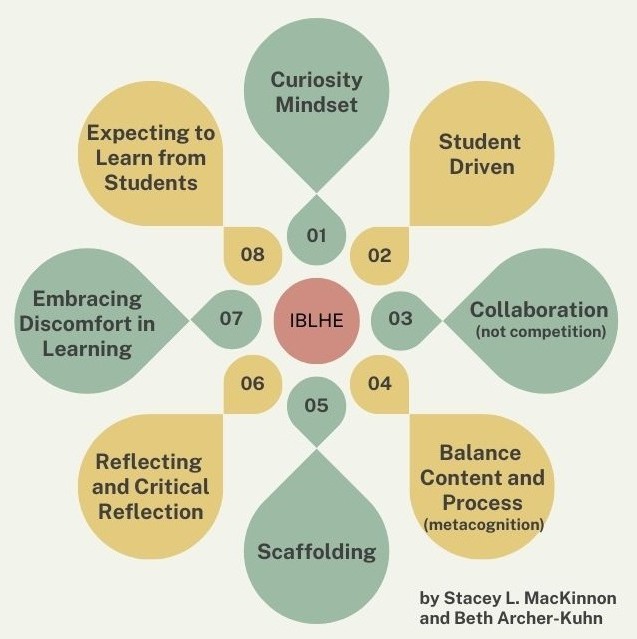
From MacKinnon & Archer-Kuhn, Reigniting Curiosity and Inquiry in Higher Education: A Realist’s Guide to Getting Started With Inquiry-Based Learning (2022)

FP 1: Fostering a Mindset of Curiosity – Modeling and encouraging a mindset of curiosity is key to making IBL-HE more than just a pedagogical tool, a classroom exercise, or a set of skills, but a way of thinking that can result in lifelong and life-wide learning for you and for students. As an instructor, let students see your enjoyment of exercising your curious mindset and inquiry skills so that a norm of valuing curiosity becomes the gold standard in your courses, in the classroom and outside of the classroom. Students need to hear and see curiosity from the instructor (and peers) and then practice or experience the validation of their curiosity themselves

FP 2: Being Student Driven – The best way to develop and strengthen students’ curiosity involves questions. Through the use of IBL-HE, students are encouraged, supported, and expected to pose their own inquiry questions, which they pursue throughout the course. They are supported by formative feedback from instructor and peers as the inquiry process unfolds. In an IBL-HE course students follow their own interests and pursue topics they want to learn more about.

FP 3: Focusing on Collaboration Not Competition – In an IBL course, the learning is not fully dependent, nor is it fully independent, but is interdependent (i.e., individual learning is enhanced and strengthened by the contribution of others, contributions the individual has the option to utilize or ignore as they see fit). When we emphasize collaboration (even on individual projects) and put the focus on the quality of learning rather than standing in the class, students are much more willing to offer their insights, consider the feedback of others as truly constructive, pose differing views, and engage in making the most of everyone’s learning, not just their own.

FP 4: Balancing Content and Process/Metacognition – Successful IBL-HE comes from a desire to not only have students learn facts but to think critically and creatively about the content and about the process of their own learning (i.e., metacognition). For the instructor, finding a balance between content understanding and metacognition is an important objective in an IBL-HE classroom. Students’ inquiry skills will allow them to determine what questions need to be asked and how to find the answers, consider multiple perspectives, and communicate their findings.

FP 5: Scaffolding, Choice, and Growth – There are many ways to include IBL in your practice (activity, course, program) and different levels of structure (structured, guided, open) you can choose from. It is fine to start just outside your comfort zone and grow your practice of IBL from there. Starting slowly is recommended. Some things will go smoothly, and others may not. Remaining reflective and using your own inquiry skills will help you to figure out how to support your students’ inquiry learning process. When you make your choices about the type of IBL-HE that you want to implement (structured, guided, open), you will also need to be mindful of the level of student support that is necessary within each IBL type. Remember, the instructor’s role in IBL-HE is a facilitator of student learning. The level of support is highest with structured IBL-HE and decreases progressively as you choose guided or open IBL. Introducing structured IBL-HE then means you are providing a significant amount of student support within a student-led inquiry learning process. This principle requires ongoing check-ins with students about their learning process.

FP 6: Reflection and Critical Reflection – Reflection is key for success, both for yourself and your students. Make note of what works and do it again. Reflect on why things did not go according to expectations, make some changes, and try again. Learn from your students’ reflections on their experience and consult them on ideas you are considering. Be explicit in asking which activities facilitated their learning and which did not, and why. Let them know that you adjust the course based on their feedback. IBL-HE requires more than simply reflecting on experience and behavior though. It necessitates students and instructors critically reflecting on all aspects of the inquiry journey from the creation of an inquiry question through to the effectiveness of different strategies for disseminating their findings to various audiences. Engaging in critical reflection helps us and our students refine our inquiry questions, identify and confront biases, consider causality, contrast theory with practice and identify systemic issues, key issues in creating a mindset of critical evaluation and enhancing the likelihood and quality of knowledge transfer.

FP 7: Embracing the Discomfort of New Learning – Implementing IBL-HE will likely raise the anxiety of some, if not all students initially (not to mention your own). They are being asked to trust a process that they very likely have not been exposed to in their educational career. As we know, new experiences can create anxiety. Although the level of student anxiety will vary, a handful of students experiencing a high level of anxiety, or even one or two, can heighten your own anxiety. How the instructor manages their own and their student’s anxiety will determine how the students’ progress. Transparency and modeling are important traits for the instructor. In terms of transparency, let students know what to expect, that this way of learning is new and different and will likely cause some initial anxiety. Modeling confidence in the process and trust in your student’s abilities will help to ease their and your own anxiety. After the first assessment and/or reflection tasks, students’ anxiety often decreases significantly. Think outside the box when considering how to help students embrace the discomfort of new learning by encouraging them to find support from varied sources: peers, instructors, research literature, and, when possible, community resources.

FP 8: Expecting To Learn From Your Students – Take every opportunity to learn from your students and make your classroom your own IBL project. Use what you are learning to customize the IBL-HE experience for each cohort, to plan for future cohorts, to test out new ideas, and to track your successes as well as your challenges. Remember that if you are doing inquiry well, finding answers will spur the next round of questions. IBL-HE is meant to be dynamic, so each experience brings you new insights, opportunities to try something different, and new questions to explore with your students. Whenever possible collect data on your students’ IBL-HE experiences and consider writing a SoTL paper or presentation to share what you’ve learned with others! Situating IBL in a postsecondary context provides an opportunity to examine its possibilities and implications for applied and nonapplied disciplines.
Posted in News & Links | Tagged , , , , , , , | 5 Comments

Bonus Features: Being Hnau in the Age of AI: A View from Hogwarts (for Mythmoot XII)

Last week, I posted about this very cool talk that I get to do at Mythmoot XII. I am here now, actually, at the National Conference Centre in Leesburg, VA, and have already had dozens of great conversations.

In my everyday life at home, I have been doing a series of writing projects and teaching units on what I’m calling “Authentic Intelligence.” I know that the implications of our sudden leap into the Age of AI are hardly new. We have been reading and writing about the possibilities and implications of human-machine hybridity for generations. The loss of one’s humanity in one’s human activity is a theme that goes back to the ancients, including the Bible. I use the phrase “Authentic Intelligence” because rethinking “AI” from different angles helps me get to the fundamental human questions of science fiction.

Also, I continue to use the term “hnau” when envisioning our human being and doing in the future.

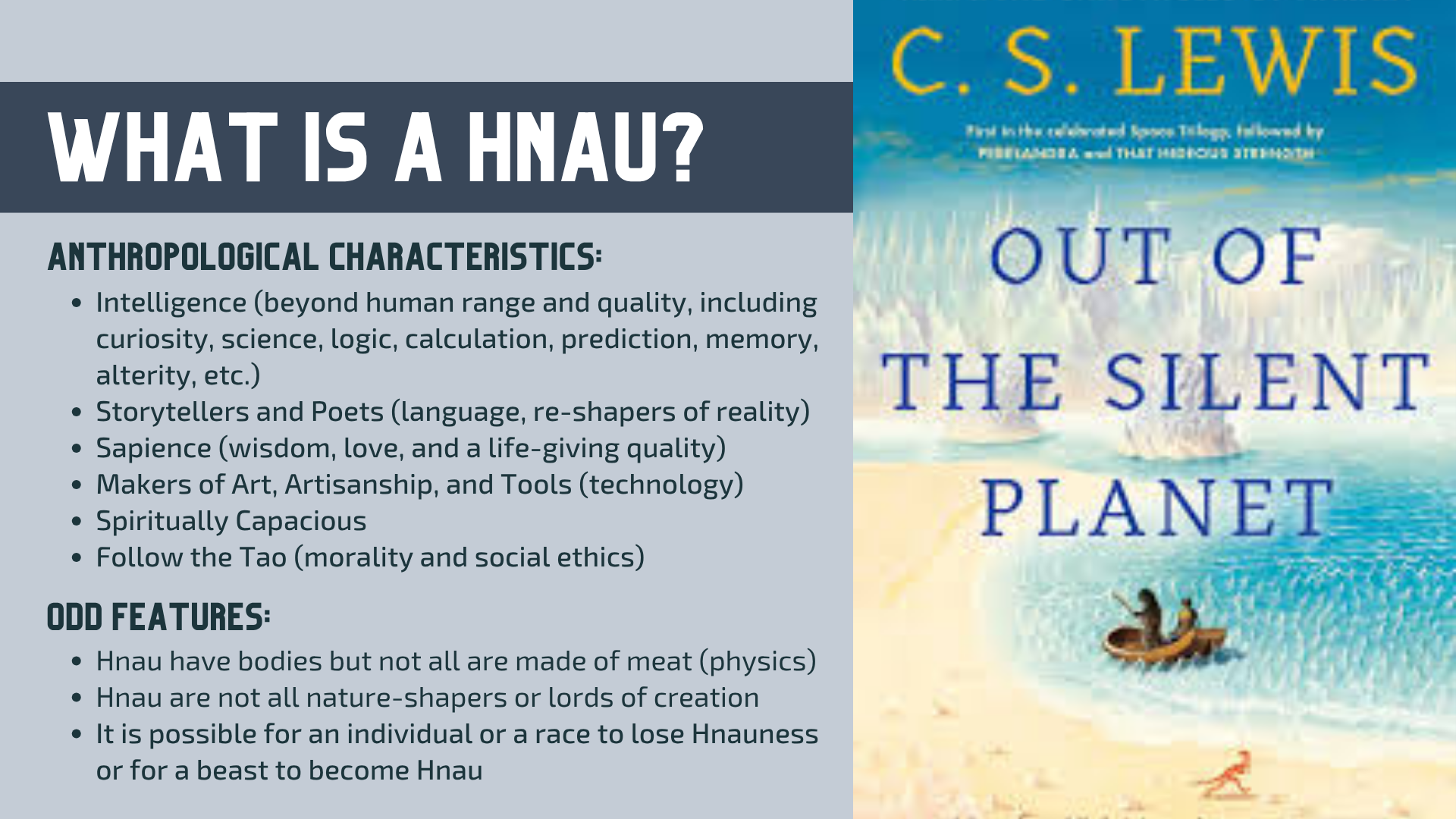
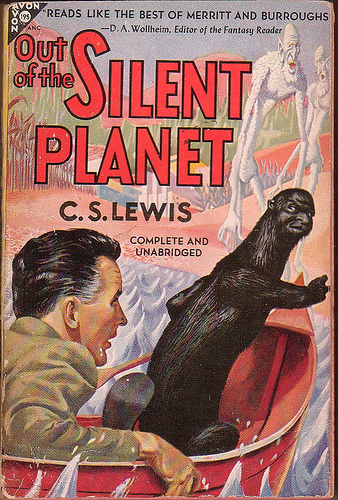
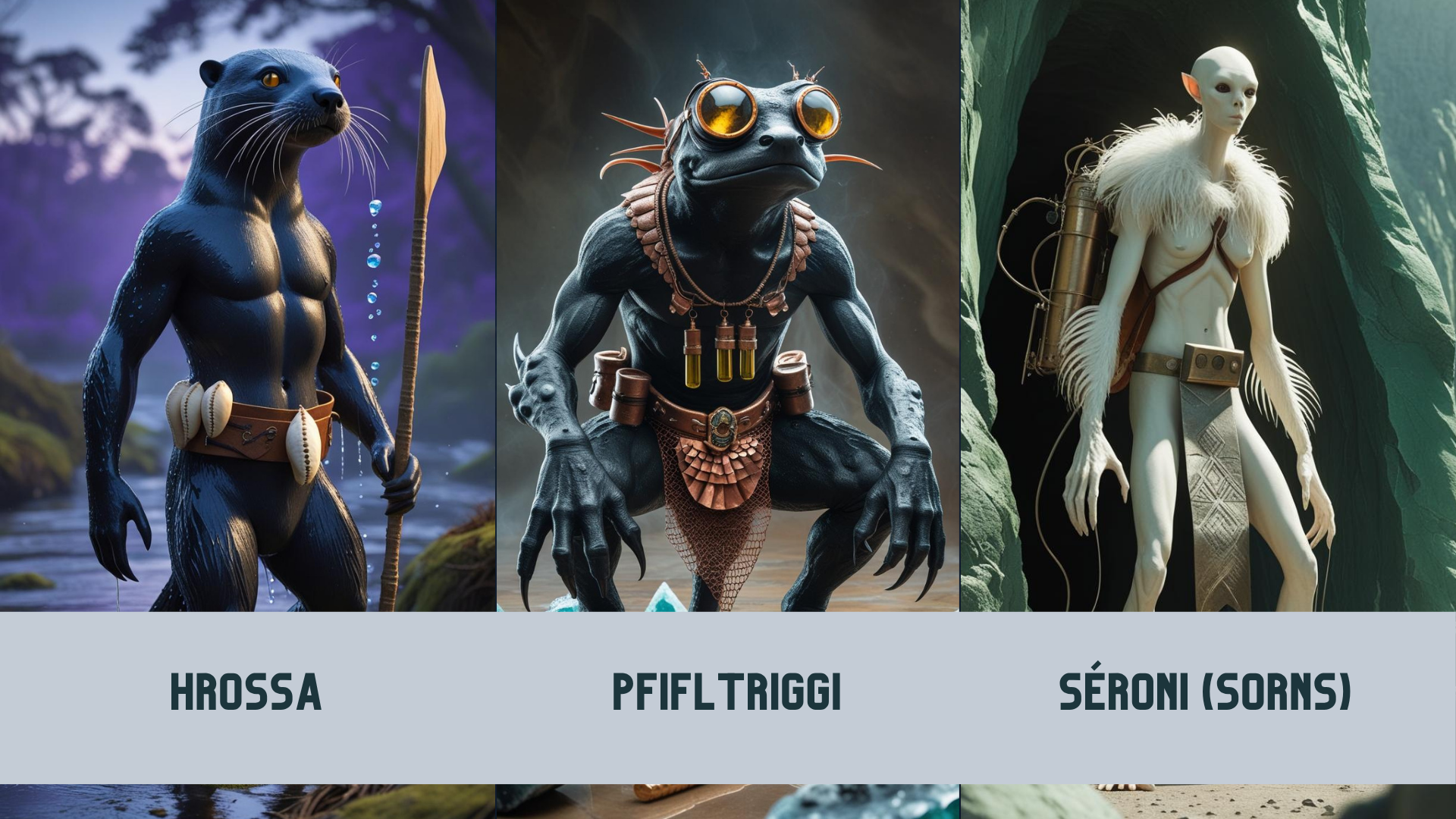
Before WWII, Lewis coined hnau to describe sapient, sentient, spiritually capacious, art- and artisan-making, storytelling, beings of whatever form. He wrote about a number of other kinds of human-like but not humanoid beings, like the Hrossa, Pfifltriggi, and Sorns. I have used Canva’s Magic and all of the possible prompts from Out of the Silent Planet to visualize those three flesh-bodied Hnau, and the results are not terribly satisfactory (I could not get the bot to understand the sinewy implications of life in 0.38g), but they are peculiar and alien and show me features I had never noticed before in the text.

I don’t know if Terrans are the only hnau created in the image of God, but we will, sooner or later, create beings in our own image. It is our human occupation to do so–babies, students, followers, parishioners, apprentices, and all the rest–and very soon, humanoid thinking machines not made out of meat. The way we relate to them will say a lot about what we think is fundamental to our society and race.

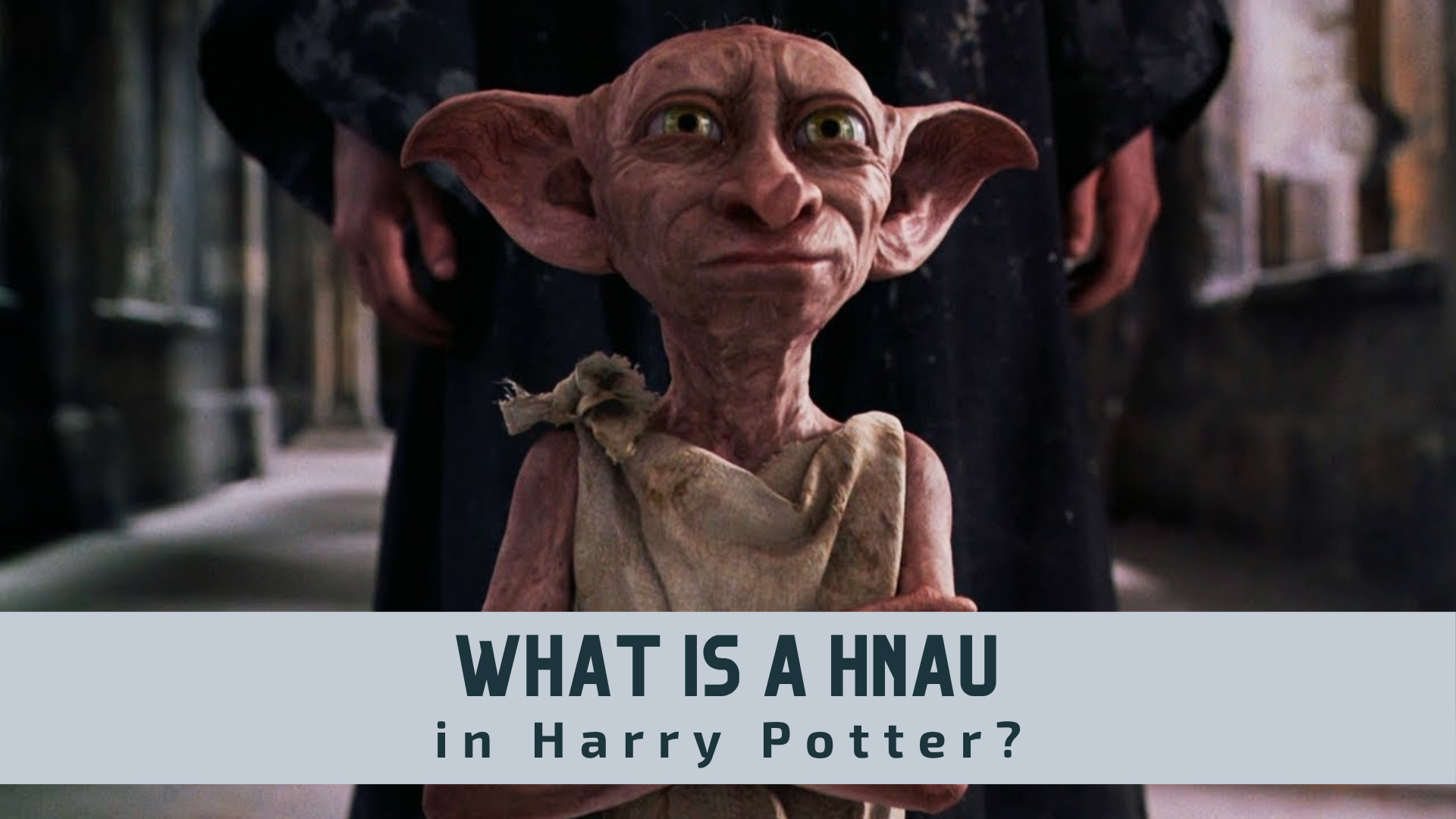
While rereading Harry Potter this past winter, I began to wonder if fantasy could contribute in some ways to my hnauological enquiry. Because I live with non-human animals, I know what to do with Fawkes the Phoenix in the series; but what do we do with the Fat Lady and Phineas Nigellus Black–who exist only in living portraits–or the Weasleys’ Ford Anglia–a machine with developing sentience and emotion–or the Goblet of Fire–a magical item manipulated in the way that we program computer technology.

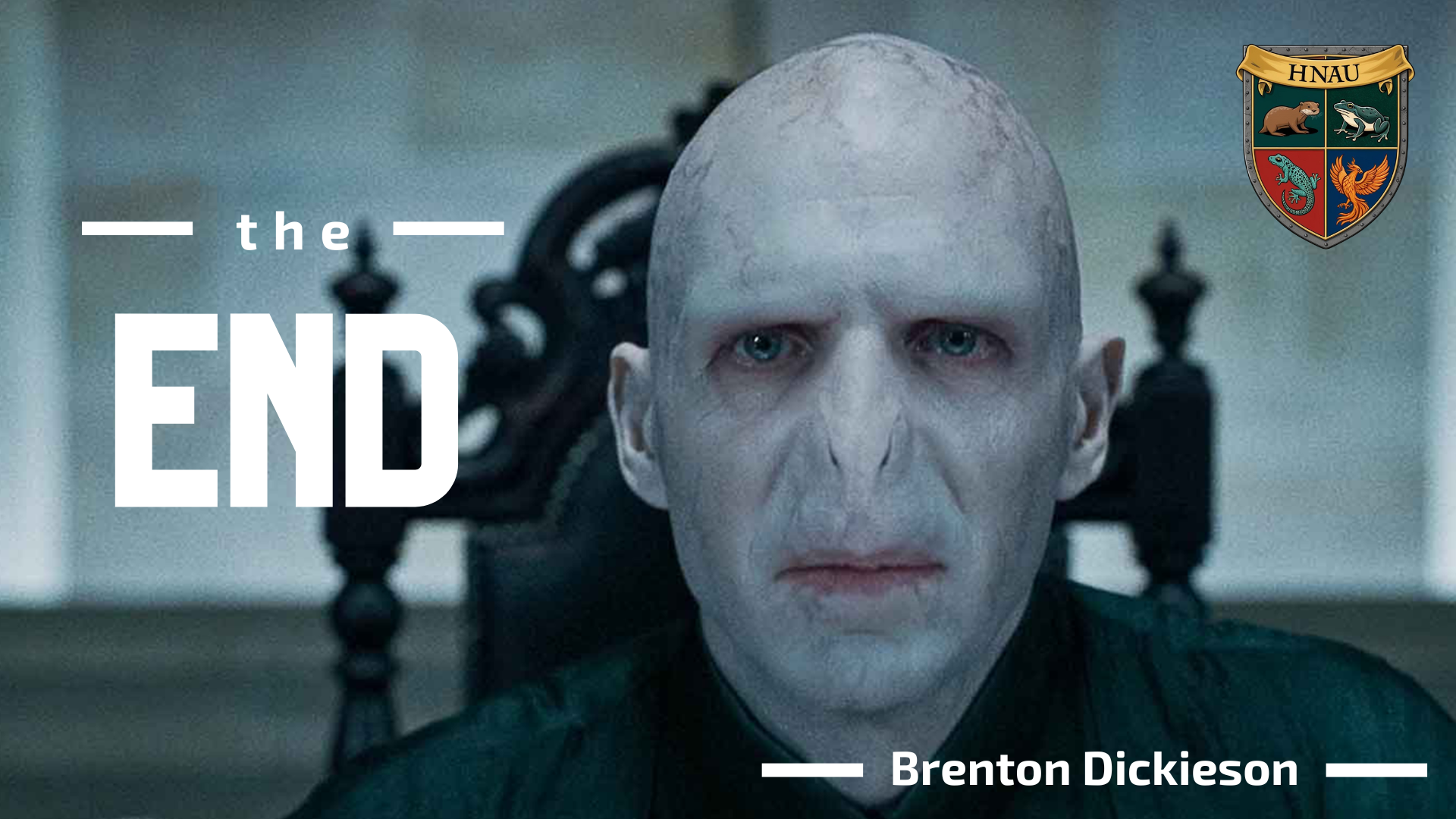
I’m starting to think that Remus’ photo there was not taken with full consent. But it’s important to ask: Is Remus Lupin still human when he transforms? While one of the tensions in the series is the degree to which Goblins, Centaurs, and Merfolk are truly hnau, does the Ministry of Magic’s standardized testing make Trolls an intelligence baseline for sharing humanity? Perhaps the Owls and Cats of Hogwarts are merely superanimals, but what about Nigini, which inhabits the soul of Voldemort? Tom Riddle’s diary makes me wonder whether Voldemort’s flight from death is also a retreat from humanity. Does going beyond humanity make one superhuman or not a hnau at all.

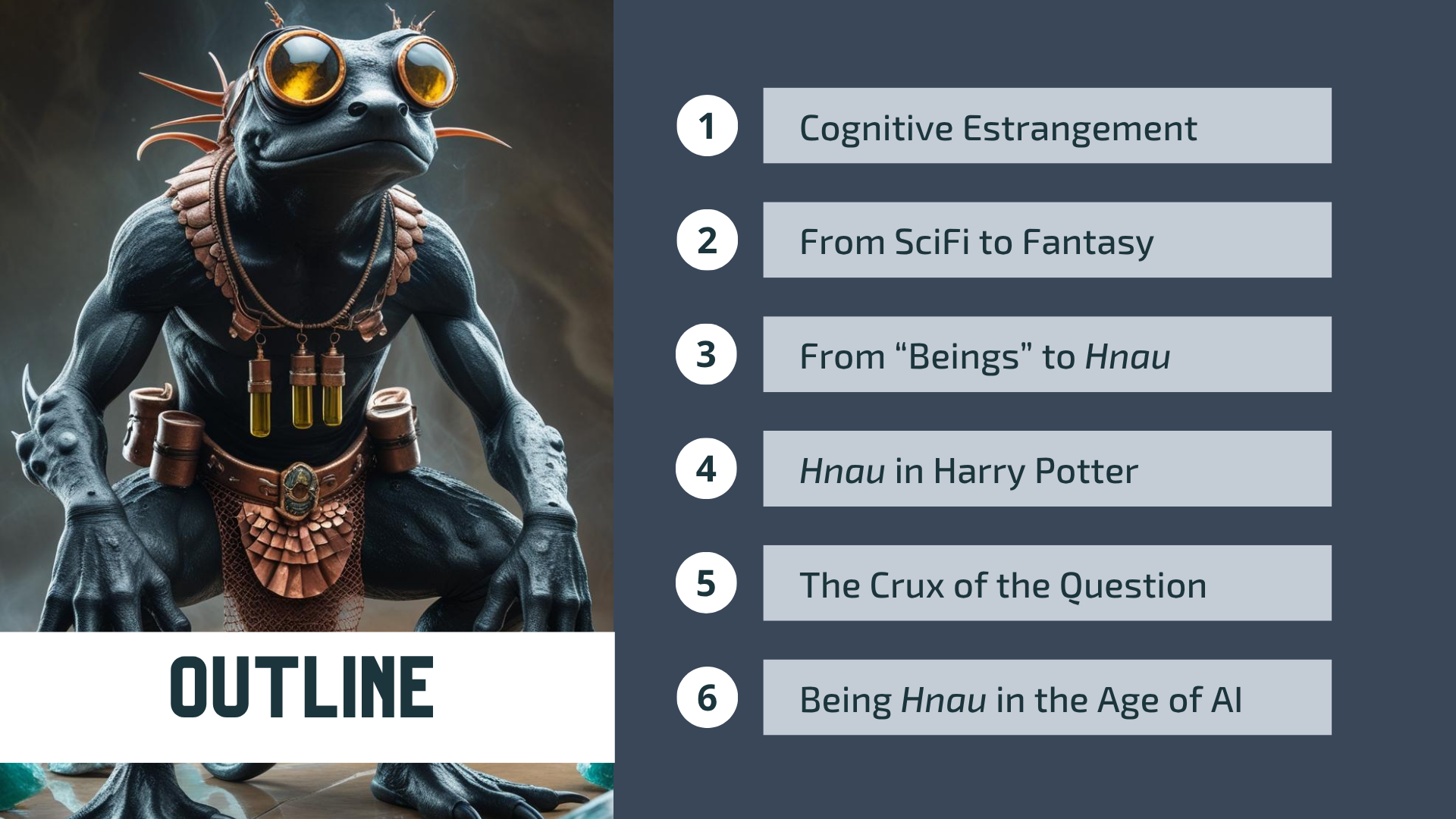
I ended up sketching out so many questions and potential links that I decided I would take this inquiry public. The Mythmoot XII theme, “Drawn to the Edge,” invited me to reflect on the boundaries of my hnauological sketches, so I decided to pitch my Harry Potter project, “Being Hnau in the Age of AI: A View from Hogwarts.” My accepted abstract is below with an outline and some links to relevant pieces. I look forward to presenting some preliminary findings, and here is a link to the slide deck for anyone who is interested: https://www.canva.com/design/DAGqm3JQZpc/DJOo-qAn5MJqnKnFYlr0Gg/view?utm_content=DAGqm3JQZpc&utm_campaign=designshare&utm_medium=link2&utm_source=uniquelinks&utlId=h2d79c4e394.

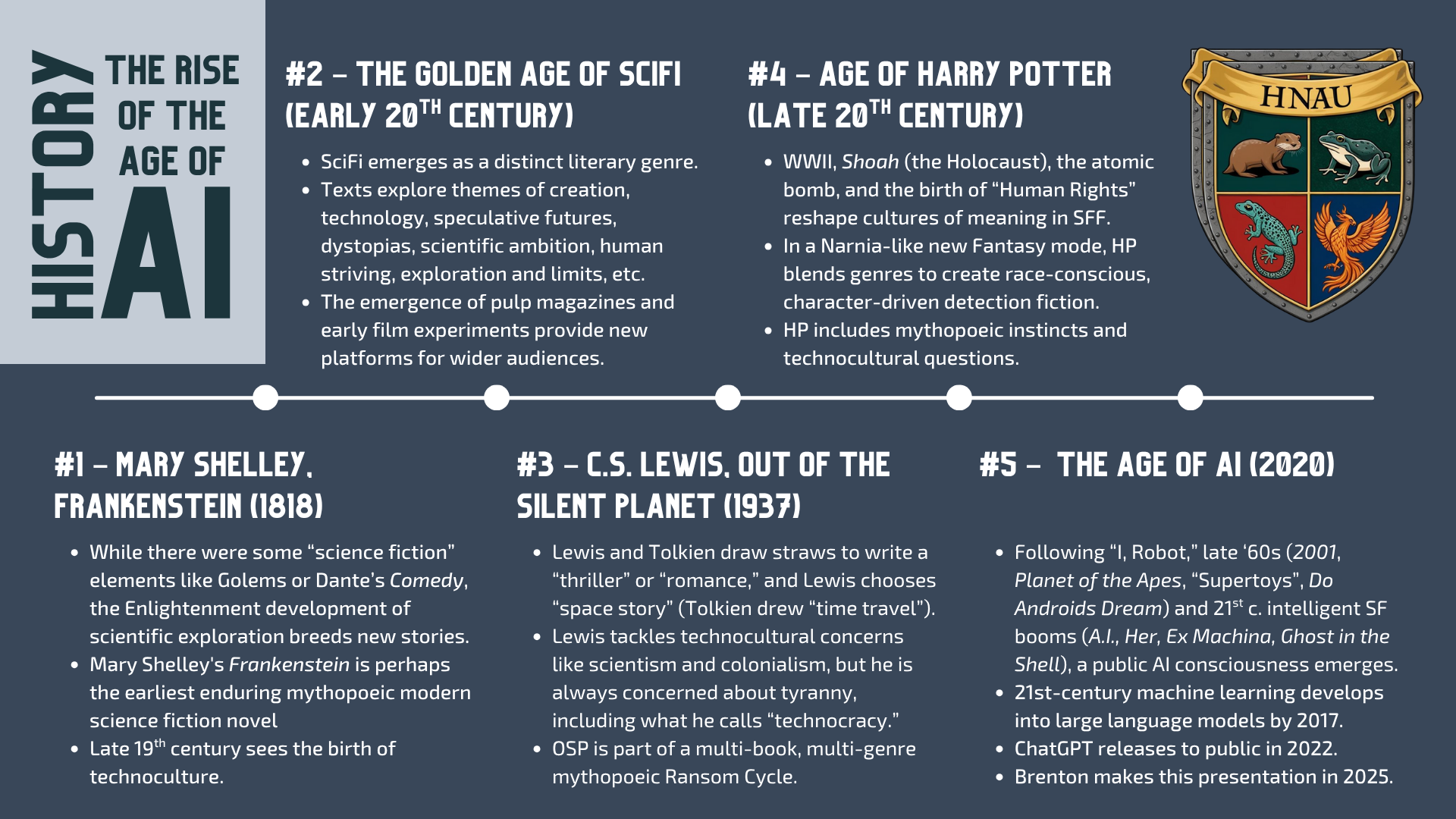
That said, as is usual, I have prepared more than I can talk about. For example, I created a pleasingly narcissistic timeline of the Age of AI that won’t even get a mention:

I love timelines, as long as we don’t take them too seriously.

In any case, you have the link to the slides, and I look forward to seeing how this works in the room bright and early on the solstice, Saturday, Jun 21, 2025.

Being Hnau in the Age of AI: A View from Hogwarts
by Brenton Dickieson

The move from the Information Age to something like the Age of AI has, like all fundamental cultural changes, caused us to reflect on what it means to be human. This is old turf for science fiction readers. While it might be a bit premature to make a survival kit out of Charles Stross’s 2005 exponential apocalypse, Accelerando, science fiction always asks fundamental human questions. Mary Shelley’s Frankenstein is a Promethean tale as much as it is an Edenic one, going to the core of what it means to be human. Frankenstein is about stealing fire from the gods and the fire that burns in the human soul.

Darko Suvin’s “cognitive estrangement” theory of science fiction argues that SF disturbs readers’ worldview, inviting them to turn a prophetic lens upon their own society. In the 1930s, three wise Malacandrian species cause C.S. Lewis’s hapless protagonist to face the folly of his Eurocentric colonial instincts and renegotiate his understanding of what it means to be human. Lewis coins the term hnau to describe sapient, sentient, spiritually capacious, art- and artisan-making, story-telling, beings of whatever form.

Though Suvin would resist the parallel, J.R.R. Tolkien’s “escape and recovery” in fairy stories has a similar effect. So, I turned to a fantasy world, Harry Potter, to think about the blurred edges of what it means to be hnau in the Age of AI. Although we have not yet seen humanlike Artificial Intelligence, we have begun interacting with AI bots and other sentient-like tools as if they were people—an anthropomorphizing instinct I call the “Wall-E Effect.” Like Lewis’s Malacandria, the Potterverse has other races of hnau, like centaurs or merpeople. But there is also a spectrum of magical somethings that show human-like sentience, from mandrake root or The Weasleys’ Ford Anglia all the way to the Sorting Hat and the paintings on Hogwart’s walls. Read as a recovery of cognitive estrangement, the Harry Potter chronicles offer guidance, warnings, and wisdom for human interaction in the Age of AI.

Notes: This abstract is slightly adapted already (I keep reworking it). I made the images with Canva, and took photos from Creative Commons as available.

Posted in News & Links | Tagged , , , , , , , , | 15 Comments

Being Hnau in the Age of AI: A View from Hogwarts (for Mythmoot XII)

A technical note to readers: I have been banned from Facebook and Messenger–hopefully temporarily, as I am not guilty of espionage or whatever the issue is. If you are one of the more than 500 readers who use Facebook to get your news from A Pilgrim in Narnia, I would encourage you to sign up for Pilgrim Posts in your email box–at least until this is resolved. I’m always reachable at junkola[at]gmail[dot]com–though quite behind in correspondence, as I’ve talked about here and here.

I have been doing a series of writing projects and teaching units on what I’m calling “Authentic Intelligence.” See what I did there? Authentic Intelligence … AI.

Anyway, Artificial intelligence is all the rage these days. While I don’t believe that we have AI–or, indeed, that it is possible–as folks in my world–writers, artists, teachers, content providers, designers, and the like–continue to process vocational crises, some more fundamental questions are starting to emerge.

I have confessed that as a science fiction nerd, I find little of this “sudden technological leap” we are experiencing surprising. I am frequently impatient with how slow our technologies are moving, but that might simply be my vice of impatience.

And the implications are hardly new. Honestly, we have been reading and writing about the possibilities and implications of human-machine hybridity for generations. The loss of one’s humanity in one’s human activity is a theme that goes back to the ancients, including the Bible.

Even culture-watchers who are not SF nerds should see the signs: In North America, we have bred functionalism into the DNA of our children; is it any surprise that when given the chance, students, politicians, and business people are apt to choose function over art, ethics, or identity? We left the path of wisdom some time ago when we decided that the heart of man was composed merely of walls, cavities, atriums, and valves.

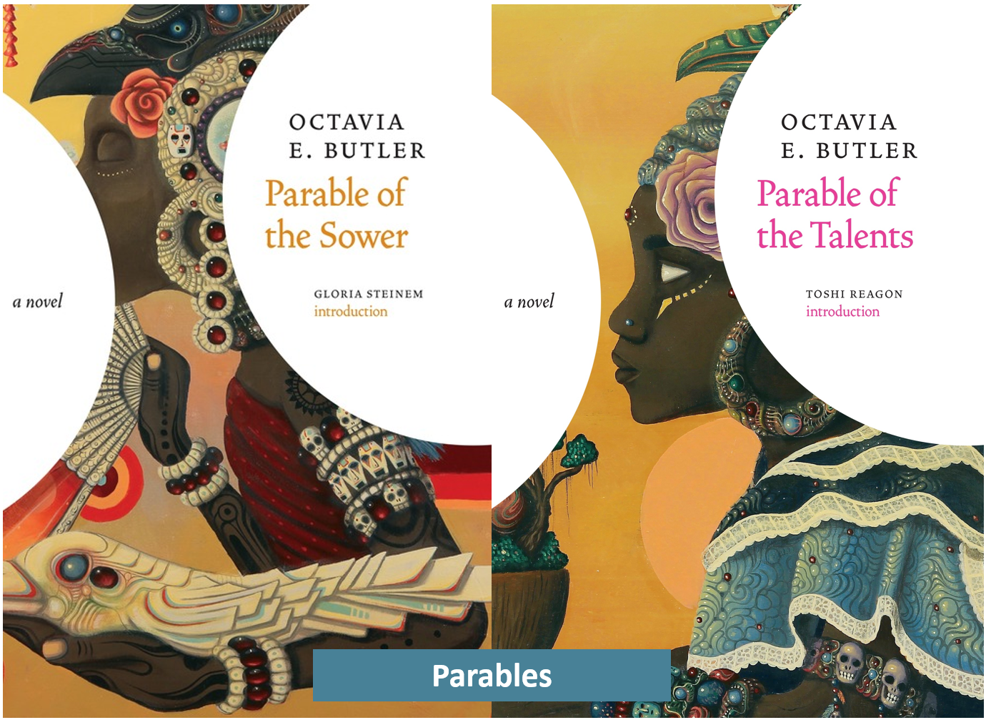
I get why people are curious and afraid, I really do. I’m rereading Octavia Butler‘s Parable of the Sower (1993) right now, and it reads at points like a decades-old roadmap for our 2025 dystopia.

As I feel like I have been living through a series of technocultural, mediatized phallocracies, I find myself drawing away from culture. I use the phrase “Authentic Intelligence” because rethinking “AI” from different angles helps me get to the fundamental human questions of science fiction.

Also, I continue to use the term “hnau” when envisioning our human being and doing in the future. Before WWII, Lewis coined hnau to describe sapient, sentient, spiritually capacious, art- and artisan-making, storytelling, beings of whatever form. I don’t know if Terrans are the only hnau created in the image of God, but we will, sooner or later, create beings in our own image. The way we relate to them will say a lot about what we think is fundamental to our society and race.

Thus, I am looking to extend my understanding of hnauology in order to shape our evolving consciousness as a species.

While rereading Harry Potter this past winter, I began to wonder if fantasy could contribute in some ways to my hnauological enquiry.

Because I live with non-human animals, I know what to do with Fawkes the Phoenix in the series; but what do we do with the Fat Lady and Phineas Nigellus Black–who exist only in living portraits–or the Weasleys’ Ford Anglia–a machine with developing sentience and emotion–or the Goblet of Fire–a magical item manipulated in the way that we program computer technology. While one of the tensions in the series is the degree to which Goblins, Centaurs, and Merfolk are truly hnau, does the Ministry of Magic’s standardized testing make Trolls an intelligence baseline for sharing humanity? Perhaps the Owls and Cats of Hogwarts are merely superanimals, but what about Nigini, which inhabits the soul of Voldemort? Tom Riddle’s diary makes me wonder whether Voldemort’s flight from death is also a retreat from humanity. Does going beyond humanity make one superhuman or not a hnau at all.

I ended up sketching out so many questions and potential links that I decided I would take this inquiry public.

Mythmoot XII is June 19-22, 2025, at the National Conference Centre in Leesburg, VA. The theme, “Drawn to the Edge,” invited me to reflect on the boundaries of my hnauological sketches, so I decided to pitch my Harry Potter project, “Being Hnau in the Age of AI: A View from Hogwarts.” My accepted abstract is below with some links to relevant pieces, and I look forward to presenting some preliminary findings.

Mythmoot is always an excellent conference. You can register here for on-site registration–and for those not in the neighbourhood, the online version is called “MootHub” and is only $75.

Being Hnau in the Age of AI: A View from Hogwarts
by Brenton Dickieson

The move from the Information Age to something like the Age of AI has, like all fundamental cultural changes, caused us to reflect on what it means to be human. This is old turf for science fiction readers. While it might be a bit premature to make a survival kit out of Charles Stross’s 2005 exponential apocalypse, Accelerando, science fiction always asks fundamental human questions. Mary Shelley’s Frankenstein is a Promethean tale as much as it is an Edenic one, going to the core of what it means to be human. Frankenstein is about stealing fire from the gods and the fire that burns in the human soul.

Darko Suvin’s “cognitive estrangement” theory of science fiction argues that SF disturbs readers’ worldview, inviting them to turn a prophetic lens upon their own society. In the 1930s, three wise Malacandrian species cause C.S. Lewis’s hapless protagonist to face the folly of his Eurocentric colonial instincts and renegotiate his understanding of what it means to be human. Lewis coins the term hnau to describe sapient, sentient, spiritually capacious, art- and artisan-making, story-telling, beings of whatever form.

Though Suvin would resist the parallel, J.R.R. Tolkien’s “escape and recovery” in fairy stories has a similar effect. So, I turned to a fantasy world, Harry Potter, to think about the blurred edges of what it means to be hnau in the Age of AI. Although we have not yet seen humanlike Artificial Intelligence, we have begun interacting with AI bots and other sentient-like tools as if they were people—an anthropomorphizing instinct I call the “Wall-E Effect.” Like Lewis’s Malacandria, the Potterverse has other races of hnau, like centaurs or merpeople. But there is also a spectrum of magical somethings that show human-like sentience, from mandrake root or The Weasleys’ Ford Anglia all the way to the Sorting Hat and the paintings on Hogwart’s walls. Read as a recovery of cognitive estrangement, the Harry Potter chronicles offer guidance, warnings, and wisdom for human interaction in the Age of AI.

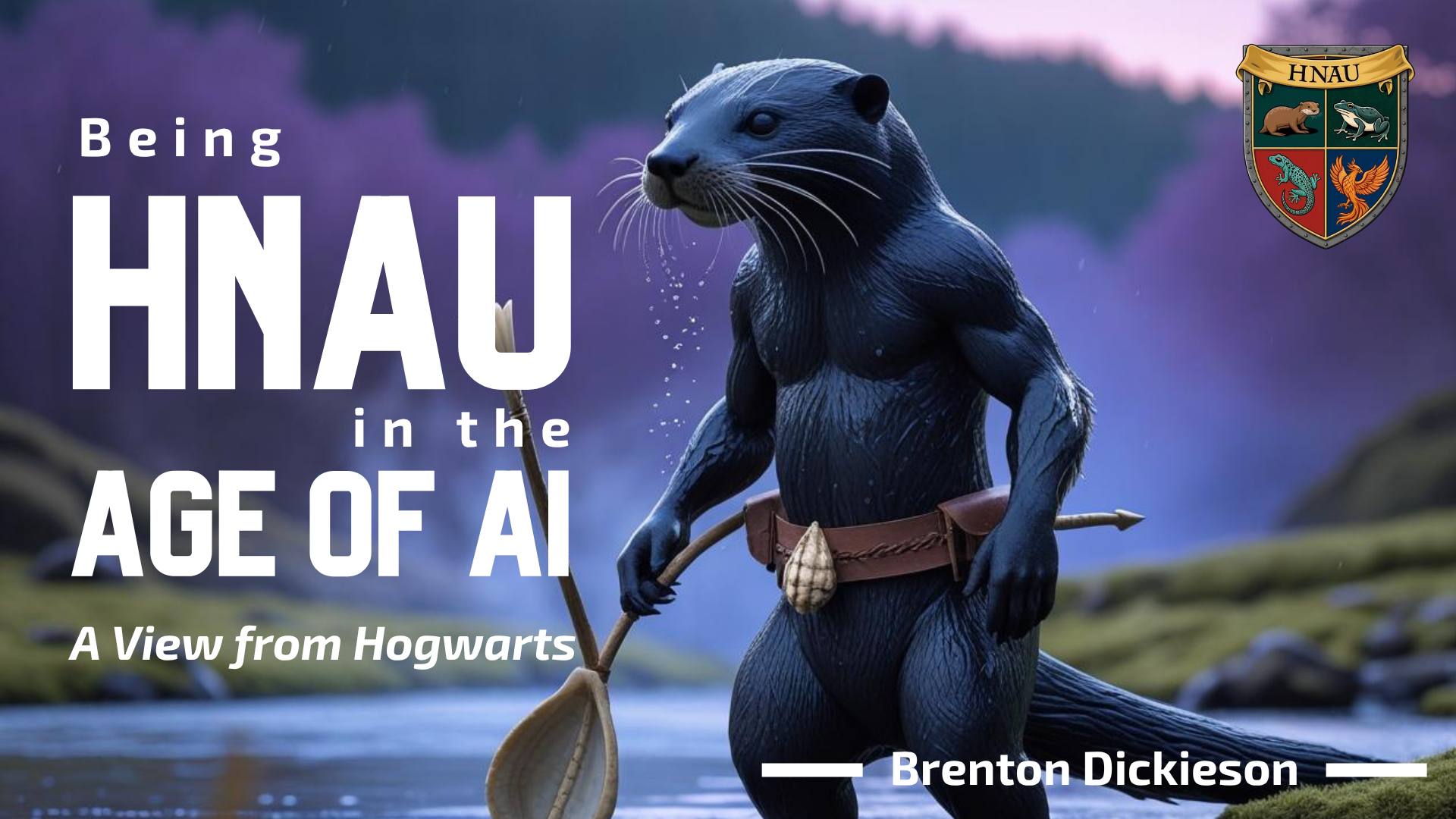
Notes: This abstract is slightly adapted already (I keep reworking it). I made the “HNAU” banner and shield with Canva, with hilarious results, I think.

Posted in News & Links | Tagged , , , , , , , , , , , , , | 18 Comments

Do the Inhabitants of Arda Know How Their Own Story Ends? A Thesis Theatre on Middle-earth Eschatology by Jeffrey Wade (Wed, Jun 4, 5:00pm ET)

Once again, I have had the distinct pleasure to work with a Signum University MA student through their thesis process. Jeffrey Wade has completed his thesis on “Unveiling Hope: Do the Inhabitants of Arda Know How Their Own Story Ends?” You can see the full abstract and a bio by Rev. Wade below, but I think you will be intrigued by the elegance of this question.

Readers of The Hobbit and The Lord of the Rings may be surprised to know that there are not many references to the creation stories in The Silmarillion. And yet, there is a narrative of hope in other parts of the Middle-earth materials, including the Ainulindalë in The Silmarillion and the unique dialogue, “Athrabeth Finrod ah Andreth.”

Imagine for a moment that we are the people inside the worlds of Frodo and Bilbo and their gangs and neighbours at the close of the Third Age. What do we know about that creation myth’s narrative of hope? What do we believe will happen at the end of days–even if we couldn’t fully articulate it? Do we have any reason to be hopeful, or is it just one weary age after another? How do we think the story ends?

Then, effectively shutting off (for a moment) the information in the dozens of volumes we have out here in the primary world of Earth in the Age of the Machines–and even setting aside Tolkien’s own beliefs, religion, and social imaginary–we return to the tales and epics in the secondary world of Arda and see what we can find. Do the inhabitants of Arda know their own eschatology?

Very cool idea, isn’t it? What results is a rich paper and an enlightening conversation.

You are welcome to join us for this free, online discussion on Wednesday, June 4th, a 5:00pm ET (2:00pm PT, 6:00pm Atlantic, 10:00pm UK Time, 12:00 midnight in Madagascar, and 6:00am in Japan). Simply register here. Following a presentation of his ideas by Jeffrey, I will provide some questions, and then we’ll open it up to those joining online throughout the world.

Part of the great fun of teaching graduate students is the work they produce in their thesis writing. I have been able to supervise projects about medieval models in C.S. Lewis’s science fiction (here and here), symbiosis in Octavia E. Butler, and several Tolkien studies, including “Speech-acts and Sub-creation,” “The Nonviolent Countercurrents in Tolkien’s Epic of War,” the figure of Galadriel and Tolkien’s mythopoeia, and an autoethnographic approach to Tolkien’s “Sub-creative Vision.” I have also been a second reader on projects about a vampiric reading of Emily Brontë’s Wuthering Heights and “Draconic Diction: Truth and Lies in Ursula K. Le Guin’s Old Speech.”

“Unveiling Hope: Do the Inhabitants of Arda Know How Their Own Story Ends?”

Abstract

This thesis concerns itself with the question of whether the inhabitants of Tolkien’s Arda possess an awareness of their creation’s eschatological end. It is not a study of Christian doctrine, Tolkien, or outside analysis. It is a study of how myth carries the weight of a telos through music, memory, and hope. This thesis’ conceit is the same as Tolkien’s, the entire legendarium has been recorded and passed down from the Valar to the Elves and subsequently through the Hobbits. Therefore, all of Arda is revealed to be undergirded by the Music of the Ainur, which is more than a creation hymn – it is a sustaining breath, echoing through waters, songs, and the hearts of every individual. This Music is heard beside hearths, in dreams before perilous roads, and wherever water is found. Drawing from the legendarium, with modern scholarship simply providing context, this study argues that Arda is alive and looking forward to a final eucatastrophe where all sad things come untrue.

Biography of Rev. Jeffrey Wade

Jeffrey E. Wade, Concordia Seminary, M.Div. ’14, became a student again shortly after discovering Signum University. What started as a hope to be a better reader, researcher, and writer soon blossomed into enrollment in the MA program with the desire to better communicate and inculcate hope using Tolkien’s legendarium as a foundation. Bringing hope is Jeffrey’s primary vocation as a pastor and head of school in Michigan. When not teaching, conversing, or residing in a good book, Jeffrey spends his time outdoors with his wife and three living children.

Direct registration link: https://us06web.zoom.us/webinar/register/WN_Gefl3FQkQ1WiqFb9iUnivA#/registration

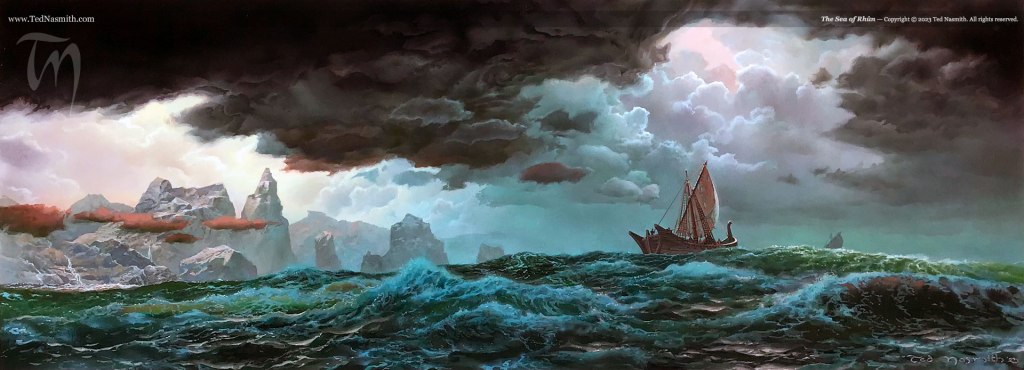
Photo: “The Sea of Rhûn” by Ted Nasmith

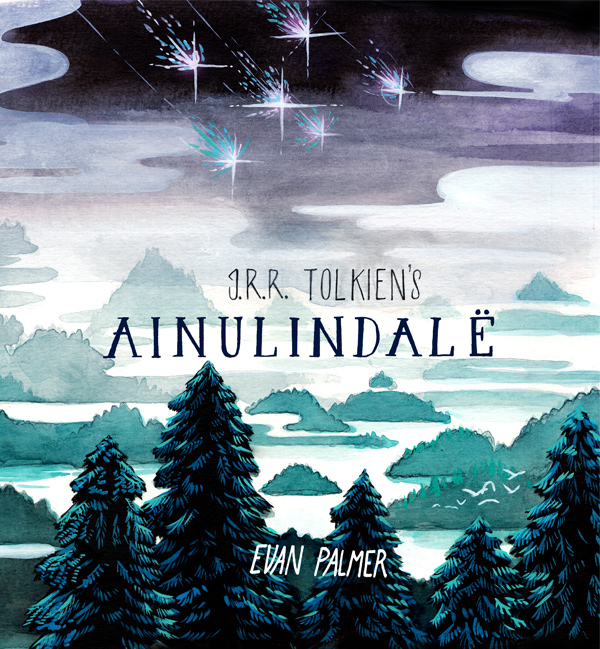
Book Cover: J.R.R. Tolkien’s Ainulindalë, a Graphic Novel by Evan Palmer

Posted in News & Links | Tagged , , , , , , , , , | 8 Comments

An Abundance of Spreadsheets about Tolkien’s Expanded Letters (Part 2 of Voyaging With Voyant)

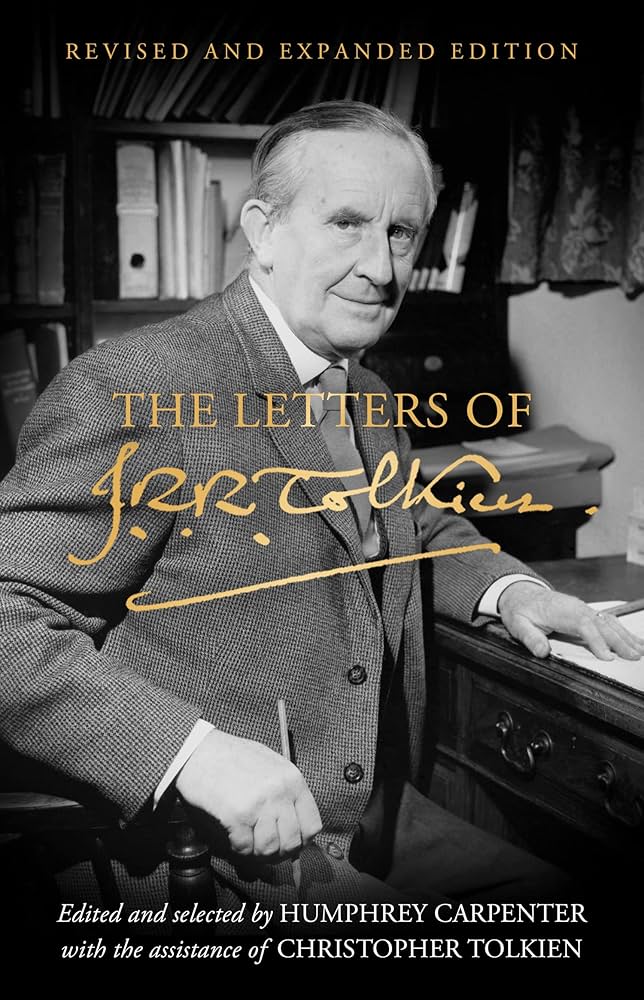
Introducing The Letters of J.R.R. Tolkien

I have confessed before how much I value the letter collections of authors that intrigue me. Besides C.S. Lewis and J.R.R. Tolkien, I’ve spent time in correspondence collections by Dorothy L. Sayers, James Thurber, L.M. Montgomery, E.B. White, Dietrich Bonhoeffer, Joy Davidman, and Warren Lewis. To get closer to his sense of self, artistry, and vocation, I undertook a lengthy “Statistical Look at C.S. Lewis’ Letter Writing” with some follow-up notes (see here).

On A Pilgrim in Narnia, I have written numerous reflections on Tolkien’s letters, including fan pieces, like “The Tolkien Letter that Every Lover of Middle-earth Must Read” (which we’ll come back to), and personal pieces, like his last letter to his daughter Priscilla. I’ve also reflected on my own life and work while reading Tolkien’s letters, such as “Battling a Mountain of Neglects with J.R.R. Tolkien.”

Humphrey Carpenter and Christopher Tolkien edited The Letters of J.R.R. Tolkien in 1981. My copy is filled with folded-over pages and marginal notes. So you can imagine how excited I was when I heard that the 2023 restored edition would have 165 new bits of correspondence and some other expanded letters. I am grateful to the publishers, Baillie Tolkien (Christopher Tolkien’s Executor, Catherine McIlwaine (Tolkien Archivist at The Bodleian Libraries), Chris Smith (who wrote the new foreword), and Wayne G. Hammond & Christina Scull (who prepared the Index and provided some notes).

From Voyant to Spreadsheetophilia

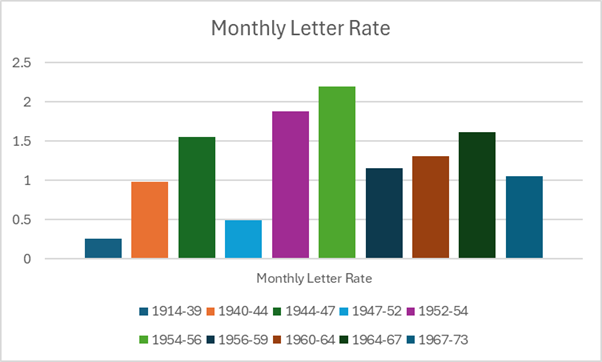
Last week, I wrote about “Voyaging with Voyant in Tolkien’s Expanded Letters (Part 1: Background and Themes).” One of my realizations was how precious few letters are available to the general reader. In Tolkien’s most significant publication period—from The Hobbit in 1937 until his death in 1973—this new, greatly appreciated collection contains only 1 or 2 letters a month.

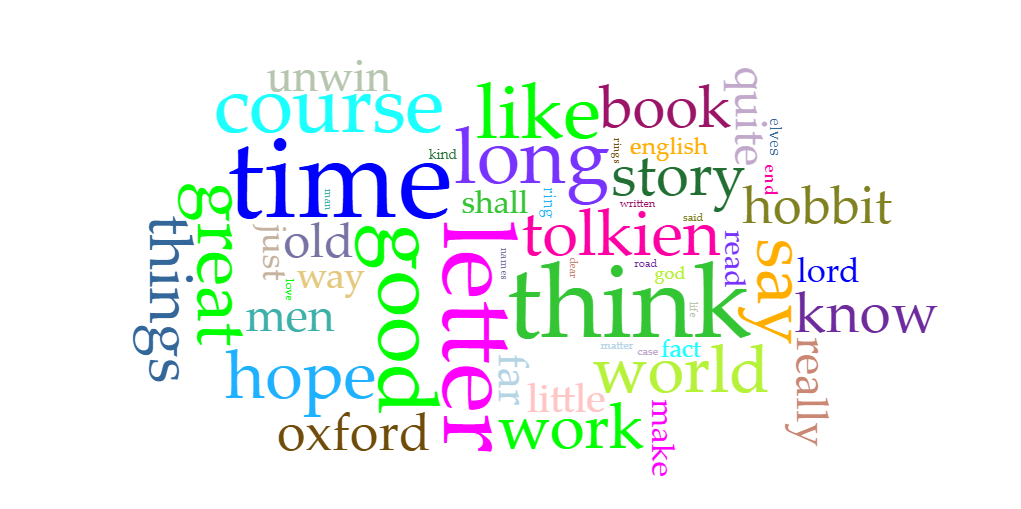
Part of my goal with last week’s piece was to experiment with the text analysis tools at Voyant https://voyant-tools.org/. What I found when going more deeply into Tolkien’s connections and relationships—the beginning of network analysis—was that I needed to step back and do more work on my own.

Frankly, my cleaning of the initial text was inadequate for this next layer of experimentation.  I had previously excluded commentary and footnotes, but not greetings and addresses–leading to unhelpful biases.

Removing Doubles

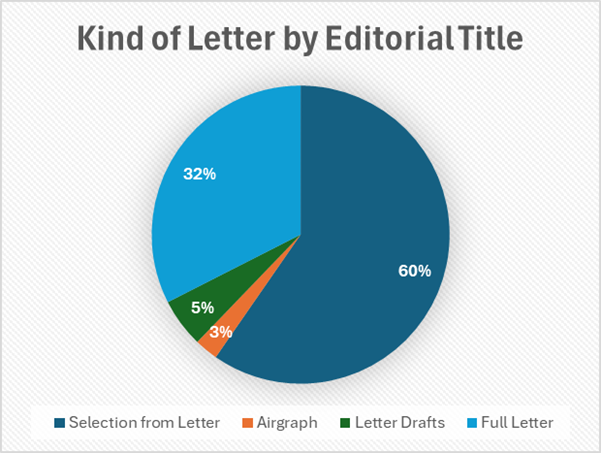
First, because so many letters were written with letterhead from Oxford, it skewed the word association tools like word clouds (and potential place analysis or GIS). Each of the 508 letter entries has an editorial title like this:

  • “From a letter to…” 303 entries
  • “From an airgraph to…” 13 entries
  • “From a draft to…” 3 entries, as well as 23 other editorial mentions of a “draft” (two of which were marked “not sent”)
  • “From a carbon of…” 1 entry

Leaving about 165 “To…” letters, i.e., full letters with greetings (e.g., “To Michael George”).

In my original cleaned digital text, about 1/3 of entries had potentially doubled data, so a letter title might say “To Stanley Unwin, Allen & Unwin,” and then Tolkien’s greeting: “Dear Sir Stanley” or “Dear Mr Unwin.” Thus, we have an unhelpful repetition of names.

There is also a lot of name doubling—not just Unwin, but multiple generations of Gordon, Michael, Christopher, Joan, Lewis, and so on. Cleaning the text helped me work these out.

New Letter Organization

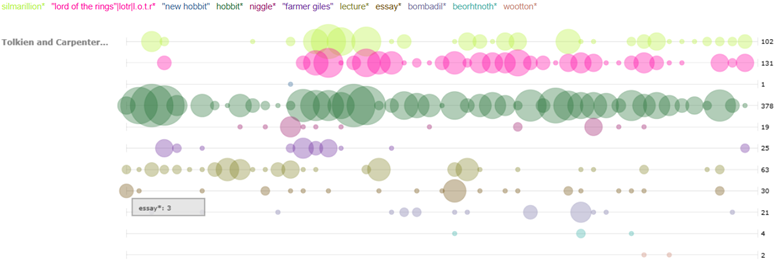
The visual analogies from Part 1 still work, like this one:

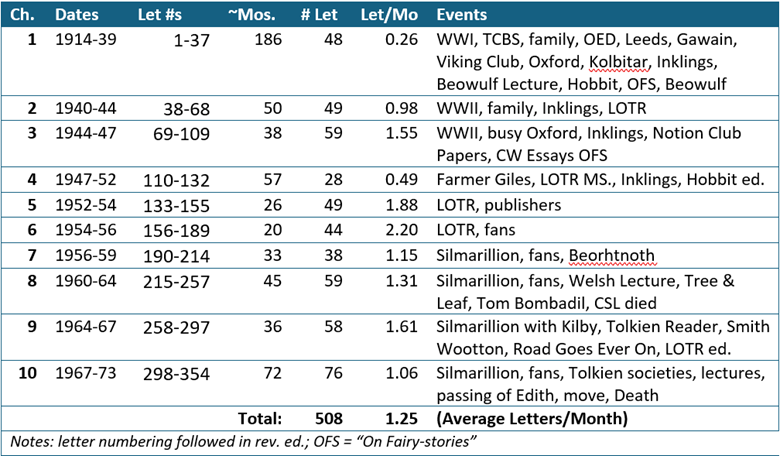
Dividing the text of the Letters into 10 equal parts (chapters) has the benefit of avoiding forced periods. However, when it comes to relationships, I am very interested in periods defined by their connections.

So, I decided to create a yearly breakdown of the letters. As the years 1916-1936 have very few extant letters, I ran averages for both the full volume (1916-73) and the period of 1937-73. Voyant or another platform might have a process to do this, but I did not find one. So, I spent a good part of a day remaking a Digital Text and creating some old-fashioned spreadsheets. And counting letters by hand.

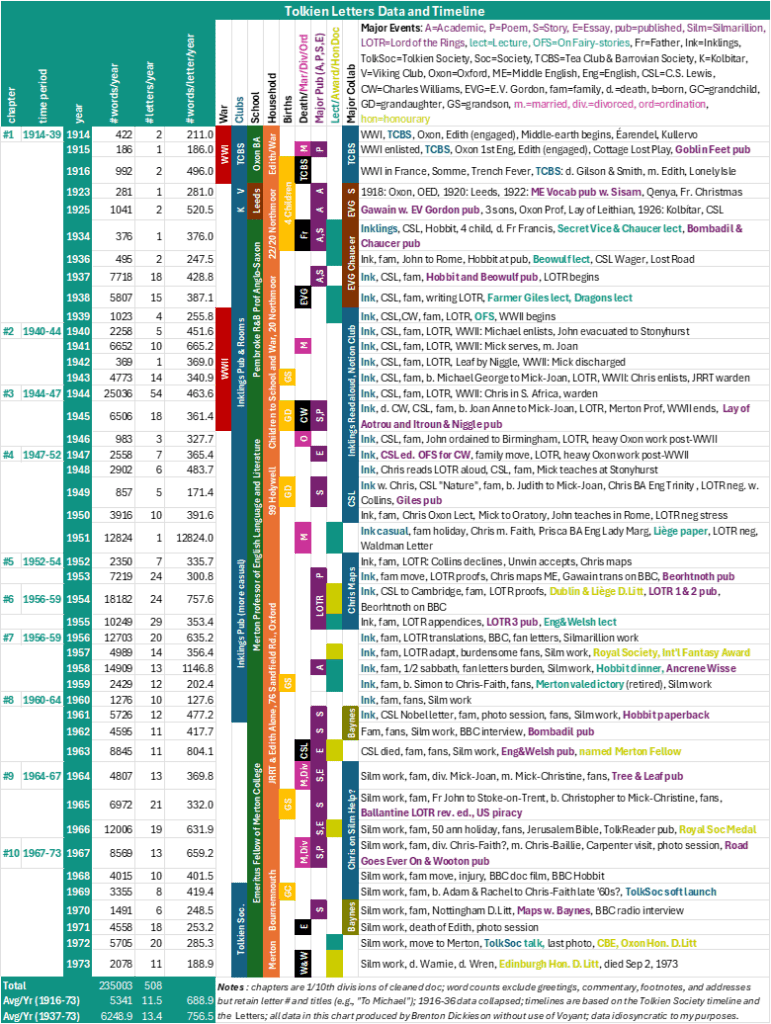
Admittedly, the initial spreadsheet is a wee bit full:

In the columns on the left, we have the original 10-part chapter divisions and their time periods set next to the years that we have letters (scattered between 1916 and 1936 and then more consistent from 1937—the year The Hobbit was published—and his death in 1973).

This is a highly functional spreadsheet for me, though I cannot imagine other people finding it intuitive. If you think you could use it (and address errors), let me know.

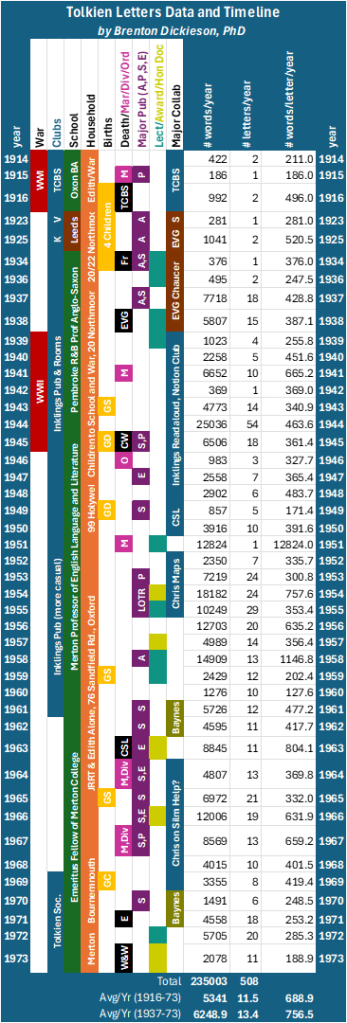
This trimmer chart on the right allows us to focus on the data more, but you need a strong sense of Tolkien’s timeline. I use the Tolkien Society timeline, which I nuanced in a conversation with DeepSeek AI (using the Letters, Carpenter’s Tolkien biography, and open-source materials as the data set).

I also understand there is a lot of colour. That works for me and allows me to add secondary categories.

With my newly organized doc and a hand count of the letters, I could count the number of words in each year, allowing us to see averages like the number of letters and words per year.

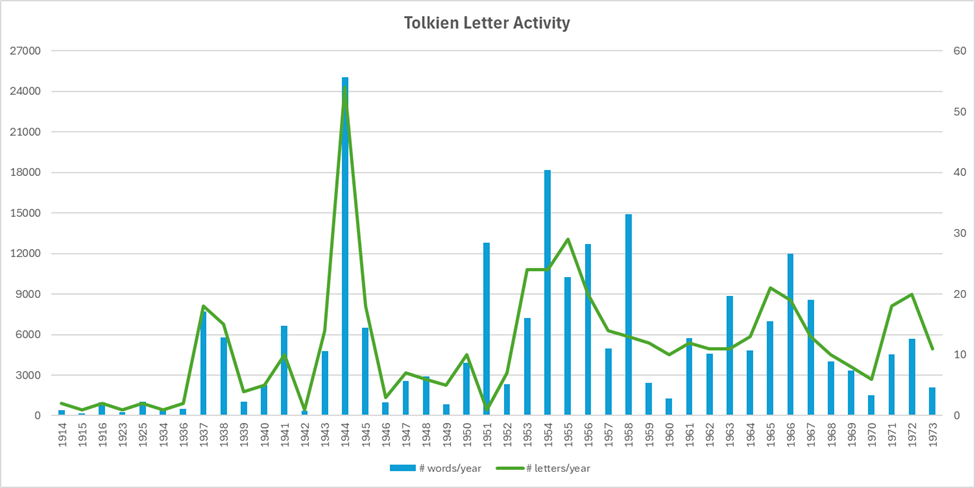
In the chart below, the green line shows the number of letters included in the collection from each year. There is an average of 11.5 letters each year—roughly one a month.

The averages on their own, though, don’t show the wild diversity of these figures, which you can see when the blue bar and green line go in opposite directions. In 1944, there were a lot of long letters to his sons in the war and a great number of letters, overall. In 1968, Tolkien was responding in detail to fans of The Lord of the Rings, so that there were fewer letters, but these were even longer.

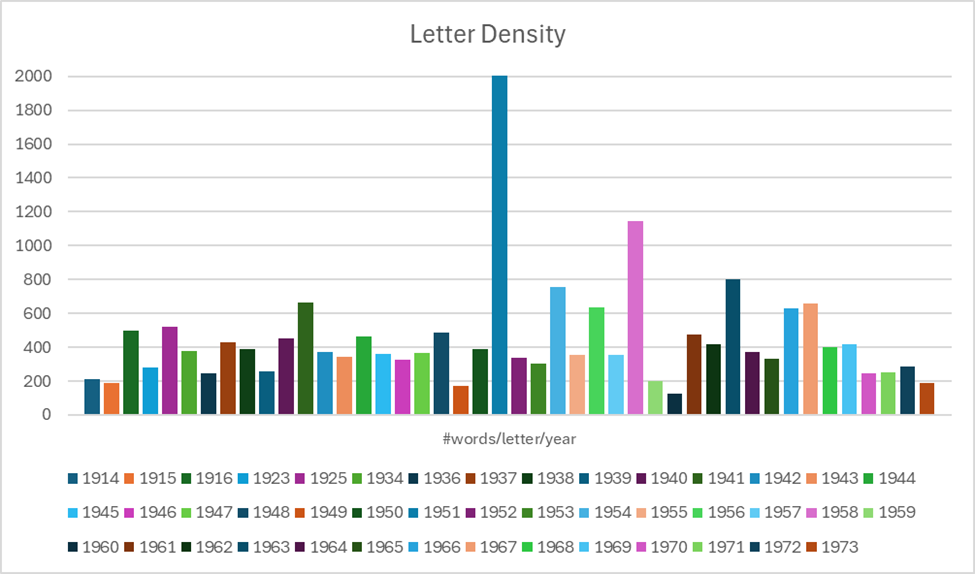
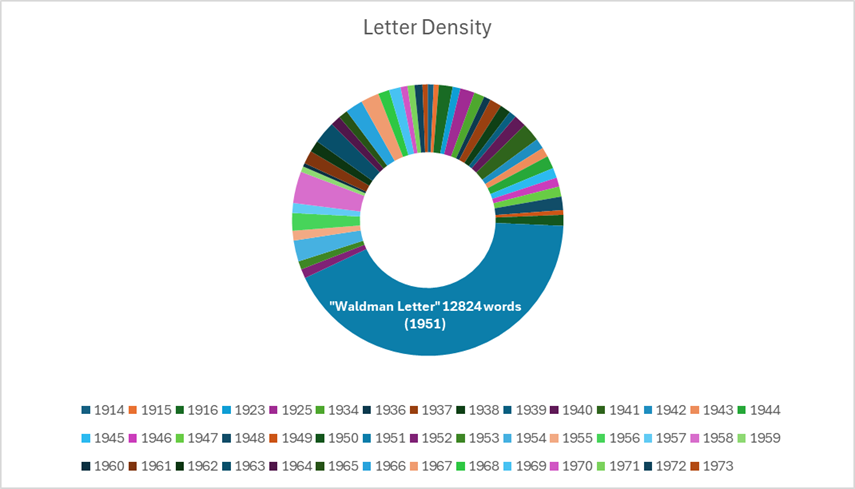
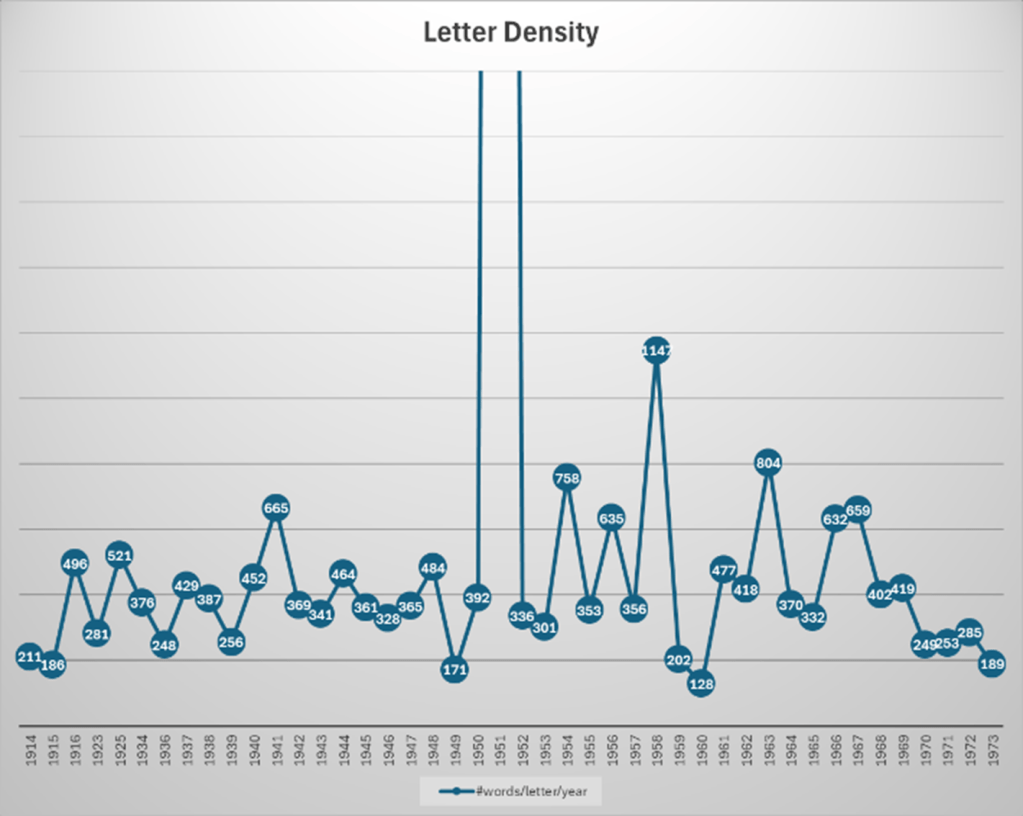
The piece that throws off the data totally is the “Milton Waldman Letter.” The Letters include only one piece of correspondence in 1951, a facsimile of a description of The Silmarillion that Tolkien sent Collins publisher Milton Waldman. This is “The Tolkien Letter that Every Lover of Middle-earth Must Read”—or so I claimed in a previous post.

It really is a remarkable letter—which is why Mr. Waldman made a copy … and kept it, even when Collins decided to pass on The Lord of the Rings and The Silmarillion. In time, editor Christopher Tolkien included it as a prolegomenon to The Silmarillion.

Statistically speaking, this letter throws off the data in wonderful ways. I capped the letter density chart at “2,000 words” above; actually, that blue column should extend about 6 times as high! Here’s another way of looking at it:

And then there are bubbles, with the Milton Waldman bubble way off the chart:

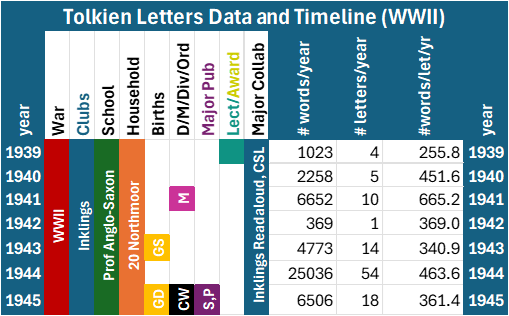
Ultimately, what this data reorganization has really done is give me a spreadsheet with which to draw some pictures. For example, here is my chart narrowed in on the years of WWII.

In the period where Tolkien is supporting his children in wartime and enjoying grandchildren, he is at a point of peek support from the Inklings. While we can guess at the inconveniences and fears of WWII, what the chart cannot show is how his Oxford workload increases—though the paucity of publications in this period is a hint.

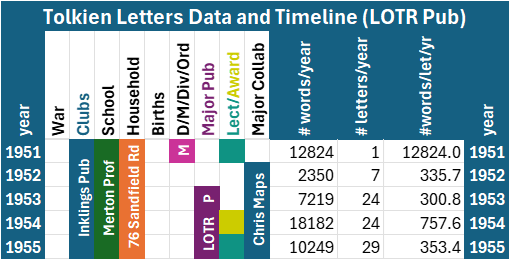
1951-55 is an extremely stressful period for Tolkien. He has completed The Lord of the Rings—or, at least, he is ready to publish it. He has grown convinced that it must be published with The Silmarillion, though he has not yet produced a manuscript for his legendarium’s founding book. When his publishers, Allen & Unwin, balk at a contract involving The Silmarillion (which they have not seen), Tolkien pitches the project to Collins Publishing (this is where Milton Waldman comes in). Ultimately, Tolkien will fail with Collins and return with gratitude to Allen & Unwin. They rush to meet a 1954-54 series of deadlines, including glossaries, maps (drawn by Christopher), and endless copy editing.

What my chart brings home to me is the relative stability during those years. Edith and Ronald are settled in an empty nest home and there are very few family events in the period (one marriage). The grandchildren are growing and he has secured the professorship that will bring him to retirement at the end of the decade. While there is much personal difficulty in this period, it was less stressful in terms of raising children and sending them to war, or constantly preparing for the next job or house.

The spreadsheets help me close-read the letters and see history in new ways.

What the Letters Are and Are Not

In my next post, I will turn to look at some of Tolkien’s relationships as the data visualizes them. In the meantime, an obvious but essential observation.

As I’ve been rereading the letters, I am moved by how intensely personal and intimate Tolkien’s letters are to his children—especially to his sons in wartime, but also as they were children with childhood’s challenges. Seeing the data, I was struck by how intensely committed Tolkien was to writing and sharing his legendarium. There are more publishers than family members in the letters, and names from The Lord of the Rings are as common as people in his everyday life.

Now, a cynical reader may conclude that my use of Voyant to organize and visualize data from the digital text of the letters is circular: In a collection designed to shed light on Tolkien’s creative processes, it is not shocking that my data points to Tolkien’s creative processes.

However, it is essential to recognize that, by definition, letter collections are selective. Even in an exhaustive collection, the letters that survive are not necessarily the most important pieces of evidence.

Letters are also deeply contextual. In times of war, they are filled with codes and censorship. Letters among those we live with are rare. We don’t have a lot of letters between the Inklings because they met regularly in Oxford. Their shared words are written on the walls of pubs and cobblestone pathways in a kind of invisible ink that I do not have the technology to recover. By contrast, the father and son duo at Allen & Unwin publishers—and quite a number of their editors—lived elsewhere. Almost all of their communication happens by mail.

For all of these reasons, the evidence of epistolary history can never be judged by the weight of the remaining mailbags.

In the next post, I want to press in a bit more on Tolkien’s relationships.

Posted in Original Research | Tagged , , , , , , , , , , , | 7 Comments