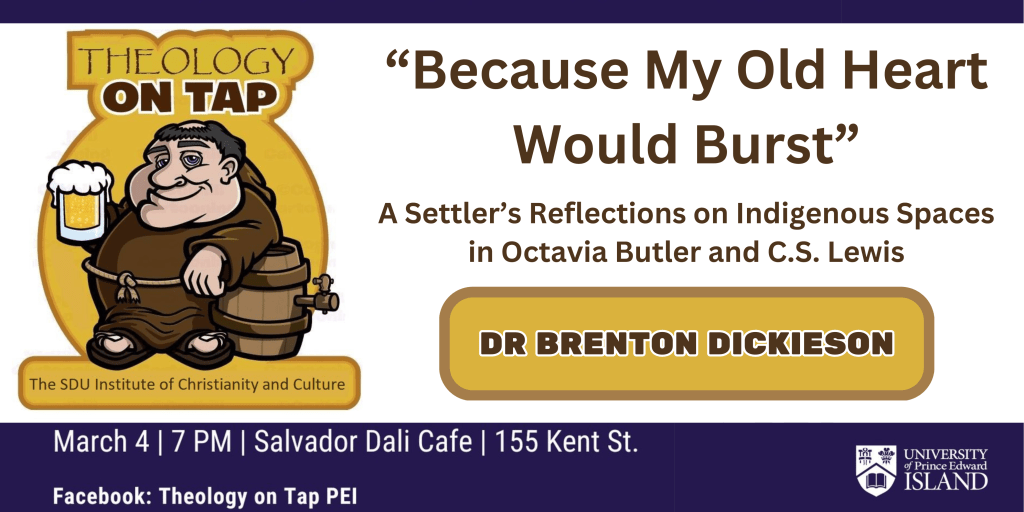
“Because My Old Heart Would Burst”: A Settler’s Reflections on Indigenous Spaces in Octavia Butler and C.S. Lewis (Theology on Tap by Brenton Dickieson)

I have some exciting news! On Tuesday, I will be giving a talk in the “Theology on Tap” series. After a pandemic hiatus, it is lovely to see this event emerge again. A few years ago, I did my “Hobbits Theology” talk, officially called “Concerning Hobbits and How They Save the World.” I’ve linked that talk below, which I rewrote for a Northwind Seminary lecture a couple of years ago. It also has a place in my upcoming book.

This year, I pitched a new subject. I wanted to challenge myself and test out some ideas that have come out of my reading of two great 20th-century speculative fiction writers: Octavia E. Butler and C.S. Lewis. I also wanted to tackle a complex question–a wicked question, nearly an impossible question, a question I have been afraid to talk about but one that I think is essential to my calling as a father, teacher, neighbour, and theologian.

There seems to be a little buzz around the event. It is my first time being featured in UPEI’s “Campus Connector” digital magazine. I have since been rethinking my Star Wars shirt selfie in front of SDU Main building on campus as my official professorial profile pic. I suspect I’ll be getting an offer from the campus photographer at some point to get new headshots. 🙂

I spend a little time going into my thinking below, but here’s the blurb for those who want the quick version. It is not a livestreamed event, but hopefully they tape it like last time, so I can share it with you all.

“Because My Old Heart Would Burst”: A Settler’s Reflections on Indigenous Spaces in Octavia Butler and C.S. Lewis

While Octavia E. Butler and C.S. Lewis are quite different in style and worldview, their fantasy and science fiction novels excel at showing the complex relationship between indigenous folk and the powerful people who settle in their spaces. With Butler’s and Lewis’ stories in mind, Dr. Dickieson offers a theological reflection on his own experience of “home” in Epektwik.   

Readers will know that I am a huge fan of Octavia E. Butler’s science fiction. I love her writing, but Butler is not easy to read. Her stories poignantly capture the complexity of forced interrelationships between settlers and indigenous peoples during situations of rapid technological and societal change.

In a short story named “Amnesty,” an alien hive-mind species settles in Earth’s deserts and disrupts the global economy. It took the aliens years to understand that humans were sentient-sapient beings (what C.S. Lewis describes as “hnau“), and the discovery process included some atrocious acts. When frustrated and terrified humans ask why the aliens can’t go back where they come from, the protagonist human character, Noah, responds: “They’re here to stay … There’s no ‘away’ for them” (Bloodchild 167). They have nowhere to travel and no way to get there if they did. They put all their hopes in this new world. Earth is their home.

Similarly, in the Xenogenesis trilogy (or Lilith’s Brood), a species of alien genetic race-makers observes Earth in a mounting global nuclear holocaust. The aliens could tell that humans were hnau, but they did not understand until very late that the nuclear war was not consensual for most humans. The aliens rescue and archive a few hundred humans in suspended animation with the goal of a postnuclear reseeding of Earth. This is not mere altruism, though. These aliens are genetic treasure hunters, using the knowledge of the universe to evolve their own species. While humans are reliant on the aliens for a new chance to recover our species, the aliens become reliant upon the human-alien genetic bond.

These aliens, too, are homeless wanderers in space. When the protagonist Lilith describes her dependence upon the scientific masters who have saved them, her words are stark:

There is “nowhere to go, nowhere to hide, nowhere to be free” (Dawn III.3, “Nursery”).

While the stories are each unique in Butler’s work, they often feature what one of my MA students, Jens Hieber, calls “negotiated symbiosis.” A “symbiotic” relationship is one where species share a biological need for one another, like humans and microbiotics (so the yogurt commercials tell me). Or like those Egyptian Plovers and the crocodiles, or Clown Fish and Sea Anenom… Amenonm… well, watch Finding Nemo for that one.

In Butler, that symbiosis might be parasitic or mutually beneficial. The negotiated symbiosis might be shared genetic makeup, like a species, or shared bodies and minds. In fact, the symbiotic relationships are so complex and diverse that for a Mythmoot conference in 2023, I made a spreadsheet:

Granted, not everyone is as enamoured by spreadsheets as I am. But it all helps me press in on the implications of Butler’s interspecies symbiosis when thinking about my own space.

I am Brenton Dana Gordon Dickieson, son of Dana, son of Roy, son of Percy, son of Charles, son of James Dickieson, who married Catherine Stevenson, with whom he migrated to Mi’kmaq territory. 205 years ago, my Scottish family began farming in beautiful Prince Edward Island—in Epekwitk, the “cradle on the waves.” We were part of a great migration, and we fought for the land that we cared for and lived with. I still own a tiny corner of that land.

Map of Prince Edward Island in 1775. Titled: “A plan of the island of St. John with the divisions of the counties parishes & the lots as granted by government likewise the soundings round the coast and harbours. Surveyed by Capt. Holland. 1775. Source: https://www.wikiwand.com/en/File:Prince_Edward_Island_map_1775.jpg.

This great migration, though, displaced the peoples that lived here. Canada’s First Nations had nowhere to go, nowhere to be free. Likewise, I have nowhere to go back to. I have no place in Scotland or Europe that is mine. For me, to go somewhere is to displace someone. PEI is my home. I am bound to this homeland of the dispossessed.

Butler helps me frame the problem and offers a thoughtful–and troubling–speculative framework for reconsidering Indigenous displacement, hybrid identity, and shared spaces. Some of her greatest work is about the trans-Atlantic colonial project of using Indigenous Africans to help displace the people who first called these lands home.

While Butler excels at visualizing the troubling realities of negotiated symbiosis, I encountered a more personal and vibrant response while reading C.S. Lewis.
Like Butler, Lewis is intensely interested in tyranny–whether that is colonial oppression, economic enslavement, state control, or hegemonies of the mind and heart. Whether that is Jadis’ century-long winter in Narnia, Dymer‘s Republic of perfection, or various eugenic, technocratic, and ideological superpowers in the Ransom Cycle, Lewis’ stories are often about control:

“Man’s power over Nature turns out to be a power exercised by some men over other men with Nature as its instrument” (The Abolition of Man).

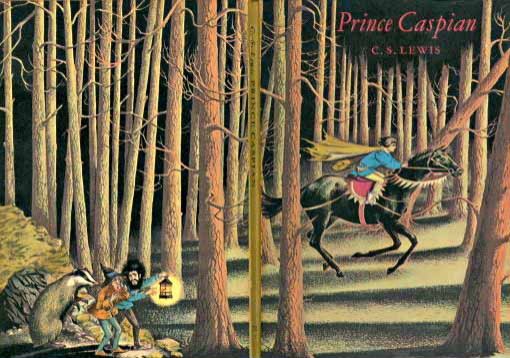
The stories have become increasingly personal to me. I was reading Prince Caspian when I suddenly caught a new vision of what was possible for me in my land of beauty, invention, and broken hearts–me with nowhere to go back to.

So this is what I would like to talk about in my Theology on Tap.

Posted in News & Links, Original Research, Reflections | Tagged , , , , , , , , , , , , , | 10 Comments

Voyaging with Voyant in Tolkien’s Expanded Letters (Part 1: Background and Themes)

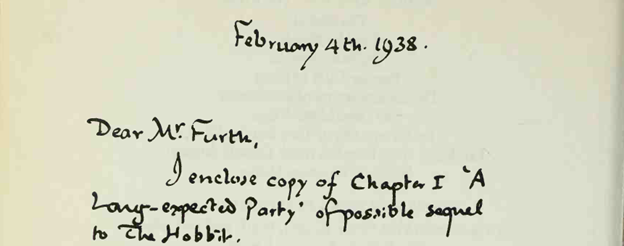
Tolkien’s 4 Feb 1938 Letter to Mr Furth of Allen & Unwin, referring to “A Long Expected Party” as a Sequel to The Hobbit, from the inside leaf of the 1st edition of The Letters of J.R.R. Tolkien (1981)

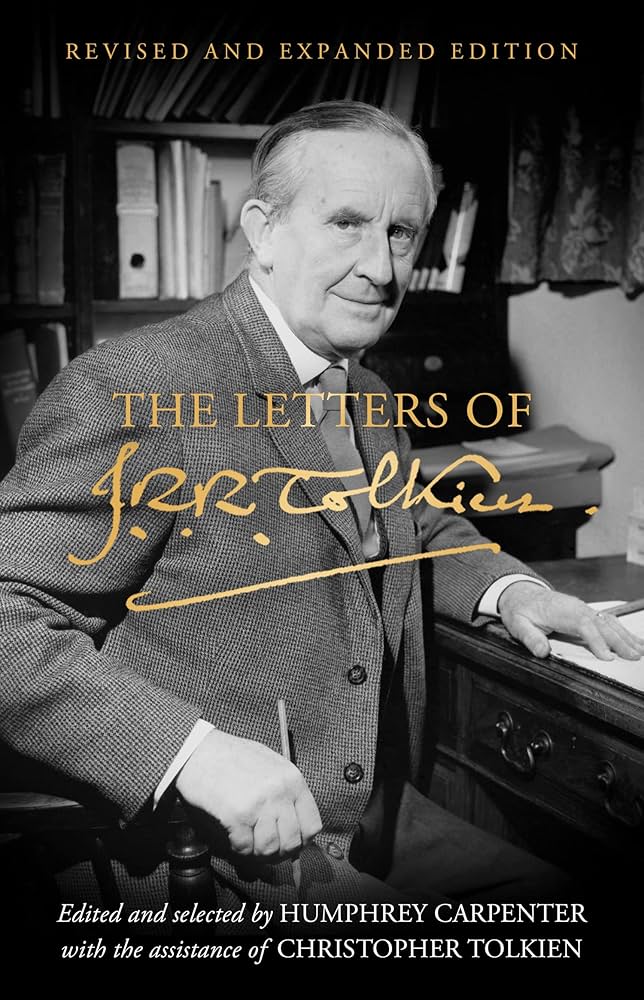
When I wanted to dig deeper into J.R.R. Tolkien‘s creative imagination, my first purchase after The Silmarillion was his letter collection. Humphrey Carpenter was a colourful 20th-century public intellectual who took an interest in Tolkien. A well-known voice of “Great Lives” on the BBC, Carpenter published a literary biography of Tolkien in 1977 and then turned to editing the letters.

With help from Christopher Tolkien, Carpenter published The Letters of J.R.R. Tolkien in 1981. The initial collection included 354 letters, some of which were fragments or drafts of correspondence. Carpenter shares in a preface that the original collection was completed in 1979, but publishers Allen & Unwin determined that it was too long. Thus, we might call the 2023 publication of The Letters of J. R. R. Tolkien: Revised and Expanded Edition a restored edition. I don’t know if all 50,000 words that were cut for the 1981 edition are now included, but there are 165 new letters.

Fans and scholars were disappointed that the collection did not include much more from the letters between Tolkien and his wife-to-be, Edith, during the period of the war. I might be the only one who is disappointed that the boring, day-to-day, mundane letters are still in the vault, but I am appreciative of what we have.

Introducing Voyant

Recently, I have been playing with the text analysis tools at Voyant https://voyant-tools.org/. Voyant is a digital humanities tool developed by Canadian scholars Stéfan Sinclair & Geoffrey Rockwell. While Voyant is not intuitive to the nonspecialist, some time and creative risk are easily rewarded, making it one of the most accessible digital text analysis tools I know.

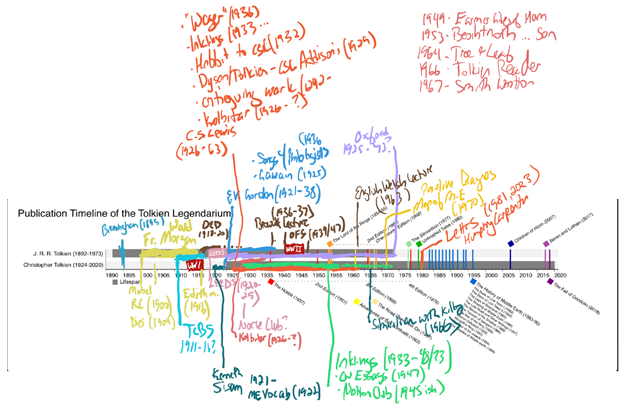
When I start a new study, I create an Excel sheet of data–some of which I’ve talked about before (e.g., see here). However, I am sometimes limited in my visual capabilities. For example, here is my Tolkien Timeline:

And that is getting a head start from something I found on reddit a while ago!

Anyway, so my limitations: Even though I am the least of digital humanities scholars, I wanted to test Voyant’s tools on a large text. So I turned to Voyant with the new expanded Letters text. There are some limitations. I cleaned the text but did not do much work text markup, indexing, or tokenization. I also did not select out the new letters for topic analysis or compare the Letters to other documents. Still, I hope readers find my wanderings here will help them get a sense of how the Letters shape our perception of Tolkien’s life and work.

This week is about some background information and textual trends; next week, I will post about Tolkien’s relationships.

Some Text Trends

Here are the details in Voyant’s summary of the text that has been stripped of all footnotes and editorial comments: This document with 231,865 total words and 16,273 unique word forms.

  • Vocabulary Density:  0.070
  • Readability Index: 7.947
  • Average Words Per Sentence: 22.5

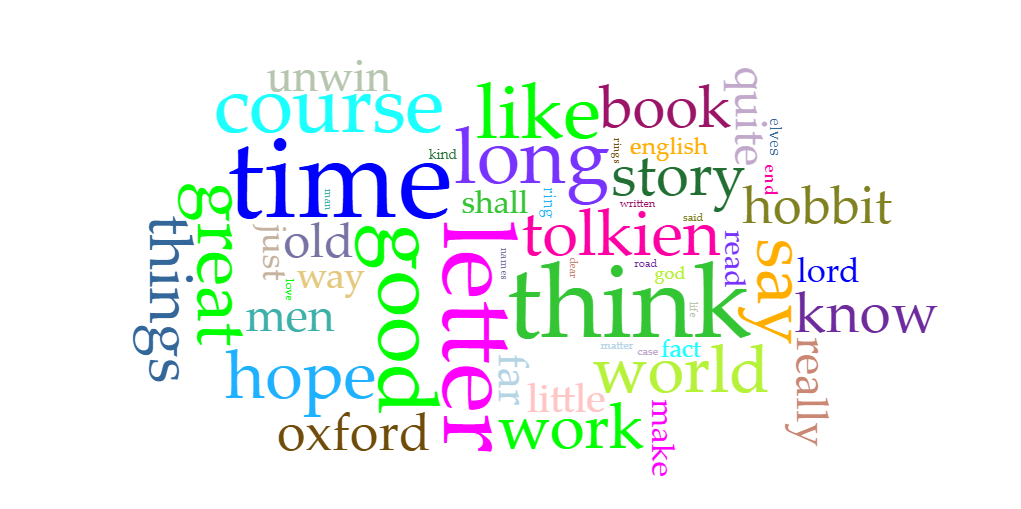
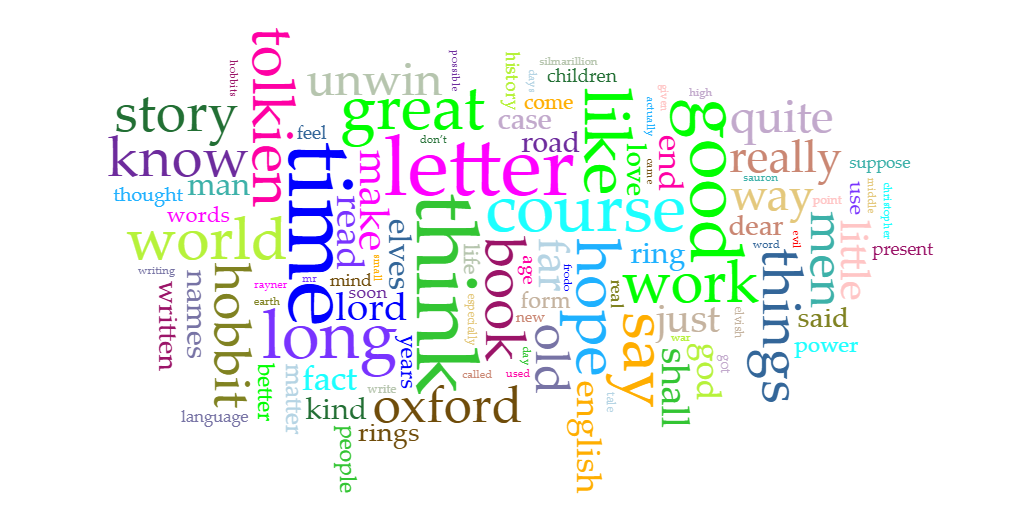
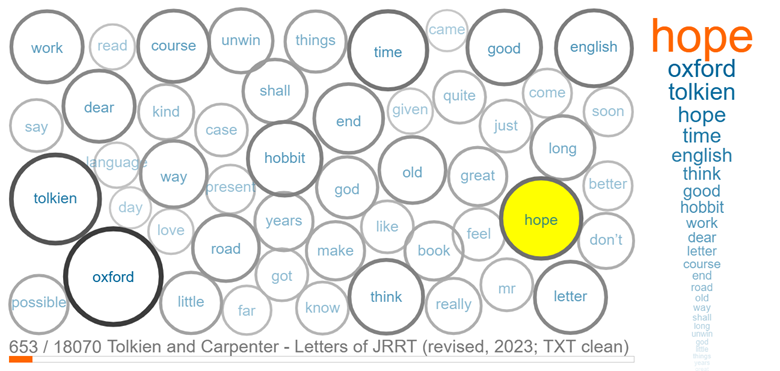
Voyant’s word cloud is satisfying because it selects out most of the common words that can clutter up our visuals. The visualization is set to capture the 50 main words of interest:

I find these word clouds so visually satisfying that I sometimes forget to use it to look for trends. While we can expect that “letter” is common (525 occurrences; I left the titles of the letters in place), it is significant that “time” (526) is the most common word. For much of his life, Tolkien was harried by time.

Here are some of the other words that pop out to me among the top 100 as defining the collection: long, course, world, hope, story and tale, work, book, lord, hobbit(s), Oxford, know, old, little and small, read, fact, English, ring(s), God, elves/elvish, road, life, written/writes/writing, years, words, power, children, mind, language, Frodo, war, earth, Sauron, Silmarillion, evil, middle.

The Collocates Trends visualization begins to cluster these words by significance. You should be able to hover over a term and see its word occurrence count, but I wasn’t able to figure out how to let you see the edges (or links) between the nodes (words).

good (353)gooddeal (31)dealthink (494)thinkevil (20)evilhope (17)hopeshall (199)shallsoon (14)soontime (526)timejust (11)justletter (525)letterwork (269)workbetter (148)betterhobbit (21)hobbitsay (303)saythings (8)thingslike (16)likereally (15)reallytolkien (298)tolkienunwin (216)unwinrayner (116)raynerchristopher (115)christophermarch (38)marchoxford (86)oxfordsincerely (85)sincerelyroad (77)roadnorthmoor (66)northmoordear (66)dearfs (51)fs1944 (51)1944spent (41)spentwriting (3)writingtrying (3)tryingold (3)oldmorning (3)morningallen (78)allenlong (15)longcourse (15)courseworld (289)worldhistory (15)historygreat (13)great

It does not take much additional context before the interrelationships become too complex to map well in this visual:

spent (41)spenttime (526)timewent (5)wentgot (5)gotfar (5)faryears (4)yearswriting (104)writingletter (525)lettertolkien (298)tolkienthink (494)thinklike (356)likemorning (82)morningc.s.l (14)c.s.lnight (12)nighta.m (11)a.mtrying (45)tryingwork (269)workstory (4)storyreally (231)reallyold (240)oldenglish (46)englishage (18)agehope (289)hopelong (344)longago (33)agocourse (341)coursethings (279)thingssay (303)sayworld (289)worldgood (353)goodshall (199)shallunwin (216)unwinrayner (116)raynerchristopher (115)christopherhistory (137)historymen (13)menelves (13)elvesgreat (328)greatdeal (79)dealbetter (148)bettersoon (131)soonreturn (17)returnpossible (14)possiblejust (208)justhobbit (251)hobbitsequel (43)sequellord (25)lordrings (22)ringsevil (100)evilsauron (14)sauronpower (14)powerside (13)sidematter (9)matteroxford (250)oxforddear (158)dearroad (161)roadsincerely (74)sincerelynorthmoor (80)northmoorfs (58)fs1944 (58)1944dearest (42)dearestmarch (77)marchairgraph (20)airgraphmr (50)mrsandfield (40)sandfieldallen (78)allen

Letter Statistics Over Time

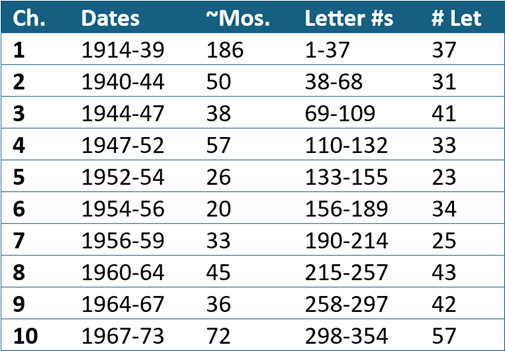
Before launching into the full Voyant Voyage, though, some of the work is done by old-fashioned counting and spreadsheeting. As the document is nearly a quarter-million words, I wanted to create a relatively even spread of the letters rather than setting out a set of periods ahead of time (e.g., WWI, Leeds, early Oxford, etc.). I divided the doc into ten chapters, each about 1/10th of the volume. Then I did a letter count:

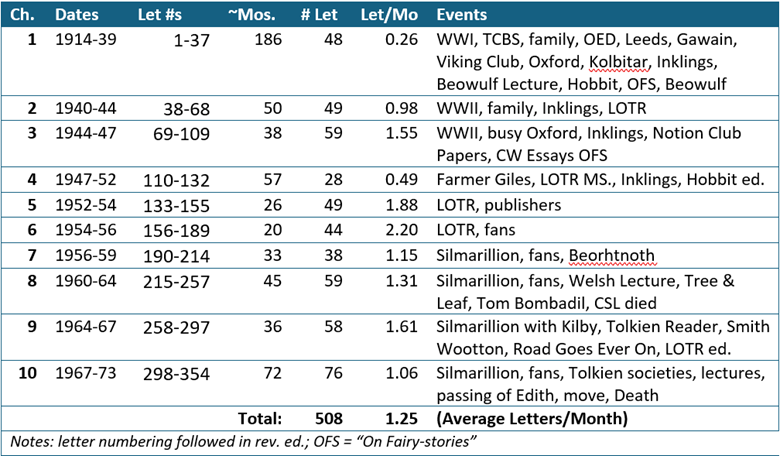
The more complex version of this chart is hard to show on WordPress, but I was able to make a compressed chart that connects the letters to the major moments of Tolkien’s life:

I understand that my list of events is not going to be helpful for everyone, but the frame is there for you to play with.

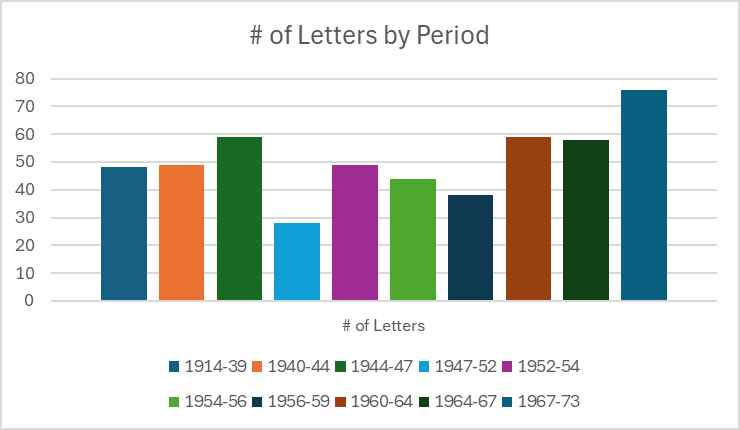
When I did the math, I was suddenly struck by how few letters we have. Take a look at a graphic of the letters in each period:

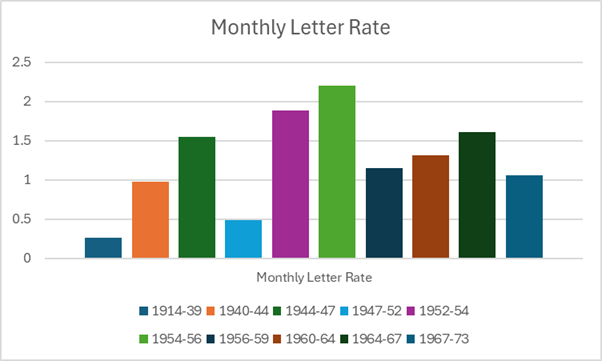
In Period 1, 1914-39, we have an average of 1 letter for every 4 months of life! Even in the periods where we have the most letters, we are only getting 1 or 2 letters a month—during an age where letter-writing was part of everyday life. Flipping the phrase, I made a graph of monthly letter rate of what’s included in the volume:

Conclusion: We have so few of Tolkien’s letters! While the letters of figures like Dorothy L. Sayers, C.S. Lewis, and T.S. Eliot are carefully edited for public consumption, the vast bulk of Tolkien’s correspondence is either in archives or no longer extant.

Voyant Tools I Can’t Show on WordPress

Still, we have what we have, so back to Voyant. Before a deeper dive into relational connections in Part 2, I wanted to note some things I can’t show from Voyant’s platform (at least, with this version of WordPress).

This tool is called “Loom.” It shows thousands of significant words in their woven reality (occurrences graphed across the 10 sections). On the left, there is a rolling word alphabetical selection tool, which allows you to highlight the words you are looking for. I love this—though I don’t know if it shows me anything new, except that a fresh way of looking at things always helps me make new connections.

The Textual Arc tool is so dynamic I cannot even show it, but I think we can use our imaginations about the Word Bubble feature. The app plays the major unique words through the text, while the common word bubbles move and float according to linked significances. It is a dynamic tool you need a lot of time to read.  

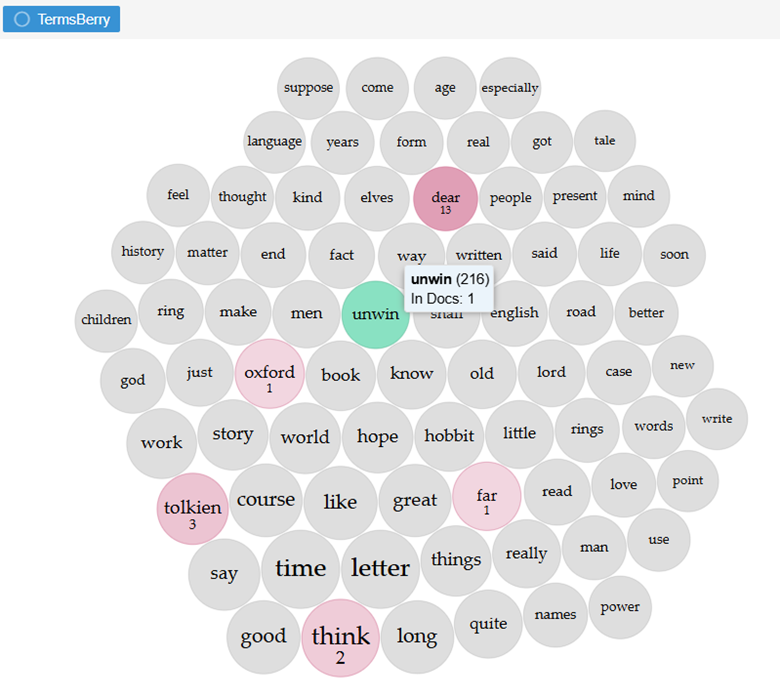
A more linear tool is TermsBerry, showing the most popular words and revealing usage and ngram data (links between the words).

I didn’t understand the significance of the “Knots” tool, but if you want to watch slow hypnotic movements on your screen, try it out. “Mandala” and “MicroSearch” are better for comparing documents.

For the new user, though, most of the most essential tools are set up for you when you add your first text.

On this main page, we have the Cirrus Word Cloud creator (top left), a Reader that allows you to tap a word and show its trendline (top middle), the Trends of featured words (top right), the document Summary (bottom left), and a Contexts/Bubblelines/Collocates tab, which I have set to Bubblelines (bottom right).

Until Next Week

Next week, I will share Part 2 of “Voyaging with Voyant in Tolkien’s Expanded Letters,” focussed on Tolkien’s Relationships. Before stepping back, though, a couple of fun notes.

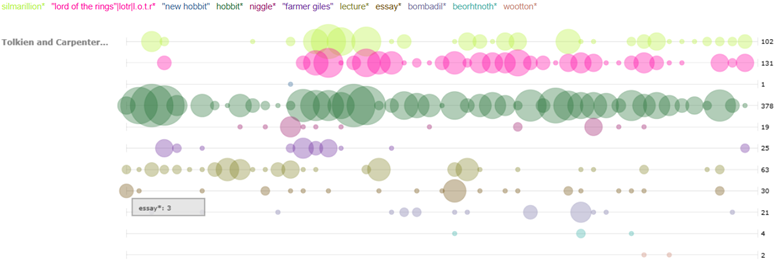
I fed the Bubbleline visualization tool some of Tolkien’s major projects. I added the words “lecture*” and “essay*” to compare the way Tolkien thinks about his Oxford University work over against his “secret vice” of language invention, poetry, and mythopoeic storytelling. The distinctions made me smile: Notice how intensely interested Tolkien is in his correspondence about the Middle-Earth legendarium—Silmarillion, Lord of the Rings, Hobbit—and other fictional bits of fancy. While the letters are far too limited to draw deeper conclusions, I feel like this chart is visually representative of reality.

The Topics tool is one that I’m still playing with, but I can see some intriguing possibilities. The Topics tool analyzes the text and selects related terms into various … well, various colours, as far as I can see. Calling them “topics” is a bit allusive and elusive to me … I can almost see the links, but not quite–and yet, they do feel connected in some ways to me. Very aethereal. I could increase the words and make fewer topics, but it goes some direction towards a user-guided topic or sentiment analysis.

Because of its ridiculous length, I’ll leave this strange list of repeating phrases at the bottom. “Count” means how many times that exact phrase appears. “Length” has to do with the length of the phrase. “Trend” multiplies the two to calculate a relative power, I guess. It is cool that these 17-word fragments occur twice: “he that breaks a thing to find out what it is has left the path of wisdom” and “own skill in healing it shall not be so i myself will go to war to fall.” But a more personal one spoke to me: The 7-word message, “all the love of your own father” occurs six times, not including variants. The “Trend” setting calls attention to some endearing features but needs cleaning up. I’ve omitted the most boring phrases (i.e., addresses).

I am open to sharing the basic spreadsheets of my letter counts for you to do your own work or correct mine. Contact me by email if that would help you: junkola[at]gmail[dot]com.

TermCountLengthTrend
he that breaks a thing to find out what it is has left the path of wisdom2172
own skill in healing it shall not be so i myself will go to war to fall2172
i have only recently returned from convalescence after an operation and2112
lead us not into temptation but deliver us from evil2102
elves and men were called the children of god292
i am interested to hear what you say about292
i am sorry that i have not answered your292
of the sea on the shores of the world292
such a work as the lord of the rings292
those that like this kind of thing at all292
very best wishes yours sincerely j r r tolkien393
with best wishes yours sincerely j r r tolkien797
a stiff necked young philologist i did not282
am faced with much neglected work term begins282
as far as i can see i shall282
i am not at all happy about the282
i am not at all sure that it282
i am sorry that i have been so282
i am very grateful to you for the282
if i am ever to produce any more282
it is my birthday on jan 3rd and282
it was extremely kind of you to write282
nothing much has happened here since i wrote282
of all the companions save frodo and sam282
of celtic beauty intolerable to anglo saxons in282
on all copies of their edition sold and282
opinion that this mass of stuff is not282
over all title the lord of the rings282
shelob’s lair and the choices of master samwise282
surprising success of the lord of the rings282
thank you very much for your letter and282
the chronology of the second and third ages282
the lord of the rings and the silmarillion383
the lord of the rings as soon as282
the rawlinson and bosworth professorship of anglo saxon282
the revision of the lord of the rings282
the west shores of middle earth where they282
we do not know the original meaning of282
with very best wishes yours sincerely ronald tolkien282
yours sincerely j r r tolkien p.s i282
1953 i am sorry that i have272
a cosmogonical myth the music of the272
a small woodland glade filled with hemlocks272
about the name and inception of the272
ago i had a letter from a272
all the love of your own father676
as far as i can make out272
as far as the end of the272
burned pages of the book of mazarbul272
but as far as i can see272
but i shall not be able to272
dear mr unwin thank you for your272
elf friend and his sons isildur and272
have enjoyed the lord of the rings272
i am afraid that you may be272
i cannot think how i came to272
i do not really know what to272
i do not think that i should272
i have had no time at all272
i have not had a chance to272
i have received a copy of the272
i have to thank you for the272
i shall have a chance of seeing272
i should have liked to see it272
i will try and answer your questions272
i wonder how you are getting on272
ii of the lord of the rings272
iii the war of the ring or272
in the hearts of a race doomed272
in the lord of the rings i272
in the lord of the rings to272
it is very kind of you to272
it was very kind of you to272
legends of the first and second ages272
most westerly of all mortal lands and272
nice to have a letter from you272
october 1937 dear mr unwin thank you272
of chapter v riddles in the dark272
of sir gawain and the green knight575
of the lord of the rings i373
of the lord of the rings though272
of the lord of the rings was272
or it would not have been used272
takes place in the north west of272
thank you very much for your long272
the cats of queen berúthiel but i272
the horns of the rohirrim at cockcrow272
the sequel to the hobbit i have272
the small map part of the shire272
they are of course at liberty to272
thinking of you and praying for you272
to the lord of the rings i373
very much love from your own father373
were clad in a thick curling hair272
a long time since i wrote262
a new edition of the hobbit262
a piece of singular good fortune262
about the lord of the rings262
all i can say is that262
all the names that appear in262
all the same i do not262
and i do not think that262
and in any case i am262
and saw a good deal of262
and the l of the rings262
and the lord of the rings464
are on the whole a good262
as a matter of fact i262
as far as i am aware262
as far as i am concerned363
as far as my memory goes262
as soon as i can get363
beyond the circles of the world262
book ends with the destruction of262
but i am quite prepared to262
but i am sure you will262
but i could not get it262
but i do not believe that262
but i do not see how363
Posted in Original Research | Tagged , , , , , , , , , | 11 Comments

I Won A Teaching Award! The MacLauchlan Prize for Effective Writing

Dr. Brenton Dickieson, receiving an award from the Honourable Dr. Wade MacLaughlan, President Emeritus of UPEI

Hello friends, I’m proud to say that I was recently a recipient of the MacLauchlan Prize for Effective Writing at the University of Prince Edward Island (UPEI)! This award has categories for student writing in their courses, student writing in the larger community (like drama, editorials, professional writing, etc.), and a category for faculty and staff who teach writing in the classroom or in our Writing Centre. I was pleased to win the faculty prize.

The MacLauchlan Prize for Effective Writing is awarded to UPEI faculty and staff who have shown exceptional leadership in the development of writing among students. While I teach other writing-intensive courses, I was nominated for my work in our foundation-year “Inquiry Studies” course.

I believe that University should be an encounter with big ideas and other people. As an educator, I curate a classroom environment for transformational experiences.

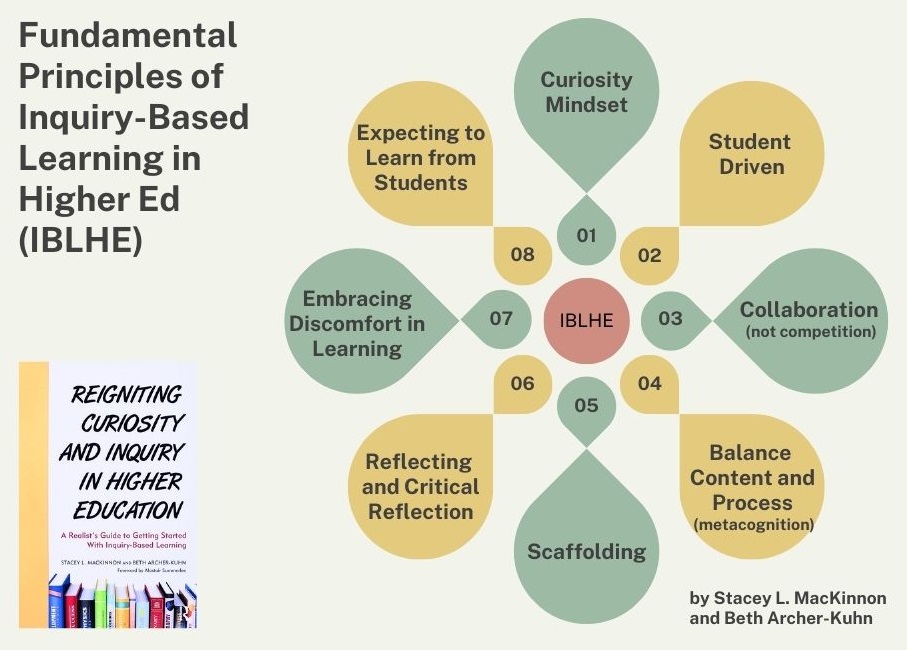
Our team at the Curiosity and Inquiry Research and Collaboration Lab (CIRCL) has developed an inquiry-based learning (IBL) framework for an experimental approach to teaching first-year critical thinking and writing. IBL reorients the roles of “teacher” and “student” by fostering a curiosity mindset through interactive, collaborative, and supportive student-centred learning. In this approach, we provide students with the opportunity, tools, and support to pose their own research questions, design their research methodologies, determine the best ways to share their learning, and reflect on the learning process. With the eight Fundamental Principles of IBL in Higher Education, we spend more time as teachers providing formative feedback, allowing us to teach “at the elbow,” resulting in greater differentiated learning opportunities in our increasingly diverse classrooms.

Besides the practical advantages of a student-centred, curiosity-driven model, IBL gives educators a tremendous amount of space to focus on our teaching strengths while getting support in our weaknesses. I love doing lectures and coming up with innovative ways to share content. However, by creating a culture of openness within the classroom where students are safe to explore and share, I have seen exponential growth in possibilities for student learning.

And I think the broader campus is starting to see the value of this approach.

The prize was founded by the Honourable Dr. Wade MacLauchlan, President Emeritus of UPEI, former Premier of Prince Edward Island, and recipient of the Order of Canada. The annual prizes recognize the importance of effective writing as a foundational skill for academic success and lifelong learning. The prize was established in 2011 by the MacLauchlan family to honour Wade MacLauchlan’s contributions to the University and his 12 years of service as president and vice-chancellor (from 1999-2011). Up to $30,000 are distributed annually in awards, which the guest speaker claimed was the most robust undergraduate prize of its kind in Canada.

That guest speaker was Paul MacNeill, publisher of community newspapers here in Prince Edward Island. He is an award-winning journalist (including Canada’s most prestigious award), and is a well know political commentator on CBC and other media. Paul never holds back, and he painted a stark view of press freedom and culture’s capacity for thinking with clear and logical approaches to well-established evidence. On a practical level, MacNeill said,

“The skills displayed will hold you, and our community, in good stead for many, many years to come. Use your writing skills to promote organizations you are involved with, write a letter to the editor, or a note of support to someone under troll attack on social media. . . . I’m not sure if the MacLauchlan family envisioned how important this prize would be in relation to the challenges we face today as a society. We are very fortunate it is here to challenge UPEI students because effective writing is a needed skill that will last your lifetime. Keep writing. Your words matter.

The family of Harry and Marjorie MacLauchlan created this substantial program of awards in order to encourage and recognize student writing achievement, and to honour H. Wade MacLauchlan’s 12 years of service as UPEI president and vice-chancellor. It is encouraging for me to be part of a cool initiative, even in a small way.

Posted in News & Links | Tagged , , , , , , , , , , | 28 Comments

Event Announcement: “C S Lewis: The Spiritual, Social, and Ethical Vision in his Life and Work” by the EICSP (Feb 12, 2025 at 2pm EST/7pm UK Time)

Dear Reader,

I am pleased to be part of a panel with the Edinburgh International Centre for Spirituality and Peace. The EICSP was founded in December 2007 to provide educational opportunities and an international forum for understanding, experiencing, and participating in the rich diversity of the world’s spiritual traditions. I will be speaking about “The Shape of C.S. Lewis’s Spiritual Imagination” with an intriguing combination of folks from England and North America, including Simon Barrow (the Chair), Ron Wheeler (JohnsonU), Jim Beitler (the Marion E. Wade Center, Wheaton), Elizabeth Drummond Young (the Centre for Open Learning, U Edinburgh), and Andrew Lazo (Northwind Seminary).

You can register for the live event here (by donation). The forum is about an hour of the panelist talks and then a dialogue with the audience. I have included the bios below, and I encourage you to check out the EICSP’s work.

I have been relatively busy of late, so I will update my own part in this forum when I firm up the details. I spoke last night for the New Glasgow, PEI, Women’s Institute on the topic of “Lucy Maud Montgomery: Pulling Back the Veil” as part of a series they are having for their 100th anniversary. I am also prepping for a “Theology on Tap” public talk (in a pub) on C.S. Lewis and Octavia Butler on indigenous spaces. I am teaching two great new local courses in Applied Communications, Leadership, and Culture at UPEI–one on Digital Humanities and one on Podcasting. I’m supervising a J.R.R. Tolkien MA thesis and second reading a BA Honours one while working on a chapter on Tolkien’s networks for an upcoming volume. As part of our local interdisciplinary courses, I am pinch-hitting on some Japanese history lectures. We are working to establish the Curiosity and Inquiry Research and Communications Lab (CIRCL) at UPEI, and I have a related chapter on Religious Studies and Inquiry-based Learning in its last stages. And … conference season ahead. And … I eagerly await the next stage of edits for my book in press with Oxford UP. Lots on the go!

Other news and details to come.

Best to you all,
Brenton

Online Zoom Forum: C S Lewis: The Spiritual, Social, and Ethical Vision in his Life and Work.

Date: Wednesday 12 February 2025.
Time: 7pm-9pm (UK time).

Description:

Format: There will be five talks, each of 12 minutes, followed by 20 minutes of discussion among the speakers and the chair, followed by Q & A.

Chair:

Simon Barrow:

Bio: Simon Barrow is a writer, commentator, educator and researcher with wide experience in politics, public issues, media, organisational change, ethics and religion/beliefs. He was director of the think-tank Ekklesia from 2005-2024. His book Britain Needs Change: The Politics of Hope and Labour’s Challenge, co-edited with Gerry Hassan, was published by Biteback in November 2024. His latest book is Beyond Our Means: Poetry, Prose and Blue Runes (Siglum, January 2025) and will be followed by Against the Religion of Power: Telling a Different Christian Story (Ekklesia Publishing, April 2025).

Speakers:

Prof Ron Wheeler:

Title: Reading The Screwtape Letters for Instruction in Practical Theology.

Description: In The Screwtape Letters, C. S. Lewis tackles some of the difficulties and distractions faced by the developing disciple of Jesus. To aid the transformation of Christ followers, Lewis addresses four questions: What is the nature of Reality? How do we develop as followers of Christ? What should we avoid as followers of Christ? What should we engage as followers of Christ?

Bio: Ronald E. Wheeler instructs students in composition and literature courses at Johnson University in Knoxville, Tennessee (fall 1977 to present). He also taught rhetorical studies for Tusculum College at the Knoxville campus (May 1995 through October 2006). He teaches an adult fellowship of readers at Woodlawn Christian Church. Ron and his wife, Martha, have two adult children, eight grandchildren, and one great-grandchild.

Prof Jim Beitler:

Title: Reading as a Spiritual Practice: Lessons from C.S. Lewis’s Library.

Description: This talk explores what C.S. Lewis’s notes in his books have to teach us about reading as a spiritual and ethical practice.

Bio: Jim Beitler is the Director of the Marion E. Wade Center and a Professor of English at Wheaton College, where he holds the Marion E. Wade Chair of Christian Thought. His scholarship focuses on the rhetoric of Christian witness and writing as a spiritual activity, looking to C.S. Lewis, Dorothy L. Sayers, Desmond Tutu, and other exemplary communicators as guides for faithful practice. Beitler is the author of three books—Charitable Writing: Cultivating Virtue Through Our Words (with Richard Hughes Gibson, 2020), Seasoned Speech: Rhetoric in the Life of the Church (2019), and Remaking Transitional Justice in the United States (2013)—and he teaches undergraduate courses on C.S. Lewis and J.R.R. Tolkien, Tolkien and Environmental Stewardship, and Christianity and Fantasy. He also serves as one of the hosts of the Wade Center Podcast.

Dr Elizabeth Drummond Young:

Title: Friendship and Faith.

Description: In this talk I look at CS Lewis’s assessment of friendship, and consider whether his views on this have any relationship with his personal faith journey from atheism to Christianity.

Bio: Elizabeth Drummond Young is a teaching fellow in philosophy at The University of Edinburgh (in the Centre for Open Learning). Her research interests include the contribution of women to philosophy in the 20th Century and the philosophy of religion. 

Dr Brenton Dickieson:

Bio: Besides teaching in the literature department at Signum University, Dr. Brenton Dickieson is Lecturer in Literature at The King’s College in New York City, Lecturer in Theology and Literature at Maritime Christian College in Charlottetown, Prince Edward Island, Sessional Instructor in the Centre for the Study of Christianity and Culture at the University of Prince Edward Island, and Instructor in Spiritual Theology at Regent College in Vancouver, BC. He also does freelance speaking and writing and is the author of the popular Faith, Fiction, and Fantasy blog http://www.aPilgrimInNarnia.com.

After completing a Masters degree in biblical literature at Regent College, Brenton moved with his wife Kerry and his son Nicolas to their native home in Charlottetown, PEI to teach and write. His academic interests include how the creation of fictional universes helps in spiritual formation, theological exploration, and cultural criticism. He has recently completed a PhD at the University of Chester, focusing his work on C.S. Lewis, J.R.R. Tolkien, and the Inklings.

The Rev Andrew Lazo:

Bio: The Rev. Andrew Lazo is an internationally-known speaker and writer specializing in C.S. Lewis and the Inklings. Andrew earned his Masters in Modern British Literature from Rice University where he was a Jacob K. Javits fellow in the Humanities. He is a frequent speaker around the U.S. and U.K. and has written several articles on C.S. Lewis and J.R.R. Tolkien. In 2009, Andrew published Mere Christians: Inspiring Encounters with C.S. Lewis. In 2014 he also was honored to transcribe, edit, and publish a previously unknown book by C.S. Lewis, “Early Prose Joy,” which was Lewis’s very first spiritual autobiography. For ten years he taught English and C. S. Lewis at St. Thomas and  Houston Christian High Schools. in Houston.

After finishing studies for an M. Div. (with Honors) at Virginia Theological Seminary in Alexandria, VA in May 2022, Andrew was ordained a priest in the Episcopal Church in January 2023 and serves as the Apprentice Rector at Church of the Messiah in Winter Garden, FL. He is also pursuing his doctorate in Romantic Theology at Northwind Seminary, where he serves as a Distinguished Lecturer. Andrew is married to author and speaker Dr Christin Ditchfield Lazo.

For more than fifteen years, Andrew has been working on a long-awaited study of Till We Have Faces, making groundbreaking discoveries all along the way. The results of his ongoing research have led him to give talks to the Mythopoeic Society in 2016 as Scholar Guest of Honor; in the summer of 2017, Andrew served as a plenary speaker at the C.S. Lewis Foundation’s 2017 Summer Institute in Oxford and Cambridge.

Posted in News & Links | Tagged , , , , , , , , , , , | 5 Comments

The Crowded Skyscape of the Modern Mind: An Oxford Tale

In Mary Poppins’ London, chimneys puncture the skyscape like fenceposts on an English hill. New York’s skyline shattered in our imagination as this 21st century began, and still, the skyscrapers crowd together as if protecting Lady Liberty from the sea. We know Chicago’s lakeside shadow too, though it is acres of suburban clusters in neat little spirals linked with old West grids that organize the eye when flying above. In Paris the Eiffel Tower is the vertical axis of both geography and culture, as are the towers of Seattle, Toronto, and Dubai. Even here in quaint Charlottetown, the spires of St. Dunstan’s arise from the city, like three hands reaching for the heavens.  

Oxford’s legendary skyline is a human way to paint the sky. In a poem to a lost friend, Matthew Arnold begins, 

“How changed is here each spot man makes or fills!” 

It is certainly true that human beings make and fill. Naturally, we shape nature, but then we fill it full to bursting with us, from “The village street its haunted mansion lacks” to “the roofs the twisted chimney-stacks.” 

In this way, Arnold walks us into Oxford: 

Runs it not here, the track by Childsworth Farm, 
Past the high wood, to where the elm-tree crowns 
The hill behind whose ridge the sunset flames? 
The signal-elm, that looks on Ilsley Downs, 
The Vale, the three lone weirs, the youthful Thames?— 
This winter-eve is warm,
Humid the air! leafless, yet soft as spring, 
The tender purple spray on copse and briers! 
And that sweet city with her dreaming spires, 
She needs not June for beauty’s heightening, . . . (“Thyrsis,” Selection, 153) 

Arnold’s patriotic plan for changing “each spot” with human making and filling has, at times, been horrifying in its presumptions and results. However, there is a reason that his phrase “dreaming spires” seems exactly right. Glimmering steeples, ancient towers, and lanterned domes stand guard over a medieval city in the air. Like stalagmites with vertigo, Oxford’s steeples and pinnacles and gargoyle-guarded cathedral girding have grown with the ages. The skyline is peopled with the ghosts of a Gothic era that Oxford never quite leaves behind. As (now) Dr. Emilie Noteboom said when I first put feet to cobblestones, in Oxford, you must look up. 

360 Virtual Tour of Oxford by Circus

I don’t know whether Oxford’s dreaming spires are swords of civilization raised in triumph or candles of the penitent trimmed by the gods, but it fills me with imaginative delight every time. I miss it now. 

Even in a city of a million peaks and a hundred churches, Oxford’s Christ Church Cathedral is not forgotten. Though the current building is much newer—built in the last part of the 1100s—it is on the traditional site of St. Frideswide priory and a Saxon cemetery. It is a mixture of Norman and Gothic architecture; its cruciform (cross-shaped) stone walls are the foundation for its great hexagonal spire. If you look up at the crossing at the centre of the church, the ribbed vaulted ceiling seems to be in motion, rising up into the central tower. At least, that’s how it felt to me as I followed Emilie’s advice to lift up my eyes in Oxford. 

This tower, the church’s ten-petalled rose window, and the Great Quadrangle have shaped and continue to shape Oxford’s visual culture. As a place dedicated to learning and worship, the architects of Oxford structured their spaces in the form of the cross.  

But it took me longer to discern another essential feature of Oxford’s literary and spiritual architecture. It began on a Sunday morning.

Depending on your view, I was either very late for the 8:00 Eucharist or very early for the 10:00 Matins. Like a character from Dorothy L. SayersGaudy Night, the Christ Church porter had one of those bored, “another uninformed American tourist” look on his face as I hesitated. It was 8:50, and I had an hour to kill.  

Instead of loitering in the Quad under the porter’s disapproving eye, I found my way to Starbucks on Oxford’s busy Cornmarket Street. In one of the odd synchronicities of life—the saints call this “providence,” and the novelists call it “realism”—Dr. Laura Smit, an American theologian whose work I had read, walked into the coffee shop and said, “You’re Brenton Dickieson, aren’t you?” I was, and still am, and admitted as much. So we had coffee together.  

As it turns out, Laura was also early for Matins at Christ Church. I now had a guide to the world of High Anglican liturgy, a sacred multi-sensory space where the body engages in worship as the mind finds the words. It is a world very foreign to me, but one that echoes the pattern of the universe where Word becomes Flesh.  

And in another incarnation where the digital becomes analog, I had a friend at Christ Church. 

Oxonians believe that in order to explore the multiverse of human and divine knowledge, one needs both space and beauty. The beauty of Oxford’s architecture is enough to break your heart, and I knew that about Europe even before I landed. I even know about the shape of the cross in Oxford’s design. 

What I wasn’t expecting was the need for “wasted space,” which in Christian tradition is sacred space. 

By its very architecture, Christ Church draws the heart to centre and the eye to the ceiling. The Great Quadrangle, the Tom Quad, is also cruciform. The perfectly manicured lawn and paths crossing centre and circling the perimeter create the shape of a Celtic cross from the sky.  

In the famous fountain at the crossing stands the messenger of the gods, Hermes or Mercury, known in the Ransom Cycle universe as Viritrilbia. I don’t know if Mercury is singing odes to the gods, or raising his fist to the sky against them, or ready to launch off to lead heaven himself. I’ve never been able to get my mind around Mercury. 

As the porter had directed us, the Cathedral sits at one corner of the Quad. It isn’t often that beauty catches my breath, but this was one moment. From the dark hallway and checkerboard pavingstones, the walk into Christ Church’s marble arches gave the illusion of eternity—or perhaps was meant to give a hint of the reality beyond time and space.  

How can I describe this sanctuary? Apostolic scenes in hardwood, columns holding the weight of millennia, an altar of gold, stained glass stories tucked into the transepts—there are times when it is best to point to a digital panorama rather than try to do justice to the aesthetics.  

I trip across John Locke’s memorial stone on the floor as the pipe organ fills even the spiderweb rafters with sound. We sit on crushed velvet cushions, softer than the severe wooden pews that were designed to keep one’s mind and morals as straight as Renaissance spines. I do not know if the Bible is resting on a golden eagle or phoenix—each with its own mythic significance—but Scripture is not just for reading in the service. It reverberates in song as the boys’ choir rises to chants, hymns, and the call-and-response pattern that shapes the rhythms of both the body and the spirit.  

The scriptures are read, and we kneel. The gospel message and the stories of the saints are evoked in prayer. Song and story, voices and movement, the liturgy becomes one of those incarnations where spirit becomes flesh. While I imagine that I am inhabiting the church, it is that sacred space that is making its home in me. Even for those who come to church in the silence in between these services, the story is told in stained glass, moulded wood, and chiselled stone

And for those who have eyes to see and ears to hear, the story resonates in the wasted space. Silence, stillness, white space, unfilled margins, form without function, hollow shadowy regions far beyond our reach—Oxford’s theological design is both a fulfillment of and a resistance to Matthew Arnold’s description of the human vocation:  

“How changed is here each spot man makes or fills!” 

We make and fill. But even in these spots made by human hands—the untrod grass of scholarly quadrangles and the empty rafters of cruciform churches—we do not fill out all the spaces, as is our wont. While wasted space is an ugly blot in our technoculturally designed urban landscapes of map and mind, Oxford reminds us that we cannot—we must not—fill every space with our human making.

We must leave room for something else.  

Visual artists know the value of negative space. Filmmakers and preachers know the value of silence and stillness as much as they know light and motion. But when our making is economically refined and utilitarian, architects can get lost in filling space rather than shaping our experience of otherness in the unused, unknown, unseen, and unusable parts of the places we inhabit. Architects create emptiness as much as space to be filled.  

Writers, too, have a tendency to forget that not every vessel is made to be filled. My teaching partner, Ryan Drew, shared with me the word “skeuomorph” last night. Literally “a transformed vessel,” the word refers to the transformation of meaning that the vessel carries when it moves past its prime technological usage. Corinthian columns are rarely load-bearing anymore, and the chandelier in my dining room has electric lights in the shape of candle flames. Words can transform this way, too. “Digital” rarely refers to our fingers these days any more than the symbol for a phone has much connection to the dynamic computers we carry in our pockets and purses. Indeed, how often do we use our computers to compute? 

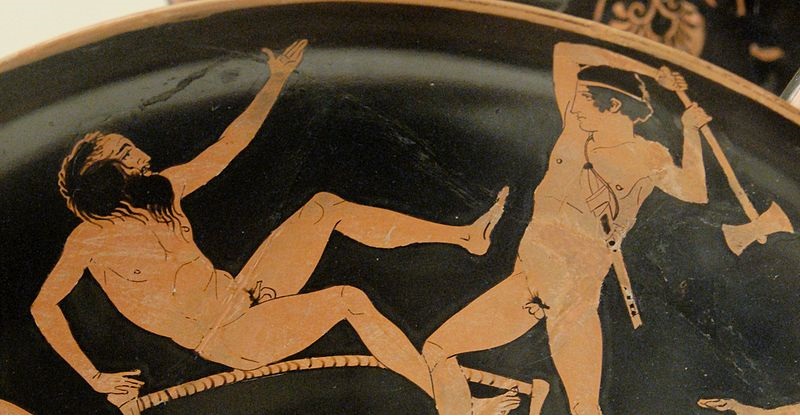
Mythological Detail on Greek Pottery

The word also reminds me that ornamental vases are never made to do what functional vases are manufactured for. So, while the vessel does not carry flowers or flour, water or wine, it still carries meaning. In its wasted space, it carries beauty.

To be a potter is to shape empty spaces. Some of these empty spaces we fill and empty, again and again. And some remain in that realm of what we call a waste, a lack, negative space. 

Our social imaginary—the way we collectively visualize our beliefs about what is real and possible—biases us toward usefulness. My Scottish-PEI cultural background demands usefulness. But the empty vase reminds us of St. Paul’s lesson about the artist and the clay: 

“When a potter throws a vessel on his wheel, who is to say except the potter himself whether he forms the lump of clay into something glorious or humble?” (Romans 9:21, BUV*) 

Potter’s Wheel image by Ami Looper

Even though I learned it a decade ago, I have forgotten this lesson. Like how the empty spots on my bookshelf magically fill with books, I unreflectively fill the wasted spaces of my day. In the fifteen-minute transition times, I slam off a few emails to save time later. I feel my ears with podcasts or audiobooks at every moment I’m away from a screen. I eat my breakfast while editing this draft. I am restless and always moving. The idea of jail terrifies me because there is nothing to do, nothing to read. Even to sleep, I must go through a series of mental exercises. Sleep has become hard work rather than meaningful, life-enriching, soul-filling wasted space. 

It is no wonder that I find it hard to discover meaning. The ideas come more slowly, and the aha! moment is rare. Prayers rarely happen to me by accident. I never finish the poems I start on scraps of paper or in my journal. Reading is my everyday work, but it is also my delight and my vocation. I stare endlessly at the screen and then struggle to keep my eyes pinned to pages I yearn to read. 

Though I am in the publication phase of a book on the cruciform—The Shape of the Cross in C.S. Lewis’s Spiritual Imagination—I have forgotten the other part of Oxford’s theological design: Wasted space is essential to intellectual, social, and spiritual transformation. 

Matthew Arnold captured something with his description of Oxford’s “dreaming spires.” He reminds us to look up. And he is right that as makers, we humans are also fillers of the spaces we make.  

However, in reclaiming the sacredness of wasted space, I am resisting his empire-building, fill-in-all-the-spaces vision of the world.  

Most of all, though, I am choosing to leave room in my crowded mind for the unusual, the unexpected, the unnecessary, the unbidden, the intangible, the ignoble, the uncomfortable, the impossible, and the Other. I need room to breathe, to dream, to look up. I need once again to become an architect of wasted space in my life.

*BUV: Brenton’s Unauthorized Version 

Note: A previous version of this piece put Sulva as the Mercury figure in the Ransom Cycle; truly, it is Viritrilbia, and I even made a handy “Planet Narnia Chart” so I wouldn’t forget. Ah well, it’s a very mercurial figure in all worlds.

Posted in Reflections | Tagged , , , , , , , , , , | 11 Comments