
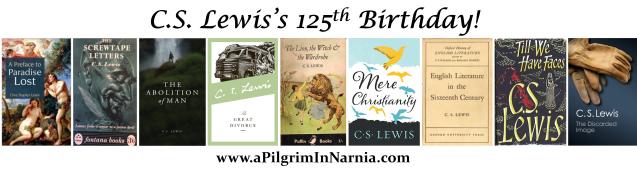
“It’s my 125th birthday!” C.S. Lewis might cry out in celebration to a gathering of a few dozen of his closest friends. If he could have lived until he was 125, that is. And if he was a rather remarkable hobbit.
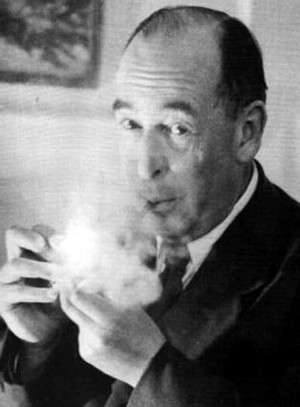
Though hobbits were scarce in Oxfordshire in the 20th century, Lewis shared with them a ruddy, brusque cheerfulness and love of homely things. And like Bilbo, Lewis combined a Tookish and a Bagginsish side. Lewis was an adventurous scholar and playful traditionalist whose life and work were the bringing together of word and image, reason and imagination, realism and the fantastic, love and loss, death and resurrection. Indeed, I believe that because he recognized the new life principle in the character of God and the patterns of creation, he was able to have a healthy view of death, loss, and self-giving love. The epic journey from Good Friday to Easter Sunday absolutely fills the landscape of Lewis’ creative writing in every mode: poetry, fairy tales, speculative fiction, literary history, cultural criticism, and theological reflection.
What do you get such a remarkable man of contrasts and possibilities for his 125th birthday? As there is no common etiquette for quasquicentenniality in the days since the longlivers have left our shores, I thought I would give C.S. Lewis readers the gift of some of my favourite writings about Lewis on A Pilgrim in Narnia. It is C.S. Lewis reading day, after all!
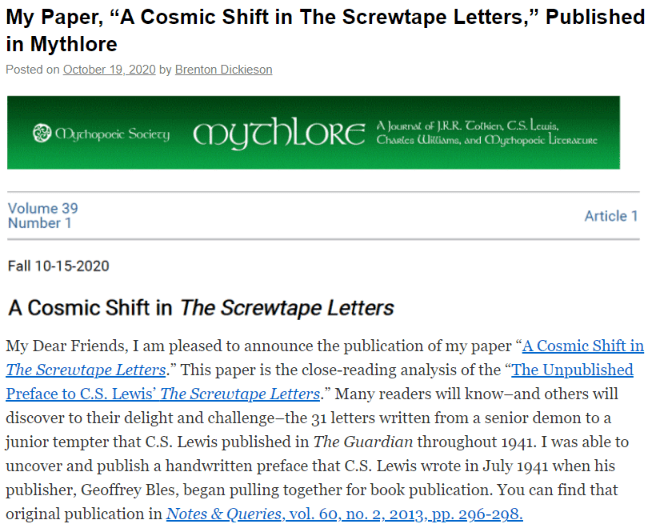
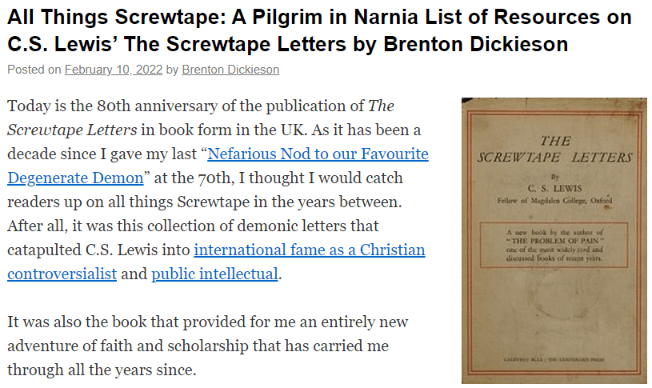
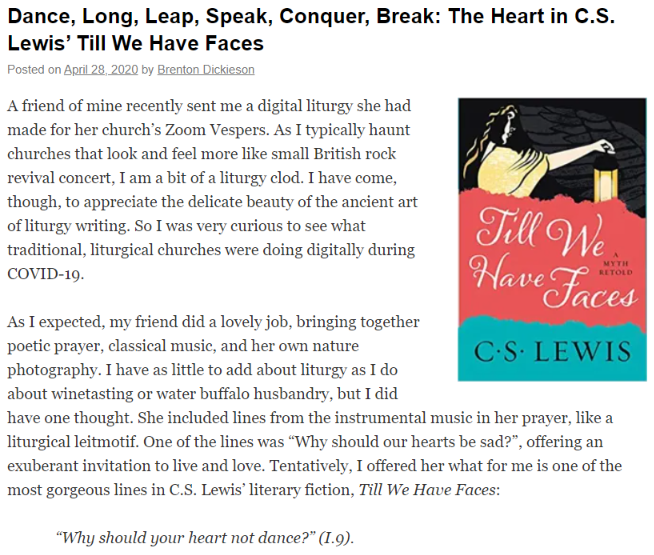
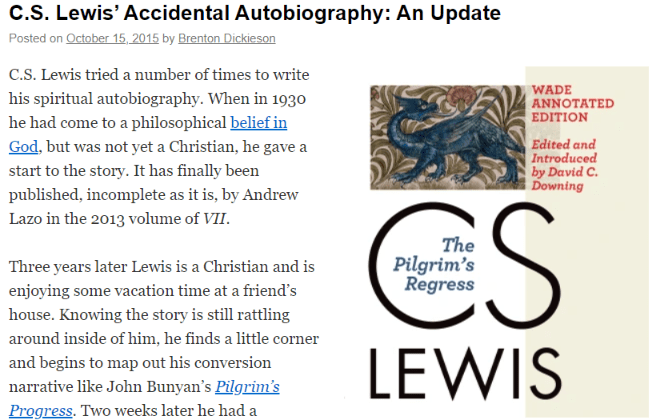
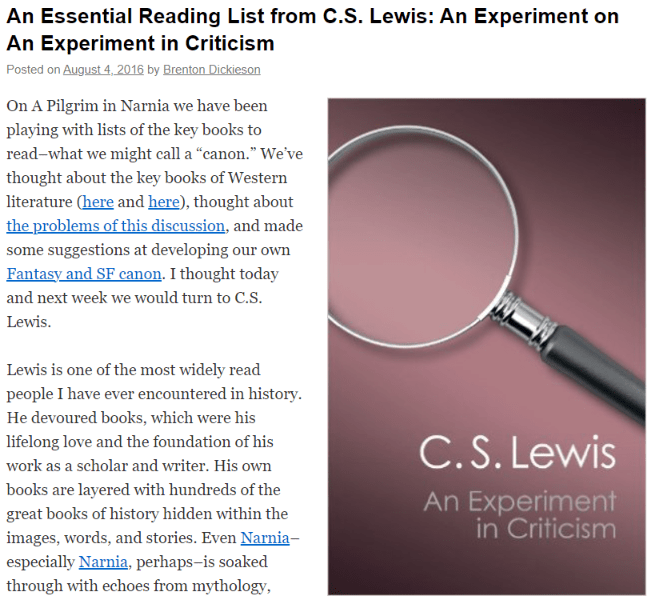
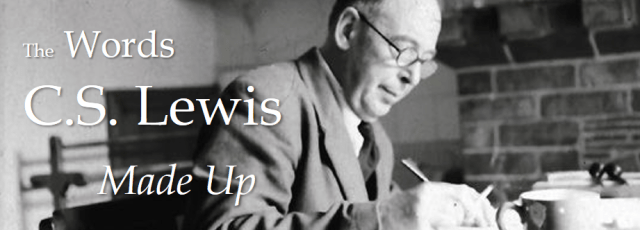
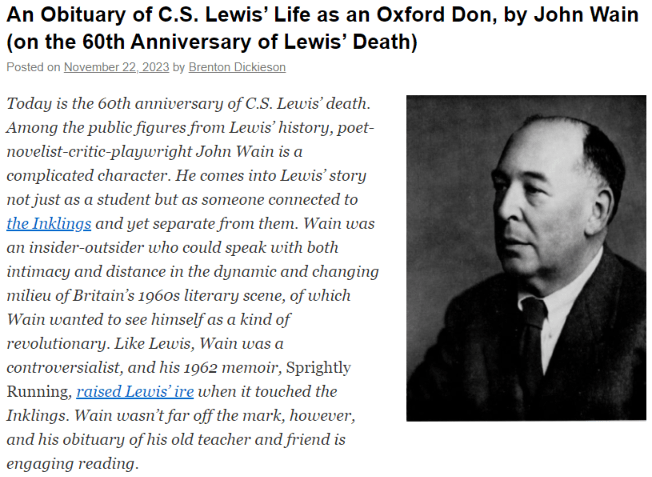
Some of these are my most popular essays and blog posts, but a couple of them are things I wrote that I still have fond feelings about, even if few noticed them at the time. Click on the snippet, and it should take you there. In any case, be well, read with wonder, and share generously.




 A Pilgrim in Narnia
Happy 125th, old friend!
LikeLike
Thank you for this! I was just about to start rereading The Great Divorce in case I could get to a discussion group about it in a week or so – without a thought of What Day It Was!
We had a friend who got to be at least 107, who enjoyed catching a bus to go shopping, and once scared off a burglar at well over 100! What might another 47 years of Lewis have been like, and produced?
LikeLike
Well, 47 more years … 30 more books!
LikeLike
Wow – but something a bit like it could well be! I’ve encountered various active older scholars and writers, one way and another. A.G. Dickens, for instance, was 78 when I interviewed him for the Wade Oral History Collection about Lewis’s teaching political philosophy to history students (Lewis on Lenin’s State and Revolution!), while Martin Lings was 81 when he visited The Kilns, talked to the Lewis Society, and I interviewed him. And Barbara Reynolds lived to 100, and the latest book listed in her Wikipedia article, Petrarch : The Forgotten Genius, appeared in 2009 when she would have been 94 or 95!
LikeLike
Reynolds and Barfield really pushed the marker for late-in-life work!
LikeLike
Indeed!
LikeLike
I’m currently enjoying Bruce Marshall’s Father Malachy’s Miracle (published in 1931 by Heinemann, who published Spirits in Bondage) – albeit in Dutch translation, having enjoyed a couple other of his books already in English (including his Yeo-Thomas biography, The White Rabbit), but somehow never noticed he was about half-a-year younger than Lewis, apparently published his first book in 1918, and like Lewis lived to a couple days short of his next birthday – but in his case that would have been his 88th, with his last book appearing posthumously the next year: a 70-year publishing period!
I don’t immediately find a reference to him by Lewis (or Warnie), but have not searched very far, yet. Father Malachy’s Miracle is fascinating to compare and contrast with Williams’s novels of the same period, and has a passing remark which reminds me of Sarah Smith of Golder Green (!)
LikeLiked by 1 person
That’s lovely. I finished the Lord Peter Wimsey stories by Dorothy Sayers, and turned to the Jill Paton Walsh continuation, which has been good. I wonder, sometimes, if Walsh was making links to Lewis that would make sense to those fictional worlds, but I can’t really know for sure. It’s just a feeling, but she did her England 1936-53 research well.
LikeLike
Dorothy Sayers is coming to mind, too, as I read Bruce Marshall (not least in the tart treatment of newspapers, for example, since it had been “four months since a lady typist had flown the Atlantic, the miracle, as far as the journalists were concerned, had fallen as manna upon a sensationless world”!).
We’ve enjoyed the Jill Paton Walsh continuations, also as Edward Petherbridge audiobooks!
LikeLiked by 1 person
Speaking of Barfield, I see from the forthcoming-books section of the latest Dutch Tolkien Society magazine this listed for March 2024 (from Routledge):
Jeffrey Hipolito, A Study of Owen Barfield’s Poetry, Drama, and Fiction: Rider on Pegasus
LikeLiked by 1 person
Barfield Studies are kind of heating up.
LikeLike