
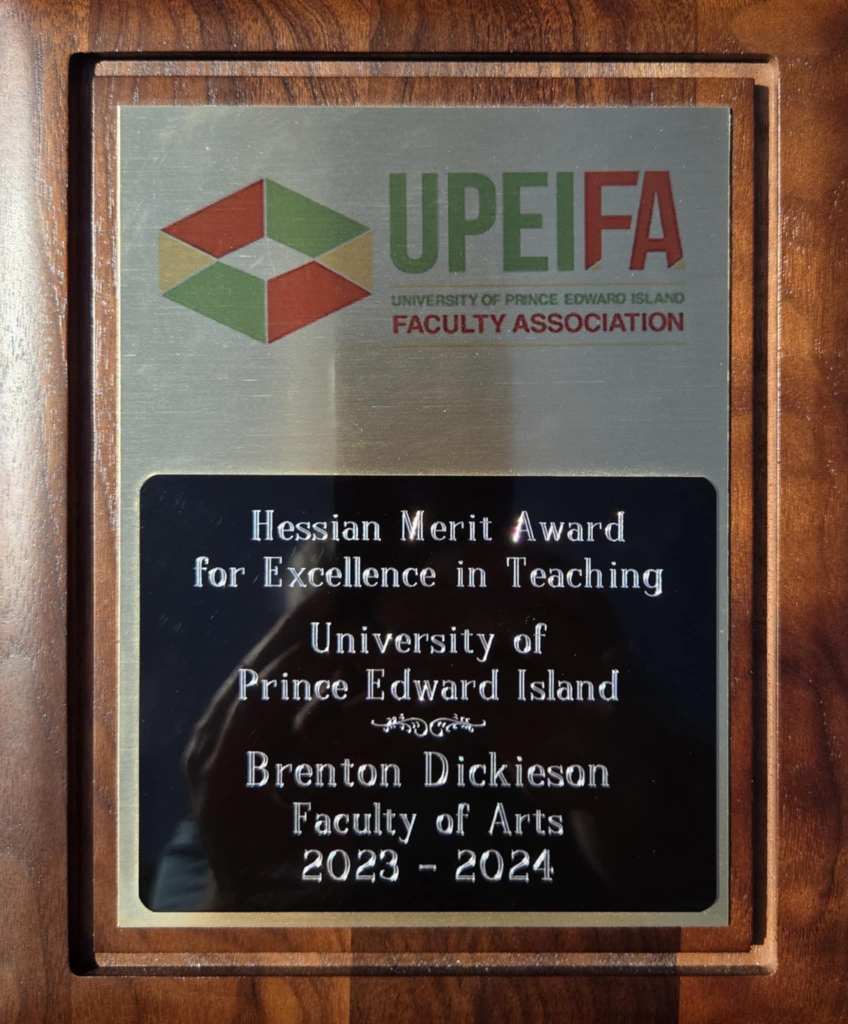
I am at one of these professional moments where I am thinking about what I believe are, for me, the essential values, methods, and attitudes of an educator. My Teaching and Research Dossier is dozens of pages, but it is also a living document, always growing and moving. At the centre of this mammoth document is my Statement of Teaching Philosophy, which I am retooling now. As I read my own dossier, I see that I have some news that I had not shared with you, dear readers.
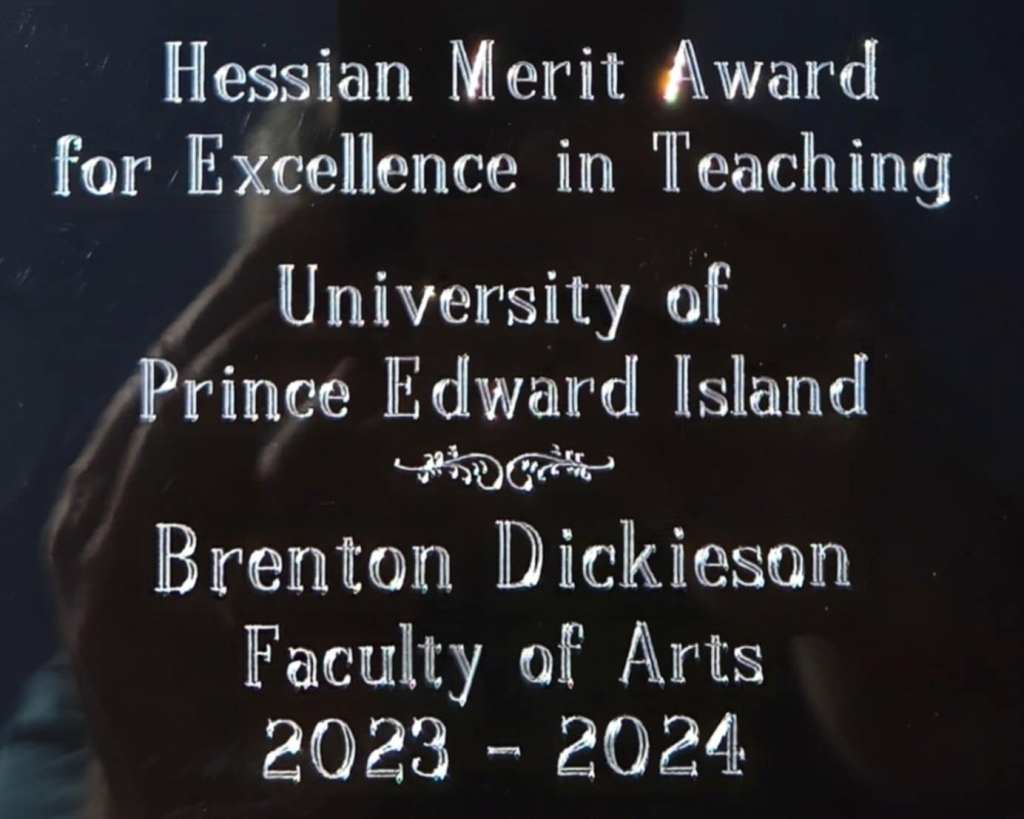
I won the Teacher of the Year award! This Hessian Teaching Award is of a different weight than the specialized teaching award from earlier this year, the MacLauchlan Prize for Effective Writing. Graciously provided by the Hessian family, the UPEI Faculty Association chooses research, service, and teaching awards–including one dedicated to sessional lectures (contract faculty, what you might call adjuncts).
I was pleased to be nominated and thrilled to win.
Apparantly, though, I wasn’t quite as motivated to share the story. This award is actually from the previous school year. If I could blame it on humility, I would. Rather, I’ve celebrated my other awards, like the Elizabeth R. Epperly Award for Outstanding Early Career Paper (see what I did there?). Somehow, though, after a wonderful evening with colleagues and friends–and a lovely spread of Prince Edward Island edibles–I kind of forgot about it.
So, here I am telling you all: I won one of the Prof of the Year awards last year!
While sharing this news is cool enough to warrant its own post, I thought I would also share excerpts from my Statement of Teaching Philosophy. The voice of this version is for a Canadian public university setting. I have left out some aspects of the Philosophy about which I am actively doing research and writing, such as Authentic Intelligence in the Age of AI (noted here), Equity, Diversity, and Inclusion (EDI), Indegeneity and the University Curriculum, and much of what I would say about Inquiry-Based Learning in Higher Education, which I talked about last week. I have also left out references to most inside-voice dialogues within the schools I teach in, and added a few pics and links.
The Statement is a two-dimensional document meant to capture the three-dimensional reality of teaching. Still, I hope this gives a hint of what I am thinking about as someone who loves teaching and learning.
Best to all,
Brenton
Teaching Philosophy
Teaching as Student Care
I love lecturing. The lecture-preparation process disciplines my mind to concentrate on the key elements of the lesson and the learning needs of the students. Even as doubts began to haunt my mind about the efficacy of “the lecture” as the prime meridian of higher education methodology, my relentless pursuit of innovating teaching methods worked to enhance, diversify, and fill out my lecturing style. All the while, though, my doubts increased.
And through it all, I could never shake the memory of a twenty-minute walk with a Newfoundland lad when I was an undergraduate student. In the summer before my senior year, I was part of a large team of students working in a small Newfoundland town. That summer, I was a guitarist in a music team, a camp counsellor, and youth teacher under the leadership of other students, the producer and lead writer of a twelve-episode children’s television series, Patches and Friends.
That summer, I met a ten-year-old camper whose home did not have electricity. He was crawling the walls at camp, so a director asked me to take him for a walk. Excited for the opportunity, he squeezed his shoes onto his feet, leaving the clay-caked laces to click along the deck boards. When we stopped at a picnic table, I decided to teach him how to tie his shoes. It only took twenty minutes, but no one had ever taken that time with him before. After that discovery of the essentials of human learning–relationships–why would I ever have confidence in a sole expert-at-the-front-disseminating-data model of an educator? It could be that the most intensive and effective educational moment of that boy’s life happened outside of the camp curriculum with a few moments of adult attention.
I have never thought that humans were disembodied minds needing a data update. Why would my teaching style treat them that way? Moreover, every one of my students is carrying around at least one all-the-information-in-the-world machine—a cell phone, tablet, or computer. So why would I prioritize data transfer as a teacher in the Age of AI?
I have come to believe that, contrary to what culture teaches us, the people I work with are not at heart analysts, teachers, researchers, workers, and students. People are primarily people. Students are not lines in a spreadsheet. They are not their student numbers. I have seen the limited results of treating workers and students as cogs in some social or institutional machine. Instead of continuing this modern fantasy of learning automation and social efficiency, I have come to believe that education is not an input:output data processing challenge. Education is an encounter with other human beings in the world. Education can only ever take place in the meaningful connections we have with one another.
Myriad experiences have confirmed my belief that, ultimately, teaching is student care. All aspects of scholarship begin with the respect I have for the dignity of individual students and an awareness of the deeply personal journey they are on.
The implications of this pedagogical starting point are intriguing. Indeed, this Statement of Teaching Philosophy is a brief mind map of the consequences of a student-centred approach to higher education. Seeing students as primarily people has provided opportunities for student care and collegiality that extend my work as a classroom teacher and allow me to learn from my students as we explore great and troubling questions together.
Curiosity about the human-learning process drives all of my teaching and research, my engagement with diverse kinds of students, and the traditional and innovative ways I design my curricula.
The Classroom as Space for Transformational Experience
If teaching is student care, what do we do in the classroom?
I believe that University should be an encounter with ideas, tools for discovery, and other people. As an educator, I curate a classroom environment for transformational experiences. My key pedagogical frameworks keep moving out from this point. As educators talk about “flipping the classroom,” there is a battle in the world of pedagogy between philosophies of outcome-based education and student-centred approaches. There is also an emerging tension between the University as a protected space for critical inquiry and the University as a job preparation tool. I do not believe that these philosophies of education are either universally applicable or diametrically opposed. Different courses and programs will have different outcome requirements and explorative opportunities.
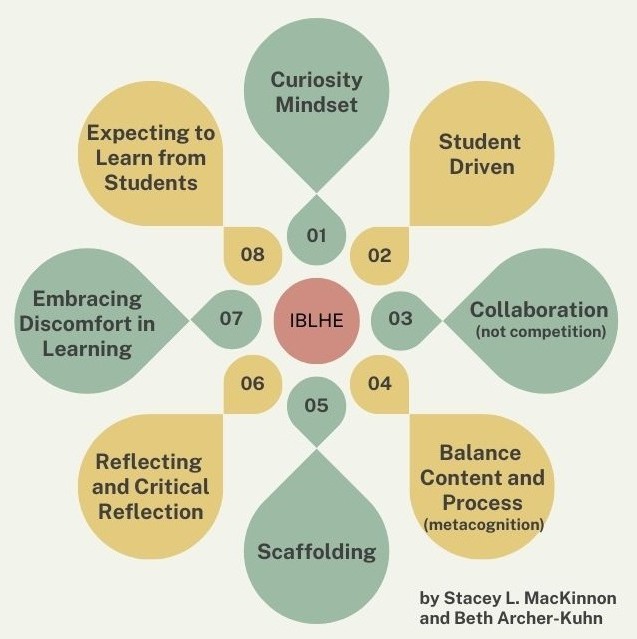
Out of both my pedagogical principles and my observations of the craft of teaching, I have discovered an Inquiry-based Learning in Higher Education (IBL-ED) approach, which I talked about in the chapter that I posted about last week. IBL-HE reorients the roles of “teacher” and “student” by fostering a curiosity mindset through interactive, collaborative, and supportive student-centred learning. In this approach, we provide students with the opportunity, tools, and support to pose their own research questions, design their research methodologies, determine the best ways to share their learning, and reflect on the learning process. We spend more time as teachers providing formative feedback, allowing us to teach “at the elbow,” resulting in greater differentiated learning opportunities in our increasingly diverse classrooms.
Discovering this framework was, for me, like seeing my philosophy of education captured in a Table of Contents.
Critical Thinking and Inquiry
I have worked hard to engender good student-teacher relationships by being awake to their ways of learning and place in life. With student experience at the centre of my teaching, I intentionally create an atmosphere of “critical empathy” in the classroom. Students are invited to ask any question, knowing they do so within an ongoing personal conversation with colleagues, with the professor, and with the material. The study of literature—reading texts together—is ideal for developing the twin skills of critical thinking and inquiry, and my approach to teaching religious studies and philosophy is also question-driven. We want to give our students the space to learn how to ask the right questions and think through the great problems of human experience.
Throughout the past two years, there has been a good deal of panic about GenAI and education. Instead of running from the question, we integrated the personal and professional questions of the cultural moment in a way that was relevant to our course goals: equipping students to think and write critically, holistically, and empathically by using the tools of informed inquiry. We engage with big questions like “What is AI?” and “Is AI Possible,” combined with technical writing and research tutorials and discussions like “Mis/Dis/Malinformation” or “Are They Lying to Me?”
“Critical Thinking” has become a bit of a buzz term. To disarm the entropic effect of an essential skill, we use curiosity, differentiated learning, and metacognition to help students think creatively and critically. We trust that thinking critically will follow, even without the trademarked capital letters.
The Classroom Space and Vocational Development for a Dynamic Job Market

There is a lot of discussion today about the university’s role in shaping students for their work-life. This is a discussion that I have been a part of in my role as a university teacher, government researcher and policy writer, and student vocational counsellor—and as a student for most of my adult life. We are in a time of great change as the university is being redefined and the global marketplace continues to evolve. This change has only increased as we have opened the “classroom” to digital spaces during the ongoing COVID-19 crisis and the emergence of GenAI.
As much as the world around is in a period of accelerated transition, students themselves are also in a period of vast changes and development—perhaps changing even faster than our hyper-speed culture. While a university education should excel at discipline-specific and interdisciplinary preparation, our teaching should meet students in the midst of their life journeys. The classical idea of vocation—a sense of calling—can inform our conversations with students as we create classroom space where they can explore who they are, where they fit in the world, and what roles they want to fulfill in personal, family, work, and community life.
It is, perhaps, easy to forget that university is “real life” to our students, not just a preparation for real life. Post-graduation employment, career development, and success in community leadership depend on the critical thinking, research and writing, oral communications, and literacy skills we provide them in the classroom. However, this happens not merely in the skills we teach, but in our ability to provide a context where students can consciously shape their learning towards becoming successful leaders in the workforce. I aim to effectively use curiosity-based approaches that are open to a wide variety of project outcomes, and to focus essential skills development in ways that are most effective for developing life-integrated competencies in leadership, communication, and critical thinking. From the very first day of class, I urge students to become pilots of their university experience by identifying the skills they are gaining and by seeking opportunities to enhance their education through work, research, and volunteering.
Multi-Modal Education for Critical Inquiry and Skill Development
Thinking vocationally and methodologically, different courses and programs will have different outcome requirements and explorative opportunities. Indeed, a multi-modal approach to education adapts ongoing exploration of critical ideas with both the tools and methods available and the intention of shaping students to be workplace engaged. The goal is to create an interactive atmosphere that identifies the skills a student can achieve in the classroom while protecting that space for being curious, exploring ideas, curating self-understanding, and thinking critically.
Indeed, those things are precisely the kinds of identifiable skills that employers require. When we combine the ideas of critical inquiry and learning goals, we can facilitate a student experience that allows learners to shape their own educational encounters. This student-driven and multi-model approach is, I believe, in continuity with classic Liberal Arts education where discussions of literature, history, and culture make the humanities an exciting and broad arena of discovery.
Therefore, I do not feel like it is my job merely to impart knowledge. I do impart knowledge, of course, and my students sometimes feel overwhelmed by the complexity of theoretical approaches, the breadth of ideas, or the depth of texts. But my key job is to impart enthusiasm, to excite the imagination, to awaken dreams, and to help students mine the great depths of the human story. Ideally, then, I do not teach classes; instead, I teach students, allowing them to shape their transformational experience as organically as possible while being true to the curriculum.
Teaching Methods
Besides the practical advantages of a student-centred, curiosity-driven model, IBL-HE gives educators a tremendous amount of space to focus on our teaching strengths while getting support for our weaknesses. I love doing lectures and coming up with innovative ways to share content. However, by creating a culture of openness within the classroom where students are safe to explore and share, I have seen exponential growth in possibilities for student learning.
Practically speaking, this philosophy of teaching means augmenting the lecture and discussion model I have inherited with other teaching methods. Education should be relevant, not just economically and vocationally, but also personally and culturally. I passionately believe that each coming generation—and the generations seem to shorten with time—is charged with the task of changing the world for the better. This seems like a grand statement, but each cohort of students really does stand on the edge of new worlds. The university is a place that shapes the potential of the generation that is before us.
Thus, I am constantly seeking to develop my teaching skills—whether I am providing feedback, developing systems of learning, mentoring students, or concentrating on certain ideas or skills. I demonstrate this by the numerous workshops and seminars I have attended or led. I also seek to expand students’ experience through a variety of teaching methods, including:
- Teacher led-discussion
- Professor or student debates
- Journaling, quick writes, mind-mapping, and other kinds of student response
- Team discussions and break-out group activities (often with a shared tablet, whiteboard, or poster-board paper and markers)
- Moodle discussion groups, blogs, wikis, glossaries, and video presentations
- Blogging and social media interaction (student and professor)
- Video and media integration, including YouTube tutorials, lecture supplements, course teasers, and “What’s Ahead” video correspondence
- Live-taped lectures in various settings to augment lecture ideas or stimulate discussion, such as Stonehenge, a monastery, a cemetery, etc.
- Class dramatic readings, monologues, and student improvised skits
- Close readings of texts, films, and artwork
- Improvised lectures from outlines designed to be responsive to at-the-moment student needs
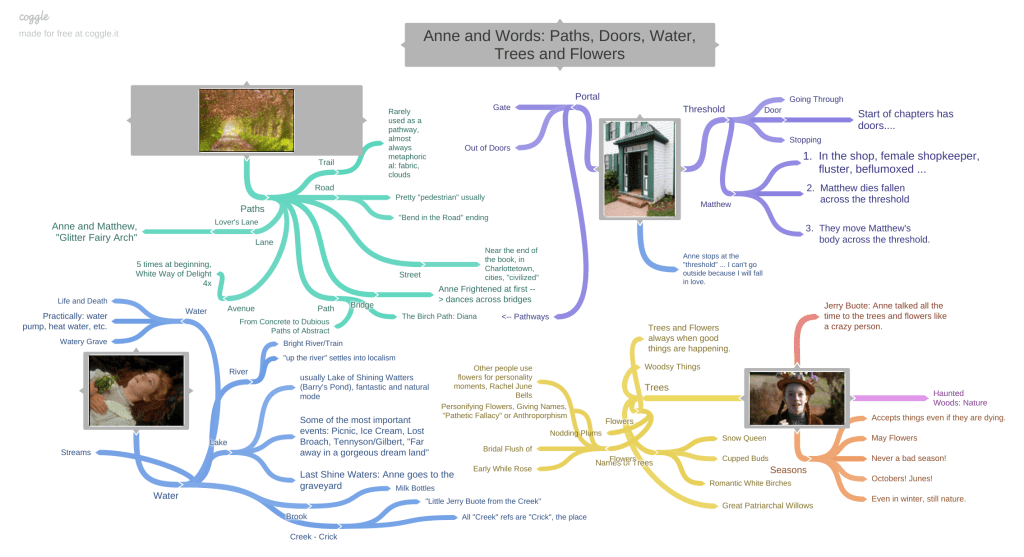
- Various design tools: PowerPoint, Google Slides, Prezi, Coggle, Blackboard Collab, Canva
- I have been working to provide certain students with an outline of the lecture so they can organize their thoughts and reduce anxiety
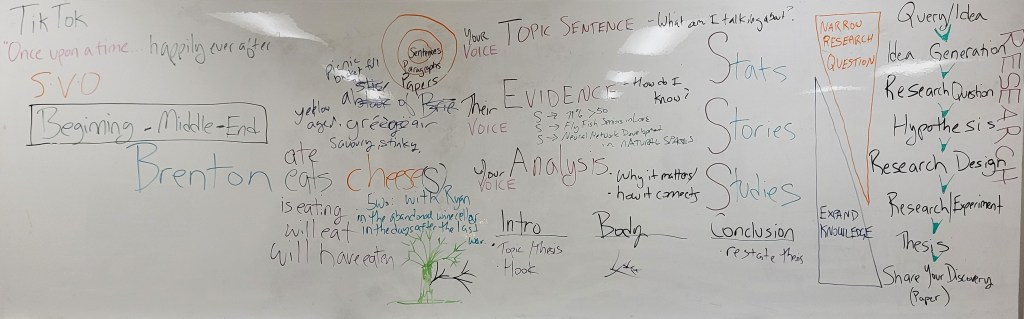
- I purchased my own vibrantly coloured whiteboard markers to enrich my sketchy whiteboard markings
- Thought-mapping, mind-mapping, and concept-map development as class exercises or material for lectures
- Dozens of kinds of team-teaching
- The use of various digital humanities tools, including Geographic Information Systems (GIS), AI experiments, and Digital Text analyses
- Poetic, fictional, and other arts-based responses
Online teaching enhances some of these methods, challenges others, and offers opportunities for refinement at every point. For me, the critical difference is intentionality: Is the online course intentionally designed for that medium, or are we doing remote emergency education?
In any setting, I continually seek to develop these methods and hone my skills as a communicator and facilitator of learning. As the ultimate goal is student engagement, I will experiment with almost any creative endeavour to draw the students into the material.
As an emerging scholar with significant experience, I am excited about the opportunities to integrate the oft-separated academic pillars of research, teaching, community outreach, and service. Any university education that does not weave those worlds together is, I think, missing the opportunity before them. My scholarship exists both in academic forums as well as in blogs, articles, editorials, interviews, guest lectures, and podcasts. In continuity with my philosophy of education, I have extended the classroom and the research process into the worlds of social media. I am actively engaged on social media, rooting the conversation to my popular blog on faith, fantasy, and fiction (www.aPilgrimInNarnia.com), and extending my work as host of the Maudcast: The Podcast of the L.M. Montgomery Institute.
Learning from Students about Learning
Admittedly, not every classroom experiment works swimmingly. For example, I was recently doing a section on FOMO: Fear of Missing Out. FOMO is a recent, in-vogue social quality that is usually connected to social media. As the students are much more connected to the digital social moment, I gave my planned lecture time to the class to teach me and one another what they know. I assigned a brief reading and then divided them into breakout groups with some discussion questions. Perhaps it was because of the time of year, or because they only pretended to prepare for class, but as each group was working to present their findings to the class as a whole, it was clear that they were not thinking about FOMO with any clear social media connections.
What should I do in the moment of a failed teaching activity? I could address the lack of preparation, or give them guidance to get back on track. Instead, I decided to follow their lead—as had intended. What resulted was a meaningful conversation about what it has been like for them to be immersed in school—sometimes continents away from home—and miss that stage of family life or fall out of step with their best friends from high school. Because I am open to learning from my students, even when in doubt, the “lecture” time was more intimate and valuable than what I had in mind.
Being willing to be a relevant, student-centred teacher requires active, ongoing attention to their learning and an ability to adapt quickly to changing environments.



 A Pilgrim in Narnia
Brenton, congratulations on the Hessian merit award! Even more so, congratulations and admiration for your Philosophy of Teaching! You are not only a gifted writer and researcher, but a top-notch pedagogue too – which is becoming an endemic today.
LikeLike
You are awesome Nikola!
LikeLike
Congratulations yet again! I enjoy very much reading your teaching philosophy thoughts. When I was young, my plan was to become a teacher; it was probably for the best that it didn’t work out that way, as I’m not sure I wouldn’t have become a tad insufferable to be around… In any case, I’m still interested in what teaching involves, and my oldest has just earned his Doctor of Musical Arts and is teaching at a small public university, so thinking about it in that context, too.
Dana
LikeLike
Most teachers are insufferable to someone in their class … sometimes in a loveable way, sometimes not. And sometimes teachers are pretty hard on spouses, but I hope not insufferable! Congrats to your son, very cool!
LikeLike
COngratulations
LikeLike
Thanks man!
LikeLike
Wonderful news, Brenton. (And unsurprising too, knowing how passionately you love your vocation!)
LikeLike
Thanks Rob!
LikeLike
Congratulations, so happy for you! Glad that you are recognized for all your hard work, and that you share your discoveries and thoughts here.
LikeLike
Hello! I just posted “Link Love” and mentioned your blog in it, at https://happilywriting.com/2025/07/25/link-love/ . Happy blogging! Ramona
LikeLike
I saw that, Ramona, super cool!
LikeLike
Pingback: The 2025 Mythopoeic Award Winners are Out! Tolkien’s Poetry, Urban Fantasy, and New Fiction - A Pilgrim in Narnia
Pingback: My New Role at the University of Prince Edward Island (or How to Beat the Summer Heat in the Land of Anne of Green Gables) - A Pilgrim in Narnia