That Awkward Conversation in the Face of Death

Like so many others before me, I spent my teenage years working in a pizza joint after school and on weekends. We were not well off, so if I wanted the things that mattered to me in high school—a car, date money, an occasional change of clothes—I had to work for it. Over my six or seven years slugging pizza, I met dozens of different people at various stages of their lives. Like me, they were tossing pizza dough and manning ovens and running little red-and-green-decaled Honda Civics around town to make sure people go their pizza fix. The place, the people, were formative in my teen years.

My pizza place job popped into my brain a while back. I walked into our faculty office at the university and saw one of those “Supporting Colleagues Through a Loss” kind of brochures. I’m not certain who had suffered a loss, of it was an employer-driven campaign of some time. But as someone who has had someone important die, the last thing I would want to see upon returning to work is a “How To” sheet left lying around the office.

I know, I know. It is always hard to know what to say at these kinds of times. Impossible really. But can a photocopied brochure really address the awkwardness that is our conversations after loss? The brochure at work suggested that instead of saying, “I know how you feel,” say, “I’m very sorry”—perhaps the lamest, least sentimental, most fully inauthentic advice I can imagine.

I remember when my father and brother died. Thousands lined up in the freezing Canadian February weather to give their condolences in the torturous East Coast ritual we call a “wake.” Each pink-cheeked and puffy-eyed mourner trudged through a greeting line in vinyl jackets and knit wool hats and limply shook my hand, mechanically repeating the phrase “I’m sorry for your loss” until I thought I could hear no more. And then we had casserole for lunch at some relative’s nearby home.

Don’t get me wrong—I appreciate that people wanted to connect with that moment. But at fourteen, I found it tremendously awkward. I still do, and I am somewhat relieved that my mother decided not to have a funeral.

Yet, I am exactly the same when it comes to other people’s loss. With each keenly felt death, I find myself doe-eyed and ineffectual when it comes to talking to the bereaved. In the awkward space where I am supposed to say something, I finally offer that weak handshake and grim smile of comfort. My only hope is that I will be either accidentally helpful or forgotten in the masses of mourners waiting to share their condolences.

I felt that painful nothing-to-say struggle for months after my own childhood tragedy. Consistently, teachers, neighbours, old people I didn’t know—they all had to say something “meaningful” to me. Typically, I grimaced shyly at them, hoping their condolences would stop, and they would find another victim to comfort.

All too often, I had to comfort them, for it was their friend or cousin or neighbour or student they had lost. It was an experience I absolutely hated, which may be why I am frozen with inaction when faced with a grieving friend or neighbour.

As I was reading through C.S. Lewis’s A Grief Observed, a journal of his thoughts and experiences in the months after the death of his wife, I discovered I was not the only one who felt that awkwardness keenly in a time of grief. In the journal, Lewis pours out his feelings into the pages, and we can feel the pain of his incisive self-reflection. He comments that he wants to talk to no one at all, but fears being alone—he simply can’t be satisfied. And when it comes to his wife’s children, he was at a loss:

I cannot talk to the children about her. The moment I try, there appears on their faces neither grief, nor love, nor fear, nor pity, but the most fatal of all non-conductors, embarrassment. They look as if I were committing an indecency. They are longing for me to stop. I felt just the same after my own mother’s death when my father mentioned her. I can’t blame them. It’s the way boys are (18).

celtic cross shoreSaying nothing doesn’t satisfy, yet there is nothing to say that works.

Lewis was on the receiving end of the awkwardness, and saw in the faces of the people around him.

It isn’t only the boys either. An odd byproduct of my loss is that I’m aware of being an embarrassment to everyone I meet. At work, at the club, in the street, I see people, as they approach me, trying to make up their minds whether they’ll ‘say something about it’ or not. I hate it if they do, and if they don’t. Some funk it altogether. R. has been avoiding me for a week. I like best the well brought-up young men, almost boys, who walk up to me as if I were a dentist, turn very red, get it over, and then edge away to the bar as quickly as they decently can. (18-19).

While he ends the passage with humour, he still feels the pain—only too evident in his final reflection of the paragraph:

Perhaps the bereaved ought to be isolated in special settlements like lepers (19).

by C.S. Lewis, Signature Classic SeriesWhat has this to do with my brief career as a pizza maker? As I reflected on the brochure I found at work and thought about what I had read in Lewis’ journal, one of my pizzeria stories popped into my brain. I was sweeping the floor in a brief lull in the supper rush. I began a conversation with an older guy named Lole, who was busy chopping vegetables at the prep table. He began asking questions about my life—really personal questions. Though I thought he was weird, I didn’t mind so much. It was something to pass the time.

Eventually, he came to the inescapable question: what does your father do for a living? It had been months since Dad had died, and I was in this new job with people who mostly didn’t know my story. I felt I was in control of my emotions, and told him that he had died a year earlier. He had been a farmer. Lole stopped chopping his green peppers and looked at me with wide, sad eyes, his cleaver hanging limply beside his stained white apron. He took a moment to contemplate what I said, and then asked a crucial question: “how do you deal with that?”

I reeled backwards. How do I deal with it? I had quickly learned how to talk about the event of their death. I’ve spoken about it dozens of times in speeches and lectures and testimonies—it was easy for me. I found new friends, a new faith, new habits, big dreams, and a part-time job that filled voids that existed in my world. But I was startled by his question: no one had ever asked me that before, and I really had no idea how to answer it. Even now, two and a half decades later, I am still processing what the loss meant for me, and who my dad was, and how I deal with it. Emotionally, I no longer limp, or wince, but them-not-there is still present with me.

I later found out that Lole was a Pentecostal Christian, and if you know real life Pentecostals you know they have the peculiar ability to get to the heart of things so they can view a person’s spiritual life from the inside. In our further conversations, where I typically peppered him with theological questions he was entirely unequipped to answer, one time he asked me what I thought God was doing by allowing so much tragedy in my life—the kind of question strictly forbidden by the bereavement brochure I found at work.

I never answered him. I still don’t know the answer even as I am now grieving another essential loss. Coincidentally I am reading Job, which seems to me a book that spends 40 chapters of poetry asking that question and never managing to answer it.

Yet the question put me in mind of an event that occurred in that long wake line on that cold February afternoon way back when. I was standing next to my mother, who was burying her little boy. A woman, a nun I believe, reached out and said something absolutely shocking. She looked at my mother and spoke compassionately: “God must really care about you to give you so many troubles.”

I don’t remember Mom’s reaction—the whole event is fuzzy to me even now. It occurs to me know that I can never know. But what struck me about the nun’s comment was not the theological impact—I had no belief in God at the time. I wasn’t offended by the possibly crass or petty nature of what many would interpret as a facetious religious platitude. C.S. Lewis had experienced that himself and struck out at those who carelessly spoke in empty religious language:

…. don’t come talking to me about the consolations of religion or I shall suspect that you don’t understand (26).

And as I reflected on the nun’s comment, I certainly wasn’t fazed by the fact that she had broken rule #4 on the “Supporting Colleagues Through a Loss” talk sheet.

jesushugInstead, and here my experience was a little different than Lewis’, I was struck by the sheer authenticity of the moment. She spoke not out of bumper-sticker Jesus smiles or a trite washing out of emotion or out of a robotic cultural response to the awkward impossibility.

Instead, she spoke from her gut, a word that was warm and hard and would haunt me for decades. It may have done damage to my family, I don’t know. But for me it was a brief escape from the legions of undead condolences I had to face that day. Wake goers–and the bereaved–are the closest thing I’ve seen to zombies. At least, that’s how it feels.

And here was a real live person suddenly in front of me.

Now, what to do about that awkward silence in the face of death? My mother’s recent death after a fairly rapid descent means I am once again experience these sorts of conversations.

Now that I’ve sufficiently demonstrated myself as completely unsuitable to give advice on the matter, here is my version of the “Supporting Colleagues Through a Loss”. Be authentic. Be real. Be present. Don’t speak if you don’t have real words. And if you do speak, take courage, and make sure your word resonates with the spirit of the moment, and the Spirit’s voice in the colliding universes of grief we all experience. Consolation and advice and hope need not be hypocritical platitudes, after all.
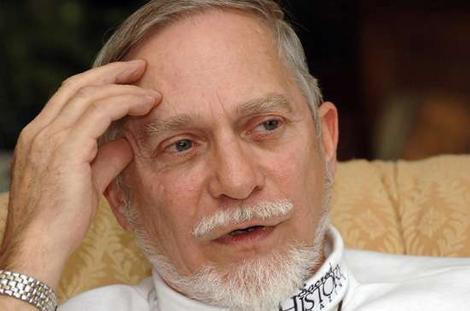
Stepson of C.S. Lewis; Introduction to "A Grief Observed"

Douglas Gresham, C.S. Lewis’ Stepson and the Son of Joy Davidman, Lewis’ wife who died

And you never know when you may have an effect, or that you may help someone—or yourself—see things from another angle. Writing the introduction to A Grief Observed, Douglas Gresham took the time to clear of something that is misunderstood in Lewis’ journals:

He did not understand, which was very unusual for him. I was fourteen when Mother died and the product of almost seven years of British Preparatory School indoctrination. The lesson I was most strongly taught throughout that time was that the most shameful thing that could happen to me would be to be reduced to tears in public. British boys don’t cry. But I knew that if Jack talked to me about Mother, I would weep uncontrollably and, worse still, so would he. This was the source of my embarrassment. It took me almost thirty years to learn how to cry without feeling ashamed (11).

The geography of the griever is complex terrain, often unexplored and misunderstood by the one grieving and the ones closest to him or her. So whatever your response is, let it be authentic.

And, finally, my last piece of advice, shake hands firmly. A grieving teenager who spends his weekends tossing pizzas would expect nothing less than a solid grip. Now, a full grown man with more knowledge but not much more wisdom, I still feel the same.

Posted in Reflections | Tagged , , , , , , , , | 28 Comments

The Haunting Death: Lewis, Buechner, and Me on the Loss of my Parents

Mom GraduationOn Friday, February 12th, I watched my mother finally succumb to cancer. She was only 61. In her death she taught me a great deal about how to live. You can read a brief story of her life here.

I am now an orphan, having lost my father in house fire in February 1990 (see my post here). I have written a lot during February, trying to process these events, but nothing that I have really been able to feel was complete. I keep coming back to this post–one of my first here on A Pilgrim in Narnia. Rereading it makes me wonder how I will be shaped over the next few years in my writing. 

Lewis in Letters

I’ve read, now, more than 3000 pages of C.S. Lewis’ letters. This is just a small slice of the letters that I’m sure he wrote in his life, but it is enough to begin to see patterns and to witness themes arising. In his younger letters, I see the pretentious teenage prig developing toward being C.S. Lewis, the eminent literary scholar. In his Letters to an American Lady, I see the other end of life, the finishing of a career, the failure of a body, the discovery and loss of love. As I come now to the end of his letters, I’ve come to understand C.S. Lewis more and more, finally finding a sense of the man through his pen.

What was surprising to me early on his letter-writing project–perhaps as far as his teen letters, and in his Letters to an American Lady, was how seldom he referred to is mother. Little “Jacksie” Lewis absolutely adored his “Mammy,” Flora Lewis, who died of cancer when he was just a little boy (about nine years old). She was the centre of all life and love and imagination for Lewis. She was very dear, so that much later, as Lewis reflects on the shape of his early life, he says of her:

With my mother’s death all settled happiness, all that was tranquil and reliable, disappeared from my life. There was to be much fun, many pleasures, many stabs of joy; but no more of the old security. It was sea and islands now; the great continent had sunk like Atlantis (Surprised by Joy, 7).

As his world shattered with the loss of his mother, his broken father retreated to a world of public service and work. Despite the lack of evidence in his letters, the abandonment of Lewis by his parents has had an enormous effect on his literature. Most of the children in his Narnia chronicles are orphaned: Eustace Scrubbs is abandoned to a vacuous self-centred education, the Pevensie children are sent to the country away from their parents to escape the bombing of London, and Prince Caspian is literally orphaned by his uncle, the usurper King Miraz.

The Orphan Motif in Literature

Certainly, the orphan motif is a strong one in English literature. Think of the orphans that we have collected in our literary imagination: Huck Finn, Anne of Green Gables, Jane Eyre, Heidi, Lemony Snicket’s unfortunate Baudillaire siblings, and the James of Giant Peach fame. Each of the books in Lois Lowry’s The Giver trilogy feature notable orphans of various kinds, and, curiously, Lowry spoofs the entire orphan-nanny motif in her 2008 book, The Willoughbys—see my here. As I think back to my own writing, I realize my children on the page are all in someway orphaned or abandoned.


harry and hermione emma watson daniel radcliffe
And who could forget the great orphan of the last generation, Harry Potter, the boy who lived, the orphan who was subjected to the cupboard under the stairs, and whose own boundless luck and stuttering humility is the deus ex machina of each book. The orphan motif is particularly strong for single mom J.K. Rowling, not just in Harry’s parents’ death—and the discovery and loss of a parent in Sirius Black—but all throughout the books. After all, it was Neville Longbottom, the hapless Hogwarts orphan who, all befuddlement aside, really saves the day. In the end, it isn’t so much that Neville takes his courage in both hands and faces evil as much as it is that he is mad that his parents are dead.

More than a Motif

With Lewis, though, I think there is more than a literary motif at play. Take, for example, the character of Digory Kirke. Like Lewis’ own story, Digory’s mother is dying, and he has begun losing her to the sickness even before death has come to take her away for good. As the story goes, Digory is drawn into the magical worlds of Narnia—or chased there by a self-centred uncle who had cursed his friend, Polly, into the dark unknown. United, Digory and Polly explore the Narnian gateway and land in a dead world. Despite objections from Polly, Digory rings literally a bell that cannot be unrung and raises the Satan character, Jadis, from her eternal nothingness. This act of curiosity unleashed a demonic power that follows them into the universes that contain Earth and the nascent Narnia.

Aslan, the melodic creator of Narnia, confronts Digory and gives him a chance to earn redemption. Digory’s mission is to sneak into a garden and take a magical apple that can right the great wrongs that he has wrought—unring the bell, so to speak. As he smells the fruit, the evil Jadis appears and consumes one of the apples, becoming immortal herself. Unlike Milton’s Adam and Eve, Digory is able to resist the temptation to eat the fruit. But there is a greater temptation that confronts the boy: Jadis promises him that if he takes the apple to his mother, her illness will be healed. Digory’s mother could live, if he will only disregard Aslan.

It is not difficult to imagine that, for the orphaned fifty-year-old Lewis writing The Magician’s Nephew, that Digory’s situation is the ultimate mental temptation. Would Lewis bring his mother back to life if he could? Given the outcome of Digory’s story, it is hard to imagine he wouldn’t.

Given the great weight that her life and death had on him, mention of Lewis’ mother is conspicuously absent in his early letters. Truly, it isn’t until Lewis’s father dies (when Lewis is 30) that Flora Lewis returns as a character in the correspondence—a full two decades after her death.

Thinking about the un-self-reflective power that Lewis’ mother’s death had on his life and work, I am struck by the power that haunting death has for all of us who have lost a parent as children.

Frederick Buechner and His Father

I have set to reading Frederick Buechner’s memoirs again, a spiritual ritual I perform every two or three years. Many don’t know his work, but I have found both his own story and his unusual books to be transformational in my life.

Buechner had a happy, comfortable family life growing up, though he expresses a sense of displacement by the frequent moves he experienced as his father drifted from job to job. As his first memoir, The Sacred Journey, moves along, you can feel the haunting death gathering strength on the horizon of the narrative. An orphan story is building in the pages.

While “Freddy” Buechner was still just a boy, a little older than Lewis, Buechner’s father killed himself in their garage. A few days later, they found a suicide note written on the back page of a new novel, Gone With the Wind. It said, “I adore you, and I love you, and I am no good.” In his memoir, Buechner writes:

“For many years if anybody asked me how my father died, I would say “‘heart trouble.’”

It was true, after all.

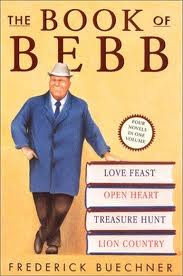
The fatherless theme emerges here and there in Buechner’s novels. It is prevalent in his brilliant tetralogy, The Book of Bebb—it might be that the whole Bebb series is a desperate groping for fathers–not just Anthony, the protagonist, but each of the men and women who find themselves around the conflicted Bebb.

I even see the parental death motif in his retelling of an old saint story, Godric, and Buechner admitted that The Return of Ansel Gibbs deals specifically with his father’s death in narrative form for the first time. Poignantly, though, the implications of his father’s suicide ebb and flow all throughout his four memoirs. Even now, halfway through Now and Then, his memoir on vocation, I can feel that storm of implication building in the storyline. And it isn’t until, after years of therapy and reflection, that he can write about his father directly:

My father was a fine swimmer and a wonderful dancer. He was at home everywhere, but in another sense, he had no private home inside of himself. Therefore, when trouble forced him home, there was nowhere to go. He had no home, or if he ever had one, he had forgotten the way to get there. I suppose he died of astonishment as much as anything else. Or perhaps it would be more precise to say he died of homesickness.

And I think that even such a self-reflective writer as Frederick Buechner would be astonished to really understand how important his father’s death is in his work, and how that haunting death visits every other literary world. Like his father, he too is looking for a home.

Does My Father’s Death Haunt Me Now?

Thinking of these two great writers, not to mention the Lois Lowrys and Jane Austens and Roald Dahls of our orphan literature heritage, I wonder how oblivious I have been to my own father’s death. He died when I was fourteen. Our home caught fire in the middle of the night, and Dad went into the burning house to get my little brother. I never saw either of them again.

I’ve told the story dozens of times. I’ve written about it, I’ve preached it. I’ve told the story with lights low and brought tears to the eyes of an enraptured audience. In my mind, I’ve been the master of the story.

But I wonder if the story has actually been mastering me. I wonder if my own dad’s death is haunting as it does in the literary tradition of Lewis and Buechner.

The thought occurred to me recently as I, for the first time ever, put together what my dad did that freezing, fateful night in February, 1990. I was reflecting on the work of John in the New Testament, and I realized that my father “laid down his life” for us, the greatest gift that a person could give (John 15:13). And in 1 John, the laying down of one’s life is both the evidence of true love and, significantly, an echo of what God has done in Christ. For John, God’s self-sacrificial love on the cross is the model of all love in every part of life.

It is no wonder that the gospel made sense to me, encountering the idea of the heavenly Father’s self-sacrificial love just a few months after my earthly father demonstrated the same.

celtic cross shoreIt seems obvious, doesn’t it?

Recently, I mentioned this connection to someone who has heard my story of the fire in one of my talks. For her the connection was obvious—she thought my talk was actually intending to draw the connection of self-sacrificial love out. Meanwhile, I was clueless.

The haunting death goes further. I’ve written two poems in my journal that parallel my father with God in the themes of love and absence. I’ve taught on the absurdity of self-death in Albert Camus’ work, most famously in his “The Myth of Sisyphus” essay. I’ve written an entire novel, The Drive, about self-death as represented in the metaphorical giving of one’s life to another and the literal decision to commit suicide. The children’s book I am shopping around, Hildamay Humphrey‘s Incredibly Boring Life, is an urban orphan tale turned on its head. This was happening so much I finally gave in and wrote a philosophical novella, “Wish for a Stone,” that was some attempt to struggle with the real questions I was asking.

It is even in my academic work. My first peer-reviewed academic article was on an emerging death cult out of Mexico, and the second was on the theme of dying to the self in C.S. Lewis. And, on top of all that, the work of Watchman Nee on the theme of Galatians 2:20 has been the preeminent reflection of my spirituality for two years now. What does Galatians 2:20 say?

“I have been crucified with Christ and I no longer live, but Christ lives in me. The life I now live in the body, I live by faith in the Son of God, who loved me and gave himself for me.” (Gal 2:20, NIV)

Could it be any more obvious?

But that is the nature of the haunting death. These themes emerge in our lives, unbidden, called by the echo of a forgotten voice, by the voice of those who have long ago left us behind. Yet, their voice lingers on in the poetic imagery and the living characters and mundane chores of our everyday lives. My father’s sacrifice is written all over my life. Buechner’s father’s suicide is spelled out on every page. And consciously or unconsciously, Flora Lewis’ death shaped the lives of those earliest pilgrims of Narnia.

Posted in Reflections, Reviews | Tagged , , , , , , , , , , , , , , , | 31 Comments

The Problem with Moralistic Art: A Note on the Expository Demon

­

An Empty Theatre Stage

I am not an avid theatre goer, but it is something I secretly love. Rather than the grand urban stages, I especially enjoy the small, intimate theatres that we have here in Atlantic Canada and tucked away in cities across the country. I like theatre because I like to see the seams in the costumes, the imperfection of story-in-flesh.

Theatre is the most incarnational of storied arts.

Over this past year I have seen 6 plays that have a moral message in them. It is very easy to critique evangelical filmmaking (see this great article here)—too easy, in fact. Even with the increase in technology, funding, and the elegance of videography, the kinds of movies my mother-in-law loves to bring home from the Christian bookstore are painful for me to watch.

blue like jazz don miller steve taylorAdmittedly, I enjoyed Moms’ Night Out when I was forced to watch it, and I loved Blue Like Jazz (I think Steve Taylor is a genius). But the Left Behind films are the poster boys of bad Christian art. Painful, and too easy to mock.

Because it is so easy to whitepaper Christian art, let me turn instead to other stories that emerge out of popular culture to talk about the problem with moralistic art.

These six plays were each designed to challenge an audience to think about environmental issues, immigration policy, aboriginal issues, and cultural diversity. Five of the plays were commissioned to tell this kind of story, while one is a popular published play. They were all performed on Canadian stages, though one is a British plays, and they have shown on many stages across the country. Each of them was well acted, and each featured with superb stage management and creative direction with minimalist staging. None were big productions, though they reached a large audience throughout their respective tours and runs.

From an audience perspective, the plays were filled with moments of great humour and great sadness. I laughed at times, and was sometimes very moved. I am grateful for the experience of being there, always just a few feet from the pain and problems the playwrights wanted to feature.

Of Other Worlds by CS LewisBut there was a problem. Of the 6 plays, 5 of them had moments where the message came to the forefront and the story or characters slipped into the background. Setting aside one self-deprecating short comedy, the other 5 plays each had moments of the thing that C.S. Lewis called “the expository demon”—the potential to bend the story into a philosophical dialogue. One of the reasons Lewis liked writing Narnia was that it slayed that demon, or at least kept it at bay. Even then, some readers of Narnia thought the message threated to outstrip the story. This is my concern with some of the plays I’ve seen over the last year.

Of these plays, about half of them used dialogue as a hammer, so that the characters in brief moments became embodied brochures. Honestly, 4 of them felt like very short versions of 1980s Billy Graham films, where there is a moment to repent at the end of the play.

Now, my concern is not the issues. These are things I’m passionate about. I very much want my culture to be challenged by environmental apathy, immigration access, and systemic cultural racism. I am not critiquing the ideas.

I am critiquing the art.

Let me highlight one of the plays, the one that I thought was artistically the best.

“Lungs” is a two-person play by Duncan Macmillan, and has been staged successfully many times throughout the world (see favourable reviews in the UK’s Guardian and Canada’s Chronicle-Herald).

It is filled with comedy, a couple who are thinking about their future together. The woman, a doctoral student, is passionate about environmental issues and is wondering whether it is ethical to have children in an age of carbon overload.

The actors that performed this piece did a phenomenal job. It is an intimate play, and I was so close that I felt each awkward moment with my own awkwardness, and each loving movement with my own empathy. Beautifully done.

But I think the play goes off the rails. As it comes to a close, the environmental problems in the background come to the forefront and frame the end-of-life experiences of the characters. The world around the characters falls into social apocalypse: smoke, sirens, noise, hatred, scarcity.

I’m not against apocalypse. I love stories that end badly, whether it is Flannery O’Conner or your Hollywood blockbuster.

Anthony Black Francine Deschepper lungs AntigonishBut this was a moment where the expository demon emerged. A great play—a brilliant play, really—went sideways, and the artfulness of the moment was lost as the narrative pixelated.

This is, I think, the problem of moralistic art: We don’t trust the stories to work as stories. We don’t trust images. We don’t trust movement.

We don’t trust anything except words.

As Walter Ong said, “the Word became flesh, and we made him word again.” We have a cultural tendency, when there is something important to talk about, to only trust the talk.

It’s too bad: a play is word in flesh, where the narrative is the most important thing. Plays and films can be powerful social transformation tools, but only if we forget they are tools.

Margaret Atwood Handmaid's TalePicasso once said that art is a lie that tells the truth. We are talking here about art with ideas. The activist playwrights are passionate about social issues and terrified about a future that ignores the problems. The Christian filmmakers have a story that they think will transform all things to the good and want to share that. So they use their art as storytellers to try and share what is essential to them.

But in doing so they often fail to trust the story.

There are some good storytellers that take ideas head on. Margaret Atwood as a feminist writer, C.S. Lewis retelling myths in Till We Have Faces, and Marilynne Robinson recasting biblical narratives are three that come to mind. But there is nothing worse than reading a book or watching a film and discovering that we were being used.

Can there be good moralistic art? Perhaps, but only if the art is first and the moral emerges naturally from the art. Stories rooted in meaning must look sideways at their subject matter. There needs to be a self-forgetfulness about art that is about something.

We must exorcise the expository demon.

Posted in Reflections | Tagged , , , , , , , , , , , , , , | 57 Comments

A Lenten Reading List by Warren Lewis

warren lewis brothers and friendsI have been slowly gathering a cobbled-together list of books that C.S. Lewis read during Lent. Part of the problem is that, due to the humble nature of Lent, one does not boast of one’s reading. I knew that he read Dorothy L. Sayers‘ The Man Born to be King leading up to each Easter, but I thought there could be more gems there for the rest of us.

As it turns out, another season of Lent has come upon us and I have not finished the list.

I did, however, run across a list in the diary of C.S. Lewis’ brother, Warren H. Lewis. The note suggests, I think, that Warren was feeling low at this time:

Monday 30th March (Easter Monday), 1959
Another Lent over, and I make a note of my doings; not as a Pharisee, but that if I am spared until Lent 1960, I may do better. (1). I was a teetoller, drank tea for breakfast, and had only bread and butter on Friday mornings. (2). I attended evensong on Sundays, in addition to my usual services….

Warren Lewis then sets out the books that he read in Lent 1959:

  1. J.B. Phillips’ Letters to Young Churches (1947, a modern translation of the New Testament letter, prefaced by C.S. Lewis)
  2. François Maruiac, Life of Jesus (1937)
  3. G.K. Chesterton, Everlasting Man (1925)
  4. F.W. Robertson, Sermons Preached at Brighton (1847-1853)
  5. Henry Latham, Pastor Pastorum: or, The Schooling of the Apostles by our Lord (1890)

I suspect this is a sufficiently different Lenten reading list from anything you’ve seen before! If Lent is a season for shaping, this list is certainly designed to do that.

Warren Lewis ends his diary entry like this:

And when set down, how trifling it all seems.

Posted in Reflections | Tagged , , , , , , , , , , , | 12 Comments

For My Mother

Mom GraduationJanet Norgrove (08/05/54-02/12/16)

Dear Friends,

If life is a journey, then Janet began by walking early.

Born in El Dorado, Saskatchewan as an only child, as a toddler she lived in Edmonton and Toronto, where her father was very ill. When he had learned to walk again after his illness, his job as a mining accountant took them across the country. She lived in Ontario, on the Prairies, in Newfoundland and in the North, where she summered on Great Bear Lake, in Echo Bay.

Janet attended a dozen schools in as many years, enjoying learning even if she never found it exceptionally challenging. Her father eventually died after a long decline when Janet was fifteen. After struggling with illness and the financial challenges that accompany them, Janet and her mother (Lucille, d. 2001) moved to Wilmington, Delaware.

For a moment Janet’s feet stilled and the journeys that opened up before her were of a different sort. She spent her high school years in Delaware, exploring ideas and developing her appetite for books—she was a voracious reader until the end. The late 1960s and early 1970s were exciting intellectual times and Janet cut her political teeth on the civil rights issues of the day. It cost her a bra or two in protest, but during this time Janet set a trajectory for the life of learning and public service that would define much of her work in the 1980s.

Wilmington was also where Janet began lifelong friendships. Guy and Dorothy Palandrani were at first neighbours, but their house soon became a second home. There, growing up with their children, Janet found new strengths—strengths that set her feet to journeying after an underwhelming semester at the University of Delaware. It was in the mildly Bohemian years that followed that she met Dana Dickieson in Hamilton, Ontario. He was the love of her life, and together they moved to his family farm in New Glasgow, Prince Edward Island.

Mom & Dad in field_editedJanet and Dana were married in 1974 and she took the world by storm. Janet began to get involved in the social issues in her community in creative ways. After attending the University of Prince Edward Island as a young mother (BBA, 1984), she turned to progressive politics. Janet was truly a trailblazer, helping to introduce the New Democratic Party to Islanders by running federally in 1984 and provincially in 1986. She was the first woman to run for the PEI NDP and was instrumental in changing the way Canadians understood their relationship with politics.

With the birth of William “Riel” Norgrove Dickieson in 1987, Janet turned from public life to a renewed engagement with the Island’s private sector. There was tragedy, then, that stilled all our feet. On a cold February day in 1990, with Tina and Brenton at each side, she buried her beloved Riel and Dana.

The road goes ever on, and after supporting her children through high school, Janet loaded up her little Dodge and went west. She finally settled in Calgary, where she spent much of the next decade as CEO of the Western Stock Growers. Her home in Calgary became a second space for both Tina and Brenton, who had made southern Alberta home for a little while.

The east called again. Brenton and his family returned to Charlottetown, PEI, and Janet settled in Antigonish, Nova Scotia. Soon Tina found her way there too, establishing a family of her own. Janet managed a prominent university research project, and created a community of friends and family – most important of these her two grandsons, Nicolas (age 11) and Hunter (15 months). These were strong years for our family, and once again Janet’s little apartment was a sanctuary, and included Janet’s daughter-in-law (Kerry) and son-in-law (Jerry).

For us children, and for others, Janet was the first feminist in our lives, the first teacher, a great risk-taker, a committed activist in whatever she chose to do. She was fierce in love and debate and friendship, able to carry a great weight of pain through her life and to finish that journey in a way that was a powerful testimony to everyone in her life. She faltered at times. Somehow, though, she found strength to continue on, often leading others on a path she did not know.

Cancer is its own journey, and sometimes a destination. Eventually, it was cancer that brought us all to Janet’s bedside at St. Martha’s hospital. We were celebrating, as we often did on a night when we could gather. We sprang for the $18 wine, this time, and local beer, and take-out that filled the ward with smells of garlic and curry. We tilted beer bottles and lifted wine glasses and paper cups to Janet’s life. And while we were celebrating, she tried to slip out without us noticing, journeying on to whatever comes next. It was her way, after all.

We are sad that we will not be able to journey with Janet anymore, but glad that she made the trip worth it, and was with us when she could.

Love,
Brenton and Tina

There will be a service for the family at a later date.

Posted in Reflections | Tagged , , , | 44 Comments