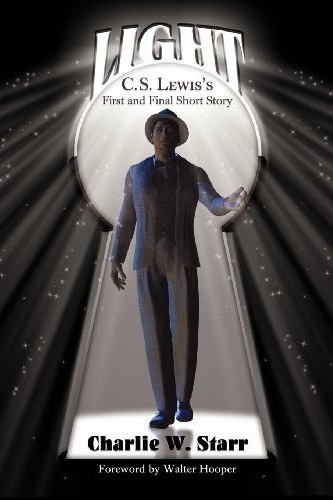
As I am between steps in the publication of a book about C.S. Lewis’s thought, I find myself coming back to my bookshelf with a bit of mental space. I have been following Charlie W. Starr’s work for almost as long as I have been blogging. I reviewed his ground-breaking book Light: C.S. Lewis’s First and Final Short Story, which launched his Lewis Handwriting Chart (LHC). Light and the LHC seemed to come at exactly the right time for me, and I tested out his in the archives over the next few years. In “What Art is For: With C.S. Lewis and Dr. Charlie Starr,” I had an opportunity to reflect upon what I am doing here on A Pilgrim in Narnia in dialogue with other artists-writers-critics. And as I talked about in my last post on “The Other Side of Screwtape,” I worked with him to publish an important piece of Lewis’s papers, the “Archangel Fragment.”
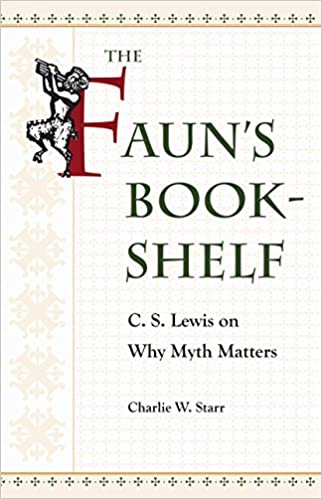
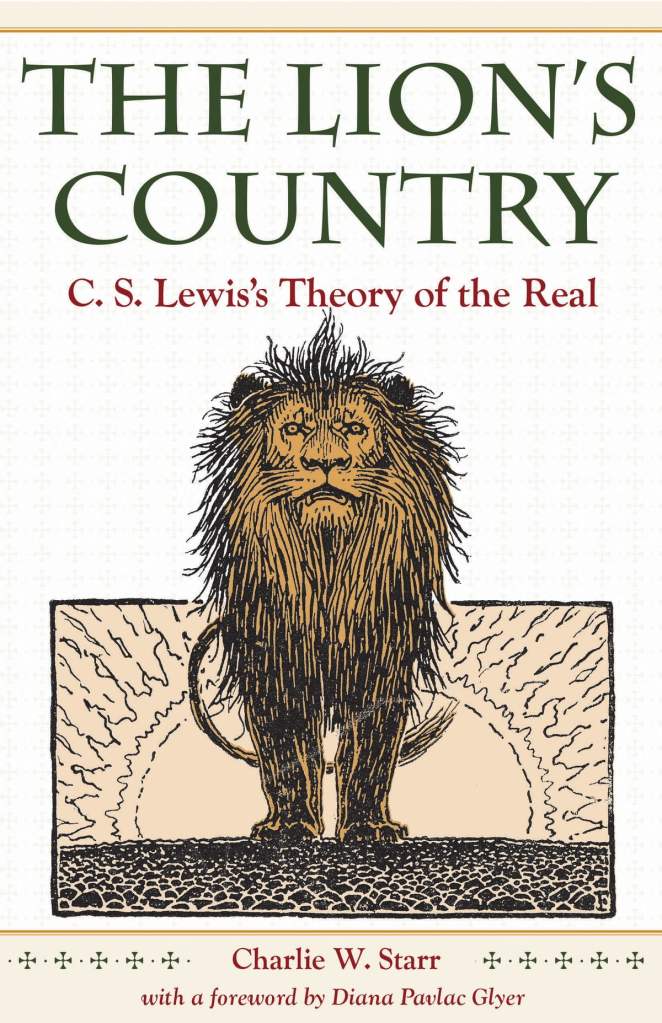
More than anything, I suppose, is that we have become friends. Charlie’s publisher, Kent State University Press, reached out to me for a blurb of The Lion Country, a companion to an earlier intriguing book about C.S. Lewis and myth: The Faun’s Bookshelf The request came at a point in my life where I was not capable of responding well. I read the book and wrote the blurb, but alas, I missed the publication deadline. Unfortunately, I still don’t have the ability to write a full review because there is more I want to say. Ch. 4, “The Apologetical Decade,” is breathtaking in its concision and clarity–though is new research that clarifies the timeline of Lewis’ spiritual journey to Christian faith. There is also something niggling me about one key aspect of Charlie’s argument.
Still, I would like to share how The Lion’s Country is a thoughtful discussion that helps readers dig deeper into Lewis’s life, work, and thought. Thus, for you dear reader, Still, I would like to share how The Lion’s Country is a thoughtful discussion that helps readers dig deeper into Lewis’s life, work, and thought. Thus, for you dear reader, I give you my unblurbed blurb–conscious of the lateness but not conscience-stricken!
The Faun’s Bookshelf by Charlie W. Starr (Kent State University Press, 2022)
Two of the great questions of human thought are tucked into many of the social debates of our generation: “What is really real?” and “How can I know what is true?” These questions were among C.S. Lewis’ central concerns–not just in his philosophical works but also in his literary criticism, popular essays, and world-famous, life-transforming fiction like The Chronicles of Narnia and The Screwtape Letters. Charlie Starr engages C.S. Lewis to address these critical questions of “epistemology” in a smart and accessible conversation in The Lion’s Country. Besides providing a resource for those who have been moved by Lewis’ life and works, The Lion’s Country equips everyday readers to resist two cultural pressures to equate “truth” with “reality.” On the one side are those who state that their scientific theory, moral belief, biblical interpretation, political ideology, historical understanding, or conspiracy theory simply is the truth. On the other side are those who reduce all truth and morality to their personal or cultural experience. A culture lost in either pathway will lead to what C.S. Lewis calls the “Abolition of Man,” the loss of our humanity in willing but unwitting slavery. In a winsome style and an earnest commitment to clarity, Charlie Starr offers readers an invitation to a deeper way of living that resists the thin worldviews of the popular imagination.
I believe in open access scholarship. Because of this, since 2011 I have made A Pilgrim in Narnia free with nearly 1,000 posts on faith, fiction, and fantasy. Please consider sharing my work so others can enjoy it.
Have I talked about this super cool bit of research and writing yet? As I look through the Pilgrim in Narnia archive, I see a couple of hints of the “Archangel Fragment,” but not much more. In a cultural moment of bad news and social media warfare, I think it is time to share this full-on, totally invested, super fun bit of nerd news.
Back in the previous decade, before pandemics like COVID, AI, and digital duels about the Rings of Power, Charlie W. Starr sent me a message. I am friends with Charlie, so it was not startling to get a message from him. For context, though, I have been following Dr. Starr’s work for almost as long as I have been blogging. I reviewed his ground-breaking book Light: C.S. Lewis’s First and Final Short Story, which launched his Lewis Handwriting System (LHC). Light and the LHC came at exactly the right time for me, and over the next few years, I tested out his handwriting analysis system in the archives. Prof. Starr is the author of a pair of intriguing books about C.S. Lewis and myth: The Faun’s Bookshelf and The Lion’s Country. He’s also a teacher, novelist, hilarious Facebook poster, and publisher of a ridiculous amount of scholarly work.
This message was in the “Famous Handwriting Expert Dr. Charlie W. Starr” mode–the kind of message that makes even a friend sit up a little straighter in their chair:
Hi Brenton, Have you seen the angelic letter at the Bodleian, the one where Lewis attempts to write a letter from an archangel to a guardian angel (or some such)? It’s in one of the notebooks there.
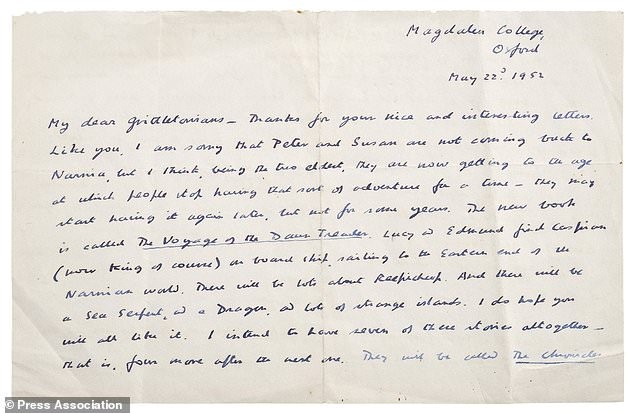
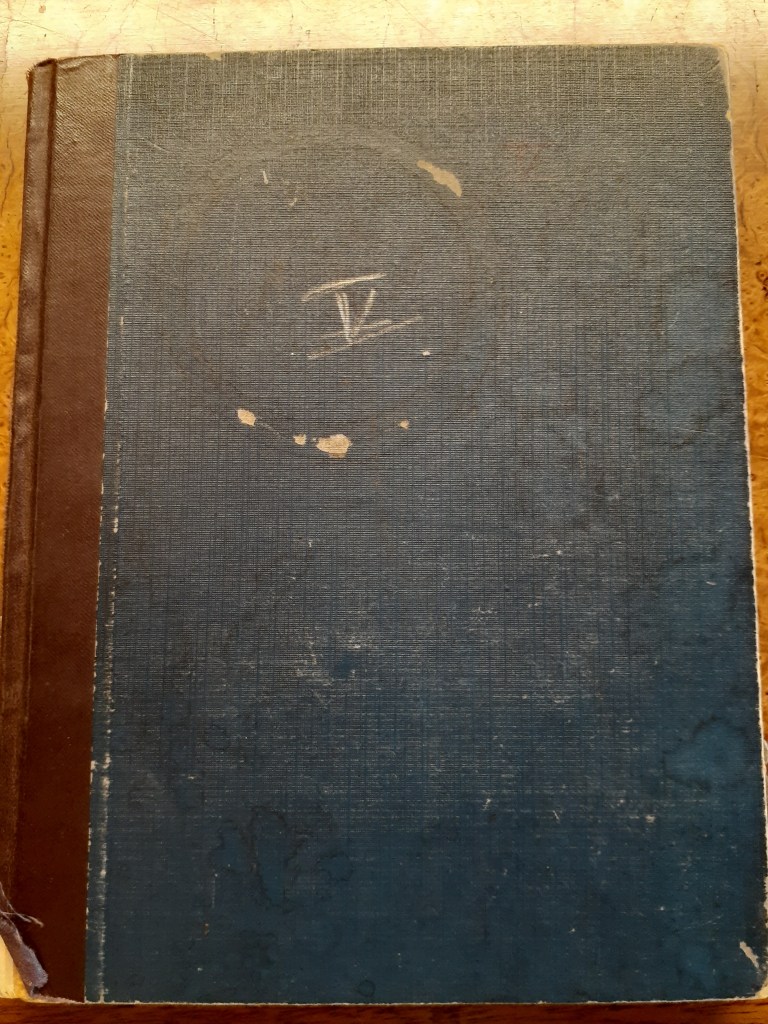
As it turns out, I had seen this fragment in Lewis’s “Notebook V” (which I think of as the “Teastained Everything Book from the 1940s,” as pictured here). I had not honestly thought much about this bit of text and was not even certain if it was Lewis’s original composition or a quotation. As soon as Charlie pointed me in the right direction, though, I immediately saw what he was seeing:
C.S. Lewis once began an “Archangel Letter” as a response to The Screwtape Letters.
We need to back up a step or two–even for archive lovers, Lewis readers, and faithful visitors to A Pilgrim in Narnia.
While The Screwtape Letterswas Lewis’s first bestselling book and provided him with a substantial audience for his writing, he sometimes minimized its value. He thought Perelandra was worth 20 Screwtapes and he found Screwtape painful to write. He even called it a literary “stunt.”
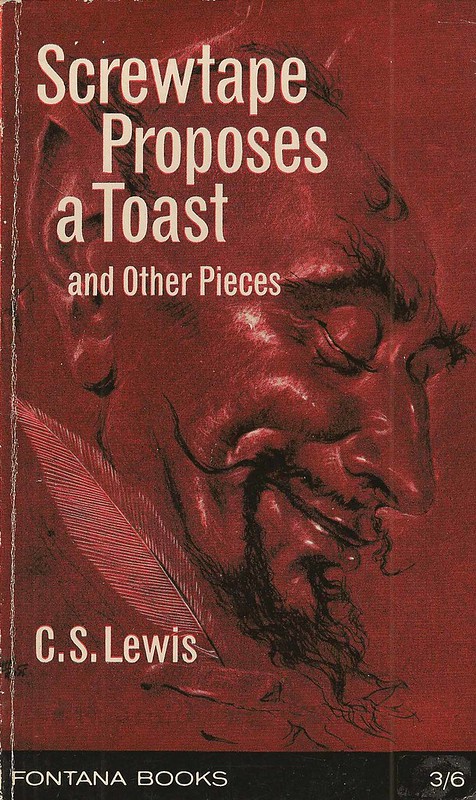
In the preface to a later addition to Screwtape’s archive of antispiritual advice, “Screwtape Proposes a Toast,” Lewis admitted that:
I had, moreover, a sort of grudge against my book [Screwtape] for not being a different book which no one could write. Ideally, Screwtape’s advice to Wormwood should have been balanced by archangelical advice to the patient’s guardian angel. Without this the picture of human life is lopsided.
To flaunt the deficits of one’s literary creation is a peculiar marketing device, but Lewis defends himself on his own challenge.
But who could supply the deficiency? Even if a man—and he would have to be a far better man than I—could scale the spiritual heights required, what “answerable style” could he use? For the style would really be part of the content. Mere advice would be no good; every sentence would have to smell of Heaven.
If he was bothered by the imbalance of Screwtape, why had Lewis not written The Michael Memos or Answer from an Archangel? His answer: How could a mere mortal write such a thing? Considering his own life–which was one of the uncomfortable aspects of writing Screwtape–Lewis felt that he lacked the moral and spiritual capacity to write at such a level.
Lewis died three or four years after writing these words. As far as anyone knew, he had never expected to publish anything like The Seraphim Scribbles or Gabbing with Gabriel. Even in choosing a title, we can see how un-heavenly such a collection might be–even if the advice was angelically good.
Just because it was impossible, though, doesn’t mean Lewis didn’t try.
On fol. 63v of Notebook V, Lewis writes a paragraph that begins like this:
For this, my dear, is the true delight. To take a creature whom, if the King permitted and our own will were so strangely perverted, we could with one touch of the little finger turn into nothingness, even as that creature could spoil the down on a butterfly’s wing. . . .
The first sentence of this paragraph is 8 words; the second sentence continues on to 231 words. In that second sentence, each phrase lifts the language a step closer to a heavenly diction. As the imagery tumbles out, the meaning intensifies until there is nowhere else to go–at least in the limited grammar of authors after Eden.
I have touched up the quotation a bit for clarity, and you can find references in the linked paper. And I should warn you that I am going to turn all of this upside down at some point. But I have only shared a little excerpt from the full Archangel Fragment. I want you to join us in the discovery!
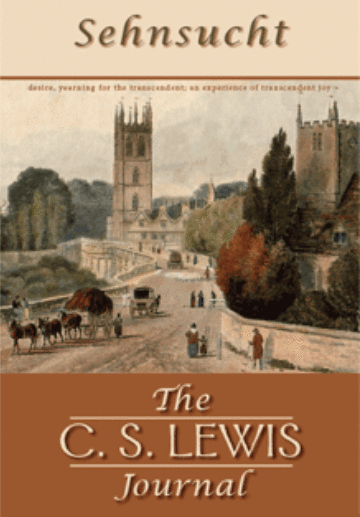
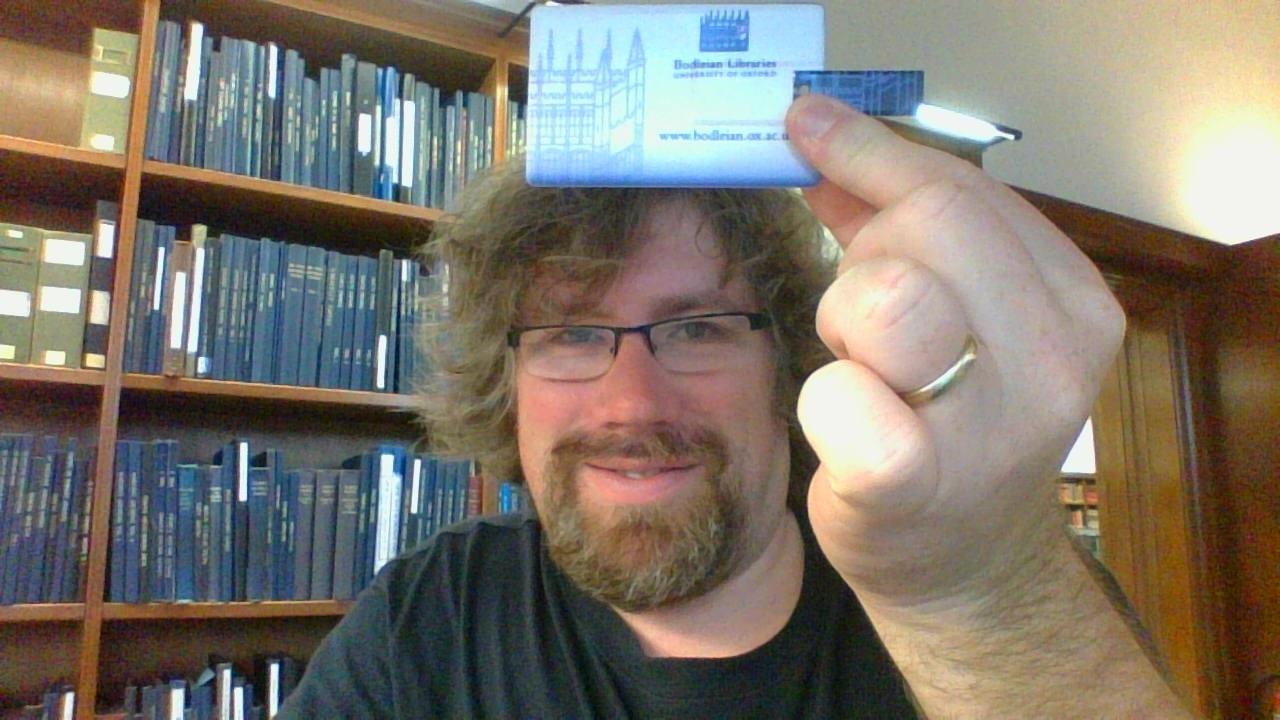
After clarifying the significance of this passage, Charlie and I worked together when I was in the Bodleian. Actually, in the Bod: I was in the Reading Room checking details, confirming our transcription, and seeing this celestial experiment in its context. The paper that resulted is “The Archangel Fragment and C.S. Lewis’s World-Building Project,” published in the 2019 edition of Sehnsucht: The C. S. Lewis Journal.
Blessedly, Sehnsucht journal is now open-source and available free to everyone. I provided the first few words of the Archangel Fragment as a teaser, but now you can read the entire fragment in the context of the argument Charlie and I made about C.S. Lewis as a writer about the spiritual life and creator of fictional worlds. I hope this is something you can enjoy and share–and respond to if you like–as Joe Ricke has done in his Sehnsucht piece, “The Archangel Fragment: Identifying and Interpreting C. S. Lewis’s ‘Cryptic Note.'”
“The Archangel Fragment and C.S. Lewis’s World-Building Project” (click here for the full paper)
Abstract
In this article, we argue that, from a few hints in the Bodleian archive and elsewhere, we have discovered C. S. Lewis’s singular attempt at an Archangelic sequel to The Screwtape Letters. By analyzing this small fragment and its contextual clues, we can hear the heaven-scented voice of this anti-Screwtape world. Through this discovery we can unlock hidden links among Lewis’s fiction project of the late 1930s and early 1940s and the ways he created the speculative worlds of those stories, including a spirit of playfulness and discovery, themes critical to his theological perspective, and potential links that draw his 1937–1945 work together into a cohesive whole. Finally, considering this fragment provides an opportunity to test the Lewis Handwriting Chart and open possibilities for further archival research.
Right now (in October, 2024), I am teaching a Signum SPACE course on C.S. Lewis’s archival material and writing habits. Click below for more information or follow the direct link here. It may be a program that interests you in the future!
I believe in open access scholarship. Because of this, since 2011 I have made A Pilgrim in Narnia free with nearly 1,000 posts on faith, fiction, and fantasy. Please consider sharing my work so others can enjoy it.
Where is the meaning found in the art of reading? Is it in the text itself–some magic of language or mystery of persuasion in the telling of a tale? Or do readers carry meaning in their own curiosity and willingness to undergo the quest? Is a story still a story without a reader? Can stories mean more than what their authors intended? Can there be a story that specifies only a certain interpretation of meaning while remaining a story? Can a story’s meaning change over time? Can we ever receive a story from another culture–time, place, language, or worldview–without creating new meaning?
As a teacher, reader, and critic, these questions are tremendously exciting. However, I have found that too many of these conversations are unnecessarily confusing. Sometimes, the debate is cloaked in the obscure, mercurial echoes of aitiocidal French criticism; at other times, common sense is wiped out by movements to defend or redefine the primacy of the text.
And, don’t you think this nebulous scene is worsened by the neologophilic nature of literary theory conversations? Like how I made up the word “neologophilic” to describe an unnatural love of making up new words (literally from Greek words meaning “new-word loving”). Or how I invented “aitiocidal” (also from Greek, an “aitiocide” would be a “source-killer” or “author-killer”) to describe the “Death of the Author” moment in terms that suggest the “Murder of the Author.” Honestly, I struggle with the terms. When I talk about the methods and means of reading and writing about literature, I have to bring out a spreadsheet to make it through the term-happy terrain.
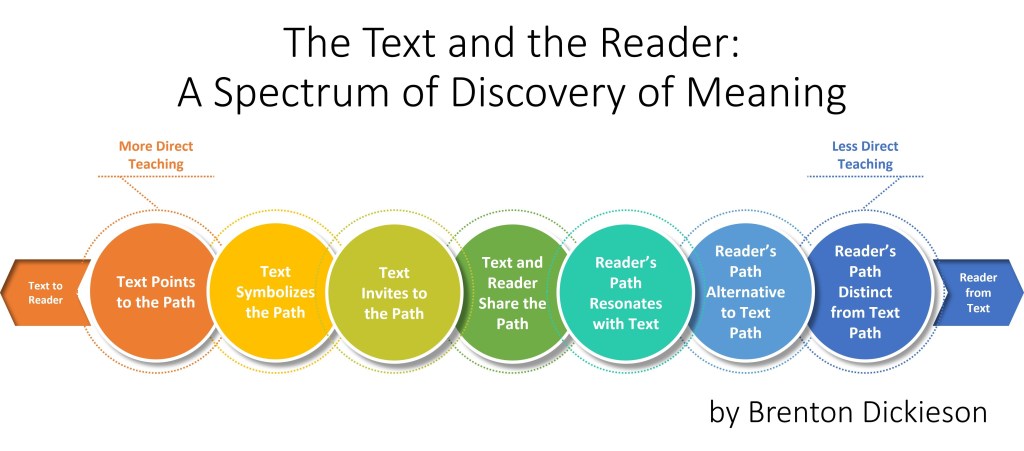
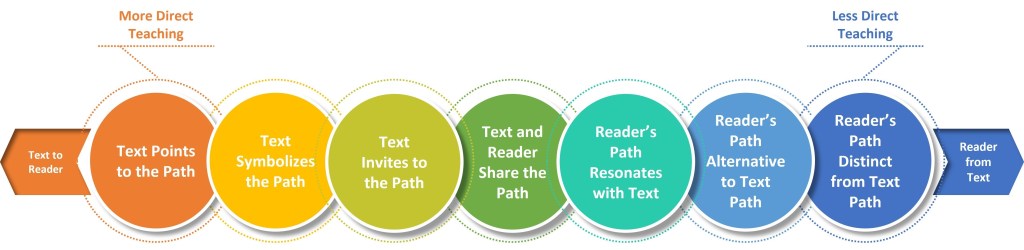
Thus, for the sake of honesty about what we are doing–and as a tool I can use for teaching and reading–3 or 4 years ago, I made this little spectrum chart. I sketched it out during a conference as I struggled to shape some layperson language for the relationship between texts and readers. Spectrum thinking is inherently limited by a two-dimensional spread, but I will address some third-dimensional thinking another time.
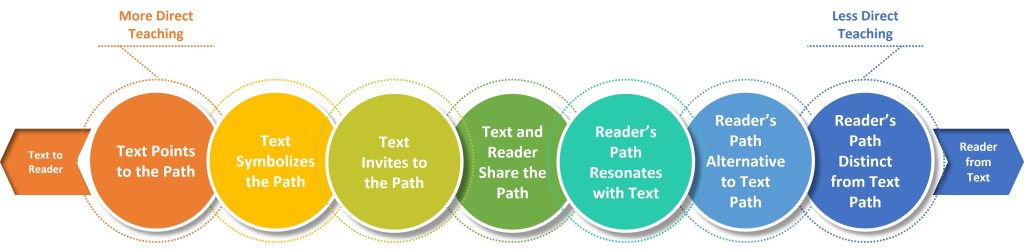
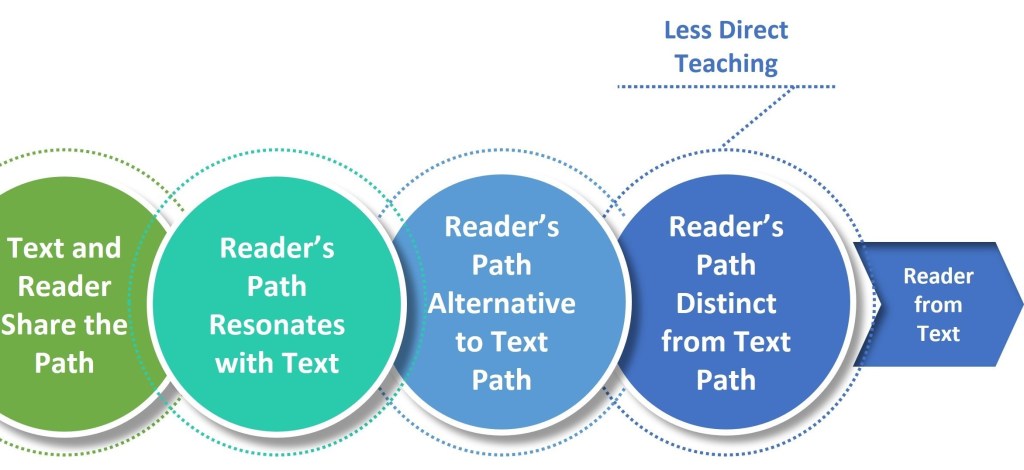
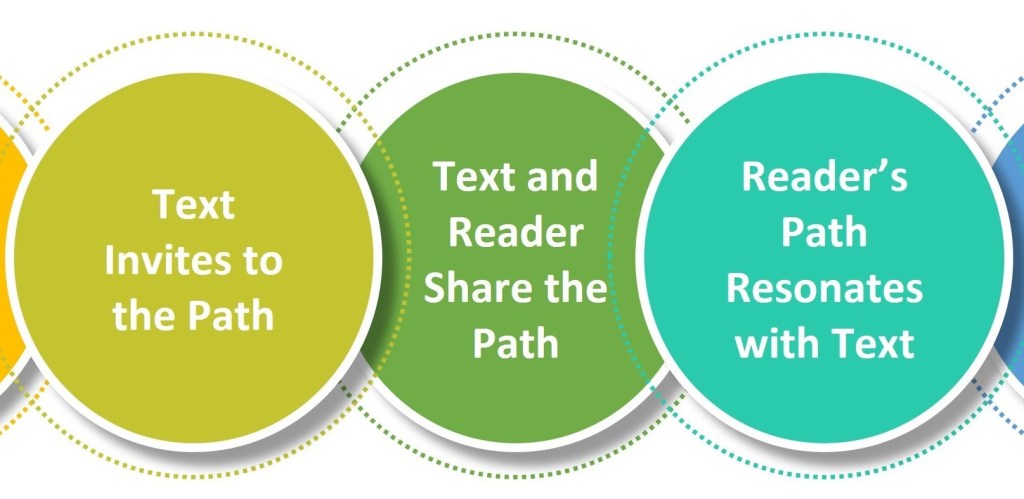
This little chart moves along a spectrum of direct to indirect (left to right). Perspectives on the left show the movement out from the text to the reader; on the right, we see the dialogue between the text and reader from the reader’s point of view. It is tempting to think of this as a spectrum from “literal” to “metaphorical” storytelling, but that does not work if we want to be honest about what we are doing.
On the very left, perhaps we can use the word “literal” to describe a text that speaks directly to its readers about morality, truth, religion, spirituality, politics, ethics, science, love, sexuality, gender, home, land, the future, or whatever meaning an author would want to describe, symbolize, or intimate in a text. In Ayn Rand’s Atlas Shrugged, there is a 3-hour speech recorded word for word about the philosophy that is presented in the novel. That speech, though, is not always “literal” as it uses metaphors, similes, and other symbolic and rhetorical tools. “Direct” is a better word: The “Text Points to the Path” that the author wants us to understand. Atlas Shrugged also “Symbolizes the Path” in that the plot (and character journey) is about what the novel is about. Moreover, the “Text Invites to the Path” as Atlas Shrugged creates a vision of courageous, risk-taking, hard-working wealthy business people retreating to a mountainside resort as America burns because of its unwillingness to make unrestrained commercial activity the centre of its constitutional reality.
We can see the (more or less) direct pointing to the path in less political texts. In our “Canada Reads” contest each year, it is clear that the short-listed texts are increasingly about something: immigration, indigeneity, gender, independence and relationality, coming of digital age, and a constant redefinition of what Canada “is.” A 1990s version of myself standing bewildered in front of a Christian fiction bookshelf would have called these 21st-century novels “preachy.” Moralistic art is hard to do well, but the Canada Reads contest both shapes and reveals Canada’s moral moment along the spectrum.
Narnia, too, has this sort of spread. At points the text teaches directly, like when Aslan describes the kind of character a king must develop in himself. Sometimes, Narnia symbolizes the path to meaning, like the turning of winter to spring and the death and resurrection of Aslan in The Lion, the Witch and the Wardrobe. And Narnia is an invitational world: Life-giving characteristics like wonder, joy, clear-thinking, wisdom, and insight are there for the reader whether or not they share Lewis’s understanding of creation and the Creator.
From the other direction, the reader brings their questions, curiosities, cares, and concerns to the text. We can’t help doing it, really–though there is a case to be made for how best to receive a story (which I will make another day). My limitations of language, my cultural expectations, my faith, hope, and dreams, my literary imagination–all of these things are part of my experience as a reader in shaping meaning. And, sometimes, I do this more intentionally–reading a book to critique it, rewrite it, or find myself somewhere in it.
Philip Pullman‘s His Dark Materials trilogy is an example for me. I don’t know if these Golden Compass books quite get to the far left of direct teaching, but it comes close. Lyra‘s journey, though, is a path to wisdom (in Pullman’s understanding), and the series intimates and invites us to a number of beliefs, judgements, and questions about religion, authority, sexuality, and art. And though I fundamentally reject Pullman’s worldview, I resonate with Lyra’s journey–even as it goes in a direction that diverges from my own. I also critique the book, showing where I think Pullman succeeds and fails as a storyteller trying to intimate meaning. Frankly, I also use His Dark Materials as a test of my own heart: Looking honestly at myself as I read, could it be that I am really just using my own fears and beliefs to obscure a great work of literary art?
I don’t know if this spectrum is available to every book–though I think books shade to one side or another. The more I try to enrich my reading of Narnia by studying history, reading fairy tales, understanding Lewis’s life and culture, and writing my own prose and poetry, the more I find Narnia fits in the greenish pathways for me–some negotiation of text and reader. This is quite opposed to those who think Narnia is an “allegory” and decide that it is a singular vision. I gleefully misunderstood Animal Farm the first time I read it, showing that although an allegory fits in that orange-yellow part of the spectrum, I could successfully create remarkably consistent new (blue) meaning in my ignorance. I almost always read Richard Bach’s Jonathan Livingston Seagull completely in the blue spectrum, but I suspect I am self-deluded and am intimating something of the author’s orange-yellow-greenness.
My point here is not to limit reading, readers, or that which is read.
Rather, I think it is helpful to know what we are doing when we read. It is very easy to be reductive–to reduce Narnia to an allegory, to limit Pullman by his own anti-Narnian tendencies, to ignore our own biases, or to blame George Orwell for how wrong he was about the 2020s roll-out of AI in his futuristic novel, Animal Farm. This spectrum may or may not work for you, but I hope it helps us take a step out of fuzzy nonsense and obscure debates about literature so that we can enjoy the books we enjoy on whole new levels.
Text Points to the Path: Text teaches directly, laying out the moral (ethical, political, theological, relational, or artistic) vision
Text Symbolizes the Path: Text teaches indirectly, using symbol to reveal the moral vision (allegory, allegorical elements, symbols, mythic meaning)
Text Invites to the Path: Text invites the reader to look where the text is looking, morally speaking, where the teaching is not direct or symbolical, but emerges from character, plot, atmosphere, or other literary quality
Text and Reader Share the Path: A reader’s moral vision overlaps with some aspect of the text’s moral vision, questions, or literary quality, though the larger consequences or concerns might be different; thus, the text and reader can share some part of the journey toward the reader’s moral vision, but not all
Reader’s Path Resonates With Text: A reader’s moral vision or questions find some sort of resonance with some aspect of the text, like character, plot, atmosphere, or other literary quality–though the reader and text are asking quite different questions and may not share a moral vision
Reader’s Path Alternative to Text Path: A reader’s moral vision or questions is dramatically opposed to some aspect of the text–like the moral vision of the text itself, the questions it asks, the character, plot, atmosphere, or other literary quality–and the reader uses the text antipathetically to speak to the reader’s moral vision
Reader’s Path Distinct from Text Path: A reader’s moral vision does not overlap with the text’s moral vision, the reader and text are asking different questions, and there isn’t anything in the text–like character, plot, atmosphere, or other literary quality–that resonates or opposes with the reader’s moral vision or questions, and yet the reader uses the text to speak to the reader’s moral vision or questions (but why use the text)
I believe in open access scholarship. Because of this, since 2011 I have made A Pilgrim in Narnia free with nearly 1,000 posts on faith, fiction, and fantasy. Please consider sharing my work so others can enjoy it.
Greetings fellow pilgrims on the path of curiosity and imaginative adventure. Things have been quiet here on the blog front, but some great new things are happening in the background. One of these projects is a brand new short course with Signum University’s SPACE program. SPACE is an online, interactive, non-credit short course program. It is really quite a gorgeous program for folks who want to engage in great discussions and learn about things they love.
Last fall, I taught “Reading L.M. Montgomery as Fantasy: Anne of Green Gables,” and it was one of my favourite teaching experiences ever. In fact, there might be a chance to run the course again in November. If you are interested, you can “wish list” the course here. For details on SPACE, including the cost of courses ($100-$150 USD), click here.
This year, I am offering what I think is a unique approach both to C.S. Lewis and to creative writing as an art. “Ink Spots and Tea Stains: What We Learn from C.S. Lewis’s Writing Habits” is a confirmed October SPACE module. I have spent hundreds of hours in C.S. Lewis’s archives, working with original manuscripts and the various drafts in his writing process. I have studied his letters, diaries, and autobiographical materials to discern his process. And I have researched what we can know about Lewis as a prose writer and poet in all his modes, including experts like Walter Hooper (a literary secretary), Diana Pavlac Glyer (on creative collaboration and the Inklings), and Charlie Starr (who has developed a system of analyzing and dating Lewis’s handwritten manuscripts).
Without ignoring the lines themselves, what can we learn from C.S. Lewis about writing, imaginative expression, personal discipline, and literary subcreation when we look between, beside, and behind the lines.
The name for this course comes from my experience visiting the Berg Collection at the New York Public Library, and sitting with the manuscript of The Screwtape Letters. There were a number of ink spots–Lewis used writing technology that matched his creative process–and there was a prominent round stain from one of his mugs of tea on a neat, clean page. In that moment, I began to understand Lewis as an artist. I also realized that much of what has been said about Lewis the Writer needs some rethinking.
C.S. Lewis is one of the most prolific and influential writers of the 20th century. And yet, in his early career as an Oxford don, he viewed himself as a failed poet. Moreover, his most canonical and transformational writing happened during the most stress-filled periods of his life. This short course allows students to peek into the writing life of C.S. Lewis. Our goal is to see through the lines of printed text by visiting the letters and archival remains of Lewis in a virtual setting. Most of C.S. Lewis’s papers remain undigitized and unpublished, available only locally at archives in North America and England.
As Professor Brenton Dickieson has visited these archives, he is able to invite students to appreciate C.S. Lewis’s writing life by looking at the way that he consciously and unconsciously built his literary career. This course is for writers who are developing their own habits and literary life-prints, as well as folks who are curious about C.S. Lewis’s life beyond the biographies and bestselling books.
We are not doing text close readings, but looking at the “paratextual” information available to us: writing drafts, letters, diary entries, manuscripts and typescripts, titles, and the like.
Week 1: Lewis: Pen, Ink, Paper • C.S. Lewis’s Single-jointed Self-Conception as a Writer • What Lewis Says about his Writing Habits • Legendary Bonfires, Stuffed Dolls, and American Suckers: A Story of Lewis’s Papers and Manuscripts • The Screwtape MS. Story: Part 1
Week 2: Leaves, Bombs, Stains • The Screwtape MS. Story: Part 2 • “Villainous Handwriting”: Charlie Starr’s Lewis Handwriting and Rough Draft vs. Fair Draft • Reconsidering the Lindskoog Affair with Manuscript Evidence of “The Dark Tower”
Week 4: Hits and Mythes • Is it True that Lewis Wrote in a Single Draft? • A Grief Observed • Tumbling Through the Wardrobe: The Discovery of Narnia • Arthurian Torso • A New Sketch of Lewis’s Writing Process(es)
I believe in open access scholarship. Because of this, since 2011 I have made A Pilgrim in Narnia free with nearly 1,000 posts on faith, fiction, and fantasy. Please consider sharing my work so others can enjoy it.
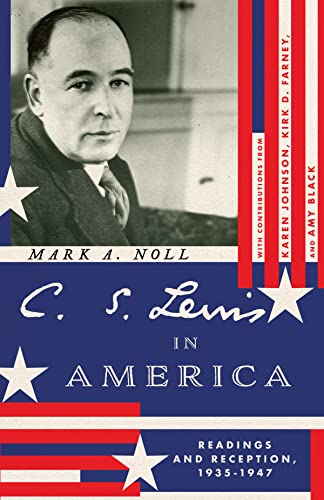
Who can count all the ways that books happen to us? There certainly isn’t a single pathway of discovery when it comes to the books that occupy not just our shelves but also our hearts and minds. This book, Mark Noll’s C.S. Lewis in America: Readings and Receptions, 1935-1947, came in the mail from the publisher (IVP Academic) with no note about who sent it and no sense of what they wanted me to do with it. As I am interested in what we call the “reception history” of Lewis’ work—and I have a general understanding of what one does with books—I thought it was most natural that I read it.
C.S. Lewis in America comes out of the Hansen lecture series at the Marion E. Wade Centre on the campus of Wheaton College. A couple of years ago, I reviewed an earlier version of these lectures, published as Splendour in the Dark: C.S. Lewis’s Dymer in His Life and Work (IVP Academic, 2020). In that volume, David C. Downing created a new annotated version of Lewis’s mid-1920s epic narrative poem, Dymer, and Jerry Root supplied the initial lecture series. Following each of the three lectures, a scholar of Interest responds—not just creating a debate but something like call and response, where the scholars tee up fresh ideas from their various perspectives and specialties.
C.S. Lewis in America: Readings and Receptions, 1935-1947 follows the same pattern with three movements:
“Surprise: Roman Catholics as Lewis’s First and Most Appreciative Readers” (with a response by Karen J. Johnson, an expert on religion and race)
“‘Like a Fresh Wind’: Reception in Secular Mainstream Media” (with a response by Kirk D. Farney, an historian with an interest in ministry and media)
“Protestants Also Approve (But Evangelicals Only Slowly)” (with a response by Amy E. Black, a researcher on religion and American politics)
Naturally, there is no Lewis annotation, but an appendix includes two critical articles by Charles Brady from 1944—including one that I was unsuccessful in finding when I first looked for it a decade ago.
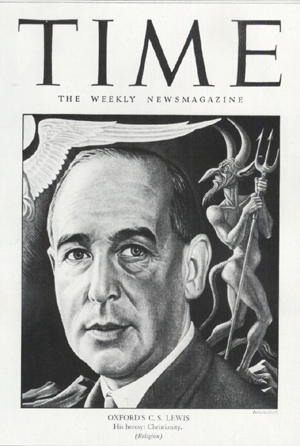
Though he is probably most well-known for The Scandal of the Evangelical Mind (1994), Mark Noll is an historian who—like George Marsden—helps us discern the rapidly evolving shape of America’s religious history. The three lecture/chapter titles give a clear outline of the topic as he focuses on the ways that American scholars, theologians, journalists, and critics read and reviewed Lewis’ books from the first American editions in the mid-1930s until the point that he landed on the cover of Time Magazine in 1947.
In each lecture/chapter, Noll uses that reception history to discuss critical features of three historical moments:
American Roman Catholicism as it strove to escape isolationism, deepen its roots in American theological and intellectual culture, and grapple with rapidly changing cultures of race and class around them
Mainstream American intellectual, literary, and media cultures as they negotiated traditional popular respect for religion with emerging secular thought and the crises of the Great Depression, war, and technological change
Mid-20th-century Protestantism in these same radical social changes, with Liberal and Mainstream thinkers responding critically and often positively to Lewis, while the movement that would become Evangelicalism was far more tentative about bringing Lewis into their faith conversations
Honestly, in a busy period where it has been hard to focus my mind well, I really enjoyed just sitting down and reading this book. I put my pencil away and read leisurely, trying to find time to read each lecture and the response when I knew I had space to think about the whole.
And while this piece of mail was a surprise, I knew the book was going to land on shelves eventually. I no longer remember how Mark Noll and I connected, though I think it was a Regent College (Vancouver) event, where he is now Research Professor of History and where I have done some online teaching in spiritual theology. In any case, we got talking and found we shared an interest in historical materials on C.S. Lewis that don’t appear in the places we might expect them.
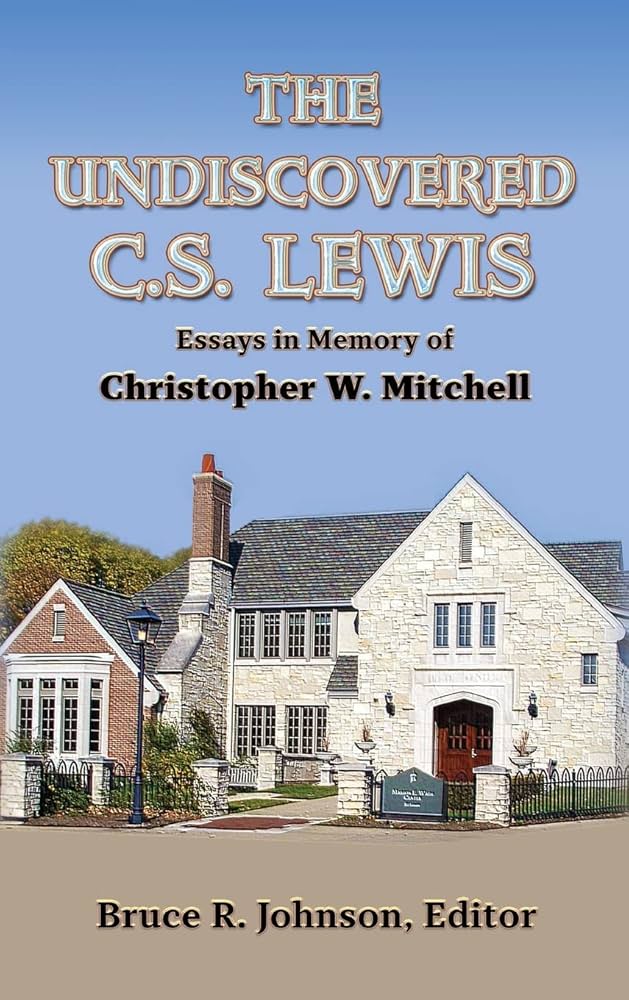
In this desire to dig into the past, though, I am merely an amateur. Mark and Maggie Noll—the husband and wife team—partnered for a deep dive into every single review and response to Lewis’s writing that they could find in American papers, magazines, and journals in the period (1933-47). An earlier review of findings appeared as “C.S. Lewis in America, 1933-1943” in The Undiscovered C. S. Lewis: Essays in Memory of Christopher W. Mitchell, edited by Bruce Johnson. Although the analysis in this earlier article and the new book is relatively short, the spreadsheet behind these materials represents years of work.
C.S. Lewis in America, then, provides researchers with the leads they need to approach questions of Lewis and American culture in broad terms, and the particular questions of Roman Catholic social culture, American secular thought, Mainstream Protestant theological development, the birth of Evangelicalism, and the remarkable story of how in America Lewis becomes a media superstar, a scholar of note, and the imaginative saint next door. For the reader and researcher of Lewis’s thought, Noll introduces dozens of thoughtful responses to his work that are usually unknown to most of us.
So, although I kept the pencil tucked firmly behind my ear while reading this book, it really is one that is meant to be marked up and to prepare the way for others to do their own work. I don’t know who sent me this book and certainly did not contribute anything to its creation, but I am appreciative of the discovery. It’s been a good year for literary postal surprises, as I noted in a recent response to Amy Baik Lee’s Homeward Ache. Perhaps I should take a walk to the corner and see what is waiting for me!
I believe in open access scholarship. Because of this, since 2011 I have made A Pilgrim in Narnia free with nearly 1,000 posts on faith, fiction, and fantasy. Please consider sharing my work so others can enjoy it.




 A Pilgrim in Narnia