

In his evocative and soul-revealing re-imagining of the spiritual life in the irreconcilable ecosystems of heaven and hell, The Great Divorce, C.S. Lewis tells a lie.
As I described last week, The Great Divorce is a travel-journey philosophical novella. Like Dante, the author-as-protagonist journeys from hell to glance, even briefly, at the bright lands of deepest heaven. Lewis’ hell is a gloaming suburb of near-nothingness, a ghostly, misty, insubstantial realm of despondency and despair. By contrast, heaven is wild and vivid, with a bright, penetrating light and landscape. Lewis’ cosmos is terrestrial rather than celestial, but the object is the same. As Lewis wrote of Dante’s Divine Comedy, it is about the
“imaginative interpretation of spiritual life” (Preface to Paradise Lost, 111).
Lewis’ Beatrice (or one of them, anyway) is a bus driver who transports hellish day-trippers to the front lawn of heaven. As Lewis takes his seat on the bus, an obscure, self-absorbed scholar sits beside him. Lewis then writes:
“Realising with a shudder that what he was producing from his pocket was a thick wad of typewritten paper, I muttered something about not having my spectacles…” (ch. 1).
It is a small lie, granted, but it makes hell seem murkier for a moment.

I have to admit that it is a lie that tempts almost everyone who spends much time in professional literary lands. Almost monthly, I am offered a book for peer assessment or academic journal review, or asked to give advice on a manuscript. Once upon a time, I defended my stance not to write bad book reviews. As the scholarly stakes increased, however, that luxury slipped away from me. Of my last three published reviews, one was critically positive, one deeply negative, and an anthology with a mix of the two. Those latter two—combined with a hard “no” to an editor on a scholarly book and an editor passing over a book I gave a solid “yes”— made me lose heart. I’ve passed on almost every request since, mumbling something indistinct about not having my reading glasses.
Thus, when I got a request to review a book in the “Inspirational” category from the epicentre of American Christian publishing, This was a hard pass. I decided to ignore the request.
Then I took a glance. The author was Amy Baik Lee, a name I knew from the Rabbit Room newsletter and (I think) connected to the Anselm Society. She and I had also chatted a bit online about links between C.S. Lewis and L.M. Montgomery. So, I took the risk and opened the request.
What I found was an endearing letter from the author—which she followed up with the loveliest handwritten note I’ve received in some time. Intrigued, I looked at an eBook sample and discovered three things.

First, wherever the book was made, its subject was right in the centre of what I have been thinking about. This Homeward Ache is captured well in the subtitle: How Our Yearning for the Life to Come Spurs on Our Life Today. In 2020, I was preaching a 10-part series in our church called “Remembering Heaven.” This theme was precisely what I was trying to do, and made me retroactively envious of Lee’s phrase, This Homeward Ache. Unfortunately, an apocalypse happened—which is always inconvenient when you are preaching about heaven—and my project kept adapting to the social distance. Still, Amy and I seemed to share the same literary and theological friends—including C.S. Lewis—and I felt drawn to the content.
Second, after reading only a few pages, I knew that the writing was thoughtful and descriptive—which I would expect of any writer on this topic. Deeper than that, though, the prose was careful, precise, intricate, even—this was not just writing but craft. It revealed a text that had the reflective weight of years and literary friendship behind it.
And as I read, I discovered that in concert with the subject itself, the prose was refreshing. It was a life-giving meeting of form and content. I used up most of my pencil marking up passages that resonated within me:
Something I had only sensed in times of great grief and great wonder had me in its grasp, and I had no name for it (8).
Piercing is a word I try to use sparingly to describe Homeward longing, mostly because I suspect I’d become a one-word writer if I gave it free rein. This ache is undeniably a sharp-edged joy… (37).
I am missing the wholeness of a world that I have only ever experienced in shards…. I understand, then, that I am Homesick indeed, and that the long is chronic. I walk about—and write—like a woman with an open wound and a dressing that never seems to stay. This thing gets everlastingly in the way of my living and yet fuels its very core (56-58).
Narnia opened my eyes to the immediate presence of another reality alongside my tangible one—and the call I have as a human being to engage in both. It is in this world, with its breaking news reports and quotidian library corners that “we have battle and blazing eyes, / And chance and honour and high surprise” (67-68, quoting Chesterton).
My mental map is gradually taken up more by blank spaces than the crowding of dots (88).
And so on, through the end.
Third, the book is beautifully designed—and I love beautiful books whose skin matches their innards. So I asked them to send it along.
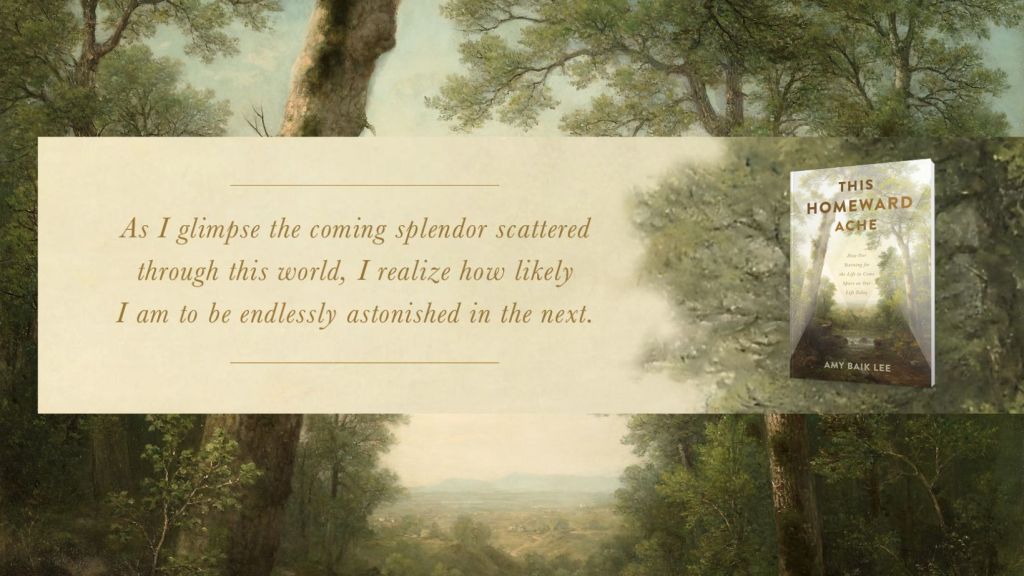
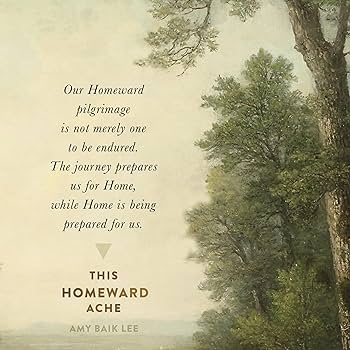
I have not been well, as I talked about earlier this year. I would like to properly review This Homeward Ache, but I only have the ability to write the introduction. At the moment, I’m not capable of expressing my wish that Part 1, the author’s background story, was longer. And I can’t express why ch. 5, “Return to the Meadow,” was the most delightful chapter, or that ch. 9, “With Temporary Homes,” was the most helpful to me as it brought together the previous three chapters on exile, wandering, and pilgrimage.
A beautiful book deserves a beautiful review. But if I delay the review any longer, I will never write a word.
Instead, all I can do is speak simply to my experience of reading This Homeward Ache. I read it slowly through the winter, page by page. If I was not up for a full chapter, I read a section, giving myself the freedom to close the book for a walk or a nap whenever I felt like it was needed. Duty is the wrong posture towards soulful refreshment and self-care—not least when, like The Great Divorce and Lewis’ other images of longing for heaven, the book is about giving our spiritual imaginations their head.
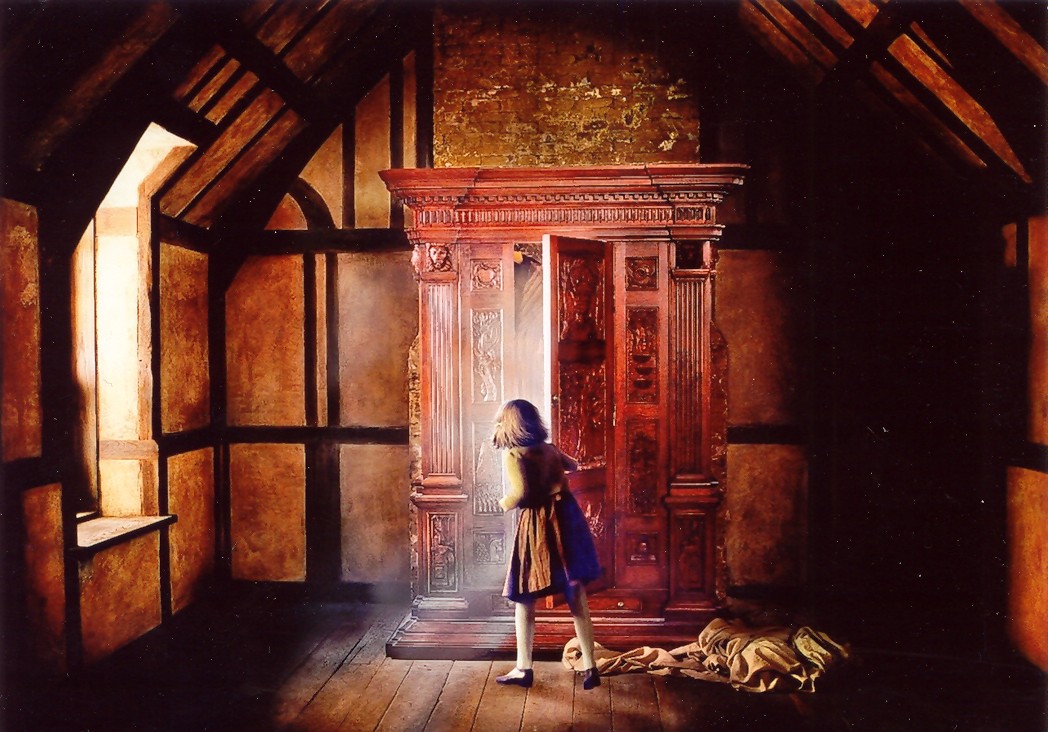
As I read This Homeward Ache, even through this hellish post-covid fog, or whatever it is, I found myself healing. I read a little, and I was able to read a little more. If they can cease obsessing about their own fears and injuries, even for a moment, the miserable, feeble ghosts of The Great Divorce are invited to follow their longing to go deeper in and higher up. As they journey in a land of goodness that is “harsh to the feet of shadows” (ch. 5), they begin to grow more substantial. Their feet begin to toughen up as they acclimatize to the unbending realness of heaven. In a similar way, This Homeward Ache drew me out of myself, little by little, into a fuller reality of this tangible world of email requests and front sunporch couches that exist in parallel to Narnia.
And, because I could see more clearly in this land, my own world, I have been able to return with fresher eyes and tougher souls in my pilgrimage to Narnia.
Amy Baik Lee has caused me to be more careful of the literary requests that find their way toward me. It is a privilege, not a cause for shuddering. And who knows where such a path may lead?



 A Pilgrim in Narnia
I am so glad to read another addition to the Pilgrim in Narnia! I have missed reading your posts. You have such a calming, thoughtful voice. This Homeward Ache looks to be the very thing to read as a change in perspective is good for the soul. Thank you for continuing to write. I look forward to more in the future.
LikeLike
Irene, that is a lovely note, so very encouraging!
LikeLike
No apology needed for not offering a more academic review of Amy’s book. This was was perfect! Perfect.
I too have received more review requests than I can honor. It is, indeed, a privilege… but time grows more and more precious each day. I am delighted, my friend, that you chose to make an exception for This Homeward Ache. And I’m blessed to hear of the healing it is bringing.
LikeLike
It was a providential choice, Rob. Beyond that particular spiritual accident, it’s a really nice book. And I am admittedly being a little playful … it’s certainly longer than my average Goodreads review!
LikeLike
I can think of no greater positive testimony for a book than that it aids healing of any sort. I am grateful to Lee that her book was that kind of gift to you.
Dana
LikeLike
Thanks Dana.
LikeLike
Dr. Dickieson,
As mentioned above, it is refreshing to read your new post. Your site is a treasure trove of information and insight on Lewis, Tolkien, etc. I referenced a couple of your blogs on Lewis and The Screwtape Letters (TSL) for my short dissertation (60+ pages). I argued that TSL is an allegorical satire that spoke to the totalitarianism of Hitler before and during WWII and to the authoritarianism of Trump today. Lewis’s brilliance in writing TSL is not just the story itself – but also its timeless content.
CRC
LikeLike
Thank you so much for the encouragement Craig! I am convinced that Screwtape is as relevant today as ever.
LikeLike
Pingback: What Are Your Favourite Nonfiction Book Covers? - A Pilgrim in Narnia
Pingback: Abstract: Being Hnau in the Age of AI: A View from Hogwarts (for Mythmoot XII) - A Pilgrim in Narnia