
Where is the meaning found in the art of reading? Is it in the text itself–some magic of language or mystery of persuasion in the telling of a tale? Or do readers carry meaning in their own curiosity and willingness to undergo the quest? Is a story still a story without a reader? Can stories mean more than what their authors intended? Can there be a story that specifies only a certain interpretation of meaning while remaining a story? Can a story’s meaning change over time? Can we ever receive a story from another culture–time, place, language, or worldview–without creating new meaning?
As a teacher, reader, and critic, these questions are tremendously exciting. However, I have found that too many of these conversations are unnecessarily confusing. Sometimes, the debate is cloaked in the obscure, mercurial echoes of aitiocidal French criticism; at other times, common sense is wiped out by movements to defend or redefine the primacy of the text.
And, don’t you think this nebulous scene is worsened by the neologophilic nature of literary theory conversations? Like how I made up the word “neologophilic” to describe an unnatural love of making up new words (literally from Greek words meaning “new-word loving”). Or how I invented “aitiocidal” (also from Greek, an “aitiocide” would be a “source-killer” or “author-killer”) to describe the “Death of the Author” moment in terms that suggest the “Murder of the Author.” Honestly, I struggle with the terms. When I talk about the methods and means of reading and writing about literature, I have to bring out a spreadsheet to make it through the term-happy terrain.
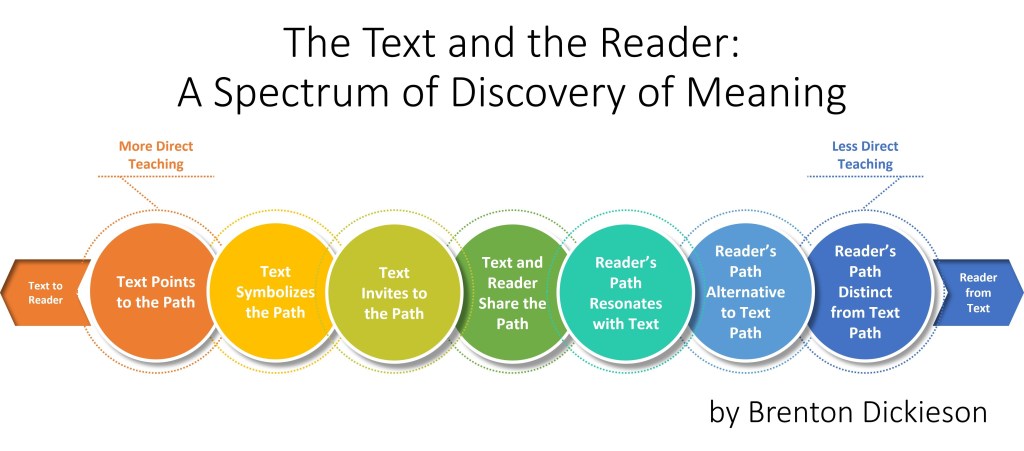
Thus, for the sake of honesty about what we are doing–and as a tool I can use for teaching and reading–3 or 4 years ago, I made this little spectrum chart. I sketched it out during a conference as I struggled to shape some layperson language for the relationship between texts and readers. Spectrum thinking is inherently limited by a two-dimensional spread, but I will address some third-dimensional thinking another time.
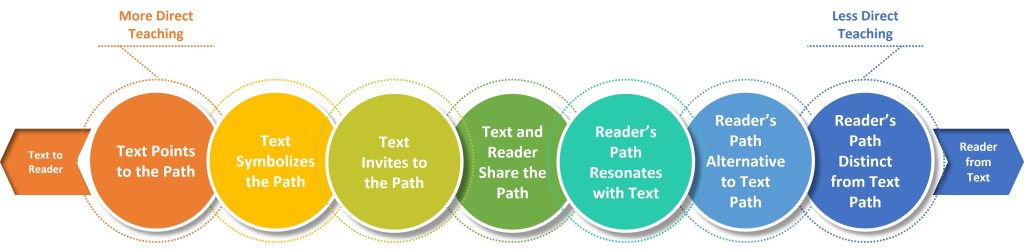
This little chart moves along a spectrum of direct to indirect (left to right). Perspectives on the left show the movement out from the text to the reader; on the right, we see the dialogue between the text and reader from the reader’s point of view. It is tempting to think of this as a spectrum from “literal” to “metaphorical” storytelling, but that does not work if we want to be honest about what we are doing.
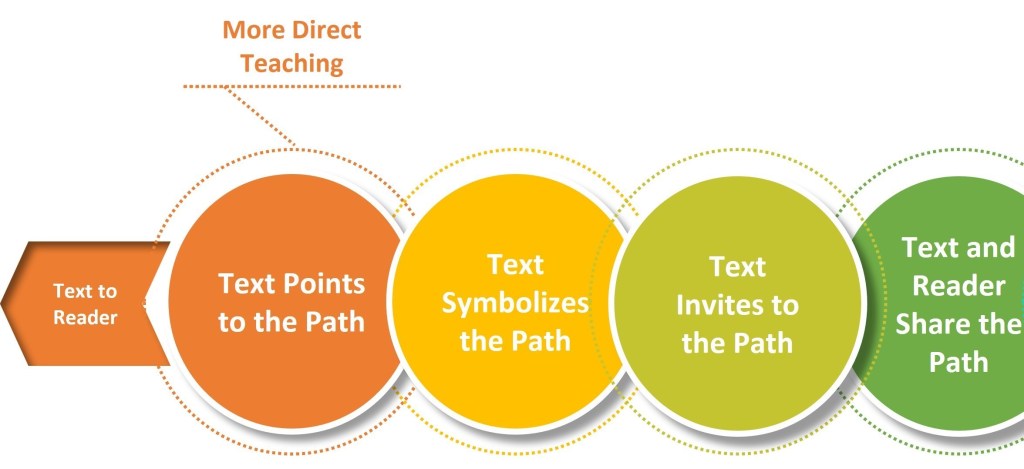
On the very left, perhaps we can use the word “literal” to describe a text that speaks directly to its readers about morality, truth, religion, spirituality, politics, ethics, science, love, sexuality, gender, home, land, the future, or whatever meaning an author would want to describe, symbolize, or intimate in a text. In Ayn Rand’s Atlas Shrugged, there is a 3-hour speech recorded word for word about the philosophy that is presented in the novel. That speech, though, is not always “literal” as it uses metaphors, similes, and other symbolic and rhetorical tools. “Direct” is a better word: The “Text Points to the Path” that the author wants us to understand. Atlas Shrugged also “Symbolizes the Path” in that the plot (and character journey) is about what the novel is about. Moreover, the “Text Invites to the Path” as Atlas Shrugged creates a vision of courageous, risk-taking, hard-working wealthy business people retreating to a mountainside resort as America burns because of its unwillingness to make unrestrained commercial activity the centre of its constitutional reality.
We can see the (more or less) direct pointing to the path in less political texts. In our “Canada Reads” contest each year, it is clear that the short-listed texts are increasingly about something: immigration, indigeneity, gender, independence and relationality, coming of digital age, and a constant redefinition of what Canada “is.” A 1990s version of myself standing bewildered in front of a Christian fiction bookshelf would have called these 21st-century novels “preachy.” Moralistic art is hard to do well, but the Canada Reads contest both shapes and reveals Canada’s moral moment along the spectrum.
Narnia, too, has this sort of spread. At points the text teaches directly, like when Aslan describes the kind of character a king must develop in himself. Sometimes, Narnia symbolizes the path to meaning, like the turning of winter to spring and the death and resurrection of Aslan in The Lion, the Witch and the Wardrobe. And Narnia is an invitational world: Life-giving characteristics like wonder, joy, clear-thinking, wisdom, and insight are there for the reader whether or not they share Lewis’s understanding of creation and the Creator.
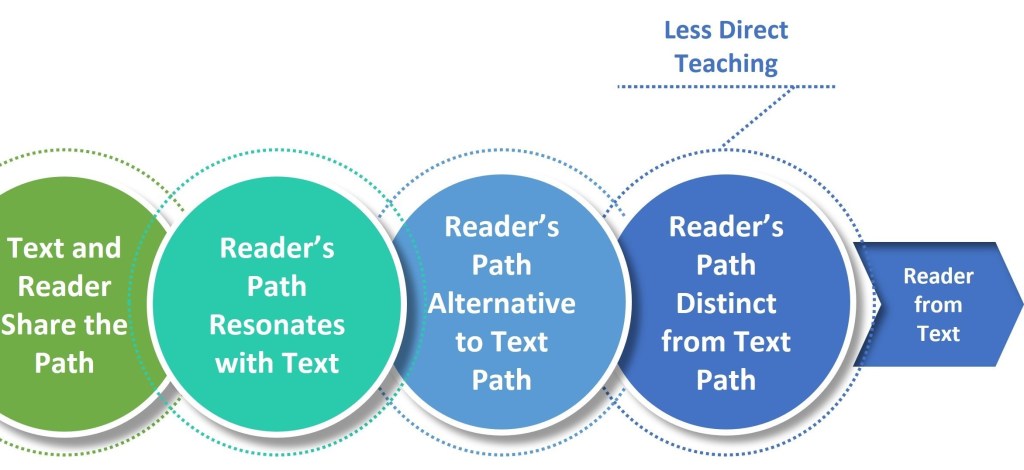
From the other direction, the reader brings their questions, curiosities, cares, and concerns to the text. We can’t help doing it, really–though there is a case to be made for how best to receive a story (which I will make another day). My limitations of language, my cultural expectations, my faith, hope, and dreams, my literary imagination–all of these things are part of my experience as a reader in shaping meaning. And, sometimes, I do this more intentionally–reading a book to critique it, rewrite it, or find myself somewhere in it.
Philip Pullman‘s His Dark Materials trilogy is an example for me. I don’t know if these Golden Compass books quite get to the far left of direct teaching, but it comes close. Lyra‘s journey, though, is a path to wisdom (in Pullman’s understanding), and the series intimates and invites us to a number of beliefs, judgements, and questions about religion, authority, sexuality, and art. And though I fundamentally reject Pullman’s worldview, I resonate with Lyra’s journey–even as it goes in a direction that diverges from my own. I also critique the book, showing where I think Pullman succeeds and fails as a storyteller trying to intimate meaning. Frankly, I also use His Dark Materials as a test of my own heart: Looking honestly at myself as I read, could it be that I am really just using my own fears and beliefs to obscure a great work of literary art?
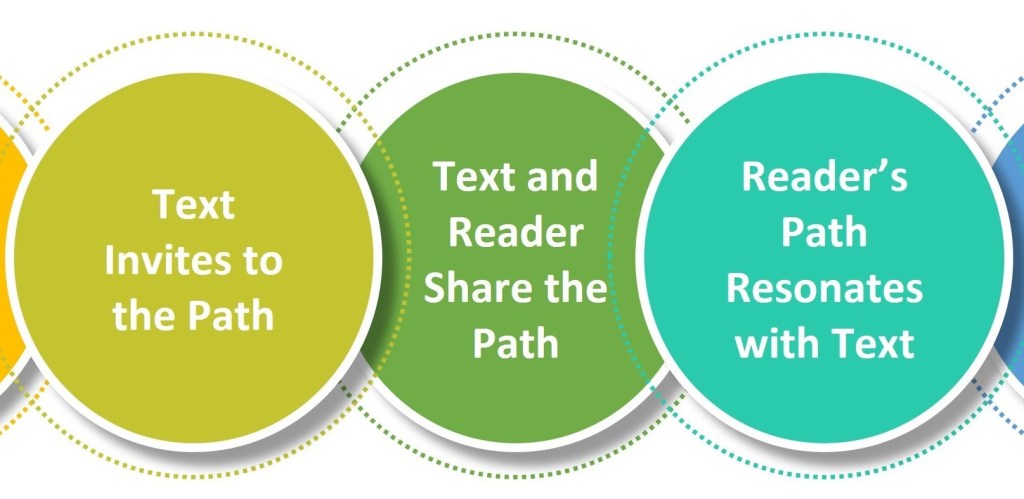
I don’t know if this spectrum is available to every book–though I think books shade to one side or another. The more I try to enrich my reading of Narnia by studying history, reading fairy tales, understanding Lewis’s life and culture, and writing my own prose and poetry, the more I find Narnia fits in the greenish pathways for me–some negotiation of text and reader. This is quite opposed to those who think Narnia is an “allegory” and decide that it is a singular vision. I gleefully misunderstood Animal Farm the first time I read it, showing that although an allegory fits in that orange-yellow part of the spectrum, I could successfully create remarkably consistent new (blue) meaning in my ignorance. I almost always read Richard Bach’s Jonathan Livingston Seagull completely in the blue spectrum, but I suspect I am self-deluded and am intimating something of the author’s orange-yellow-greenness.
My point here is not to limit reading, readers, or that which is read.
Rather, I think it is helpful to know what we are doing when we read. It is very easy to be reductive–to reduce Narnia to an allegory, to limit Pullman by his own anti-Narnian tendencies, to ignore our own biases, or to blame George Orwell for how wrong he was about the 2020s roll-out of AI in his futuristic novel, Animal Farm. This spectrum may or may not work for you, but I hope it helps us take a step out of fuzzy nonsense and obscure debates about literature so that we can enjoy the books we enjoy on whole new levels.
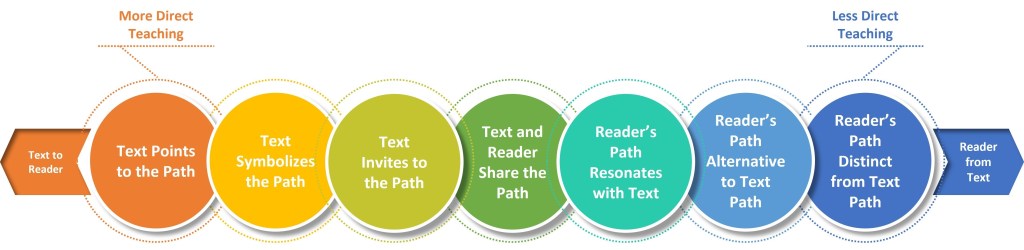
- Text Points to the Path: Text teaches directly, laying out the moral (ethical, political, theological, relational, or artistic) vision
- Text Symbolizes the Path: Text teaches indirectly, using symbol to reveal the moral vision (allegory, allegorical elements, symbols, mythic meaning)
- Text Invites to the Path: Text invites the reader to look where the text is looking, morally speaking, where the teaching is not direct or symbolical, but emerges from character, plot, atmosphere, or other literary quality
- Text and Reader Share the Path: A reader’s moral vision overlaps with some aspect of the text’s moral vision, questions, or literary quality, though the larger consequences or concerns might be different; thus, the text and reader can share some part of the journey toward the reader’s moral vision, but not all
- Reader’s Path Resonates With Text: A reader’s moral vision or questions find some sort of resonance with some aspect of the text, like character, plot, atmosphere, or other literary quality–though the reader and text are asking quite different questions and may not share a moral vision
- Reader’s Path Alternative to Text Path: A reader’s moral vision or questions is dramatically opposed to some aspect of the text–like the moral vision of the text itself, the questions it asks, the character, plot, atmosphere, or other literary quality–and the reader uses the text antipathetically to speak to the reader’s moral vision
- Reader’s Path Distinct from Text Path: A reader’s moral vision does not overlap with the text’s moral vision, the reader and text are asking different questions, and there isn’t anything in the text–like character, plot, atmosphere, or other literary quality–that resonates or opposes with the reader’s moral vision or questions, and yet the reader uses the text to speak to the reader’s moral vision or questions (but why use the text)



 A Pilgrim in Narnia
I think, Brenton, this is very brave. But I come to your Theory of Reader-and-Text from a personal background of teaching reading, and children’s literature.
For me there are vital ideas that you seem to be reinventing.
In particular, Rudolph Iser’s “Reader Response” theory, where the meaning a reader finds in an author’s text is partly constructed from both the author’s world and the reader’s.
https://en.wikipedia.org/wiki/Reader-response_criticism
I also think you would find many helpful ideas in C.S. Lewis’s late book “An Experiment in Criticism”, because Lewis seems to be independently creating a version of Iser’s theory.
John
LikeLike
Hi John, yes, I have had Iser in mind, and have written a whole chapter in an upcoming book on Lewis’s Experiment in Criticism–though independent of one another. By talking only of storytelling, I am narrowing the question a wee bit. In either case, I am resisting pop versions of Reader Response where the lines are blurred, so that the reader’s integration of the text becomes the text.
While I’m not sure I’m particularly brave (I think the lit theory wars are mostly over, for now), but teaching children is a grand way of playing with this spectrum, right? Interactive close reading with kids can swing from story analysis, cultural queries, and word studies all the way to artistic responses, discussion groups, and projects like writing the next chapter or the story from another angle. That, for me, is the playground!
LikeLike
It is definitely brave to challenge the French literary theorists. Old habitus die hard!
LikeLike
Les vieux théoriciens ont la vie dure!
LikeLike
By the way — what’s the second dimension?
LikeLike
The author, but I have drawn that in a bit here. I don’t think it is an XY axis thing but a triangle of author-text-reader. The third is a whole other thing in a future book! But it does add a dimension to the spectrum or array or whatever.
I doubt I have my math terms correct! I can think of an XY axis diagram, it is cruciform. But what is an XYZ axis? What is that called? I would actually love to know! Like if we are plotting data and we need a third dimension like time or depth.
LikeLike