

A technical note to readers: I have been banned from Facebook and Messenger–hopefully temporarily, as I am not guilty of espionage or whatever the issue is. If you are one of the more than 500 readers who use Facebook to get your news from A Pilgrim in Narnia, I would encourage you to sign up for Pilgrim Posts in your email box–at least until this is resolved. I’m always reachable at junkola[at]gmail[dot]com–though quite behind in correspondence, as I’ve talked about here and here.

I have been doing a series of writing projects and teaching units on what I’m calling “Authentic Intelligence.” See what I did there? Authentic Intelligence … AI.
Anyway, Artificial intelligence is all the rage these days. While I don’t believe that we have AI–or, indeed, that it is possible–as folks in my world–writers, artists, teachers, content providers, designers, and the like–continue to process vocational crises, some more fundamental questions are starting to emerge.
I have confessed that as a science fiction nerd, I find little of this “sudden technological leap” we are experiencing surprising. I am frequently impatient with how slow our technologies are moving, but that might simply be my vice of impatience.
And the implications are hardly new. Honestly, we have been reading and writing about the possibilities and implications of human-machine hybridity for generations. The loss of one’s humanity in one’s human activity is a theme that goes back to the ancients, including the Bible.
Even culture-watchers who are not SF nerds should see the signs: In North America, we have bred functionalism into the DNA of our children; is it any surprise that when given the chance, students, politicians, and business people are apt to choose function over art, ethics, or identity? We left the path of wisdom some time ago when we decided that the heart of man was composed merely of walls, cavities, atriums, and valves.
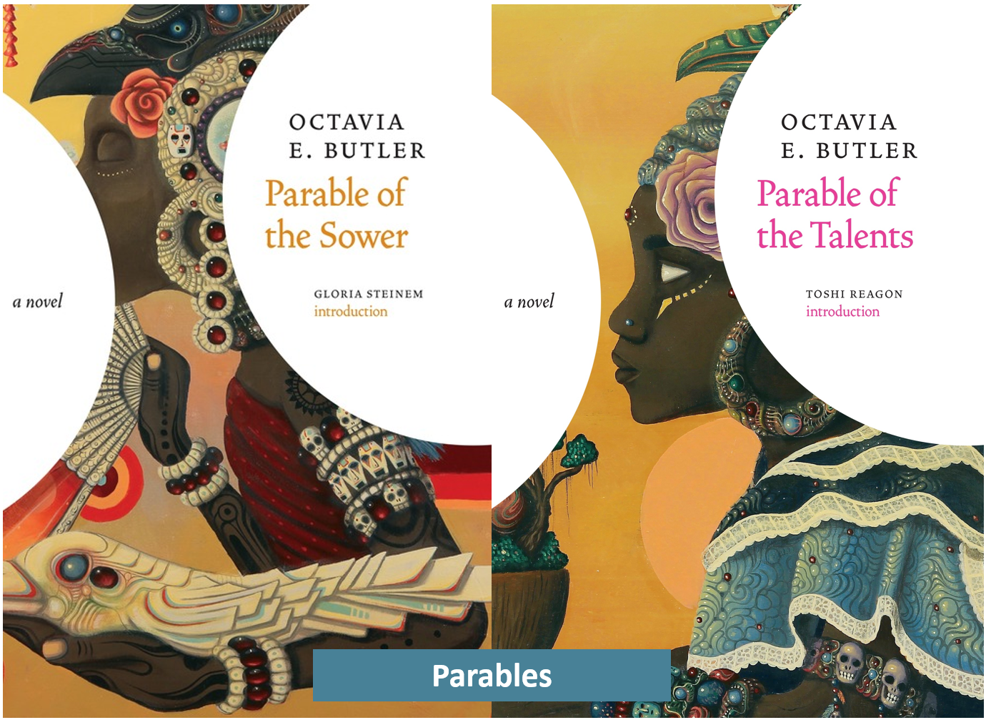
I get why people are curious and afraid, I really do. I’m rereading Octavia Butler‘s Parable of the Sower (1993) right now, and it reads at points like a decades-old roadmap for our 2025 dystopia.
As I feel like I have been living through a series of technocultural, mediatized phallocracies, I find myself drawing away from culture. I use the phrase “Authentic Intelligence” because rethinking “AI” from different angles helps me get to the fundamental human questions of science fiction.
Also, I continue to use the term “hnau” when envisioning our human being and doing in the future. Before WWII, Lewis coined hnau to describe sapient, sentient, spiritually capacious, art- and artisan-making, storytelling, beings of whatever form. I don’t know if Terrans are the only hnau created in the image of God, but we will, sooner or later, create beings in our own image. The way we relate to them will say a lot about what we think is fundamental to our society and race.
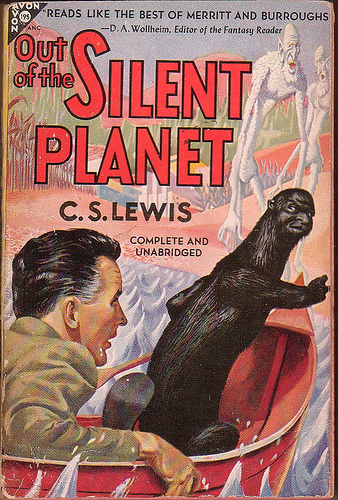
Thus, I am looking to extend my understanding of hnauology in order to shape our evolving consciousness as a species.
While rereading Harry Potter this past winter, I began to wonder if fantasy could contribute in some ways to my hnauological enquiry.
Because I live with non-human animals, I know what to do with Fawkes the Phoenix in the series; but what do we do with the Fat Lady and Phineas Nigellus Black–who exist only in living portraits–or the Weasleys’ Ford Anglia–a machine with developing sentience and emotion–or the Goblet of Fire–a magical item manipulated in the way that we program computer technology. While one of the tensions in the series is the degree to which Goblins, Centaurs, and Merfolk are truly hnau, does the Ministry of Magic’s standardized testing make Trolls an intelligence baseline for sharing humanity? Perhaps the Owls and Cats of Hogwarts are merely superanimals, but what about Nigini, which inhabits the soul of Voldemort? Tom Riddle’s diary makes me wonder whether Voldemort’s flight from death is also a retreat from humanity. Does going beyond humanity make one superhuman or not a hnau at all.
I ended up sketching out so many questions and potential links that I decided I would take this inquiry public.

Mythmoot XII is June 19-22, 2025, at the National Conference Centre in Leesburg, VA. The theme, “Drawn to the Edge,” invited me to reflect on the boundaries of my hnauological sketches, so I decided to pitch my Harry Potter project, “Being Hnau in the Age of AI: A View from Hogwarts.” My accepted abstract is below with some links to relevant pieces, and I look forward to presenting some preliminary findings.
Mythmoot is always an excellent conference. You can register here for on-site registration–and for those not in the neighbourhood, the online version is called “MootHub” and is only $75.
Being Hnau in the Age of AI: A View from Hogwarts
by Brenton Dickieson
The move from the Information Age to something like the Age of AI has, like all fundamental cultural changes, caused us to reflect on what it means to be human. This is old turf for science fiction readers. While it might be a bit premature to make a survival kit out of Charles Stross’s 2005 exponential apocalypse, Accelerando, science fiction always asks fundamental human questions. Mary Shelley’s Frankenstein is a Promethean tale as much as it is an Edenic one, going to the core of what it means to be human. Frankenstein is about stealing fire from the gods and the fire that burns in the human soul.
Darko Suvin’s “cognitive estrangement” theory of science fiction argues that SF disturbs readers’ worldview, inviting them to turn a prophetic lens upon their own society. In the 1930s, three wise Malacandrian species cause C.S. Lewis’s hapless protagonist to face the folly of his Eurocentric colonial instincts and renegotiate his understanding of what it means to be human. Lewis coins the term hnau to describe sapient, sentient, spiritually capacious, art- and artisan-making, story-telling, beings of whatever form.
Though Suvin would resist the parallel, J.R.R. Tolkien’s “escape and recovery” in fairy stories has a similar effect. So, I turned to a fantasy world, Harry Potter, to think about the blurred edges of what it means to be hnau in the Age of AI. Although we have not yet seen humanlike Artificial Intelligence, we have begun interacting with AI bots and other sentient-like tools as if they were people—an anthropomorphizing instinct I call the “Wall-E Effect.” Like Lewis’s Malacandria, the Potterverse has other races of hnau, like centaurs or merpeople. But there is also a spectrum of magical somethings that show human-like sentience, from mandrake root or The Weasleys’ Ford Anglia all the way to the Sorting Hat and the paintings on Hogwart’s walls. Read as a recovery of cognitive estrangement, the Harry Potter chronicles offer guidance, warnings, and wisdom for human interaction in the Age of AI.
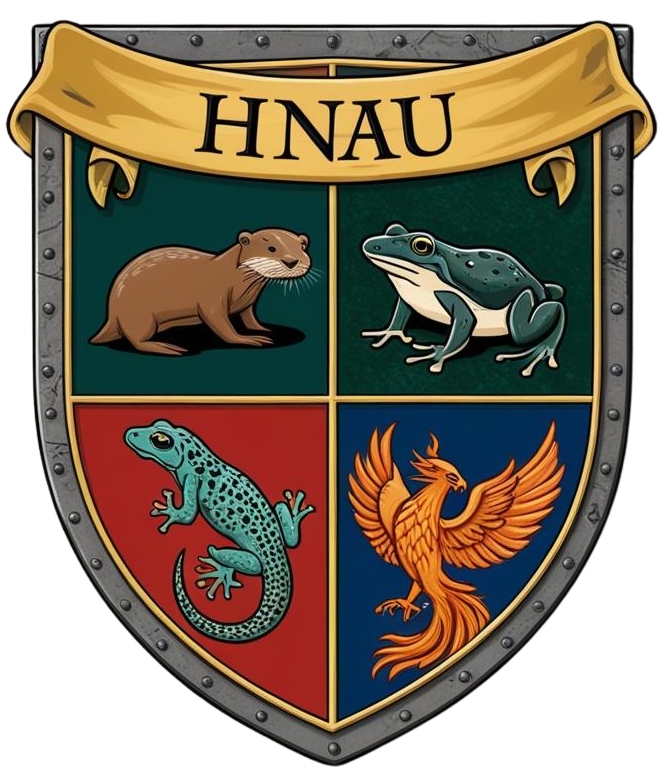
Notes: This abstract is slightly adapted already (I keep reworking it). I made the “HNAU” banner and shield with Canva, with hilarious results, I think.



 A Pilgrim in Narnia
This is clever. Very clever. I can’t wait to see where it takes you. I just finished the HP series again last week and you have got me thinking
LikeLike
Thanks Dave, I presented yesterday and it was a lot of fun. You can see a bit more in the most recent post.
LikeLike
In Hogwarts, virtually all creatures are sentient, from the spiders who flee from the presence of a basilisk to the hippogriff whose death is seen by Dumbledore to be as much a crime to be prevented as that of Sirius (who is human most of the time!). My primary problem with AI is that it is not, at present, sentient at all. It is a disembodied brain, like the demonic being who ruled the dark planet in L’Engle’s Wrinkle in Time.
LikeLike
Thanks Sharon, I presented yesterday and I thought of your comment before presenting. I ended up focussing on a fuller dentition of “human” (Hnau) that wasn’t as human-centred, so I didn’t tackle the nature of what AI is being now (and I don’t believe that we have AI. You can see a bit more in the most recent post.
Your comment about the “Dark” in L’Engle makes me think of the disembodied “Head” in That Hideous Strength.
LikeLike
Brenton, have you ever listened to Jonathan Pageau? He’s a Quebecois who talks about meaning in all kinds of narratives. His catch phrase is “symbolism happens”, but he’s not really a “catch phrase” type of person. He has some interesting ideas of what the things “on the edges” mean for stories. You may have heard his name paired with that of Jordan Peterson; their commonality is in some overlap in their thought of what is symbolic and how that works. Jonathan doesn’t subscribe to Jungianism, and he’s not a Peterson “follower”; he’s being a friend to an intelligent guy who is (right now) “Christian-adjacent”. Anyhow, if you have time, Pageau is worth a listen, on his own and with his other conversation partners. (Yes, he’s Orthodox but was raised Ev. after his parents left RC. He works as an icon carver.)
Break a leg at your presentation!
Dana
LikeLike
Dana, this is entirely new to me but something to hunt down-an iron carver who says “symbolism happens” is worth attention!
LikeLike
I shall sit in the back of the room and prepare a question about super-intelligent shades of the color blue.
LikeLike
I thought I responded to this! I appreciate that you were there at the back of the room. Before you leave Mythmoot I mean to ask you how potable water can have a blueish tinge.
LikeLike
Prof. Dickieson,
You mention trying to gain a better of “hnauology”, or Mere Humanity, from exploring the intersection between Authentic and Artificial Intelligence.
I’m not sure how much I can help with that. Though perhaps I can offer some few scattered bits of thought that can function as a starting point. For what it is worth, I’m struck by just how familiar, maybe even old-fashioned this whole dilemma seems. The be specific, the problem you talk about in the article above is very reminiscent to me of the same issues Lewis talked about in books like “The Abolition of Man”, “That Hideous Strength”, and the “Ransom Trilogy” in general. It seems to me that all we’re dealing with now is a revived occurrence of the same anti-Humanistic philosophies, and their various scientific applications that Lewis confronted in his era. Same stuff, different day, in other words. I think it might just be the fact that technology has advanced to an unparalleled degree since CSL’s day that grants it all a sense of novelty which it might find lacking in a series of pulp adventure yarns from the 1930s and 40s. If this is the case, then it might help to remember that this sense of novelty is probably more “perceived” as opposed to “apparent” and/or “real”. In other words, just because the philosophies of Weston and Devine have come bearing the same “gifts” in a new guise isn’t enough to change or hid what it truly is.
Beyond this, I get the impression you’re worried about the same topic that Lewis was in the “Abolition” texts. Are we once more in danger of creating Human Beings Without Chests? Well, I don’t know how much this helps, however, if this is the case, then it could be possible that there is at least “one” upside (so-called, for whatever that’s worth) to dealing with such individuals. It comes from the fact that they never seem to get very far in life. There’s a tragic side to this, as Lewis maintained. I can’t deny that. However, Lewis also said there was nothing inevitable about such a tragedy. Instead, it seems to boil down to a proper balance of nature and nurture. What my own experience of dealing with such Chestless individuals has taught me is that is that anyone with a bit of Heart in them can help them to recover whoever it is that they truly are. It’s all a simple matter of getting a one-dimensional perception to find and have any viable view of life that allows it to see in 3D (or however many dimensions is necessary for a full Hearted Chest). Going back to what I said about the limitations of Men without Chests, I’d argue that I’ve seen some good examples of the phenomenon in the world of the Arts.
More to the point, I’ve seen what might be described as the works of Men without Chests. As the Westonian problem you’ve broached above begins to crop up more and more in some people’s thinking, it’s almost as if they have no choice except to display how this effects their ability to do a lot of the normal tasks of living. This includes the capacity for Myth-making. This is the aspect of the whole affair that has caught my attention. And what I’ve seen convinces me of just this. Men without Chests don’t really seem to known what Art is for, what it does, or can do. They even seem to have any advanced notion of what Art is, or even means. The reason for that is because they’ve had their mental horizons shrunk to something resembling the entire living space of a sowing thimble. What results from this in practice is that anything the best lines of Shakespeare to the entirety of a classic like Steven Spielberg’s “Jaws” are all dismissed as dull and boring, at best, or else they are simply “wrong” or “incorrect” because they are unmutual to the Chestless outlook. As a result, the encounter with Art is nullified.
It gets even more intriguing when these same Chestless individuals try their own hand at storytelling. There’s one example of Chestless Artistry in particular that stands out to me, clear as day. The reason for that is because it does in fact dovetail not just with Lewis’s discussion of the dilemma in his non-fiction. The example of Chestless Artistry that I’m thinking of now actually went and borrowed from the same mythic pool of concepts that CSL utilized for the “Ransom Series”. An attempt was made to try and do the same thing as he did with novels like “Out of the Silent Planet”, except this time, the Medieval Model of the Cosmos was to be applied to a work of Science Fiction as a video game! This was an event that I caught notice of by pure chance, and yet I’m glad I did. It gave to the opportunity to see what happens when Men without Chests are put in charge of crafting Art based on the concepts of Mythopoeia. I learned a lot from that. One of the lessons is that Humanists like Lewis and Milton seem to have been more or less correct. You really did need to have a bigger Heart not just if you ever want to have a chance of enjoying, but also being able to tell any possible story well. The example I have in mind now is a textbook study of how an intriguing first draft of a maybe workable Creative Idea (to use Sayers’s phrase) is ultimately undone by the inability of Men without Chests to rise to the challenge of what Coleridge called the Imagination. It took a greater heart than the artists had in this case.
It’s something I decided to write about not too long ago. And like I say, the concepts of Lewis’s “Ransom” fiction play into on an interesting level. If you’d like to read more, it can be found here:
https://www.scriblerusinkspot.com/2025/01/the-curious-case-of-destiny-franchise.html
LikeLike
Hi Chris, I’m still here at the conference but I don’t want to lose track of your wonderful comments. Yes, I’m really talking about chestlessness! You got me, and your notes are relevant. I will check out the scriblerus essay and follow up when I’m off the road, but my larger “Authentic Intelligence” research and writing is really a long-term dialogue with Lewis on tyranny, humanity, “the chest”, techno culture, technocracy, empire, adventure, etc. I am curious whether you think there is a taste for a book along these lines where I do this and include some other authors in the dialogue.
LikeLike
Prof. Dickieson
,
That book idea sounds fascinating, and I would be interested in seeing such a publication in the near future.
In terms of any further notes, I’ll just note two in passing. The first is that the reference to the work of Coleridge is not an accident. The more I study what might be termed the historical roots of Mythopoeia, the more convinced I become that it has its origins in the thought of the Romantic Movement as a whole, and in particular the writings of STC. In other words, it makes sense to view Lewis and Tolkien as inheritors of the movement started by the likes of Blake and Coleridge, with a book such as LOTR as I’ve said elsewhere being an attempt by the author to prove to himself, as much as others, that such a philosophy still has its place in the world of Modernity. From what I can tell, the fact that so much of the literary critical discourse has begun to borrow from works like “On Fairy Stories” must stand as some kind of a testament to the shaping influence that the writings of Lewis and Tolkien have had.
Now, for a slightly controversial, yet I think viable enough idea. You mentioned a while back to having a theory surrounding the Horror elements in Lewis’s fiction, and were looking for any further pieces that might be said to help with this particular spot of the puzzle. Well, as someone who got into reading because of Things that Go Bump in the Night, my enthusiasm for the genre has reached a point where I kind of tend to want to know just as much about the behind the scenes details that go into the making of works by authors like Poe or Shirley Jackson, just as much as the actual works of literature in and of themselves. Now, it’s possible that I’ve stumbled on a connection between Fright Fiction and the work of Lewis. To summarize a long story, I seem to have found proof that one of the Narnian’s most favorite authors, Edmund Spenser, might have to be counted as a hitherto unheralded architect of the Gothic genre. Milton might have to fit into the rubric that I’m thinking about now, as well. Rather, let’s say I’ve stumbled upon the shared insights of older, canonical authors, such as Nathaniel Hawthorne. The author of “The House of the Seven Gables” is a key figure in the overlooked bit of Gothic history I’m writing about here. There’s more to share on this topic, if you want, though I go into more detail in a letter I left in your email account some while back. You can read all about it there, though only if it seems valuable.
LikeLike
What a wonderful idea for an essay. I think “hnauness” is an idea that needs to become more mainstream: the idea that what makes creatures truly sentient is their instinct to create. Any sort of robot or android we create in the near future can’t be a hnau because they either can’t create without a prompt or have been programmed with a creative instinct, so until we as a species get to the point where we can develop a Star Trek TNG-style Data, the concept of hnau will remain relevant.
I can’t really speak to the HP element of your piece since I stopped engaging with the series long ago, and I think, like Narnia, HP suffers from some inconsistent world building, but I think the piece will be a wonderful entry to audience members who are not familiar with the Space Trilogy.
Probably a different essay for you, but thinking about why the Space Trilogy is becoming all-too relevant now, I know Ross Douthat wrote an editorial about the topic a couple of years ago. As usual with Douthat’s work, it’s rushed and half-baked and he clearly doesn’t really understand Lewis’s writing, but, again, an interesting starting point. Elon Musk is definitely a Devine archetype who’s been ingratiating, and now consciously decoupling himself from, plenty of NICE-like figures lately. https://www.nytimes.com/2023/06/16/opinion/cs-lewis-ufo.html
LikeLike
Hi Cecilia, just a note that we are talking in the follow-up post, and that I should be following Ross Douthat a bit more. I think the Ransom Cycle is in an ascendency, but it will take a film to pop it out. I have an Out of the Silent Planet film treatment ready, but I don’t know how to stage Perelandra where everyone is new.
LikeLike
Look what the Postmodern NICE is cooking up…
The Invisible Leash. (Joshua Stylman – The Brownstone Institute – 17/6/2025)
https://brownstone.org/articles/the-invisible-leash/
I don’t think the author’s view is irrational… The Chinese could tell us a thing or two about what to expect in a total surveillance society, having been the guinea pigs for the test phase of this dystopia…
If you think totalitarians HAVE to be goose-stepping, Seig-Heiling Nazis, then the 21st century may surprise you by demonstrating that Evil may have more than one face…
LikeLike
Well, it seems to me that postmodern is almost quaint now in our days of absolutism and neo-objectivist cultural moment, where it isn’t just that I read the evidence differently than my opponent … we just aren’t reading the same evidence at all. What you see must be wrong because of its source. And because of what you believe, you aren’t really human, you don’t have the right to speak.
I miss the postmodern days when I could tell my story and call it mine and then see how it interacts with other stories. But that seems a long time ago.
The original NICE are somewhat dismissive meta narratives. Spreadsheets are what’s important, not humanity or morality or nature or anything. We are a generation that has become experts in pragnatometry.
The NICE’s cynical approach to the left and the right should warn us that we won’t see technocratic social control only on one side of what is probably not a spectrum.
LikeLike
By which I am agreeing that reducing the threat of tyranny to a right wing phenomenon is dangerous and wrong—and, indeed, that kind of thinking is part of the tyranny.
LikeLike
it may be of interest to some here that my web site has a fair-sized Ebook collection, with quite a few CS Lewis books.
https://www.samizdat.qc.ca/Ebooks/
All legal in Canada as here, Lewis’ works when into public domain in 2014. But Canadian copyright law was changed just before JRR Tolkien’s works went into public domain in Canada. Must be a coincidence, right??
LikeLike
Hi Paul, thanks for the note. I have used your site before and I appreciate that work. It helps me to do “distant readings” of the text.
LikeLike