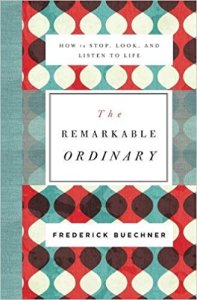
Christ and Hitler with C.S. Lewis and Frederick Buechner

This week, I have been sharing my thoughts about and some highlights from Frederick Buechner‘s recent book, The Remarkable Ordinary: How to Stop, Look, and Listen to Life (2017). Drawing materials from his memoirs–, which are a continual part of my devotional life, Buechner also reminds us in these newly published lectures some key moments in texts like The Alphabet of GraceA Room Called Remember, and Whistling in the Dark. Buechner wants to draw out how the transformational moments in life are not always remarkable miracles, but the attention to the details, the anticipation of the predictable, and astonished reflection upon the ordinary.

I have shared how Buechner quoted from J.R.R. Tolkien and George MacDonald, so it is only fitting to also share his brief quotation of C.S. Lewis. In his memoir, Buechner includes Lewis among his conversation partners when he worked as a chaplain and religion teacher at a wealthy private school. He also engages with Lewis, MacDonald, Tolkien and others in his chapter, “The Gospel as Fairy Tale” in Telling the Truth (1977). Beuchner also deals with Lewis pretty extensively in Telling Secrets (1981), which has a chapter on “The Dwarves in the Stable” from The Last Battle.

The Lewis quotation I am highlighting today is not terribly long, but it shocking and perhaps would fit well in its original context. When talking about “the face of Christ” in the people around us, Buechner closes chapter 1 of Remarkable Ordinary with C.S. Lewis:

Then there’s that wonderful passage in C. S. Lewis’s Letters to Malcolm where Lewis speaks of having met a European minister who had seen Hitler. Lewis says, “What’d he look like? What did Hitler look like?” and the minister says, “Like Christ, of course.” Like Christ. Tremendously moving.

Our secret face is that face. Paul’s right—the whole creation is moving, the whole great complex show has started so that we may eventually obtain the measure of the stature of the fullness of Christ, but to see it, the artist says, you have to stop and really look, look for it with X-ray eyes.

This is, of course, one of those moments where a Christian understanding of the “other” can be uncomfortable. In a generation of Christians being paraded across social media and news networks who clearly cannot recognize the face of Christ in the people in their neighbourhoods–let alone in the face of the widow, the orphan, the refugee, the stranger–Lewis’ reminder is essential. In Letter XIV of Letters to Malcolm, Lewis wants to press in on the biblical point that the stranger among us is Christ himself:

“Now the very Pagans knew that any beggar at your door
might be a god in disguise: and the parable of the sheep and
the goats is Our Lord’s comment. What you do, or don’t do,
to the beggar, you do, or don’t do, to Him.”

Avoiding theological extremes of legalism or what would look today like an “all is god” New Age thought, Lewis instead notes the “brotherhood” of being that is the stranger, the oneness who all share our human flesh. It is this fellowship of humanity that stands in distinction to God, the true Other: “All creatures, from the angel to the atom, are other than God; with an otherness to which there is no parallel.” One must not blur the distinction, for though “God is present in each thing,” it is not necessarily in the same mode or in the same degree.  And yet, God is present in each person:

“In each of them as the ground and root and continual supply of its reality.”

Therefore, of each person, there is both an otherness and a not-otherness, a shared reality and let a separate reality. And of this shared and distinct human experience, Lewis turns to the face of our enemy:

“Therefore of each creature we can say, ‘This also is
Thou: neither is this Thou.'”

Simple faith leaps to this with astonishing ease. I once
talked to a continental pastor who had seen Hitler, and had,
by all human standards, good cause to hate him. ‘What did
he look like?’ I asked. ‘Like all men,’ he replied. ‘That is,
like Christ.'”

Like Christ. Tremendously moving.

Posted in Memorable Quotes | Tagged , , , , , , , | 3 Comments

“I Would Rather Die for Evermore Believing,” with George MacDonald and Frederick Buechner

This week, I have been sharing my thoughts about Frederick Buechner‘s recent book, The Remarkable Ordinary: How to Stop, Look, and Listen to Life (2017). I have also been sharing some highlights from the text, including quotations from remarkable–and remarkably ordinary–authors. As Buechner wants to draw out how the transformational moments are not always astounding miracles, but the attention to the details, the anticipation of the predictable, and astonished reflection upon the ordinary, he turns to George MacDonald.

George MacDonald was a Scottish minister, lecturer, novelist, essayist, and fantasy writer. MacDonald was tremendously influential to C.S. Lewis and the Inklings, and is really a writer recovered in the last generation or so. He also, apparently, had quite an impact on Frederick Buechner‘s work. While the context of Buechner’s use of the following quotation is interesting, it is the strident and determined nature of the text’s voice that I want to highlight. Buechner captures a speech that MacDonald’s protagonist of Thomas Wingfold, Curate, speaks in the novel. I have always been uncomfortable with the all-in nature of this kind of comment–a speech that Puddleglum echoes in The Silver Chair. But I admire this commitment to the deepest rhythms of truth in the universe, even if it haunts me:

“Whatever energies I may or may not have, I know one thing for certain, that I could not devote them to anything else I should think entirely worth doing. Indeed nothing else seems interesting enough—nothing to repay the labour, but the telling of my fellow-men about the one man who is the truth, and to know whom is the life. Even if there be no hereafter, I would live my time believing in a grand thing that ought to be true if it is not. No facts can take the place of truths, and if these be not truths, then is the loftiest part of our nature a waste. Let me hold by the better than the actual, and fall into nothingness off the same precipice with Jesus and John and Paul and a thousand more, who were lovely in their lives, and with their death make even the nothingness into which they have passed like the garden of the Lord. I will go further … and say, I would rather die for evermore believing as Jesus believed, than live for evermore believing as those that deny him….”

Posted in Reflections | Tagged , , , , , , | 10 Comments

“Joy Beyond the Walls of the World, Poignant as Grief,” with J.R.R. Tolkien and Frederick Buechner

This week, I have decided to share my thoughts about Frederick Buechner‘s recent book, The Remarkable Ordinary: How to Stop, Look, and Listen to Life (2017), and to share some highlights from the text. Drawing materials from his memoirs in a storied approach to his life, Buechner wants to draw out how the transformational moments are not always remarkable miracles, but the attention to the details, the anticipation of the predictable, and astonished reflection upon the ordinary.

One of these great spots in Buechner’s book is another piece that originated as a lecture and became a famous essay. This is J.R.R. Tolkien’s brilliant piece, “On Fairy-stories,” first given in 1939 as a talk, and then drawn into the C.S. Lewis edited volume, Essays Presented to Charles Williams (1947), as well as some other collections like Tree and Leaf (1964). I have already published on Tolkien’s poem, “Mythopoeia,” but readers may not know how theory and ideas of “On Fairy-stories” shoots through my academic work.

In his closing chapter, “The Presence of Peace,” Buechner turns to the subject of “joy.” Given how important C.S. Lewis was to Buechner (see more on Friday), and how central joy is to Lewis’ spirituality (see here), prompting an autobiography called Surprised by Joy, we can imagine how he would turn to Lewis to discuss how one must listen for joy in everyday life. Instead, and with a great lyrical lift in the text, he turns to Tolkien’s “On Fairy-stories.” I will simply leave you with Buechner’s selection of Tolkien’s comments on joy:

And, of course, one of the things we must listen for is joy. It’s hard to talk about joy for the almost superstitious reason that you might take the bloom off it, you’ll quit, you’ll threaten it, you fear it will come to an end when the demons come and gobble it up. But almost in spite of ourselves we get glimpses of joy, and maybe glimpses is all we can ever have of joy. There’s a wonderful phrase of Tolkien’s in an essay he wrote on fairy tales where he speaks of “Joy beyond the walls of the world, poignant as grief,” which you glimpse in fairy tales during what he calls the “sudden joyous ‘turn’”—where the frog turns out to be a prince, where the straw is spun into the gold, or the funny little man turns out to be the king, or whatever it is. The sudden glimpse of a joy beyond the walls of the world. We do get glimpses of it, I think, if we have our eyes opened for that possibility, like when I suddenly realized that I was at the manger, or being at SeaWorld where I saw the peaceable kingdom and Eden and tears filled my eyes and also the eyes of my wife and daughter. These glimpses we have of joy—that’s part of the news of the day and a very easy part to somehow let slip by.

Posted in Reflections | Tagged , , , , | 12 Comments

“The Laughing Room of Maya Angelou” by Frederick Buechner

This week, I am sharing my thoughts about and some highlights from Frederick Buechner‘s recent book, The Remarkable Ordinary: How to Stop, Look, and Listen to Life (2017). Reminiscent of his memoirs–each year I select one to reread–with echoes from key texts like The Alphabet of GraceA Room Called Remember, and Whistling in the Dark, Buechner reads his life as a text. And in this story, he shows how the transformational moments in his life have not been grand miracles, but the attention to the details, the anticipation of the predictable, and astonished reflection upon the ordinary. It is not a terrible tight collection, but I am grateful for the release of these old lectures and some new material.

Today, I want to share with you the time when Buechner first met Maya Angelou at a shared series of lectures by the Trinity Institute. These lectures are “geared for burned-out Episcopal clergy—men and women who simply have had it,” Buechner says. Often filled with big names like theologian Jürgen Moltmann, archbishop Desmond Tutu, the archbishop of Canterbury, and the like, these thinkers and writers and ministers talk about ethics, the church, and the role of Christianity in terms of culture. Buechner, a relatively well-known novelist, was invited to share from his recently published memoirs, The Sacred Journey (1982) and Now and Then (1983). No doubt the audience of church leaders would be intrigued by hearing from a clergyman working in the arts, sharing about the moments when God had worked in Buechner’s life.
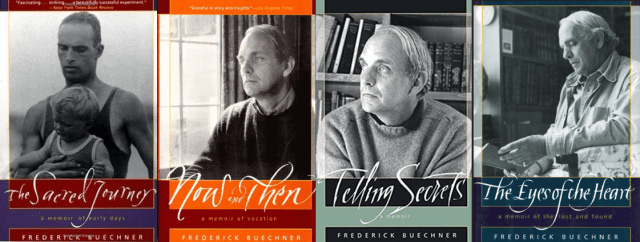
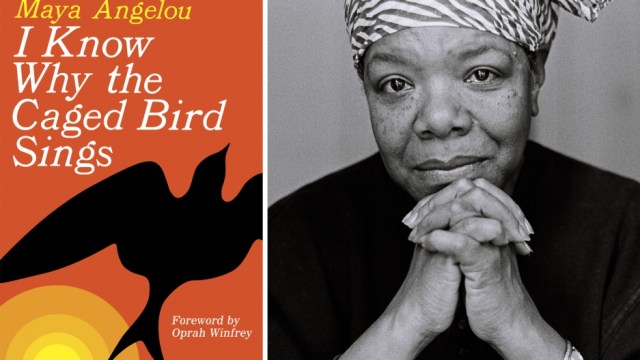
It isn’t hard to explain why Maya Angelou would be invited, and Buechner particularly notes I Know Why the Caged Bird Sings as one of his favourite of her writings. Buechner describes encountering her in his life:

Maya Angelou is a large woman about my height, black, beautiful, and so full of energy you can warm your hands in front of her. She was born in the South and brought up in great poverty by her grandmother in the little town of Stamps, Arkansas. Awful things happened to her. She was raped at the age of eight, not a violent rape but a sort of one-thing-leads-to-another rape by a boyfriend of her mother whom she’d gone to visit. She came back from that experience afraid to tell anybody about it, but she eventually told her little brother Bailey that this thing had happened. By a fluke, within a couple of days of that, word came that the man who’d raped her had died, and she was terrified that her words had killed him. So she was mute for five years—didn’t say anything for five years. Well, she grew up, became a dancer, became a waitress, became a cook, and for a brief time she was a prostitute. She fell on evil times—the man whom she was with at that time said he needed some money and, if she wouldn’t mind, could she entertain some of his friends, and she did that for a time. Then she started to write and one thing led to another—acclaimed books, operas, films, and TV shows. She’s a Renaissance woman, in other words. Full of life, full of beans, full of stories.
Buechner tells two or three great stories about Maya Angelou and what she said and did, and I would encourage you to read the entire third chapter of The Remarkable Ordinary–including what a “laughing room” might be. I would, however, like to share two bits, out of order in the chapter.

One story is about the way that Angelou and Buechner were introduced, and how Angelou worked to bridge the distance between the wealthy, white, urban Presbyterian minister and her own experience as a black woman coming out of extreme poverty.

The other thing Maya Angelou said that moved me was when the two of us were being introduced by the friendly fellow I had made cry on the phone. I had given my lecture first, which was based, as I said, on my spiritual autobiography, and after I was done, this fellow introduced Maya, saying, “Ms. Angelou will now get up and tell you her story, and it will be a very different story from the one that you have just heard from Frederick Buechner.” As he said that, Maya Angelou, who was sitting in the front row and shaking her head from side to side, got up, and she said he was wrong. She said, “I have exactly the same story to tell as Frederick Buechner.”

I was very touched by that because in so many ways, what stories could be more different? I’m a man and she’s a woman, I’m white, she’s black, she grew up in dire poverty while by comparison I grew up with riches, though God knows we weren’t rich, and yet she said it’s the same story. And what she meant I think is that at a certain level we do, all of us, with all the differences, we do all have the same story. When it comes to the business of how do you become a human being, how do you manage to believe, how do you have faith in a world that gives you 14,000 reasons every week not to believe, how do you survive—especially surviving our own childhoods as Maya Angelou survived hers and we’ve all survived ours—at that level we all have the same story, and therefore anybody’s story can illuminate our own.

And that’s the only reason I have, the only justification, to tell you my story. Who gives a hoot about my story? But you can give a hoot about it because also it’s in many ways your story.
I don’t know how Maya Angelou’s work to bridge the distance of culture with the universality of story would go over today, but it was a striking moment for Beuchner nearly 40 years ago. I will leave you with another one of these stories, this one about an encounter Maya Angelou had with a friend–and, I think, an instance of The Remarkable Ordinary that Buechner is trying to draw out, the astonishing beauty within everyday life.

The most moving part of my time at Trinity happened after one of Maya’s lectures. There had been a number of questions and one person asked her a question about racism—has it gotten better, has it gotten worse, is it better in one place in the West Coast than the East Coast? And she had said, “Let me tell you a story.” She said she had been in the San Francisco Bay area fifteen years or so before to do a public television program on African art, and out of the blue one day she got a telephone call from a white man who told her that he had a collection of a certain kind of African statue and perhaps she would like to come over and look at them. So she went over and they were wonderful examples of whatever form of African art they were, and he lent them to her and she used them in ways that pleased him. Through this experience, they became great friends. She went to his house for dinner a number of times, got to know his wife, and Maya had them over to her place for dinner, and they were terrific pals. She said it had been one of the bright spots during her time there, and then the public television show was over and she went back to wherever it was she went. Time went by and about four or five years later she returned to the Bay Area, this time for a longer period of time. So right away she called up her friend, who told her he’d be delighted to see her again. He said, “Let me just catch you up on what I’ve been doing since I saw you last. I have been in Europe working on the problem with American troops over there. It’s not an easy row for them to hoe in a way,” he said, “and it’s especially hard for the black troops for obvious reasons. There aren’t too many blacks over there, but our boys are also having a hard—”

She interrupted him. “What did you say?”

“I said, in Europe it’s especially hard for the black troops, and that our boys are also—”

“What did you say?” She had interrupted him again, she told us, because she wanted him to hear it.

So again, “Well, the black troops . . .” and then he got it. “Oh my God! What have I said to you, of all people? The black troops . . . our boys. I’m so embarrassed I simply have to stop talking. I’m going to hang up. To say this to you, of all people.”

And Maya had said, “No, don’t. Don’t hang up. This is just the time we need to talk. This is what racism is beneath the level of liberal utterance and superficial friendship, the sort of deeply rooted sense of we and they, the whites, the blacks, the browns, the whatever it is.”

So they finished off their conversation agreeing that they would meet. Then she said after that she had tried to call him innumerable times and left messages of one kind or another, and there was never any response at all.

She told us that was the end, and when she had finished that question and answer time, she had been obviously very moved and sort of shaken by it. The next day she had started her lecture reflecting on this story about racism, saying, “As I left the room yesterday, a man stood up and said, ‘Here I am!’”

No sooner had these words left her lips when this small, bearded, white Episcopal clergyman suddenly stood up in our midst a few rows behind me and walked down the aisle, up onto the platform, and put his arms around her. He was, of course, her friend who had been too embarrassed to talk to her anymore. And she cried and he cried and all of us cried because we just got a glimpse of the kingdom of God. So moving. So gorgeous.

Posted in Memorable Quotes | Tagged , , , , , , , | 6 Comments

The Remarkable Ordinary, with Frederick Buechner

A few weeks ago, I wrote about being “Enslaved to the Pressure of the Ordinary.” This was a quotation I found in The Screwtape Letters, and what I thought was a self-revelation I had during our COVID-19 lockdown and the “new normal” we have to face. This is what I wrote:

“for me, the strange self-revelation of 2020, is how much I am mourning the ordinary. I don’t want a new normal, I have come to realize. I want the old normal, the patterns and stirrings and possibilities of everyday life before the end of the world hit in early 2020”

Characteristically, it takes me more than a single try to find my words and ideas. This is one of the reasons I blog: sometimes you have to say something out loud to know if it is true. A number of people wrote to me, concerned that I was missing an essential part of life that they had recovered themselves. “The mundane can be beautiful,” one person assured me. Another reader wrote in and said:

“’Ordinary Life’ can be a good gift from God. It is when our clinging to or yearning for ordinary leads us to sin that is the danger. If we hold it loosely, if we are willing to accept whatever God brings us in each day, I am not certain it is wrong to appreciate and savor the good in the ordinary.”

I think this reader is on to something that is inside of me, though I would press it a little further. I do think that the “every day” can be a gift, can be beautiful in its very mundaneness. I like the image of holding the ordinary loosely, because what my self-revelation was about in 2020 was actually the enslavement to the normal that worried me. And reflection since has led me to realize that I learned more in 2020 than I had imagined.

For the last two decades, I have lived my life trying to resist the snares of “what everybody does,” shaping my vocational choices, my community service, and my family life as a kind of resistance to the white picket fence suburban picture of success I had imbibed as a child in the late 20th century. For a long time, that meant staying off the grid of socioeconomic culture, living a kind of vagabond lifestyle in various parts of the world. Since then, because we have made certain choices, I have been able to write and teach and study what I wanted–always with unhelpful pressure to pay the bills as a non-tenured, unsponsored public intellectual, but never finding ourselves disappearing into sheer necessity. Socially, spiritually, intellectually, religiously, environmentally, and economically, I have resisted the “normal.”

Indeed, not to put too fine a point on it, I believe it to be immoral for most Christians to live a normal Canadian (or American, or Western European) lifestyle. Even if not immoral, how tepid to live one’s life according to the Baby Boomer washing out of the American Dream that has been handed down to us!

And yet, with all my rebel dress and revolutionary heart, COVID-19 hit and I found out how absolutely dependent I was upon the normal systems and patterns of our world. I now believe I have always misunderstood Mario Savio’s famous speech. He protested in 1964, crying out that

“There’s a time when the operation of the machine becomes so odious, makes you so sick at heart”

So sick at heart. That’s where my mind hung since I first heard those words, sampled in a song I now forget. How mind-numbingly, soul-destroyingly normal North American life seemed to me–enough to make me sick at heart, though I am not one of the oppressed. To be a cog in that machine that strains the last bit of life out of every person–no, of course, I mean every taxpayer. Sick at heart. Those words.

Yet I missed the part where Savio called us to cast our “bodies upon the gears and upon the wheels” of the machine, to allow our ragged flesh and crushed bones to jam the workings of the whole damned and damnable thing. 2020 has been that kind of year too, a year of disruption, of reflection about the systems we participate in and the ones we perpetrate. Though I have been trying to reconfigure the machine, I have not died upon it.

As this call for liberation echoes in my ears this year, it brings home even more clearly to me my desperate “attachment” to this world–to use a Buddhist image. In St. Paul’s words of Romans 12:2, I have aligned the schematic of my life to the world’s blueprint in ways I was never aware of. I think the two kinds of liberation are linked, that we cannot truly have that radically sacrificial, community-connected, love-infused liberation of Romans 12 as long as we are simply cogs in the machine of the world around us. That this world system is so liberating to many, so full of opportunity and beauty and potential for equality, only makes our unreflective submission to it even more nefarious.

Thus the normal kills–both in the individual soul as well as the systemic violence of bigotry and inefficiency and technocratic ends that match economic means.

And yet there is great beauty and grace and laughter here in the ordinary. This cup of coffee, the music in my ears, waking and laying down in warmth and love, children playing in the other room, the cat supervising my work, these books at my elbow and on my bedside, making love and sharing the sign of peace, mandarin oranges, arugula, cameras in our pockets, fat snowdrops on red and brown faces, beautiful eyes above non-medical masks, the season’s death and rebirth in the great turning of the world. Oh, the beauty that there is!

So when I wrote late last year about enslavement to the normal, I really was not rejecting all the little patterns we make in our jobs and families and friendships. Humans are liturgical beings, and I believe it is healthy for us to make little liturgies of the ordinary. Sometimes that ordinary is disrupted like it was in 2020. And in that disruption, I discovered patterns in myself that I could not recognize in the cross, which is the model of true life. For there is also a danger in the normal, the mundane, the everyday–as anyone who has been crushed by the machine of the world can tell us.

Intriguingly, even when kindhearted readers were challenging me about my understanding of the ordinary, I knew I was struggling with the words to say what I mean. Truly, I anticipated that I wasn’t quite capturing what I wanted to say even before I published my piece. So I picked up a book to read devotionally, Frederick Buechner‘s The Remarkable Ordinary: How to Stop, Look, and Listen to Life (2017). Each year I select one of Buechner’s memoirs to reread, and The Remarkable Ordinary is very much reminiscent of those autobiographies. There are also echoes of key texts like The Alphabet of GraceA Room Called Remember, and Whistling in the Dark. In The Remarkable OrdinaryBuechner reads his life as a text. And in this story, he shows how the transformational moments in his life have not been grand miracles, but the attention to the details, the anticipation of the predictable, and astonished reflection upon the ordinary.

Admittedly, this tiny book is not a terrible tight collection. It pulls together some old lectures and some new material to help us recover or reimagine our relationship to mundane reality. However, with some imagination on our part, we can walk alongside Frederick Buechner as his memories and experiences show the little moments of grace in the daily routines and terrible surprises of life. To live my life going against the grain of the world’s systems–both in solidarity with those who suffer and for the health of my soul–does not mean that I reject the simple and lovely ordinary things in life. Indeed, I think that’s where my greatest strength comes from: the Spirit of God in my heart and at my elbow, at my desk and the dinner table, as I lay down to sleep and rise to walk in the road. So I am thankful for Frederick Buechner’s newest collection of ideas for reminding me of the liberation that comes in the normal moments of life.

This week, I will be blogging each day with a reflection from Frederick Buechner‘s The Remarkable Ordinary: How to Stop, Look, and Listen to Life. You do not need to have read the book to enjoy these articles, but this is a text worth having.

Posted in Memorable Quotes, Reviews | Tagged , , , , , , , , , | 5 Comments