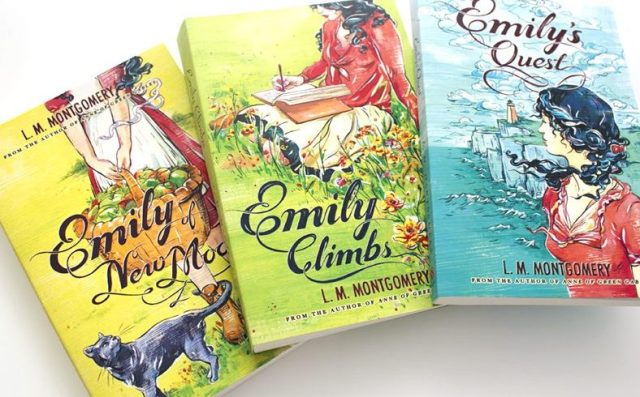
I was pleased to be part of a great online conversation on Saturday, a “Round Table” about L.M. Montgomery’s novel, Emily of New Moon. This is by far my favourite Montgomery novel in terms of artistry and thoughtfulness, a Cinderella book, I think, a sleeping giant of Canadian literary fiction. I think it is nearly a work of artistic genius–all the more so because the rich, layered tale masquerades as simply an accessible coming-of-age tale of a precocious writer. There is such vibrancy in this novel–such a taste of artistic delight, numinous joy, and the harrowing of the pilgrim’s soul–that I cannot emphasize too much how great it can be for invested readers.
Speaker List:
Brenton D.G. Dickieson, “The Megan Follows Audiobook Version of Emily of New Moon“
E. Holly Pike, “Age Values in Emily of New Moon“
Kate Sutherland, “Lessons in Law in Emily of New Moon“
I am not the only one to think Emily of New Moon an important novel and rich for conversation. So, on Saturday, I was part of a Round Table discussion with editor extraordinaire Benjamin Lefebvre as moderator. Three of us as “speakers” guided the conversation with an opening thought. Law and literature scholar, Kate Sutherland, considered the ways that morality and social structure were formed and re-formed in the novel. E. Holly Pike, whose co-edited L.M. Montgomery and Gender (with Laura M. Robinson) will be released later this fall by McGill-Queen’s University Press, spoke about “old” and “young” in the novel, using a central image of old and young women and old and young trees to provoke thought.
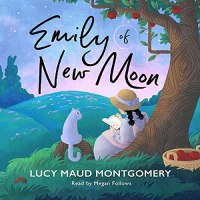
Both of these conversations left me with so much to think about that I would have been pleased to simply talk about these topics, which struck me as quite connected. I did have a conversation thread as well, however, on a new audiobook adaptation of Emily of New Moon. Megan Follows was, for me, the “voice” of Anne as she starred in the 1980s Kevin Sullivan Anne films. Late this summer, an audiobook production featuring Follows as the reader was released. It is well done as a performance, and I particularly like Megan Follows’ reading of Sheridan Le Fanu’s 1872 novella, Carmilla.
However, what I hadn’t seen in the initial advertisements about the project, was that the audiobook was abridged. And deeply abridged, leaving only about 48.7% of the original content, I estimate (though I don’t have a transcription, to be certain of those numbers). As you might expect, the abridgement comes at some literary and artistic cost, as the narrative emphasis on certain themes, images, and character lines gets shifted. In this abridgement, however, entire chapters–and, indeed, one entire central character–is cut. My conversation was about teasing that problem up and talking about what we lose in the abridgement (including, as I admit after a perceptive question, on a bit that still leaves me puzzled). I am not a book history specialist, so I perhaps fumbled Ben’s question about “what is the abridgement doing?” Later, in our conversational afterglow that isn’t in the video, I did remind us that the abridgement seems like a shaping of us as readers–and a commercial shaping, specifically.
Thanks muchly to Andrea McKenzie for hosting, Ben Lefebvre for moderating the speakers’ dialogue, and Caroline Jones for moderating the chat–all Montgomery scholars and generous with their time and thoughts in this conversation. I had fun and look forward to seeing what they come up with next.
You can now see the entire video on Youtube now:
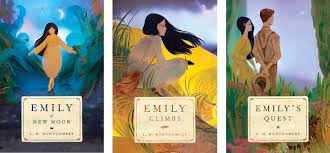
This event is part of the “Conversations about L.M. Montgomery” series, and came out of the L.M. Montgomery Readathon on Emily of NewMoon, which began early this summer. Developing out of a need for pandemic-era connection, and led by Montgomery scholars such as Ben and Andrea, it has developed into a dynamic online reading community. The “Readathon” is now moving into the Emily sequel, Emily Climbs (which began last week). You can join in on Facebook.
I believe in open access scholarship. Because of this, since 2011 I have made A Pilgrim in Narnia free with nearly 1,000 posts on faith, fiction, and fantasy. Please consider sharing my work so others can enjoy it.
Happy Friday dear friends! As regular readers will know, I teach at Signum University in their online MA program. Part of Signum’s culture is to have some local gatherings–moots, they are appropriately called, and now hybrid events for those who cannot draw near–as well as some free online events. Hobbit Day was the launch of our annual fall fundraiser, and so there are all kinds of great things going on. I thought I would take a moment to share these opportunities for you to connect and learn. You will gain much, and Signum’s mission for online, accessible, global-leading education in imaginative literature and Germanic philology is a worthy cause to support. And check out some “Don’t Miss This!” events below of other sorts (including a Emily of New Moon Round Table I am a part of tomorrow, and HutchMoot).
New England Moot 2021: Second Breakfast (Sep 25, 2021 in NH)
Please join us in Durham, NH on Saturday, September 25th (tomorrow) for scholarly papers, creative presentations, and fellowship. We will consider nourishment for body, mind, and spirit all within the Signum University common interests of philology and imaginative & classic literature. This is a hybrid event with local and online activities. See here for registration details. And what a great theme!
Presentations begin close to 9:30am Eastern Daylight Saving time:
James Tauber – Counting Breakfasts: Text Analysis in Lord of the Rings
Rob McKenzie – The Enduring Attraction of The Pilgrim’s Progress
Sarah Anne Stinnett – The Gastronomic Delights of Shakespeare’s Dream: Food and Desire in A Midsummer Night’s Dream
Liam Bisesi – Second Breakfast
Corey Olsen – Fabulous Feasts: a consideration of the magnificent meals in British literature
Pilar Barrera Wey – Colour and Light in Tolkien’s The Hobbit: Home, Greed, and Hope
Mark Schennum – A Game of Connections: ‘The Wreck of the Hesperus’ / ‘Earendil was a Mariner’
Steve Melisi – Literary Second Breakfast: The Rewards of the Re-Read
Mickey Corso- The Lady and Our Lady: Galadriel as a ‘Reflexion’ of Mary
Kate Neville – Eärendil is not “The Morning Star.” Change my mind. (#ChangeKatesMind)
Thesis Theater: Shawn Gaffney, “Hidden Contact: The Unremarkable Evidence of Brittonic and Latin Effects on English” (Sep 28, online)
Signum master’s student Shawn Gaffney will present his thesis “Hidden Contact: The Unremarkable Evidence of Brittonic and Latin Effects on English” and respond to questions from the audience in an interactive Thesis Theater. The discussion will be facilitated by Shawn’s thesis supervisor, Nelson Goering. Join us on Sep 28th at 10:00am Eastern by clicking here for details, including Shawn’s bio.
Thesis Abstract: At the beginning of the fifth century, the Anglo-Saxons arrived in Britain and within two centuries they had become a dominant presence throughout much of the island. They encountered the Romano-British and Romans, speaking Brittonic and Latin, but the presence of these two groups, their effects on culture and language, as well as their survival into later centuries are sometimes neglected in modern scholarship. Both peoples did not just disappear at the arrival of the invaders but instead interacted in ways that are still visible today, especially with respect to lexical items and place-names. Language contact theories suggest that instead of a lack of contact, these limitations of data demonstrate the specific effects of certain types of contact. Substrate languages can affect the dominant language through phonology and syntax while leaving the lexicon relatively unchanged. An understanding of how contact and substrate effects is crucial for understanding potential models of cultural contact between the disparate groups. These models demonstrate how the different groups could interact over the centuries and still present modern scholars with the perceived limitations of evidence.
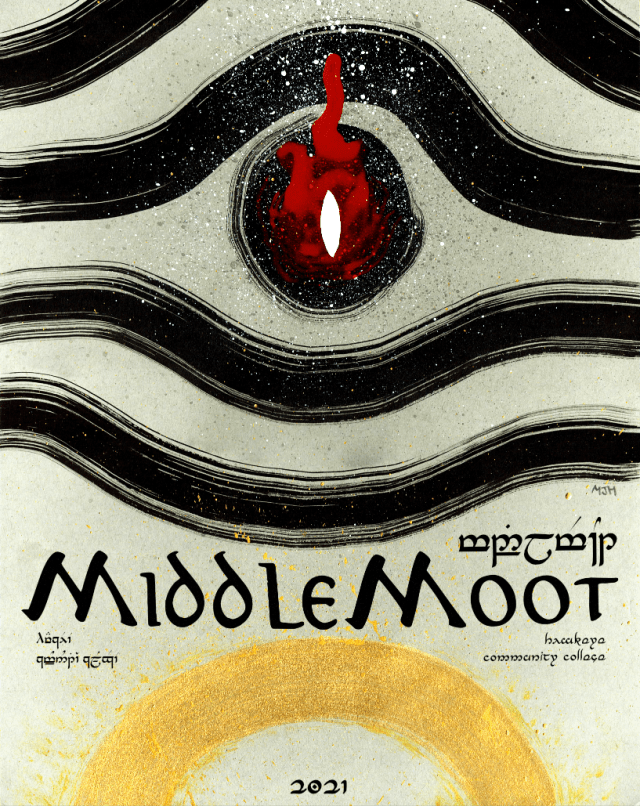
MiddleMoot – Philology: Lover of Words, Friend of Words (Oct 9, 2021 in IA)
MiddleMoot 2021 will be held at Hawkeye Community College in Waterloo, Iowa, and is co-sponsored with Signum University, with support from the Tolkien Society of Iowa City, Smial of Avallónë. Our keynote speaker and guest-of-honor is Michael Drout, philologist and pre-eminent Tolkien scholar. We are also honored to have Corey Olsen, The Tolkien Professor and president of Signum University, in attendance. The theme of the conference is “Philology: Lover of Words, Friend of Words.” Come join us as we explore various aspects of the importance of language, linguistics, and philology among other topics in Tolkien’s work! Please be aware that the registration fee includes a hot lunch and access to all activities and materials associated with the conference. We plan to follow current (early October) CDC and Iowa public health guidance pertaining to mask-wearing and other pandemic-related protocols for indoor gatherings. For more details, including a Call for Papers and Presentations, see here.
TexMoot 2022 (Feb 12, 2022 in TX)
This is just a place-holder note, but you can watch this link for future details. Last year’s TexMoot–where I asked the question, “Is C.S. Lewis too Sexy for America?”, was a great day, and I am looking forward to this local/online hybrid conference day next Winter.
And the Full Details of the Signum University Annual Fund Campaign
This year’s campaign will take place between Wednesday, September 22, and Saturday, October 16, 2021. Besides events and broadcasts, there are gifts and prizes for donors. Check out the Annual Fund page for details.
9/25 New England Moot: Second Breakfast
While this regional moot is not campaign focused, Corey will be talking a little about the campaign, and perhaps more importantly, giving away some prizes to attendees, both corporeal and virtual! Use this link to go to the event webpage and join in the fun!
10/2 Wigend Muscles through Mordor Marathon
Join Corey on our SignumU Twitch channel to watch him take Wigend through Mordor in LotRO. More prizes will be tossed about!
10/9 Middle Moot – Philology: Lover of Words, Friend of Words
Again, this regional moot is not campaign focused but Corey will have a few words to add and will be taking the opportunity to spread more thanks and gratitude in the form of prizes!
10/16 The Annual Webathon!
It will be a day-long blast, as usual. We have some delightful content planned for everyone as well as the annual State of the University address. The webathon will culminate in more LotRO shenanigans for those that didn’t get enough during the marathon.
We will be posting more details here soon, including the link to the webathon broadcast.
Don’t expect an early start as our fearless leader is rather vampiric in his daily sleep and work cycle.
Emily of New Moon Round Table (Sep 25th, online)
I don’t want you to miss tomorrow’s New England Moot–and I do wish I was there, since it is so close (just a 9 hour drive, what we call a short jaunt in my part of the world)–I would like to remind L.M. Montgomery fans that I am part of an Emily of New Moon Round Table conversation tomorrow (see here).
Hutchmoot: Homebound (Oct 8-10, online)
Also of note–and also aligning with other events and Canadian Thanksgiving–the wonderful folks at the Rabbit Room (including songwriter and storytelling brothers Andrew and Pete Peterson) are hosting another Hutchmoot: Homebound on Oct 8-10, totally accessible online, with talks and performances from our own (can I call them that?) Diana Glyer and Malcolm Guite, and other folks I love or admire for selfish reasons, like The Gray Havens, JJ Heller, Jerry Root, and Sho Baraka (and Walter Wangerin, Jr. is on the speaker’s list, though he sadly passed away a few weeks ago). Click here for tickets.
I believe in open access scholarship. Because of this, since 2011 I have made A Pilgrim in Narnia free with nearly 1,000 posts on faith, fiction, and fantasy. Please consider sharing my work so others can enjoy it.
At A Pilgrim in Narnia, we have an occasional feature called “Throwback Thursday.” By raiding either my own blog-hoard or someone else’s, I find a blog post from the past and throw it back out into the digital world. This might be an idea or book that is now relevant again, or a concept I’d like to think about more, or even “an oldie but a goodie” that I think you might enjoy.
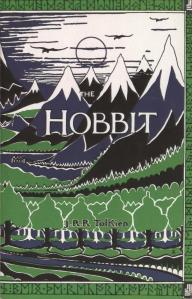
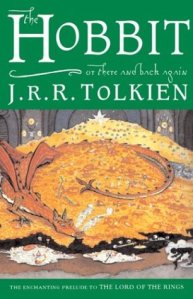
In scrolling through social media last night, I was inspired by Hobbit Day posts and thoughts. I have become enthralled by a heavy work period and forgot to take some time to reflect on Bilbo and Frodo’s birthday, September 22nd. So, for today’s Throwback Thursday, I am returning to a post from nine years ago. Nine years! This little reading reflection was one of my first forrays into networking online with other writers and fans. In celebration of the then forthcoming Peter Jackson Hobbit film trilogy, David ofThe Warden’s Walk hosted The Hobbit Read-Along. I was assigned Chapter 5: Riddles in the Dark, a particular favourite of mine. While the piece strikes me as overly buoyant and a bit precious–it was nine years ago and I did create this blog to improve as a writer–I still kind of like it. Lovers of the book might even get the joke. It is also my most popular Hobbitpost ever, read more than 4,000 times. I should note that Nicolas, now 16, no longer calls him Bilboy. I hope you enjoy this most shire-like of September days.
Here is a riddle for you:
Besides food and ice, what have I got in my deepfreeze?
Give up? I don’t suppose it is a very fair riddle, and certainly isn’t a genuine riddle according to the ancient laws. Truly, a person could have just about anything in a deep freeze. I have an external hard drive that gets overheated, so twenty minutes of freezer time fixes it up. I once put a valuable hockey card in the freezer to get the gum off of it without ripping it. And I have a friend who freezes her credit card in a block of ice so it takes a long time to melt, ensuring her purchase has been given much thought. A freezer could hold most anything.
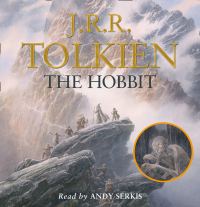
In my case—and here I will give you the answer to this clever riddle even if death is on the line—I’ve got my copy of The Hobbit in the deepfreeze.
Purely by accident, of course. This fall, when I began reading The Hobbit to my son, I searched high and low for my old, ragged copy. I have read it many times as it has been in my collection from time beyond memory. It may even have been a birthday present. It is precious to me. Alas, I must have loaned it to someone who is not a genuine book-borrower according to the ancient laws. “Where iss it? Where iss it?” my family heard me crying among our basement bookshelves. “Losst it is, my precious, lost, lost! Curse us and crush us, my precious is lost!” Ah, well.
Once I recovered myself, I purchased a copy from a local bookseller and left it in our back porch beside the dryer. When I went to bring it on our (Canadian) Thanksgiving holiday weekend, it was gone. I was scrabbling here and there, searching and seeking in vain. I was inconsolable as I left the house for the car. “It’s no good going back there to search, no,” I said to myself in the driveway. “We doesn’t remember all the places we’ve visited.” Suddenly I sat down on the back step and began to weep, a whistling and gurgling sound horrible to listen to. My wife, having kept her presence of mind, suggested we pick up another copy. After all, there were dozens at the store. I was okay after that.
Having the faintest sliver of hope I would save $10.99 (Canadian), I did not purchase another copy, but read to my son from the e-reader. When we returned home from the weekend I stood in the back porch, determined to find the missing precious, I mean book. I looked in all the cupboards, in the washer and dryer, and in the hidden spaces in between. It simply wasn’t there. Almost by pure accident, I opened the deepfreeze, and my hand met what felt like a paper book lying in the dark on top of the honey garlic chicken wings. It was a turning point in my career, but I did not know it. It was only ten minutes ago, after all.
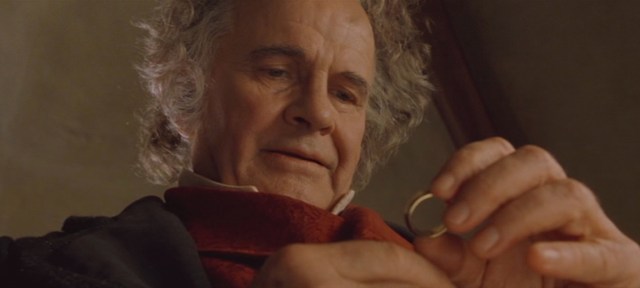
The riddle of my missing book aside, this chapter is truly a turning point in the story, and the hinge that locks the entire mythical world of Middle-earth into place. This is the chapter where Bilbo (or Bilboy as my young son calls him) finds the ring of power, setting the stage for The Lord of the Rings epic. It is also the chapter where we meet Gollum—that psychologically complex shadow of a mind in stretched skin, slinking in the inky darkness within the heart of the mountain, pouring all his love and hatred into one thing: the ring.
What strikes me about this chapter, however, is the accidental nature of the “turning point in his career.” Forgetting for a moment how The Fellowship of the Ringfilm reshapes our minds on what is taking place in Bilbo’s discovery of the ring, and leaving behind what we know of the epic that Tolkien writes years later–and, in doing so, rewrites this chapter–accidents and cheats abound in this little chapter.
Bilbo finds the ring in absolute darkness—“When Bilbo opened his eyes, he wondered if he had; for it was just as dark as with them shut”—and absentmindedly puts it in his pocket. In the darkness he follows a tunnel that, after a journey of many hours where Bilbo chose no other paths, leads to Gollum’s lair. Gollum, as it turns out, has just eaten a goblin, so his curiosity is greater than his hunger. Bilbo, then, finds himself in a battle of wits—to the death!—a contest of riddles according to ancient traditions that even this fallen creature would respect. Bilbo was immensely fortunate that he wasn’t “throttled from behind” as was Gollum’s customary hospitality.
That, my friends, is a striking number of coincidences.
Even the game seems chanced in Bilbo’s favour. He is good at riddles, and finds the first few easy. But Bilbo finally gets stuck on this one:
Alive without breath, As cold as death; Never thirsty, ever drinking, All in mail never clinking.
Bilbo is absolutely flummoxed until, at just the right moment, a fish jumps out of the water and lands on his lap. The answer is, of course, “fish,” and Bilbo is saved just in time.
And this is not the only extremely fortunate accident. Faced with an impenetrable riddle, faltering in the dim light, Gollum decides it is time to eat this hobbit that has lost the riddle contest.
Gollum began to get out of his boat. He flapped into the water and paddled to the bank; Bilbo could see his eyes coming towards him. His tongue seemed to stick in his mouth; he wanted to shout out: “Give me more time! Give me time!” But all that came out with a sudden squeal was:
“Time! Time!”
Bilbo was saved by pure luck. For that of course was the answer.
Pure luck, again, is Bilbo’s friend.
Even the final play of the game, the riddle that seals the fate of each of them (and all of Middle-earth), comes by chance:
Bilbo pinched himself and slapped himself; he gripped on his little sword; he even felt in his pocket with his other hand. There he found the ring he had picked up in the passage and forgotten about.
“What have I got in my pocket?” he said aloud. He was talking to himself, but Gollum thought it was a riddle, and he was frightfully upset.
“Not fair! not fair!” he hissed. “It isn’t fair, my precious, is it, to ask us what it’s got in its nassty little pocketses?”
Bilbo seeing what had happened and having nothing better to ask stuck to his question. “What have I got in my pocket?” he said louder.
“S-s-s-s-s,” hissed Gollum. “It must give us three guesseses, my preciouss, three guesseses.”
“Very well! Guess away!” said Bilbo.
What Gollum would later know to be a certainty—that Bilbo had a ring in his pocket—at this particular moment was not even a possibility in Gollum’s imagination. Moreover, the riddle is not a fair one—no more than the deepfreeze question above. It takes a game of cleverness and symmetry and turns it into a game of chance. Granted, the stakes were not fair from the beginning: if Gollum won, Bilbo would be eaten; if Bilbo won, Gollum would show him the way out. Still, the entire story turns on a cheat–or, at least, chance.
The number of accidents and the layers of “pure luck” are too much for the reader to imagine there are no other forces at play. When Gollum discovers that the Hobbit has his precious ring, he chases after poor Bilbo, who bumbles breathless away in the darkness.
“What has it got in its pocketses?” [Bilbo] heard the hiss loud behind him, and the splash as Gollum leapt from his boat.
“What have I, I wonder?” he said to himself, as he panted and stumbled along. He put his left hand in his pocket. The ring felt very cold as it quietly slipped on to his groping forefinger.
The hiss was close behind him. He turned now and saw Gollum’s eyes like small green lamps coming up the slope. Terrified he tried to run faster, but suddenly he struck his toes on a snag in the floor, and fell flat with his little sword under him.
In a moment Gollum was on him. But before Bilbo could do anything, recover his breath, pick himself up, or wave his sword, Gollum passed by, taking no notice of him, cursing and whispering as he ran.
What could it mean?
Accidentally, the ring of power “quietly slipped on to his groping forefinger” and made him invisible. It is quite a series of coincidences. What could it all mean?
We know from the epic that the will of Sauron is at play, but what is the invisible opposing hand? Is it pure chance, or something else? I don’t really know what other name to call it other than Providence: the invisible working of small chances and great tragedies—eucatastrophes, Tolkien would later call it—that seem in retrospect to be the guiding hand of Something or Someone from without. The Hobbit up until chapter 5 is a series of happy and unhappy accidents. Which accidents lead to fortune, we can only know when the story is entirely told.
Meanwhile, I need to thaw my copy of The Hobbit with a hair dryer—if I could only remember where I left it. I am not too worried, though. It is not a hair dryer of power. We bought it at Wal-mart.
I believe in open access scholarship. Because of this, since 2011 I have made A Pilgrim in Narnia free with nearly 1,000 posts on faith, fiction, and fantasy. Please consider sharing my work so others can enjoy it.
I am pleased to announce that I am part of a “Round Table” conversation on L.M. Montgomery’s novel, Emily of New Moon. While it is not always my favourite work of Montgomery’s in terms of sheer readerly relexation, it is by far my favourite in terms of artistry and thoughtfulness. I think it is nearly a work of literary genius–all the more so because it masquerades as simply an accessible coming-of-age tale of a precocious writer. There is such vibrancy in this novel–such a taste of artistic delight, numinous joy, and the harrowing of the pilgrim’s soul–that I cannot emphasize too much how rich it is for invested readers.
Thus, I was pleased to be invited to be part of a Round Table discussion on September 25th at 2:00 EDT on Zoom. Editor extraordinaire Benjamin Lefebvre will moderate the Emily of New Moon Round Table. We’ll be joined by Kate Sutherland, who has written a number of articles on Montgomery and law–which includes Montgomery’s deeply emotionally and historically important decade-long legal battle with her American publisher–and E. Holly Pike, who, following a number of Montgomery literary critical pieces, is co-editing L.M. Montgomery and Gender with Laura M. Robinson (due to be released later this fall by McGill-Queen’s University Press). As with other creative editions of the “Conversations about L.M. Montgomery” video series, there will be a chat moderator (literary scholar Caroline Jones) and host (historian Andrea McKenzie).
Speaker List:
Brenton D.G. Dickieson, “The Megan Follows Audiobook Version of Emily of New Moon“
E. Holly Pike, “Age Values in Emily of New Moon“
Kate Sutherland, “Lessons in Law in Emily of New Moon“
This is a free event, though registration is required: https://yorku.zoom.us/…/tJUqfuytpjsjHdEpmiFZDSOFngVMz5c…. All Montgomery readers and scholars are welcome to attend and join in on the conversation. We normally spend about an hour on the event, then throw open the microphones for an informal visit afterwards.
This event comes out of the L.M. Montgomery Readathon on Emily of NewMoon, which began early this summer. Developing out of a need for pandemic-era connection, and led by Montgomery scholars such as Ben and Andrea, it has developed into a dynamic online reading community. The “Readathon” is now moving into the Emily sequel, Emily Climbs (beginning this week, I believe).
I believe in open access scholarship. Because of this, since 2011 I have made A Pilgrim in Narnia free with nearly 1,000 posts on faith, fiction, and fantasy. Please consider sharing my work so others can enjoy it.
We have heard the rumours for months, fuelled by short news pieces that sounded promising. And now we have it, the teaser trailer of NightmareAlley, a Guillermo del Toro adaptation with a huge cast, including Bradley Cooper, Cate Blanchett, Willem Dafoe, Rooney Mara, and Mary Steenburgen.
While it is difficult to forgive him for The Hobbit adaptation, Guillermo del Toro is a genius of dark fantasy with Academy Award-winning films like Pan’s Labyrinth (2006) and The Shape of Water (2017). From the teaser, it looks like del Toro wants to languish in the smokey, eye-gazing, overwrought one-line dynamic of the 1947 film noir version of Nightmare Alley, combined with a thriller energy that back-stages atmospheric features of carnival life, both luring and lurid.
Indeed, while the trailer wants us to think that true monstrosity is always off stage–and there are some intriguing nods to the ’47 film even in this short trailer–I have no doubt that del Toro is trying to help us reimagine both terror and monstrosity.
Why the interest in this particular film?
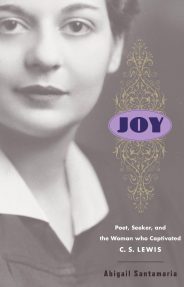
While I am a fan of thrillers that flirt with the fantastic, it is mostly because both the 1947 and 2021 films are adaptations of the 1946 novel of the same name, written by William Lindsay Gresham. That is, Bill Gresham, the husband of Joy Davidman–the enigmatic poet and prose writer who found her way into an unlikely and tender late-in-life marriage with C.S. Lewis. So while Joy Davidman’s life and work–including her compelling poetry and mercurial personality–loom much larger for me than a one-hit-wonder novelist from the ’40s, the connection keeps me intrigued. Davidman’s biographer, Abigail Santamaria, describes Nightmare Alley‘s impact on the Gresham household where both Joy and Bill were struggling writers, pressed to the edge as parents and artists:
Nightmare Alley, published on September 9 [1946] had begun generating press as early as July 7, with the Washington Post promising a “sinister and compelling piece of fiction” that would “shock some readers but send the public clamoring to the bookstores.” And it did. The novel, a work of brilliance, would become a noir classic with a cult following for decades to come.
But first, a bigger payoff presented itself: Twentieth Century-Fox bought the film rights for $50,000. And the studio invited Bill to Hollywood for the first two months of 1947 to collaborate with writer Jules Furthman on adapting the novel for the screen. In January, Bill took a train west. The picture, starring Tyrone Power and dJoan Blondell, would be produced at lightning speed for a New York City premiere at the Mayfair Theater on October 7, 1947. The windfall was more money than Bill or Joy had ever seen, and they knew exactly how they wanted to spend it. “We looked around for the biggest house we could find,” Bill said. After two years of living and writing in a cramped three-room apartment with one, and then two babies, the Greshams wanted a home with land where Davy and Douglas could grow “husky and brown and tough and mischievous. That is all one can ask.” And they “had to have a woodlot,” Joy insisted. “We wanted the feeling of walking in our own woods.” Ample workspace was also a priority, private studies in which to think and write. Both of them had new projects in the works…. The future once again promised great things. Now they could settle down. Now everything would be fine (Abigail Santamaria, Joy: Poet, Seeker, and the Woman Who Captivated C. S. Lewis (p. 178-9).
I have no doubt that Gresham’s Nightmare Alley will find its way to my bedside table this fall as I await the December 3rd release. There will be more to say. Meanwhile, here is the teaser trailer for Guillermo del Toro’s Nightmare Alley.
Someone has created a little trailer for the 1947 film:
And you can find the entire film smouldering 1947 classic here:
I believe in open access scholarship. Because of this, since 2011 I have made A Pilgrim in Narnia free with nearly 1,000 posts on faith, fiction, and fantasy. Please consider sharing my work so others can enjoy it.

 I was pleased to be part of a great online conversation on Saturday, a “Round Table” about L.M. Montgomery’s novel, Emily of New Moon. This is by far my favourite Montgomery novel in terms of artistry and thoughtfulness, a Cinderella book, I think, a sleeping giant of Canadian literary fiction. I think it is nearly a work of artistic genius–all the more so because the rich, layered tale masquerades as simply an accessible coming-of-age tale of a precocious writer. There is such vibrancy in this novel–such a taste of artistic delight, numinous joy, and the harrowing of the pilgrim’s soul–that I cannot emphasize too much how great it can be for invested readers.
 Speaker List:
 Both of these conversations left me with so much to think about that I would have been pleased to simply talk about these topics, which struck me as quite connected. I did have a conversation thread as well, however, on a new audiobook adaptation of Emily of New Moon. Megan Follows was, for me, the “voice” of Anne as she starred in the 1980s Kevin Sullivan Anne films. Late this summer, an audiobook production featuring Follows as the reader was released. It is well done as a performance, and I particularly like Megan Follows’ reading of Sheridan Le Fanu’s 1872 novella, Carmilla.
 This event is part of the “Conversations about L.M. Montgomery” series, and came out of the L.M. Montgomery Readathon on Emily of New Moon, which began early this summer. Developing out of a need for pandemic-era connection, and led by Montgomery scholars such as Ben and Andrea, it has developed into a dynamic online reading community. The “Readathon” is now moving into the Emily sequel, Emily Climbs (which began last week). You can join in on Facebook.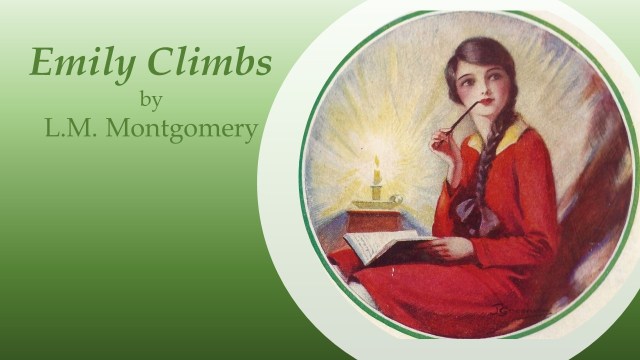







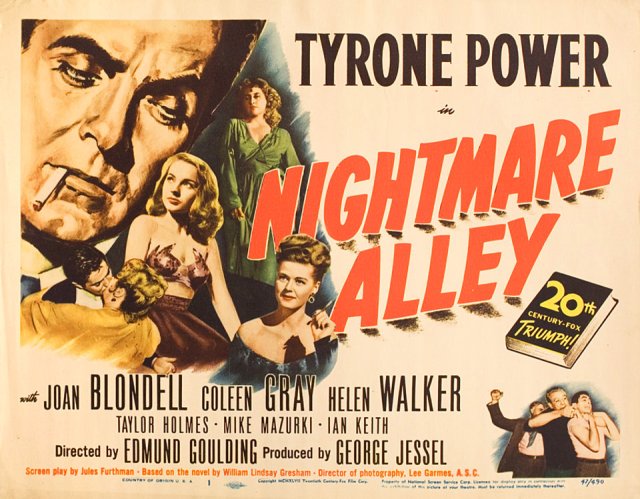
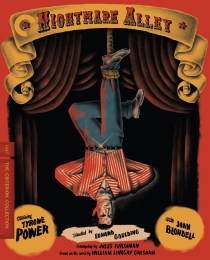
 Nightmare Alley, published on September 9 [1946] had begun generating press as early as July 7, with the Washington Post promising a “sinister and compelling piece of fiction” that would “shock some readers but send the public clamoring to the bookstores.” And it did. The novel, a work of brilliance, would become a noir classic with a cult following for decades to come.


 A Pilgrim in Narnia