
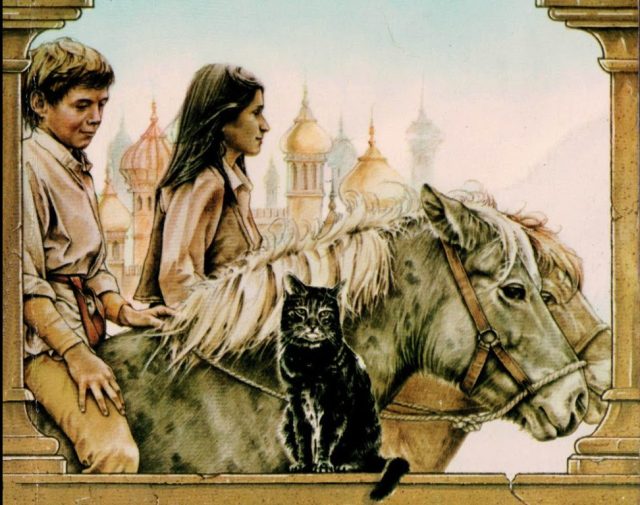
 There Are No Cruel Narnians: What The Horse and His Boy Can Tell Us About Racism, Cultural Superiority, Beauty Standards, and Inclusiveness
by Daniel Whyte IV
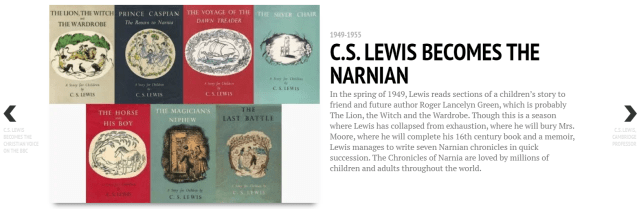
The Chronicles of Narnia has legions of fans around the world. According to journalist and novelist Lev Grossman, the much-beloved series published in the 1950s split the atom on the modern fantasy novel. But as our society becomes more aware of the inequities, injustices, and prejudices of previous generations—and rightfully so—the series has come under increasing scrutiny as espousing racism, sexism, and insensitivity to people outside of Anglo-Western religious and cultural backgrounds.
 The nexus of these issues—race, culture, religion, and sex—finds itself in the fifth-published and third-written of Lewis’ Narniad—The Horse and His Boy. With Netflix paying nearly $250 million for film and series rights to all seven books—we assume they don’t plan to sit on the intellectual property—the Narnia series will be the object of increased attention at some time in the foreseeable future. And with that scrutiny will come the equally foreseeable social commentary litigating what the books (and whatever Netflix’s interpretation of the books) are saying about representation and the way people of color and cultures outside of a patriarchal Anglo-Western worldview are portrayed in media.
Any potential adaptation of The Horse and His Boy will be fraught with minefields. Houston Chronicle editor Kyrie O’Connor claims it isn’t far-fetched to see the fantasy as “anti-Arab, or anti-Eastern, or anti-Ottoman” and suggests a desire to “stuff this story back into its closet.” While Lewis’ Narniad is emotionally stimulating and spiritually moving, it can be overshadowed by issues that led another popular fantasy writer and academic—Philip Pullman of His Dark Materials fame—to call it “one of the most ugly and poisonous things I have ever read.” He wrote that in a 1998 Guardian article titled “The Dark Side of Narnia.” Imagine what will be said about Narnia over twenty-five years later if Netflix dares to adapt The Horse and His Boy. (And I say to Netflix, as Aslan says to Bree, “Do not dare not to dare.”)
Indeed, as author, editor, and (somewhat) defender of C.S. Lewis, Gregg Easterbrook, wrote in The Atlantic two decades ago (partially in response to Pullman’s criticisms):
“Although Narnia has survived countless perils, the Chronicles themselves are now endangered… What’s in progress is a struggle of sorts for the soul of children’s fantasy literature.”
If the struggle is as eschatological as Easterbrook posits—and if Lewis’ reputation is indeed growing “beyond the reach of ordinary criticism” as Pullman argued in his ’98 hit piece—then it’s worth taking the time to look seriously at what the Narnia chronicles tell us about Lewis’ personal views and about the messaging (if any) encoded in the books.
My concern here is primarily The Horse and His Boy. But we can’t separate this work from the whole so we’ll refer to the other novels (not always by name) when needed.
_______
 The accusations against The Horse and His Boy are straightforward: Lewis painted a race of brown-skinned people (and their culture) as bad and morally inferior to the white-skinned Narnians and Archenlanders who are perfect and desirable in every way. And there is ground on which these claims can stand. Taking the Narniad as a whole, the issue of racism and the presumed cultural inferiority of the Calormenes is tempered only by perceived sexism and issues related to the way females are depicted in the series—which we’ll talk about soon. In his 1996 tome, The Natural History of Make Believe, children’s author John Goldthwaite summed up the Narnia series as a
“parable that is not only murderously misogynistic, but deeply blasphemous as well.”
I read The Horse and His Boy for the first time in my early teen years. Despite being an African-American child in a family and cultural environment hyper-aware of interracial tensions, I did not find the depictions of the competing cultures offensive. Nor did I see them as paralleling the struggles of people of color against racism and prejudice by whites. Perhaps I was too young or too ignorant to catch on. Perhaps stereotypical attitudes regarding race were already embedded in my fledgling worldview.
The accusations against The Horse and His Boy persist despite the usual rebuttal that there are plenty of bad pale-skinned people—chief among them, the White Witch, Narnia’s paramount villain—who are condemned in the stories just as bad brown-skinned characters are condemned. There are also brown-skinned characters who are regarded in the stories as good.
If we want to weigh the number of evil white-skinned humanoids against the number of evil brown-skinned humanoids (who are fully-realized characters in the Narniad), Dr. Devin Brown, in an address at Calvin College over a decade ago, does it best:
“The roster of light-skinned evildoers is a long one and includes the White Witch, the early Edmund, Miraz, the Lords Glozelle and Sopespian and many of their Telmarine countrymen, the early Eustace, the bullies at Experiment House, Governor Gumpas, Lord Bar, the Queen of the Underworld, and Uncle Andrew.
“The Calormene characters we get to know best [in The Horse and His Boy]—Aravis and Emeth—are very positive characters and are portrayed no less sympathetically than their fair-skinned counterparts, making it clear that skin color is no predictor or preventer of good or bad actions.”
 But what of Lewis casting the entire Calormene society in a negative light in many instances? True—this claim can’t be denied. After telling us that Tashbaan, the country’s capital, is “one of the wonders of the world,” Lewis hits us with negative imagery: inside, the city is smelly from the scents of “unwashed people,” “unwashed dogs,” and “piles of refuse” lying about. Not flattering in the slightest. The Calormenes themselves are described as grave, cruel, proud, and mysterious in contrast to the Narnian royals who “walk with a swing” and “chat and laugh.”
It seems that Lewis is being unfair. But we mustn’t forget: C.S. Lewis is pro-Narnian.
Narnians, those who become Narnian (like Aravis and the Pevensies), and the “friends of Narnia” (like Archenland, like Digory and Polly) are the heroes whom Lewis wants his readers to admire and cheer for. He is not writing an impartial history of his fictional realm. He is biased, as is his right.
That, however, doesn’t address the question of whether the Narnia stories—more specifically, the Narnians (since these are whom Lewis establishes as role models more or less)—embody racist tendencies. Granted, the era in which Lewis lived was not the most enlightened on racial issues. Whatever opinions he held, unconsciously or consciously, he did not care to articulate at any length, which might be due somewhat to the stuffy environs of academia which he inhabited for most of his life.
The Narniad doesn’t examine racism in any systematic way. But there are characters who express racist tendencies. A tribe of Narnian dwarves in The Last Battle appears to be racist toward the Calormenes, using the slur “darkies” as they taunt them on the battlefield. Dwarves from this same tribe also kill Narnian horses and betray their own countrymen. (These are Black Dwarves, so called because their “hair and beard were black.” In Prince Caspian, dwarves of the same tribe express a murderous hatred toward half-dwarf, half-human individuals like Caspian’s tutor Cornelius. Caspian defends his tutor, saying, “Anyone who doesn’t like his company may leave my army: at once.”)
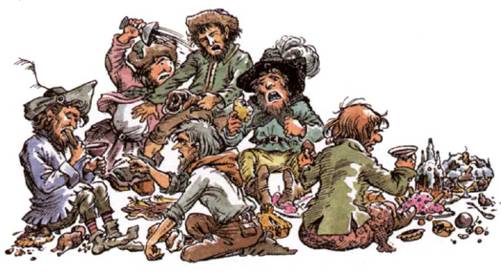
The casual reader of the Narniad would be forgiven for assuming that there are no cruel Narnians—that the simple binary of Narnians good—others bad actually exists. But the stories do not support this. In The Last Battle, the aforementioned dwarves are very bad (fair-skinned) Narnians who are unable to enjoy Aslan’s Country after the great Lion draws the world in which Narnia exists to its end. If we want to argue that depictions such as this prove Lewis was espousing racism in his work, then we must also argue that he espoused treachery and murder.
One of the indications that a character in The Chronicles of Narnia is a bad guy—or even a not-yet-good guy—is morally incorrect behavior. Expressing racism is just one of the ways in which the Narnia stories show that a character is morally reprehensible. Such behavior, no matter the skin color of the person behaving, is not to be taken by the reader as a nudge for his or her own behavior. Readers are meant to see the Calormenes as adversarial to Narnia. The story supports this by the Calormenes being imbued with morals, behaviors, and belief systems that are largely antithetical to Narnians. The brown-skinned Calormenes, like the pale-skinned Telmarines of Prince Caspian, are racist and speciesist. But, perhaps, a more correct way of saying this is: they are, by necessity, negatively disposed to native Narnians and their human royalty because that is what the story calls for. They are meant to be the enemies of Narnia. We are meant to see that any animosity the Narnians and their allies display towards others is because those others are not friendly. If they were, then the Narnians would be quick to make friends.
 It’s no surprise also that the Calormenes are depicted as sexist—child marriage is practiced and it seems females are seen as the property of their husband or father. Some might argue that this is only so the brown-skinned characters can look bad. But other fair-skinned characters also express sexist tendencies: Lord Miraz, Uncle Andrew, and Prince Rilian (when he was under the influence of the Green Witch).
And what of Narnia’s heroes and royals? Many have at one time or another uttered things that, in our present era, would be perceived as sexist. For example, in Prince Caspian, as Edmund is getting frustrated over him and his siblings being unable to find their way in a Narnia that is unfamiliar to them, he mutters to Peter and Trumpkin, “That’s the worst of girls. They never carry a map in their heads.” In The Horse and His Boy, Prince Corin describes Queen Lucy to Shasta as being “as good as a man, or at any rate as good as a boy” in battle. He thinks he’s saying something positive, but he is, for lack of a better term, not yet woke.
Some might view such statements (several more of which are found throughout the Narniad), and the attitudes that underlie them, as evidence that the stories espouse sexism. But to do so is to ask more of the Chronicles than they will answer to. Sexist behavior and language in Narnia’s villains—and even its heroes—is not a directive from the stories themselves. It is merely bad characters acting badly and imperfect heroes acting imperfectly. And we shouldn’t construe such behavior as authorial dogma.
A more recent fantasy adaptation provides a case-in-point. A trailer leading up to the release of Marvel’s Falcon and the Winter Soldier shows Sam Wilson taunting Bucky Barnes as the battered Winter Soldier hangs from the underside of an eighteen-wheeler: “That little girl kicked yo’ ass!” he yells. It’s a throwaway laugh line, one that wouldn’t have raised a single eyebrow fifteen or twenty years ago. One that probably will go unchallenged in the minds of most of Marvel’s viewers even today.
While the context is absent from the clip, Mary Sue writer Lyra Hale points out that such a comment is indeed “sexist nonsense that compares weakness with being a girl”—and, surprisingly, it rolls off the lips of a hero. However, Hale’s claim that “it’s not even something Sam would say” refuses to acknowledge that heroes and good guys, no matter how righteous, are still flawed creatures. And with that miniseries all said and done, I doubt anyone would argue that it espouses sexism (or racism, or violence), no matter how many times Sam or Bucky or any other character expresses views or engages in behavior that could be interpreted as suggesting otherwise.
Simply because a character behaves or speaks badly is not an indication that the creator approves of such behavior or desires the reader/viewer to emulate it. To demand that heroic characters be morally unimpugned—even when it comes to racism and sexism—is to ask for bland, utopic protagonists and stories that ring hollow.
________
 While Lewis did not set out to grapple with racism any more than Milton set out to deal with horticulture in Paradise Lost, Narnia did not spring out of a mind unentangled from such issues. Indeed, as the Oxford professor wrote,
“everything in [a] story should arise from the whole cast of the author’s mind.”[1]
So what was in the “whole cast” of Lewis’ mind as he crafted the Narnian tales? A close reading of the text suggests that he was not so much concerned with race and sex—his fault there more likely lies in his ignorance or disinterest in either—as much as he was concerned with culture. Sarah Hinlicky Wilson, former assistant research professor at Strasbourg’s Institute for Ecumenical Research, posits that in The Horse and His Boy…
“It is not racial superiority, but cultural superiority that underlies Lewis’ vision, though I doubt very much that he would have recognized this attitude as such, or approved of it in himself had it been brought to his attention.”[2]
As Matt Mikalatos reminds us in his brilliant, ongoing series on the works of C.S. Lewis, the author is writing for
“young, white, British children…They are both the stars and the target audience.”[3]
Their “ethnic and cultural world” is the “center” from which all other cultural perspectives, even fictional ones, are seen.
 Lewis sought to imbue the call of “Narnia and the North” with the aspects of European medievalism and English culture that he approved of. (Indeed, he bristled—most significantly in The Voyage of the Dawn Treader—at some of the academic and social shifts that were becoming apparent in World War-era Britain.) He was also writing at a time when mass numbers of people of color from the West Indies and South Asia were immigrating to England to pursue work opportunities and a better life for themselves. Despite surviving the nationalism-driven horrors of Hitler’s attempt at an empire, Britain was not immune to racist ideologies and an us-vs-them collective social mentality.
Sequestered in scholarly halls and engaging with like-minded peers in Oxford’s pubs, Lewis’ life likely wasn’t affected by the nastier throes of England’s cultural shifts. He could afford to spit at how, in his view, Britain’s education system was losing its teeth and how adults (like Eustace Scrubb’s parents) let their kids call them by their first names because they were “very up-to-date and advanced people.”
He would not have seen the harm in crafting the Calormenes in a manner that, deliberately or not, seems to ape Middle Eastern/Arab culture. Evidence to suggest that he did so because he held animosity towards that culture is thin. And the idea that he was trying to condemn the Islamic faith via The Horse and His Boy and The Last Battle is too simplistic. Along with being a medieval scholar and literary critic, he was a theologian par excellence—perhaps the most accessible Christian theologian of the twentieth century. And he, unlike the majority of those who share his faith today, viewed Islam, not as a pagan religion—he did not think Muslims were heathens—but as a heresy. He viewed Islam, which he once described as “strong, noble, [and] venerable,” as a branch of Christianity that had gone down a different path.[4] Besides, the religion of the Calormenes is nothing like Islam.
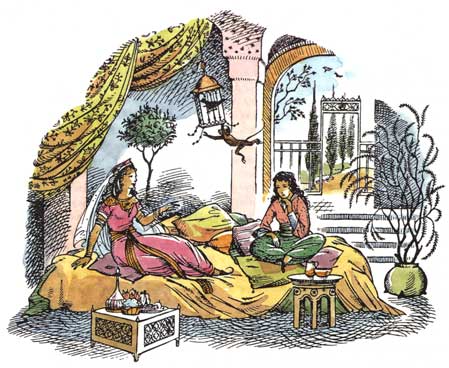 Similarities between Shasta’s story and that of Moses in the Book of Exodus have been broadly noted. If we take the same simplistic approach that we’d have to take to analogize the Calormenes as Muslims, we could say that the Calormenes are more accurately compared to ancient Egyptians. And the polytheistic religion of ancient Egypt, coupled with its pharaoh-worship, is a more precise jumping-off point for the religion Lewis created for the Calormenes with their pantheon of gods and their royalty said to be descended from gods.
Perhaps a writer more sensitive to the times, or more cosmopolitan in his outlook, would have considered that people outside of the English and Western European cultural arena might one day read his books and he would have been more meticulous and objective about his world-building. But Lewis was no Tolkien when it came to world-building and tossed in whatever he liked as he went along. This is part of the magic of the world he made: it is wild, unconstrained, and unconcerned. Judging by modern standards, it may be misguided, but it is not malicious.
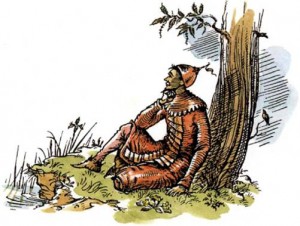 Interestingly, an article by Jin Seongeun in the New Korean Journal of English Language and Literature suggests that Lewis may have injected himself into the narrative as the Calormene Emeth who enters Aslan’s Country at the end of The Last Battle. Seongeun writes:
“[By] only focusing on the narrative in The Horse and His Boy, readers might simply conclude that Lewis is a racist. But the dread of other races coming into Narnia, a cultural reference to immigration, unveils the complexities of different color imagery in The Chronicles of Narnia. In The Last Battle we are able to see the Calormenes inside Narnia more specifically in terms of the conflict between the white culture and the non-whites’. The virtuous yet heathen figure, Emeth, contradicts the straightforward binarism between good and evil based on racial hierarchy.”[5]
The “racial hierarchy” that some would argue is present in the Narnian world reflects the racial hierarchy that was becoming more apparent in Lewis’ world—a hierarchy that he was sensitive to as an Irishman living in England. We forget that Lewis was born in Belfast and remained very Irish despite spending the majority of his non-holiday time in England. He was apprehensive about the country when he first arrived there and never fully felt at home. (This didn’t prevent him from becoming regarded by the literati of his own country as “the wrong kind of Irishman.”[6]) And it did not help that many Englanders nursed anti-Irish sentiment. During World War I, in which Lewis fought, UK military courts were reportedly harsher on Irish soldiers. And a 1934 travelogue argued that the only reason an Irish Republic would be desirable is so that its exiled citizens could leave Britain and return to their own land. “What a fine exit of ignorance and dirt and drunkenness and disease”[7] the author dreamed that would be.
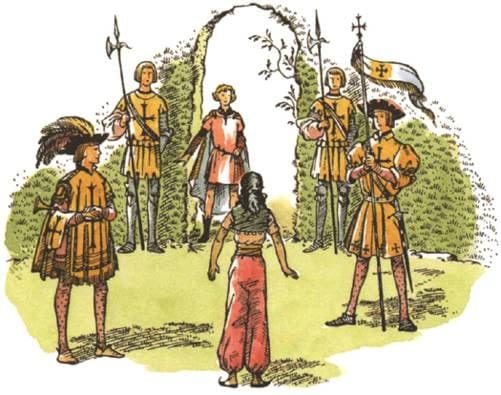 If what made it into the Narnian stories arose from “the whole cast” of Lewis’ mind, it stands to reason that, while he depicted a value system that reflected the parts of English medieval culture that he liked (and that, by nature, appeared normative to his immediate audience of white British readers), he was also sympathetic to those, like Emeth (like Aravis, like Rabadash), whom he depicted as outsiders in his own stories. Seongeun argues that,
“His literary depiction of race cannot be simply dichotomous… Lewis blurs the view of racial superiority by [his depiction of] paradise in The Chronicles of Narnia. Emeth’s salvation…is Lewis’ fantasy.”[8]
Emeth’s acceptance by Aslan was not merely an exception to the (presumed) rule that all good (white) Narnians go to Narnia-heaven. It also appears to have been an outworking of Lewis’ long-term concern over feeling rejected by his Irish countrymen and being an outsider in his adopted nation of England. He wanted to belong in the world that inspired the nature and character of Narnia. As he told his students, “Heaven is Oxford lifted and placed in the middle of County Down [in Ireland].”[9]
Lewis is not writing from behind the gates of Aslan’s Country, an exclusive community only for Narnian royals and their friends. He is on the outside, with us—with Shasta and Aravis and Emeth—longing to get in.
_______
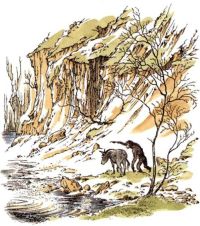 The Narniad’s protagonists are meant to be attractive to the reader. We are to see their desires, desire with them, and adopt their desires as our own. While not always starting out as such, most of these heroes end up, in the eyes of the reader, as moral or righteous individuals. They either are, or they become, “good guys.”
Lewis’ writing comes out of a steeped tradition of literature and art which saw a person’s goodness or morality as being reflected in their physical appearance. Beautiful face, ergo beautiful soul. An ugly or physically deformed individual would be presumed to have bad morals or some kind of spiritual or moral deficiency. For example, in The Last Battle, Shift is described as the “ugliest” and “most wrinkled Ape you can imagine.” And then is immediately depicted as being abusive and domineering toward Puzzle.
Nicholas Wanberg’s article in Fafnir: the Nordic Journal of SF/F Research analyzes the “strong correlation” of “good characters being attractive and evil characters being ugly” in the Narnia stories. His research points out that, starting as far back as the ancient Greeks (and perhaps before in other cultures), belief in an “absolute aesthetic ideal” would shape—or, better, warp—successive cultures’ ideas of physical beauty and what that indicated about a person’s moral state.
“It should come as little surprise that a statue carved by a European man out of white marble should differ wildly in appearance from most individuals whose descent is geographically removed from that region, but it was taken for granted by many, nonetheless, that the ideal that this statue represented would be shared and appreciated by all, regardless of what features might be more common in their own region.” [10]
We are only now beginning to live in a world where arbitrary standards of physical beauty are being challenged so that, in time, no single body shape, facial structure, or hair type is seen as superior to another. But in Lewis’ world and the literary milieu that he and his cohorts inhabited, this was not the case. While, in the Narniad, we can expect to see good, moral characters described according to a certain aesthetic—which, more often than not, means being fair-skinned—we also see three departures from the strict binarism of good-equals-beautiful and evil-equals-ugly (or fair-skinned-equals-good and dark-skinned-equals-evil). Lewis’ work, whether by happenstance or design, is more complex than that.
 The first departure is that characters’ outer appearances often change in relation to inner changes brought about by that character’s choices. Most characters in Narnia are not static: they are either good and getting better, bad and becoming good, or evil and getting worse. Wanberg argues that,
[W]henever the inner nature of a character is altered, particularly by magic, their outer appearance always changes to match. Individuals becoming royalty show strong evidence of this, with noted changes to their voices and appearance after assuming royal status… King Frank, for example, talks differently and has a different look to his face both within the first two days of being selected by Aslan…[11]
The second of the three aforementioned departures is a complete upending of the beauty-equals-goodness binary for two of Lewis’ most terrible villains: Jadis and the Lady of the Green Kirtle are described unreservedly as being beautiful. “Their beauty, however, may be unnatural,” Wanberg points out.
“It is worth noting Lucy’s experience when she is tempted by the magician’s book to use its magic for evil. One of the temptations she faces is to use a spell to make her ‘beautiful…beyond the lot of mortals.’ If this is to be a standard abuse of magic power, it would certainly explain the two witches’ deviation from the norm.”
Thus, in Narnia, we have physical beauty being deliberately used to hide evil or present evil as attractive. The Calormene view of the Narnians also bolsters this departure. While regarding the Narnians as evil and accursed “barbarians,” they often describe them as “beautiful,” implying that they at least do not take physical appearance as a face-value reflection of the moral status of others.
(Strangely enough, this particular departure is something we see more broadly culturally. Our old monsters—witches, werewolves, and vampires—have been defanged and glamorized. Even the arch-enemy of all that is good in the Christian tradition has gotten a makeover: Lucifer, which is set to end with six seasons, imbues Satan with sexy, alluring qualities as he prances around Los Angeles stopping the people who are presumably doing his work. He’s not the enemy anymore; he’s the hero. The spiritual and mythic enemy of righteousness wears Tom Ellis’ attractive face.)
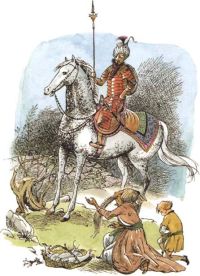 The third departure is quite simple and has been hinted at before, but bears mentioning again: The Horse and His Boy shows a breaking of the mold of the body being considered “a faithful representation of the soul within it.”[12] Characters in The Horse and His Boy are shown to be evil by their actions, not by skin-color or physical appearance. Any hint at the latter is incidental. It was, after all, one of the “free, happy,” fair-skinned Archenlandish royals who betrayed his people and kidnapped Shasta, resulting in him being raised in slavery and unwittingly setting in motion the events of the story.
Additionally, we see that (even outside of The Horse and His Boy) whiteness is not blatantly good. Wanberg notes: “Characters can be too white, just as they can be too much of several other shades.” Regarding a description of Uncle Andrew in The Magician’s Nephew, he goes on to say:
“Being ‘beautifully white’ does not, in context, imply ‘beautiful because they were white’ but ‘white in a way that was beautiful,’ implying that the whiteness in question possessed a beautiful quality, rather than that it was a beautiful quality.”
Later in the same story, after Jadis eats an apple from a tree forbidden to her, we find that she “looked stronger and prouder than ever, and even, in a way, triumphant; but her face was deadly white, white as salt.” When she is introduced in The Lion, the Witch and the Wardrobe, her stark paleness remains, but as before, “she is described as being ‘quite beautiful,’ but her beauty exists in spite [of] her paleness, rather than because of it.”
 What we see in all of this is a tension the Narniad holds between a standard of physical beauty and a standard of moral goodness. (And, yes, the physical beauty standard is rooted in that ancient “absolute aesthetic ideal” that favors the white, fair-skinned, European body that Western and Western-influenced societies are only now beginning to throw off.) There are virtues that Lewis espouses in his stories that find embodiment in its characters. The use of physical appearance is designed to call the reader to look at and desire that which is good and experience repulsion at that which is bad. However, where the story rises above simple binarism is in the subtleties that suggest its descriptions are less about simple physical appearance and more about moral quality. In Narnia, though appearance often appears as a valid foundation on which judgment of a character is made, moral quality based on a character’s actions is valued higher than appearance.
_______
Soon enough there will likely be calls for The Horse and His Boy to be banned from school libraries or to cease being published altogether. The works of Mark Twain, Flannery O’Connor, Dr. Seuss, and J.K. Rowling have received such attention with varying scope and to varying effect. The best light in which Professor Wilson can cast the question, perhaps justifiably, is whether or not the story is “salvageable.” And despite the concerns raised, she concludes that it is:
Even the obvious problems with its cultural depictions make HHB [The Horse and His Boy] valuable. The necessities and complicities of cultural translation are solved not by evasion but by confrontation.[13] [emphasis mine]
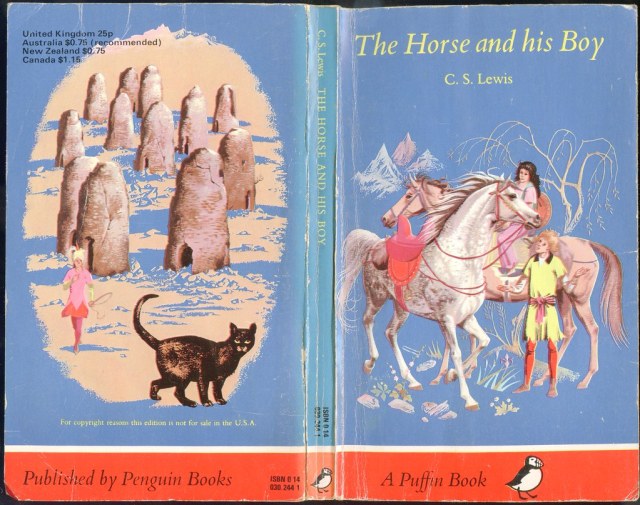 The Horse and His Boy offers us the opportunity to think through the complex layers of cross-cultural interaction, ideas of racial superiority and ethnocentrism, beauty standards and our interpretation of them, as well as how we can pursue Martin Luther King’s dream of a society where we judge people not by “the color of their skin, but by the content of their character.”
Of the northern characters in The Horse and His Boy, the ones Lewis wants readers to model after are explicitly non-racist. These northerners judge even their avowed enemies, not by their skin color or culture, but by the way they treat the creatures with whom they share the world. Queen Susan, with the support of Peter, Edmund, and Lucy, fairly considers Prince Rabadash’s marriage proposal. In the court of Cair Paravel, Rabadash behaves with grace and good humor, but in his own capital he behaves like a despot, throwing temper tantrums when he can’t have his way. He is not rejected based on racial or cultural differences but because, in the words of Edmund, he had shown himself to be “a most proud, bloody, luxurious, cruel, and self-pleasing tyrant.”
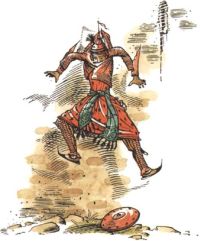 Later, as Rabadash hangs from a hook in the wall of Anvard, his scheme to conquer the northern countries falling apart around him, Archenland’s King Lune assures him that, had he challenged Narnia fairly, not a single person in the kingdom would have looked down on him, and any would have met him nobly in duel or in battle. But, by attacking “in time of peace without defiance sent,” he had proved himself “no knight, but a traitor.” Even then, Queen Lucy persuades the royal cadre to “give him another trial” and “let him go free.”
Unlike what we see in Calormen, there is no bashing of the other by Narnians and Archenlanders simply because they are other. These northerners could have justifiably assumed that all Calormenes (or southerners or dark-skinned people) were bad. But in the Archenlandish court, Aravis is not lumped in with her fellow Calormenes who had just hours earlier attacked Anvard. The Archenlanders do not treat her with suspicion or judge her according to Calormene stereotypes. They embrace her as queen, as wife of their prince, and their mixed-race son as their greatest king. (And, perhaps, it could stand to reason that, if C.S. Lewis had some kind of animus toward dark-skinned people, he would have foiled both of the potential interracial marriages in his story—one of them, Aravis and Shasta’s, not even being central to the plot.)
Aravis does not become a morally good character because she white-washes or is white-washed by marriage into a family of pale-skinned folk. She is made good because she has rejected the cruelty, vanity, and selfishness that was part of her character—the same cruelty, vanity, and selfishness that beset not only Rabadash, but white characters such as Edmund Pevensie and Eustace Scrubb.
Emeth is not the “token negro” graciously allowed into Aslan’s after life. He is established as a man who pursued truth, justice, goodness, and virtue independent of any guidance from Narnians or white saviors. He did not follow blindly. He was open to answers wherever he found them. He wrestled with real things and was rewarded.
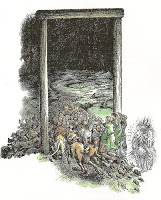 At the end of The Last Battle we find that Lucy, from the very center of Aslan’s Country, “could see the whole Southern desert and beyond it the great city of Tashbaan,” proving that—despite the negative connotations about its culture in stories told by a pro-Narnia author about pro-Narnia heroes—there is much of value and much to be desired in Calormen.
The heroes of the Narniad, imperfect though they be, are the stories’ guiding lights and moral tutors. They represent change from undesirable and negative behavior to desirable and positive behavior. And that is why we need The Horse and His Boy: to witness and re-witness examples of individuals judging others by their character and not their skin color, as people and not stereotypes; to show us that every person, even the “bad guys” like Rabadash, deserve the benefit of the doubt and the space to prove themselves by their actions.
Reading The Horse and His Boy today—and with the possible development of a screen adaptation in the near future—provides us the opportunity to, as even Philip Pullman concedes, “wrestle with real things.”[14] The answers we find may not fit a narrative of engrained racial animosity or post-modern deconstruction (and rejection) of the art of bygone years. But they can lead us to talking openly about our differences and highlighting the things that are worthy to pursue: truth, justice, fairness, equality, virtue, friendship. Basic human goodness.

 Daniel Whyte IV is a fantasy and speculative fiction writer whose essays on culture and faith have been published in Relevant, Fathom Magazine, Arc Digital, Tor.com, Speculative Faith, and Church Leaders. A former web developer and podcast producer, he holds a bachelor’s degree in Information Technology: Web and Mobile Programming. When he’s not writing about superheroes, time travel, fantasy, or Narnia, he’s tweeting about those things @dmarkwiv.
[1] C.S. Lewis, “On Three Ways of Writing for Children,” available online at https://myweb.scu.edu.tw/~jmklassen/scu99b/chlitgrad/3ways.pdf
[2] Sarah Hinlicky Wilson, “Salvaging C.S. Lewis’s The Horse and His Boy for Mission and Cultural Awareness,” International Bulletin of Missionary Research, 2014, available online at https://journals.sagepub.com/doi/abs/10.1177/239693931403800304?journalCode=ibmc&
[3] Matt Mikalatos, “Ethnocentrism, Heathens, and Heretics in The Horse and His Boy,” Tor.com, 2020, available online at https://www.tor.com/2020/09/16/ethnocentrism-heathens-and-heretics-in-the-horse-and-his-boy/
[4] Jacob Fareed Imam, “Not Merely Islam: C.S. Lewis Assesses the Religion of Mohammed,” Touchstone, 2017, available online at https://www.touchstonemag.com/archives/article.php?id=30-03-042-f
[5] Jin Seongeun, “Whiteness and Racism in C.S. Lewis’ Narnia,” New Korean Journal of English Language and Literature, 2015, page 12, available online at https://www.semanticscholar.org/paper/Whiteness-and-Racism-in-C.-S.-Lewis%E2%80%99s-Chronicles-of-Jin-Seongeun/d06efa0f7fc756a8d7c0e1b0c34b4998ca694ae7
[6] In his biography of Lewis, Alister McGrath briefly recounts the author wrestling with the dilemma of pursuing publication with small Irish presses that were associated with ‘cult-like’ Irish nationalist views or keeping his work “in the broad highway of thought.” (C.S. Lewis — A Life: Eccentric Genius, Reluctant Prophet, Tyndale House, 2013, pages 13-14)
[7] J.B. Priestley, English Journey (William Heinemann, 1934), pages 248-249.
[8] Jin Seongeun, “Whiteness and Racism,” page 16
[9] David Bleakley, C.S. Lewis at Home in Ireland: A Centenary Biography (Strandtown Press, 1998), page 12
[10] Nicholas Wanberg, “‘Noble and Beautiful’—Universal Human Aesthetics in C.S. Lewis’s The Chronicles of Narnia,” Fafnir: Nordic Journal of Science Fiction and Fantasy Research, Volume 1, Issue 3, pages 7-18, available online at http://journal.finfar.org/articles/noble-and-beautiful-universal-human-aesthetics-in-c-s-lewiss-the-chronicles-of-narnia/
[11] Wanberg, “Noble and Beautiful”
[12] Wanberg quoting Jonathan Conlin’s writing on the works of Charles Kingsley.
[13] Wilson, “Salvaging C.S. Lewis’s The Horse and His Boy”
[14] In his Guardian article, “The Dark Side of Narnia” (1998)















 A Pilgrim in Narnia