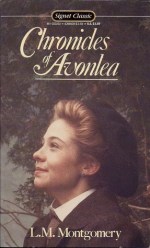
As L.M. Montgomery was a consummate storyteller, it is lovely when we get the occasional pleasure of a new L.M. Montgomery story collection.
We must admit to an embarrassment of riches when it comes to access to Montgomery’s short stories. Her 500 or so published stories are not in some archive in manuscript form, simply waiting to be published. Montgomery’s work is scattered among dozens of magazines and periodicals over a period of 50 years. Thus, our short-story richness has come with the time and commitment of hard-working Montgomery readers and editors over the past generation.
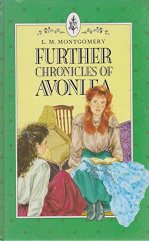
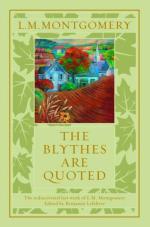
Of Montgomery’s work in her lifetime, we have Chronicles of Avonlea (1912), followed by the illicit Further Chronicles of Avonlea (1920)–initially published without Montgomery’s permission and the subject of a legal drama. Finally, we now have The Blythes Are Quoted, edited by Benjamin Lefebvre in 2009, which is the complete version of the 1974 Road to Yesterday collection.
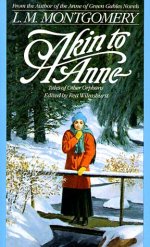
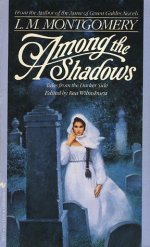
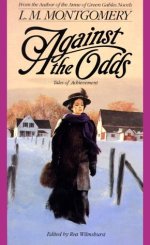
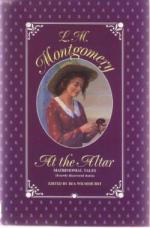
Through the late ’80s into the ’90s, Rea Wilmshurst carefully provided us 8 thematic collections that follow a similar editorial design as The Doctor’s Sweetheart and Other Stories (1979), edited by Catherine McLay.
Here is a list of Rea Wilmshurst’s collections:
Akin to Anne: Tales of Other Orphans (1988)
Along the Shore: Tales by the Sea(1989)
Among the Shadows: Tales from the Darker Side (1990)
After Many Days: Tales of Time Passed (1991)
Against the Odds: Tales of Achievement (1993)
At the Altar: Matrimonial Tales (1994)
Across the Miles: Tales of Correspondence (1995)
Christmas with Anne and Other Holiday Stories (1995)
Hidden behind these lovely volumes are hundreds of hours of detective work, discovery, transcription, editorial revision, administrative tasks, correspondence, and collection–work carried on by Rea Wilmshurst and many invisible hands. In 1986, Ruth Weber Russell, D.W. Russell, and Rea Wilmshurst published Lucy Maud Montgomery: A Preliminary Bibliography–which is hard to find but available in research libraries. Carrying on the attention to detail of Rea Wilmshurst and others, Carolyn Strom Collins has compiled and edited materials for eager readers, both published in 2016 by the L.M. Montgomery Institute:
An Annotated Bibliography of L.M. Montgomery’s Stories and Poems (which specifically extends Wilmshurst’s 1986 bibliography)
A Guide to L.M. Montgomery’s Story and Poem Scrapbooks 1890–1940: Stories and Poems Published in Periodicals and Preserved by L.M. Montgomery in Twelve Scrapbooks
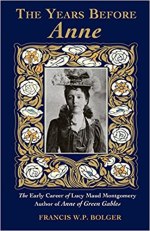
With all of this good work of story collecting, editing and anthologizing–including individual pieces published in places like Fr. Bolger’s The Years Before Anne (1974, reprinted in 1991), there are still fewer than 200 stories in print.
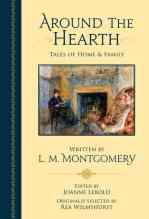
It is always a treat, then, when we hear about a new collection. Ben Lefebvre’s LMMIOnline web resource notes that a 9th volume of 17 stories selected by Rea Wilmshurst will appear in May 2022, Around the Hearth: Tales of Home and Family, edited by Joanne Lebold. In their years of commitment, Carolyn Strom Collins and the late Christy Woster have each found dozens of Montgomery stories that might have been lost, or they have succeeded in finding the original publications of those stories later published in anthologies.
In 2017, they also edited and published a new Montgomery story collection, After Many Years: Twenty-one “Long-Lost” Stories. After Many Years is an anthology of rediscovered short stories by L.M. Montgomery–21 pieces originally published in periodicals between 1900 and 1939 that Collins and Woster came across in their research. The volume has a preface and notes by Collins and Woster, as well as a foreword by Kate Macdonald Butler, one of Montgomery’s grandchildern. After Many Years is published by Nimbus and available in paperback, as a Kindle e-book, and in an audiobook reading by Elva Mai Hoover.
As you might expect of Montgomery in this mode, the stories are full of charm and grace. In the warp and weft of something like fate or providence, families shatter, hearts break, and lovely things are lost. But in that same movement of the weaver’s tale, there is space for discovery, healing, and life-after-brokenness. Children are faced with terrible decisions that, in the moment, are so intimate and life-changing that the characters almost lose themselves in the choosing. Lovers have a chance to find their way back to lost loves–or the chance to turn with bitterness toward the future. Neighbours chase and peck and quarrel, but there is every opportunity for neighbourliness to return in the end. Cats inspire adventure and lead the way home. Ghosts shake the root of injustice while fair houses haunt the lonely and mirrors speak more than the truth. More than one good soul dies too young, and more than one old soul lives long enough to laugh at themselves.
For at the heart of Montgomery’s best humour-laden short story-telling is the truth that folly waits at the edge of every one of our stories.
Since Montgomery’s copyright has expired on much of her work–though it still continues in the US for another 15 years or so for many pieces–the stories have been collected into chronological bundles and released as inexpensive Kindle books and read on Librivox–at least up to 1922 (check out Librivox’s volunteer-read Montgomery story collections here).
However, without the work of Carolyn Strom Collins and Christy Woster–as well as other editors that work with them and came before them–these stories would be lost to us.
In a note of sadness, After Many Years book is dedicated to the memory of co-editor Christy Woster, who died in April 2016 as the book was moving toward print. One of my favourite collections of Montgomery’s short stories to date, After Many Years is a fitting tribute to the work of these longsuffering literary detectives and Christy Woster’s memory.
Besides the treasures, the bibliographies, and this collection of stories, Carolyn Strom Collins is also the editor of Anne of Green Gables: The Original Manuscript–a never-before-published version of the original text of Montgomery’s most famous manuscript. This recent publication of the Anne of Green Gables manuscript provides readers with a rare chance to peek in on Montgomery’s creative process, allowing us to see the author’s scribbled notes, additions and deletions, and other editorial details and marginalia.
I have read Anne of Green Gables in my old Seal paperback, and I have listened to the story read by professional and amateur audio readers. Each time the book becomes brighter and better for me. However, reading this original manuscript edition resulted in my most fruitful and fun summer reading of Anne yet. With restrained and professional editorial comments, critical notes, and photocopies of Montgomery’s handwriting, Carolyn Strom Collins has done a superb job editing this version, providing us insight into Montgomery’s writing process and allowing us a way to read this classic text anew.
As host and founding producer of the MaudCast, I was privileged to sit down with Carolyn Strom Collins for an interview about her work. In the episode (which you can find here or on Spotify), we discuss Carolyn’s editorial work and we focus in on her work in the archive and her final manuscript publication. I hope you enjoy this resource–as well as the wealth of resources for reading Lucy Maud Montgomery’s short stories.
*if anyone locally needs a copy of Fr. Bolger’s The Years Before Anne, I have an extra that I would part with
I believe in open access scholarship. Because of this, since 2011 I have made A Pilgrim in Narnia free with nearly 1,000 posts on faith, fiction, and fantasy. Please consider sharing my work so others can enjoy it.
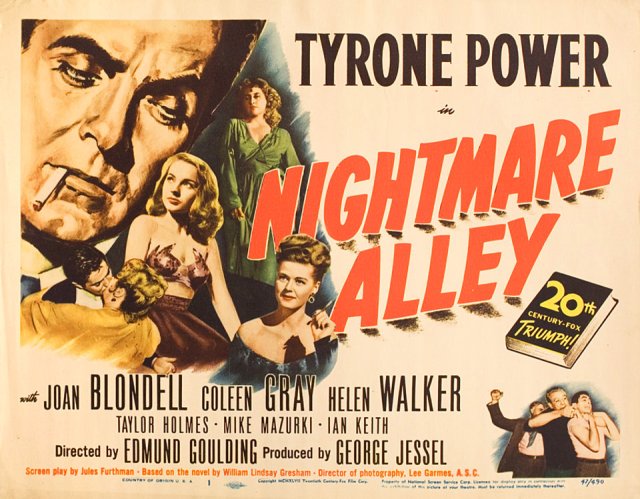
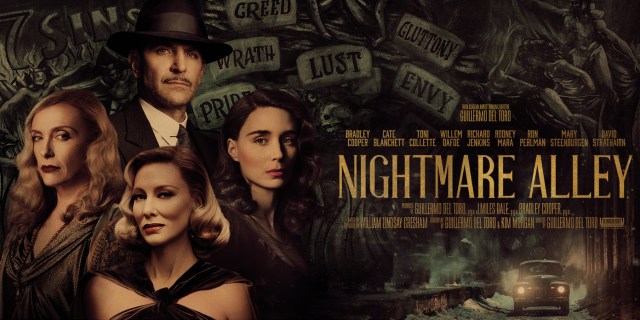
At A Pilgrim in Narnia, we are in the midst of the “Nightmare Alley Series,” inspired by Guillermo del Toro’s new film starring Bradley Cooper, Cate Blanchett, Rooney Mara, Willem Dafoe, and Toni Colette. Moving back from visually stunning film to William Lindsay Gresham’s 1946 psychological thriller, Nightmare Alley–and its first film adaptation in 1947, which del Toro follows closely–we are hoping to provide some background to Gresham’s connections. Notably, Bill Gresham’s wife at the time he wrote the novel was Joy Davidman, who began a friendship a few years later with C.S. Lewis that grew into deep intimacy.
Curious as we are at A Pilgrim in Narnia, this has developed into a playful series with these posts thus far:
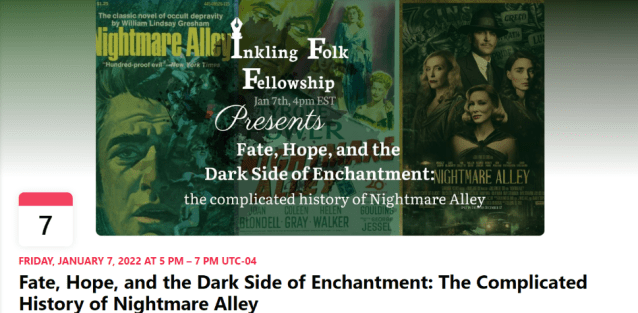
I am still trying to pull my own thoughts together on the novel and films for a review of some kind, but it will have to wait until next week. Fortunately, later today (at 4pm Eastern, free event signup here) we are holding a special Zoom event at Inkling Folk Fellowship (hosted by Joe Ricke), where John, Connor, and I will join our friends there for a video discussion. Here is the event announcement, and I hope to see you there!
The close of 2021 saw the release of Guillermo del Toro’s critically acclaimed new film, Nightmare Alley, starring Bradley Cooper, Cate Blanchett, Rooney Mara, Willem Dafoe, and Toni Colette.
An acknowledged master of dark fantasy, del Toro won Academy Awards previously for Pan’s Labyrinth (2006) and The Shape of Water (2017).
Of particular interest to Inkling aficionados and scholars is the fact that the film is an adaptation of the 1946 novel by William Lindsay Gresham. Yes, that Bill Gresham. The first husband of Joy Davidman, the enigmatic poet and prose writer who found her way into an unlikely and tender late-in-life marriage with C.S. Lewis. After Joy’s death, Gresham once visited his two sons and Lewis at the Kilns. Previously, Gresham had written a fascinating introduction for the American publication of Charles Williams‘s novel, The Greater Trumps.
Following the recent “Nightmare Alley Series” on A Pilgrim in Narnia, Brenton Dickieson will join the Inkling Folk Fellowship and host Joe Ricke this Friday, January 7, for a conversation with two students of and writers about popular culture (especially film and fantasy), John Stanifer and Connor Salter. Both John and Connor are IFF regulars, and both are steeped in Inkling lore and scholarship. The conversation will range from Gresham’s original novel to recent and classic film adaptations to the complicated relationship between Bill Gresham, Joy Davidman, and C.S. Lewis.
Brenton Dickieson is a frequent contributor to IFF, as well as being THE Pilgrim who produces the monumental achievement that is A Pilgrim in Narnia. Join us and we will make sure you know how to read more about that.
Invite your friends, especially those who might usually be more interested in del Toro or Tarot Cards or Cate Blanchett than C. S. Lewis. We figure that the Lewis people know how to find us, but others might need your help. If you are a member of the Inkling Folk Fellowship email list, you will receive the Zoom information in an email. If not, please message us here requesting the link.
Bios: Brenton Dickieson is a Canadian researcher in literature and theology. He teaches at Signum University, among other places, and curates the blog www.aPilgrimInNarnia.com.
Connor Salter is an American journalist, writer, and editor with hundreds of articles to his credit, including literary critical research on C.S. Lewis and the Inklings. Connor gave an Inkling Folk Fellowship presentation on the Inklings and English Gothic Horror films in October 2021.
John Stanifer is a librarian and English tutor by day and a crime-fighting vigilante by night. An avid fan conference attendee, John holds an M.A. in English from Morehead State University and has published a book on faith and pop culture, Virtuous Worlds: The Video Gamer’s Guide to Spiritual Truth (2011).
This event marks the second time that Connor and John have co-presented: In 2018, they spoke about H.P. Lovecraft and the Inklings in a “Lewis Tea” event (the forerunner of the Inkling Folk Fellowship) hosted by Joe Ricke at Taylor University’s Lewis Center.
Brenton edited pieces by Connor and John for the “Nightmare Series” on A Pilgrim in Narnia. Among other things he does, he works diligently to feature and promote the next generation of Inkling scholarship and Inkling-inspired artists.
I believe in open access scholarship. Because of this, since 2011 I have made A Pilgrim in Narnia free with nearly 1,000 posts on faith, fiction, and fantasy. Please consider sharing my work so others can enjoy it.
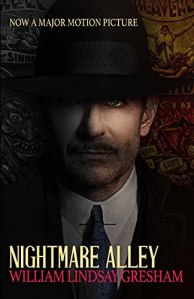
At A Pilgrim in Narnia, we are in the midst of the “Nightmare Alley Series,” inspired by Guillermo del Toro’s new star-filled feature film. This film is an adaptation of William Lindsay Gresham’s 1946 novel, Nightmare Alley–and follows closely the first film adaptatiod Inspired by the cultural moment, we are hoping to provide some background to Gresham’s connections. Especially, Bill Gresham‘s wife at the time he wrote the novel, Joy Davidman, began a relationship a few years later with C.S. Lewis that changed all their lives. As we prepare for a conversation at 4pm this afternoon on Inkling Folk Fellowship (details here), you may be interested in G. Connor Salter’s book review from Power Book Review, originally published on Dec 7, 2021.
⭐️ ⭐️ ⭐️ ⭐️ Perfect for classic crime noir fans, and for readers seeking a well-developed psychological thriller.
🖋 🖋🖋🖋🖋 The author creates an almost cinematic style with strong images, tight plotting and careful pacing the suspense elements.
Published December 7, 2021 by New York Review of Books
Edition: Movie tie-in edition
Originally published in 1946.
ISBN: 978-1681376103
Genre: Fiction, Suspense, Crime
🔪🔪One death by poisoning, a violent fight at the climax, various scenes of psychological suspense. 💋💋💋💋Various sexual references in dialogue, and three to five brief sex scenes (all of which move the plot forward). None of the sex scenes include much detail, but one has quasi-violent undertones. 🚩 🚩 🚩 🚩 🚩A Trigger Warning: this book has references to alcoholism, sex with masochistic dialogue.
Stan Carlisle isn’t planning to spend the rest of his life as a low-level carnival lackey. He’s got plans, and a taste for stage…
I believe in open access scholarship. Because of this, since 2011 I have made A Pilgrim in Narnia free with nearly 1,000 posts on faith, fiction, and fantasy. Please consider sharing my work so others can enjoy it.
At A Pilgrim in Narnia, we are in the midst of the “Nightmare Alley Series,” inspired by Guillermo del Toro’s new film starring Bradley Cooper, Cate Blanchett, Rooney Mara, Willem Dafoe, and Toni Colette. Moving back from the star-filled screen to William Lindsay Gresham’s 1946 novel, Nightmare Alley, and its first film adaptation in 1947, we are hoping to provide some background to Gresham’s connections: his wife at the time he wrote the novel, Joy Davidman, and her relationship a few years later with C.S. Lewis. A playful series, we have been looking at these sorts of things:
I am trying to pull my own thoughts together on the novel and films for a post
Tomorrow we are holding a special Zoom event at Inkling Folk Fellowship (hosted by Joe Ricke), where John, Connor, and I will join our friends there for a video discussion: Friday, Jan 7th at 4pm Eastern (free event signup here)
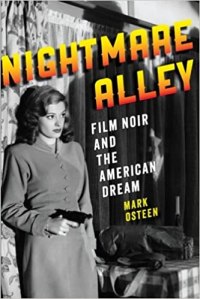
As we prepare for our conversation on Inkling Folk Fellowship tomorrow night, I thought I would share some pieces on the 1947 film adaptation of Nightmare Alley from Mark Osteen’s 2014 academic study, Nightmare Alley: Film Noir and the American Dream (Johns Hopkins University Press). Osteen’s essay is part of a larger project to situate film noir social, cultural, and political realities of the United States in the wake of World War II. Osteen will argue that “film noir remains a useful term with which to designate a peculiarly interrogative, deeply moral, visually adventurous and politically aware sensibility that characterized American cinema between 1944 and 1959” (28). To set up what is an argument about the cultural prophetic criticism of film noir, he uses the 1947 film Nightmare Alley to show the deep conflict that exists in how the American Dream was imagined. Nightmare Alley challenges the “dreams” and promises of American identity, upward mobility, and economic or social success.
I have selected from Osteen’s introduction where he discusses Nightmare Alley in some detail. The film and culture essay contains spoilers for readers and film-watchers, and thus makes a good reading for those who will not get to the films or novel before we discuss it (though the 1947 film is free online, linked at the bottom). The essay also works in conversation with John Stanifer’s review, Connor Salter’s essay, Nick Tosches’ thoughts on the novel, and Bill Gresham’s personal story. I have made some paragraph adjustments to the text, and the footnotes (which are all Osteen’s own thoughts) make some contrasts between the 1947 film and Gresham’s original novel.
“The Fine Lines Between Mind Reader and Geek”: Thoughts on Nightmare Alley, Film Noir, and the American Dream by Mark Osteen
“Is a guy born that way?”
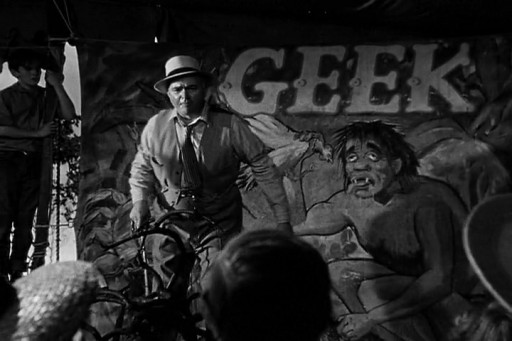
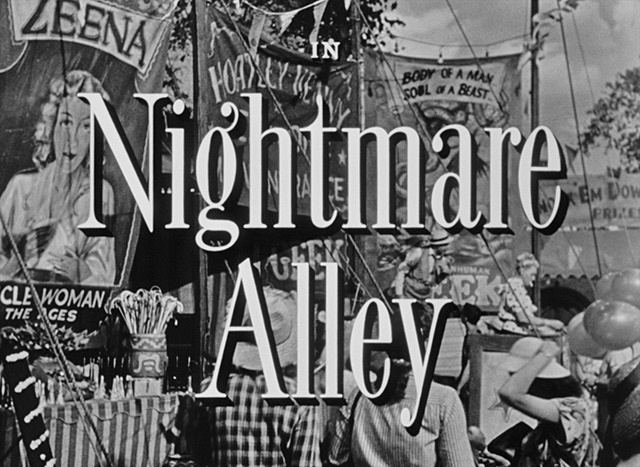
Stan Carlisle (Tyrone Power), the protagonist of Edmund Goulding’s Nightmare Alley, asks this question about the geek, an abject figure on the lowest rung of the carnival hierarchy, whose chief task is to bite off the heads of chickens.[i] One of the darkest films in the noir canon, Nightmare Alley traces Carlisle’s rise from carny assistant to slick mentalist performing in chic hotels, followed by a fall into destitution, which ends as Stan, now a groveling alcoholic, is hired as a carnival geek. The answer to his question is ambiguous: Stan’s cynicism, arrogance, and greed motivate the bad choices he makes, as does his relationship with the scheming psychologist Lilith Ritter. Yet the film’s circular structure and motif of tarot cards imply that Stan was indeed “born that way”—that he always has been a geek.
Carlisle’s quest for fame is a quintessentially American tale that depicts the pursuit of happiness through individual striving, but it is an anti–Horatio Alger fable of the perils of ambition, a warning that transforming the self may also empty it of meaning. More broadly, the geek figure offers an opportunity to assess critically the American ideals of self-creation, individualism, free choice, and upward mobility. Though the geek’s pursuit of happiness is drastically attenuated—he will do anything for a drink—it nonetheless resembles those of many film noir protagonists, obsessed with a desirable goal or object—a falcon sculpture, a seductive woman, a big score—or fleeing, like Stan, from a traumatic event. Indeed, Stan Carlisle’s life evokes questions that have troubled Americans since before the nation even existed: what is the relation between personal history and present character? Is it possible to escape from one’s past? Is identity inborn or a set of masks or performances? Nightmare Alley provides one answer to the question that lies at the heart of this book: what does film noir tell us about the American Dream?
In his study of that overused but little-understood phrase, Jim Cullen lists four dreams: those of upward mobility, equality, home ownership, and the West as a symbol of undying hope, best epitomized by Hollywood (8–9). I would add to his tally the ideals of free enterprise and personal liberty. Beneath each of these values lies an enduring faith in what the Declaration of Independence calls “the pursuit of happiness,” a phrase that, Cullen proposes, “defines the American Dream, treating happiness as a concrete and realizable objective” (38). Underpinning even that goal is the ideology of individualism—the belief that personal effort enables one to determine one’s own destiny and character; throw off the fetters of history; overcome class, gender, and racial barriers; and gain wealth and prestige. The crime films made in Hollywood between 1944 and 1959 challenge these beliefs by portraying characters whose defeat or death seems fated; by dramatizing the obstacles to class mobility and racial or gender equality; by asking whether anyone—whether detective, war veteran, or homeless woman—can truly reinvent him- or herself; by questioning whether new consumer products and technologies such as fast cars really liberate us; and by raising a skeptical eyebrow at the midcentury faith in psychoanalysis and the therapeutic ethos that supports it.
Stan Carlisle’s question has been answered in two conflicting ways throughout American cultural history. One answer, perhaps best represented by Benjamin Franklin’s Autobiography, portrays identity as an endless process of entrepreneurial invention. Thus young Ben leaves his childhood home in Boston to make his way to Philadelphia where, in part 2, he deliberately sculpts a new self through the sedulous application of reason and industry (see 79–86). For the rest of his life he constantly remakes himself: first a printer and publisher, he becomes at different periods a musician, an inventor, a scientist, an ambassador, a military leader, and a legislator. Franklin also inserts into his life story a letter from a friend, Benjamin Vaughan, who writes that Franklin proves “how little necessary all origin is to happiness, virtue, or greatness” (72). In this archetypal American success story, one’s past is irrelevant to one’s present and future: an American can be anything he or she wishes, so long as he or she maintains resilience and curiosity. Franklin’s story is the Protestant conversion narrative—a narrative of being born again—shorn of supernatural trappings. Whatever a Franklinesque American becomes, he or she is never merely “born that way.”
Set against this model of infinite reinvention is the philosophy presented by Ralph Waldo Emerson in his influential essay “Self-Reliance.” For Emerson, a person cannot reinvent him- or herself; instead, one must discover and refine his or her true nature by looking within. Emerson holds that
“a man should learn to detect and watch that gleam of light which flashes across his mind from within, more than the lustre of the firmament of bards and sages” (29).
The self must be free of fetters—on this Franklin and Emerson agree—but unlike Franklin, Emerson argues that “no man can violate his nature” (35). Self-reliance thus presumes the existence of an authentic self to be relied upon. That “aboriginal Self” cannot be escaped, for it underlies “every former state of life and circumstances, as it does underlie my present” (38, 41). Nor does mobility make a difference. Emerson writes,
“I pack my trunk, … embark on the sea, and at last wake up in Naples, and there beside me is the stern fact, the sad self, unrelenting, identical, that I fled from” (48)….
But self-reliance requires an aversion to conformity; it is individualist through and through. Despite their differences, then, and putting aside the nuances overlooked in this admittedly simplified distillation of the two figures’ philosophies, it is clear that the Franklinesque and Emersonian models of identity share a foundational belief in individual choice. And this agency, according to Cullen, is the “bedrock premise” that “lies at the very core of the American Dream” (10). Without self-determination there can be no dream.
But this premise also creates a problem: how to create a cohesive community composed of self-interested individuals. Cullen finds in the Puritans a balance between individualism and community that “straddles … the tension between one and many” (32); this is a balance that few noir protagonists achieve. Instead, in pursuing happiness they find themselves alienated, cast out, defeated; worse, their end seems fated, as if they have played only a minor role in engineering their own lives. As Ken Hillis comments, noir protagonists come to recognize “the difficulty—if not impossibility—of achieving modernity’s implicitly cosmopolitan promise that an individual, by dint of hard work, education, and reason, can develop a politically robust subjectivity” (4). To put it another way, film noir often paints the pursuit of happiness as a chimera and shows self-creation constrained by forces beyond individuals’ control.
If, as John Orr proposes, the noir protagonist initially believes that “America is the dreamland of opportunity, where all possibilities can be considered,” his or her story ends with an awakening into a chastening reality (160). The obstacles aren’t merely character flaws; they are features of society. Thus, as Hillis notes, when noir protagonists do reach the top, they discover that life there is “as rotten as it is at the bottom” (7). In short, social mobility is seldom possible in noir and irrelevant when it does occur. Considering these patterns, John Belton suggests that noir registers a “postwar crisis of national identity” related to the “dissolution of the myth of Jeffersonian democracy” (qtd. in Chopra-Gant 152). Noir, that is, posits an inversion of equality whereby almost everyone is equally trapped. Made during a period marked by social and political upheaval, films noir test and critique both the principles of the American Dream—individualism and self-determination, liberty, equality, upward mobility, capitalist enterprise—and their practice….
Among the many forces that converged to create the phenomenon we call noir [which Osteen outlines in his book] were 1930s gangster films. Movies such as Little Caesar, The Public Enemy, and Scarface are fables of American entrepreneurship camouflaged as exposés or action thrillers. As Jack Shadoian notes, the 1930s gangster is “a paradigm of the American dream”: an immigrant who, by ruthless force of will and relentless energy, rises to the top of his “industry” but is eventually punished for the very qualities that have fueled his elevation (3). Shadoian astutely observes that gangster films expose a fundamental contradiction in the American psyche:
“It’s fine to get ahead, but it’s wrong to get ahead. It’s good to be an individual, but then you’re set apart from others.” Such films, he continues, are often “disguised parables of social mobility as a punishable deviation from one’s assigned place” (6).
In them the Franklinesque and the Emersonian visions of identity collide head-on….
Fredric Jameson has analyzed a condition he calls “seriality”: a sense that
“the uniqueness of my own experience is undermined by a secret statistical quality. Somehow I feel I am no longer central, that I am merely doing just what everybody else is doing.”
Yet “everybody else feels exactly the same way” (76; emphasis in original).
Hence, while the burgeoning consumer economy offered fungible goods as the means to happiness, it also induced further fragmentation, because those satisfactions remained private and required constant renewal. Noir diagnoses this fragmentation, demonstrating the fraudulence and ineffectuality of the therapeutic ethos as a remedy for anxiety and alienation. The pursuit of wealth, like the pursuit of mental health, is portrayed as a means of exploiting the disenfranchised or dissatisfied, of gulling the naive or impulsive with fantasies of achievement or perfection. The therapeutic ethos, as it links psychiatry to consumerism, ties both practices to American ideals of self-reinvention, class mobility, free enterprise, and the pursuit of happiness. These beliefs and associations are all displayed in Nightmare Alley, where Carlisle’s enactment of the dream of upward mobility fuses what Cullen calls “earthly goals and heavenly means” (97).
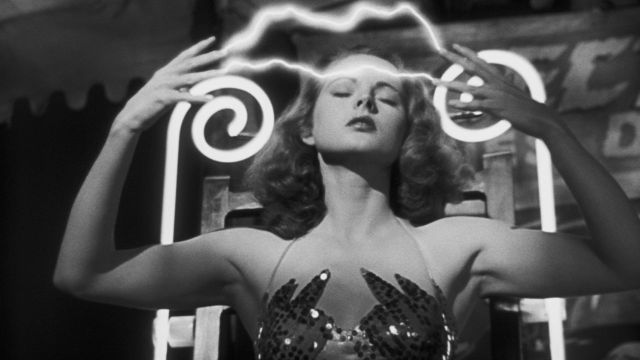
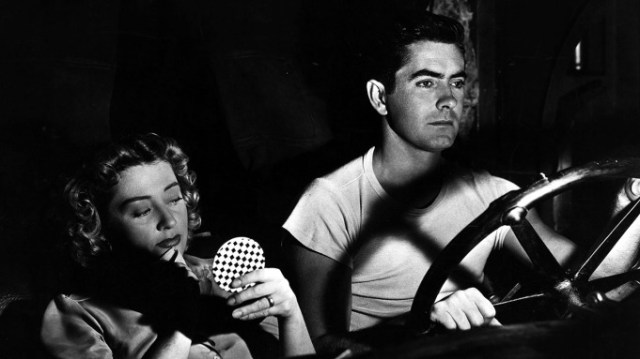
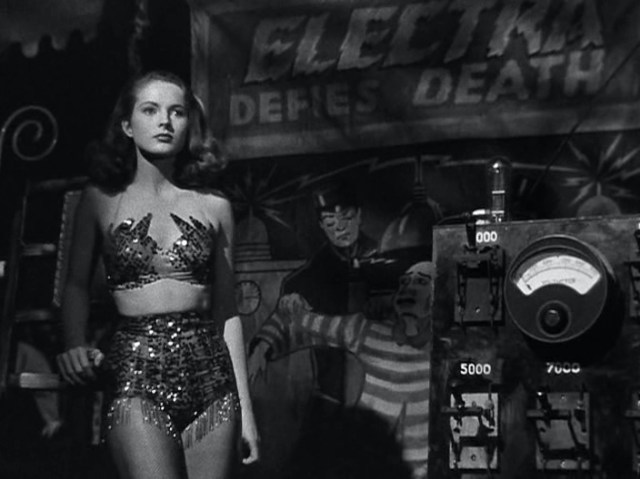
Though Stan admits to the carnival’s owner that he is fascinated by the geek (“you’re not the only one,” the owner replies; “why do you think we’ve got him in the show?”), he doesn’t understand how anyone can “get so low.” Yet he loves the carnival life—the sense that carnies are “in the know” and audiences are “on the outside looking in.” “I was made for it,” he crows to Zeena (Joan Blondell), the star of a mind-reading act. The carnival worker indeed exemplifies the mobile self: one day freakish or superhuman—geek, strong man, or “electric girl” (the role played by Molly [Coleen Gray], Stan’s soon-to-be lover)—the next day, or the next hour, a fire-eater, mentalist, or retail clerk. Never part of the masses, the carny exploits them, gives them what they want, then moves on to the next town.
Yet, as Tony Williams points out, many carnies are “one step away” from “poverty and destitution” (“Naturalist” 133). In other words, these traveling entertainers are always, in some sense, geeks. And so, Nightmare Alley implies, are their audiences, hungry for the shows’ packaged intensity to light a spark in their drab lives. Simultaneously titillated, disdainful, awestruck, and credulous, the crowds see in the carnies what they both wish and fear to be. Thus, as Zeena performs—answering questions written on cards that she never reads—the camera sits amid the crowd, shooting upward at her and Stan, who seem larger than life. But when we go backstage, we learn that Zeena’s telepathy is a trick: the cards are given to her husband, Pete (Ian Keith), who sits below the stage and feeds her their contents as she gazes into her crystal ball.
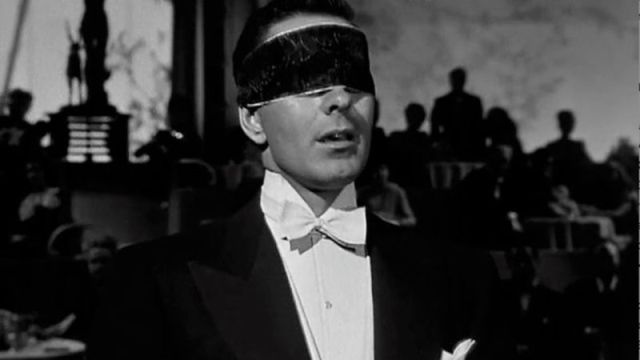
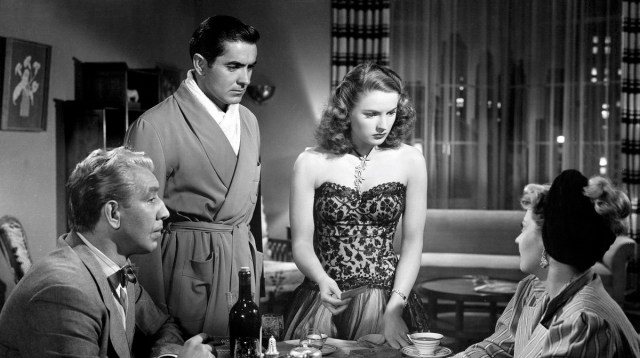
If Stan feels contempt for his audiences, Zeena resembles them: she, too, believes in cards—tarot cards. She and Stan scheme to dump Pete and start a romance and a new act using a code system (a set of verbal clues to the contents of the cards), but when the tarot predicts failure (the death card is found face down on the floor), Zeena backs out: “I can’t go against the cards.” Stan scoffs at her belief in “boob-catchers,” but he is not immune from the allure of the inexplicable. That night Pete, now a beaten alcoholic, nostalgically recalls when he was “big-time,” launches into his old act, and gives a “psychic” reading of Stan’s early life.
“I see … a boy running barefoot through the hills. … A dog is with him.”
“Yes,” Stan responds.
“His name was Gyp.” Pete breaks the spell: “stock reading. … Every boy has a dog!”
The shadowy mise-en-scène encourages us to recognize the fine lines between mind reader and geek, duper and duped.
Stan, who had earlier bought a bottle of moonshine, takes pity on the old trouper and gives it to him. But when Pete is found dead the next morning, having drunk a bottle of wood alcohol that Zeena uses in her act, Stan blames himself for giving Pete the wrong bottle, and this (possibly unconsciously deliberate) mistake, along with the geek’s howls, haunts him for the rest of the film.
Pete’s death opens the door for Stan to become Zeena’s assistant, but his big break comes when a sheriff tries to close down the carnival. Exuding a sincerity spiced with folksy references to his “Scotch blood” and blending biblical quotations and platitudes (many taken directly from William Lindsay Gresham’s searing source novel: 596–99), Stan senses that the sheriff feels unappreciated and exploits his religious beliefs to save the show.[ii] In the novel Zeena remarks, “Not much different, being a fortuneteller and a preacher”—or an alcoholic: later in the novel, Stan exults,
“They drink promises. They drink hope. And I’ve got it to hand them” (556, 599).
In the film Stan recalls learning to fake religiosity in reform school.[iii] He seems to have no religious feeling himself. But he wishes he could believe in something to help him conquer the feelings of meaninglessness and helplessness that trouble him—the recognition that humans merely stumble “down a dark alley toward their deaths” (579)—and that motivate the recurring dream of enclosure alluded to in the title (587).
In both versions Stan’s success prompts him to leave the carnival and, with Molly, begin a new, classier act as The Great Stanton, a nightclub “mentalist.” At one show a woman sends him a card asking if her mother will recover; Stan discerns that her mother is actually dead, then exchanges gazes with the woman—Lilith Ritter (Helen Walker)—to acknowledge their kinship.
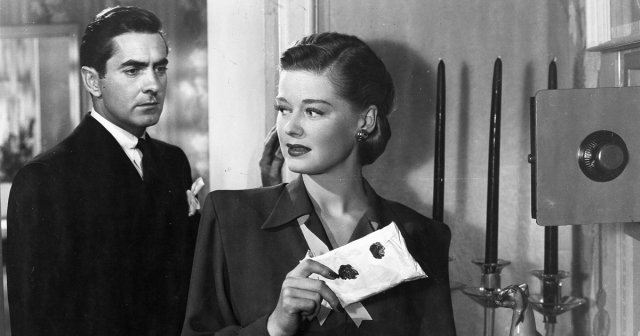
And indeed, Lilith, a “consulting psychologist,” performs a function similar to Stan’s, delving into her patients’ darkest fears, doling out reassurance or advice, but most of all making them feel important. In their early scenes together Stan and Lilith are presented as two of a kind, placed at the same level of the frame in matched singles or two-shots. The power differential begins to change, however, after a visit from Zeena brings back Stan’s memories of Pete’s death; tortured by guilt and haunted by the geek’s howls, he goes to Lilith for advice. In earlier scenes Lilith had worn masculine suits and hats, a composite figure combining the parents Stan lost.[iv] In this scene, however, she wears her hair down, dons a flowing robe, and, like a forgiving mother, reassures Stan of his normality by telling him he is “selfish and ruthless when you want something; generous and kind when you’ve got it,” just like everyone else (Williams, “Naturalist” 135–36). He feels guilty, she says, only because he profited from Pete’s death. Because of her advice, Stan pledges to proceed into the “spook racket,” holding séances in which bereaved survivors contact their deceased loved ones. This is his ticket to the big time: “I was made for it,” he declares.
Through Lilith and a wealthy client, Mrs. Peabody, Stan meets Ezra Grindle, a rich industrialist who carries a burden of regret over the death of Dorrie, a girl he loved and lost. Lilith and Stan engineer a swindle whereby Stan will receive $150,000 to “recall” Dorrie and permit Grindle to speak to her again. To do so, however, Stan must persuade the reluctant Molly to perform as the dead girl.[v] Although Stan exhorts her to help him save Grindle’s soul, Molly demurs: mentalist acts are one thing, but this is “goin’ against God.” They might be struck dead for blasphemy! Stan assures her that his séances are “just another angle of show business.” When Molly threatens to walk out, he resorts to his final ploy: phony sincerity. Admitting that he’s a hustler but professing undying love for her, he persuades her to play Dorrie, complete with turn-of-the-century garb and parasol, in a scene staged for Grindle.[vi] But the trick fails when Molly, moved by Grindle’s pleas, breaks the illusion: “I can’t, not even for you!” she cries, then flees (in the novel Grindle tries to grope Molly). Exposed as a “dirty sacrilegious thief,” Stan—or at least his plan—is ruined.
No matter: he already has the 150 grand, which he retrieves from Lilith, who has been holding it for him. But Lilith turns out to be a bigger con artist than he, having replaced the roll of high denominations with one-dollar bills. When Stan tries to get the money back, she retreats into her psychologist persona and insists that he suffers from delusions. “You must regard it all as a nightmare,” she informs him. Having learned from her research that Pete’s death was “self-administered,” she coldly tells Stan that his guilt is merely a “homicidal hallucination” and that he has made a “strange transference” to her. Just in case he doesn’t get the picture, she also reminds him that she has recorded his sessions and can, if necessary, implicate him in fraud.
Confused and desperate, Stan sends Molly away: along with his money he has lost the only person who loves him; perhaps worse, he has lost the swagger that enabled his success.
His fall is as precipitous as his rise: he begins drinking heavily, moving from one seedy, dark hotel room to another, hearing the geek’s howls wherever he goes.[vii] Before long he has become a hobo giving stock readings to other derelicts in exchange for a slug of cheap liquor. Echoing Pete’s earlier words, he scoffs at his credulous listeners:
“Every boy has a beautiful old, gray-haired mother. Everybody except maybe me.”
At last he seeks work as a carnival palm reader but is told that they don’t hire boozers. On second thought, there may be a job for him—a temporary one, just until they can get “a real geek.” Stan accepts the gig:
“Mister, I was made for it.”
This is where the novel ends, but the film adds a semiredemptive epilogue (probably the work of producer Darryl F. Zanuck) in which Stan—shot amid deep shadows on the barred carnival set—goes berserk, then rushes into the arms of Molly, who happens to work in the same carnival. The film gestures toward the salvation narrative that the novel deliberately eschews. We are even given a moral, as one man, echoing Stan’s question at the film’s opening, asks
“How can a guy get so low?”
Answer:
“He reached too high.”
This pat wrap-up does little to soften the disturbing tale we have witnessed and warns audiences that pursuing the American Dream may lead one down a nightmare alley.
But Stan’s fault isn’t that he reaches too high; it is that he doesn’t believe in his own greatness. Like many a performer, he is actually solitary and fearful, and the alienation that permits him to rise above the masses eventually pulls him down. He wants to feel superior to others yet dreads being different, thus exemplifying the gangster’s paradox that Shadoian outlines. Indeed, the film suggests that Stan lives out his destiny, that he has always been and always will be a geek. His “geekness” lies partly in the willingness, shared by many noir protagonists, to do anything to get what he wants. Unfortunately, however, Stan doesn’t know what he wants—or, rather, he wants conflicting things: both admiration and pity.
We do as well: watching him, we at once relish our moral superiority and identify with him, suspecting that we, too, are secretly geeks.
Carlisle is just one of the film’s objects of criticism, as it places him among gullible audiences who line up to be cheated and wealthy citizens duped by the elaborate con games called religion and psychoanalysis. Pursuing happiness through amusements or therapy, these citizens hope to fashion new identities out of consumer purchases, but their commodified selves are as bogus as the ghosts in his séances.
Yet Carlisle’s fate forcibly exposes the underside of the American Dream of upward mobility, singular achievement and fungible identity: his mobility isn’t freedom; it is merely restless appetite.
Nor does he ever have a home—the carnival being the antithesis of home—and his constant changes only bring him back where he started, to the no-place of the geek.
This nonidentity, a subhuman persona that lacks even a name, is the accursed share of the pursuit of happiness. Nightmare Alley suggests, then, that Carlisle’s decisions only push him to a destiny already ordained. His commodified identity as The Great Stanton is exposed as a hollow shell, inside of which dwells the geek. Individualism personified—caring for no one else; severed from community, lovers, and friends—Carlisle is a failed Franklin brought down by the Emersonian truth that no matter where he goes, he will meet himself—someone who is, at the core, nobody at all….
Nightmare Alley is a particularly potent challenge to the dream of upward mobility, [and] it is not an anomaly in film noir….
Footnotes
[i] At that time (1947) the word geek bore none of its current associations with computer engineers, their allegedly poor social skills, or their highly developed analytical powers. Yet the word’s current connotations—describing a creature at once superhuman and disabled—may derive from this earlier incarnation.
[ii] Gresham, like so many writers of the period, had joined the Communist Party in the 1930s; he later married poet Joy Davidman (to whom Nightmare Alley is dedicated). He underwent psychiatric treatment and later became a devout Christian. None of his other works achieved the success of this, his first novel. See Polito’s “Biographical Notes” in Crime Novels for further details (980–81). In an irony appropriate to his grim, deterministic tale, Gresham committed suicide in the same hotel where he wrote Nightmare Alley (Williams, “Naturalist” 137).
[iii] Because the film’s Stan is an orphan, the movie omits most of the novel’s Oedipal conflict, in which young Stan, after witnessing his mother having sex with her lover, is bought off with a toy magic set (Gresham 618–22). His magic acts automatically invoke his filial betrayal, and his guilt over this betrayal and his confused feelings about his parents make him susceptible to Lilith’s machinations.
[iv] In the novel she tells him he has imagined himself as his mother’s lover and deliberately takes the mother’s place (688). She is said to be “hooked” to him by “an invisible gold wire” (689); in the film her power is illustrated by the weblike barred shadows that surround her in her office.
[v] In the novel Grindle had impregnated Dorrie and persuaded her to have an abortion. The girl died of septicemia afterward, and Grindle has been tormented ever since. In 1947 Hollywood it was forbidden even to mention abortion, so the film cleans it up, thereby obviating Grindle’s most powerful motive.
[vi] Goulding and his director of photography, Lee Garmes, employ deep focus and fog to make the bower resemble a late nineteenth-century postcard.
[vii] . These scenes in the novel are much more gloomy and expansive, as Stan is driven crazy by violent, paranoid fantasies. Gresham implies that Stan is caught in a classic double bind: all along he has desired to be his nemesis—his mother’s lover, Mark Humphries—but once he has become him, he can do nothing but ruin him (771). While on the run, Stan also meets an African American Communist labor organizer, Frederick Douglass Scott, who is on his way to fight Grindle’s union-breaking efforts. Scott’s presence indicates Gresham’s political allegiances and, as Williams notes, signals a path that Stan “could have taken” (“Naturalist” 129; Gresham 767–76). Stan then kills a policeman whom he confuses with his father (Stan’s demons are all associated with gray stubble): this is his “own personal corpse” (781), the alter ego he both fears and inhabits. Finally, Stan shows up at a carnival, and on the novel’s last page, he is given the geek job (796).
This selection is from Mark Osteen, Nightmare Alley: Film Noir and the American Dream (Johns Hopkins University Press, 2014), pp. 12-28.
Mark Osteen is a professor of English, chair of the English Department, and founder of the Film Studies Program at Loyola University Maryland. He is the author of several books, most recently the memoir One of Us: A Family’s Life with Autism (2010). He is the editor of Hitchcock and Adaptation: On the Page and Screen (2014).
I believe in open access scholarship. Because of this, since 2011 I have made A Pilgrim in Narnia free with nearly 1,000 posts on faith, fiction, and fantasy. Please consider sharing my work so others can enjoy it.
At A Pilgrim in Narnia, we are in the midst of the “Nightmare Alley Series,” inspired by Guillermo del Toro’s new film starring Bradley Cooper, Cate Blanchett, Rooney Mara, Willem Dafoe, and Toni Colette. Moving back from the star-filled screen to William Lindsay Gresham’s 1946 novel, Nightmare Alley, and its first film adaptation in 1947, we are hoping to provide some background to Gresham’s connections: his wife at the time he wrote the novel, Joy Davidman, and her relationship a few years later with C.S. Lewis. A playful series, we have been looking at these sorts of things:
Because I had great difficulty finding it, I published William Lindsay Gresham’s Conversion Story, “From Communist to Christian”
I am right now trying to pull my own thoughts together on the novel and films for tomorrow
Friday, Jan 7th, we are holding a special Zoom event at Inkling Folk Fellowship (hosted by Joe Ricke), where John, Connor, and I will join our friends there for a video discussion beginning at 4pm Eastern (free event signup here) (it’s also worth noting the Joe retitled the event with a far better title than I had provide: “Fate, Hope, and the Dark Side of Enchantment: The Complicated History of Nightmare Alley” (his title) vs. “Nightmare Alley, Bill Gresham, and Links to Joy Davidman and C.S. Lewis” (my title)
Today, I am publishing a long selection from Nick Tosches’ “Introduction” to Gresham’s Nightmare Alley, where Tosches illuminates the reader about Gresham’s literary inventiveness and its contribution to popular culture. In 2010, the New York Review Books Classics series was prescient in reprinting Nightmare Alley. In anticipating a waiting audience eager for this neglected noir classic, this edition also restored some of the text that was excised through editorial accident or discomfort over the years. Beyond the wisdom of recovering the novel, biographer and pop culture writer Nick Tosches provides what I think is a remarkable preface to the book. I don’t know if we’ll ever get to see the book on Bill Gresham that Tosches left unfinished at his death, but this essay is a work of art as it considers the gritty core of Nightmare Alley without intruding on the dream.
I hope you enjoy, and check out the New York Review Books Classics edition, which has Nick Tosches’ essay in the 2010 paperback (which I read), the e-book, and the new film tie-in edition.
Nick Tosches’ Introduction to the New York Review Books Classics edition of William Lindsay Gresham, Nightmare Alley
Many who read this will have read Nightmare Alley. But it is to be hoped that others will be drawn to read this singular work for the first time. I envy the latter, and I don’t want to interfere with the experience that awaits them by delving into matters that would reveal its plot, which grows increasingly more powerful and bizarre from beginning to end. But, to paraphrase Ezra Pound, a little knowledge can do us no harm.
This book, first published in 1946, was born in the winter of late 1938 and early 1939, in a village near Valencia, where William Lindsay Gresham, one of the international volunteers who had come to defend the Republic in the lost cause of the Spanish Civil War, was awaiting repatriation. He waited and he drank with a man, Joseph Daniel Halliday, who told him of something that took him aback with a scare: a carny attraction called a geek, a drunkard driven so low that he would bite off the heads of chickens and snakes just to get the booze he needed. Bill Gresham was only twenty-nine then. As he would later tell it,
“the story of the geek haunted me. Finally, to get rid of it, I had to write it out. The novel, of which it was the frame, seemed to horrify readers as much as the original story had horrified me.”
Upon his return from Spain, according to his own account, Gresham was not a well man. He became deeply involved in psychoanalysis, one of the many ways he sought throughout his life to banish his inner demons.
It was while writing Nightmare Alley that Gresham drifted away from psychoanalysis and became instead fascinated with the tarot, which he discovered while turning from Freud to, in the course of his research for Nightmare Alley, the Russian mystic P.D. Ouspensky (1878– 1947).
Had only Gresham known of the paper Freud delivered at the Conference of the Central Committee of the International Psychoanalytical Association in September 1921. In it, Freud declared:
“It no longer seems possible to brush aside the study of so-called occult facts; of things which seem to vouchsafe the real existence of psychic forces other than the known forces of the human and animal psyche, or which reveal mental faculties in which, until now, we did not believe.”
Freud and Ouspensky then might have walked even more closely together down Gresham’s alley of nightmares.
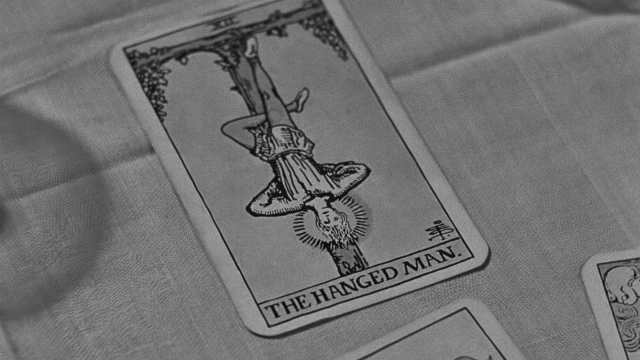
Gresham used the tarot to structure his book. The tarot deck consists of twenty-two figured trump cards, of which twenty-one are numbered, and fifty-six cards divided into four suits of wands, cups, swords, and pentacles. The deck has been used for centuries for both gambling and fortune-telling. In the case of fortune-telling, it is the trump cards, also known as the Major Arcana, that are primarily employed, and these are the cards which give the titles to the chapters of Nightmare Alley. The first trump card is the Fool, which is the card that bears no number, and the final one is the World. Gresham begins his book with the Fool, but then shuffles the deck. His deck ends with the Hanged Man.
As piercing as the psychological probings of Nightmare Alley are, eerily the tarot alone is bestowed at times with a hint of ominous gravity and credence amid all the other spiritualist cons of the novel that are to Gresham and his characters nothing more than suckers’ rackets.
It is interesting, too, that while still undergoing psychotherapy, Gresham crafted in Nightmare Alley, in the somewhat heavy-handedly named character of Dr. Lilith Ritter, the most viciously evil psychologist in the history of literature.
He would later say of this time [in his conversion story published here] that six years of therapy had both saved him and failed him:
“Even then I was not a well man, for neurosis had left an aftermath. During years of analysis, editorial work, and the strain of small children in small rooms, I had controlled anxieties by deadening them with alcohol.”
He said,
“I found that I could not stop drinking; I had become physically an alcoholic. And against alcoholism in this stage, Freud is powerless.”
Nothing worth reading was ever written by anyone who was drunk while writing it; but Nightmare Alley evinces every sign that its writing was binge-riddled. Booze is so strong an element in the novel that it can almost be said to be a character, an essential presence like Fates in ancient Greek tragedy. The delirium tremens writhe and strike in this book like the snakes within. William Wordsworth’s dictum that poetry was “emotion recollected in tranquillity” here finds a counterpart in Gresham’s evocation in sobriety of what he calls in his novel “the horrors.”
Surely “the horrors” in this sense had been part of colloquial speech, at least among drunks and opiate addicts, before Robert Louis Stevenson used it in Treasure Island (1883), and it is still very much current today.
The matter of language is paramount here. Gresham’s cold blue steel prose is consummate, as is his use of slang in dialogue and interior monologue. Never affected, always natural and effective.
As noted in a little profile of him published in The New York Times Book Review soon after the novel’s release:
“Among the Gresham interests are confidence men, their wiles and argot, which he tosses off with a bland ease that, one executive at Rinehart was saying the other day, is enough to frighten an ordinary, law-abiding citizen.”
The word “geek” (derived from “geck,” a word for a fool, simpleton, or dupe, in use since from at least the early sixteenth through the nineteenth century) was generally unknown in its carnival sense of a “wild man” who bites the heads off live chickens or snakes, until Gresham introduced it to the general public in Nightmare Alley. In November 1947 the popular Nat “King” Cole Trio made a record called “The Geek.”
As an elaboration of “cinch,” the phrase “lead-pipe cinch,” to denote a sure thing, had been around since the nineteenth century, and it would stay around a good while more. It could be found in 1949 in Nelson Algren’s The Man with the Golden Arm and in 1974 in a New York Times financial report.
Some of the enchanting slang Gresham used seems to have appeared in print for the first time in Nightmare Alley. Geek, in its sideshow sense, may have been one of them. The earliest instance to be found thus far in Billboard’s carnival section occurs in a want ad of August 31, 1946, after the novel was already for sale: “No Geek or Girl Shows” stated a notice that Howard Bros. Shows was seeking acts and concessions. (Want ads for geeks in the carnival section of Billboard continued until at least 1960. An advertisement placed by Johnny’s United Shows in the issue of June 17, 1957, was blunt: “Want outstanding Geek for Geek Show. Must know snakes.”)
The phrase “cold reading” almost certainly appeared in print for the first time here, as did the unforgettable “spook racket.” (We become aware of the meaning of these slang terms as we encounter them. Gresham never stoops to explication through forced dialogue.)
Both phrases next show up, almost immediately and in the same sentence, in Julien J. Proskauer’s 1946 The Dead Do Not Talk, which was received by the Library of Congress almost four months after Gresham’s novel and was assigned a later control number. After that, “cold reading” is found the following year in C. L. Boarde’s slim, self-printed, spiral-bound guide to the spiritualist’s craft, Mainly Mental, then begins to appear more widely, while “spook racket” seems to vanish to its well-deserved solitary throne beyond the veil.
The passage in which “cold reading” first appears, in the fourth chapter, “The World,” also contains one of the novel’s turning points, when the tale’s central character, Stan, reading in the long-fallen mentalist Pete’s old notebook, comes upon the words “Can control anybody by finding out what he’s afraid of” and “Fear is the key to human nature.” Stan
“looked past the pages to the garish wallpaper and through it into the world. The geek was made by fear. He was afraid of sobering up and getting the horrors. But what made him a drunk? Fear. Find out what they are afraid of and sell it back to them. That’s the key.”
Here too in “The World” is Stan’s, and Gresham’s, view of the language that enthralled. As Stan enters the remote piney deep South, where the fortune-teller did a better trade in John the Conqueror Root than in the horoscope cards she peddled at the close of her show:
The speech fascinated him. His ear caught the rhythm of it and he noted their idioms and worked some of them into his patter. He had found the reason behind the peculiar, drawling language of the old carny hands— it was a composite of all the sprawling regions of the country. A language which sounded Southern to Southerners, Western to Westerners. It was the talk of the soil and its drawl covered the agility of the brains that poured it out. It was a soothing, illiterate, earthy language.
This is the language of Nightmare Alley, and many urbane critics of the time found it shocking and brutal as well. Gresham’s wicked lyricism is unique: a gutter literacy that probes the stars, at times a celestial literacy that probes the gutter.
The nightmare alley into which William Lindsay Gresham leads us is not one of moral depravity, for the nicety of morality has nothing to do with it.
Gresham’s novel is a tale of many things: the folly of faith and the cunning of those who peddle it; alcoholism and the destructive terror of delirium tremens; the playing deck of fate, which allots its death-bound destines without rhyme and without reason. What it is not is a tale of crime and punishment, sin and retribution. To see it as such is to misread it. What we consider to be crime and sin pervade this alley, but the punishment and retribution here seem more the wages of life itself.
“It was the dark alley, all over again,” Stan tells himself in Nightmare Alley.
“Ever since he was a kid Stan had had the dream. He was running down a dark alley, the buildings vacant and menacing on either side. Far down at the end of it a light burned, but there was something behind him, close behind him, getting closer until he woke up trembling and never reached the light.”
Stan reflects of his marks, of everyone: “They have it too— a nightmare alley.” Yes, as Stan— that is to say, Gresham— observes elsewhere, fear is the key to human nature.
And Stan and Gresham were indeed one. There is a bizarre letter, frayed and torn, preserved in the collection of the Wade Center of Wheaton College, written by Gresham in 1959, when the end was near. In it he wrote:
“Stan is the author.”
Upon its publication, in September 1946, Nightmare Alley was an acclaimed and successful novel, and a damned and banned one. For thirty years after the first edition of 1946, every edition remained corrupt and censored. To use but one example, instead of “society dames with the clap, bankers that take it up the ass,” readers encountered “society dames with a dose, bankers that have fishy eyes.”
Within little more than a decade, it was all but forgotten. Sixteen autumns later, in September 1962, Gresham’s body was found, self-killed, in a hotel room off Times Square. He has just turned fifty-three a few weeks before. In his possession were business cards that read:
And so the alley, and the running, and the light beyond reach came to an end— for the man who wrote of that alley, if not for us who read of it.
Nick Toshes’ essay is from the introduction to William Lindsay Gresham, Nightmare Alley (New York Review Books Classics, 2011 Kindle edition, 61-151).
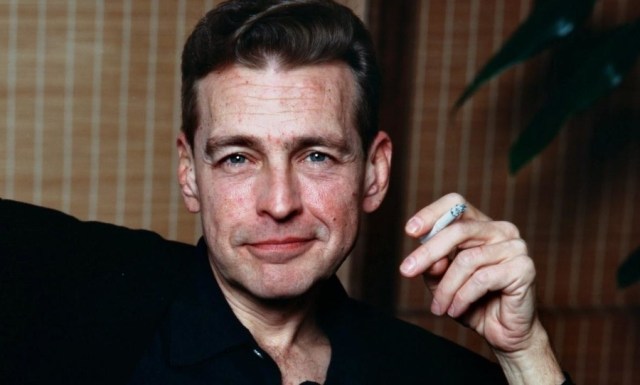
Nick Tosches authored twenty books of fiction, nonfiction, and poetry. His recent novel, In the Hand of Dante, was published in seventeen languages and selected as a New York Times Notable Book of the Year. Called “Newark’s Greaser Poet” by RockNYC, Tosches’ most notable work of music writing was his biography of Jerry Lee Lewis, Hellfire, which was praised by Rolling Stone magazine as “the best rock and roll biography ever written.” His life project, a book about William Lindsay Gresham, remained unfinished at the time of his death in 2019 at the age of 69.
I believe in open access scholarship. Because of this, since 2011 I have made A Pilgrim in Narnia free with nearly 1,000 posts on faith, fiction, and fantasy. Please consider sharing my work so others can enjoy it.


 As L.M. Montgomery was a consummate storyteller, it is lovely when we get the occasional pleasure of a new L.M. Montgomery story collection.
 Of Montgomery’s work in her lifetime, we have Chronicles of Avonlea (1912), followed by the illicit Further Chronicles of Avonlea (1920)–initially published without Montgomery’s permission and the subject of a legal drama. Finally, we now have The Blythes Are Quoted, edited by Benjamin Lefebvre in 2009, which is the complete version of the 1974 Road to Yesterday collection.
 Here is a list of Rea Wilmshurst’s collections:
 Hidden behind these lovely volumes are hundreds of hours of detective work, discovery, transcription, editorial revision, administrative tasks, correspondence, and collection–work carried on by Rea Wilmshurst and many invisible hands. In 1986, Ruth Weber Russell, D.W. Russell, and Rea Wilmshurst published Lucy Maud Montgomery: A Preliminary Bibliography–which is hard to find but available in research libraries. Carrying on the attention to detail of Rea Wilmshurst and others, Carolyn Strom Collins has compiled and edited materials for eager readers, both published in 2016 by the L.M. Montgomery Institute:
 An Annotated Bibliography of L.M. Montgomery’s Stories and Poems (which specifically extends Wilmshurst’s 1986 bibliography)
 It is always a treat, then, when we hear about a new collection. Ben Lefebvre’s LMMIOnline web resource notes that a 9th volume of 17 stories selected by Rea Wilmshurst will appear in May 2022, Around the Hearth: Tales of Home and Family, edited by Joanne Lebold. In their years of commitment, Carolyn Strom Collins and the late Christy Woster have each found dozens of Montgomery stories that might have been lost, or they have succeeded in finding the original publications of those stories later published in anthologies.
 As you might expect of Montgomery in this mode, the stories are full of charm and grace. In the warp and weft of something like fate or providence, families shatter, hearts break, and lovely things are lost. But in that same movement of the weaver’s tale, there is space for discovery, healing, and life-after-brokenness. Children are faced with terrible decisions that, in the moment, are so intimate and life-changing that the characters almost lose themselves in the choosing. Lovers have a chance to find their way back to lost loves–or the chance to turn with bitterness toward the future. Neighbours chase and peck and quarrel, but there is every opportunity for neighbourliness to return in the end. Cats inspire adventure and lead the way home. Ghosts shake the root of injustice while fair houses haunt the lonely and mirrors speak more than the truth. More than one good soul dies too young, and more than one old soul lives long enough to laugh at themselves.
 For at the heart of Montgomery’s best humour-laden short story-telling is the truth that folly waits at the edge of every one of our stories.
 However, without the work of Carolyn Strom Collins and Christy Woster–as well as other editors that work with them and came before them–these stories would be lost to us.
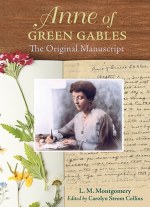 Besides the treasures, the bibliographies, and this collection of stories, Carolyn Strom Collins is also the editor of Anne of Green Gables: The Original Manuscript–a never-before-published version of the original text of Montgomery’s most famous manuscript. This recent publication of the Anne of Green Gables manuscript provides readers with a rare chance to peek in on Montgomery’s creative process, allowing us to see the author’s scribbled notes, additions and deletions, and other editorial details and marginalia.
 I have read Anne of Green Gables in my old Seal paperback, and I have listened to the story read by professional and amateur audio readers. Each time the book becomes brighter and better for me. However, reading this original manuscript edition resulted in my most fruitful and fun summer reading of Anne yet. With restrained and professional editorial comments, critical notes, and photocopies of Montgomery’s handwriting, Carolyn Strom Collins has done a superb job editing this version, providing us insight into Montgomery’s writing process and allowing us a way to read this classic text anew.
 As host and founding producer of the MaudCast, I was privileged to sit down with Carolyn Strom Collins for an interview about her work. In the episode (which you can find here or on Spotify), we discuss Carolyn’s editorial work and we focus in on her work in the archive and her final manuscript publication. I hope you enjoy this resource–as well as the wealth of resources for reading Lucy Maud Montgomery’s short stories.











 A Pilgrim in Narnia