
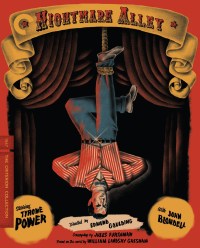
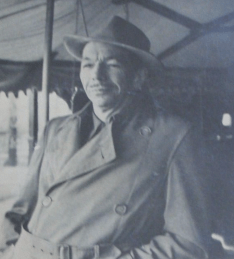
 At A Pilgrim in Narnia, we have been looking at Guillermo del Toro’s critically acclaimed new film, Nightmare Alley, and its connections to the past. The 2021 film, is an adaptation of the 1946 novel by William Lindsay Gresham, the husband of Joy Davidman–the enigmatic poet and prose writer C.S. Lewis’ wife in the late ‘50s. As we continue our “Nightmare Alley” series–and make sure you check out previous pieces (here and here), and make sure you attend our special Zoom video conversation on Inkling Folk Fellowship this Friday, Jan 7th, 4pm Eastern–this is a special background post for readers. Whenever you encounter information about Bill Gresham, they will often talk about his conversion story. I have not been able to find this story online, and it took quite some time to source it. Gresham’s conversion story, “From Communist to Christian,” was published first by Presbyterian Life magazine, and then in These Found the Way: Thirteen Converts to Protestant Christianity, edited by David Wesley Soper in 1951.
Peculiar as it is, I have decided to reproduce the essay—with most of the editor’s preface—as a resource for those who want to better understand Bill Gresham and his connections to Joy Davidman and C.S. Lewis. In the midst of the strange diction and situatedness of this piece are occasional moments of vivid writing and self-discovery. As much as it is a tribute to C.S. Lewis that gives more context to Joy Davidman’s spiritual journey, it is perhaps most powerful when Gresham is slaying his intellectual temptation of Marxist thought. It also shows a surprisingly sophisticated sense of the need for mental health from a man in the midst of a journey.
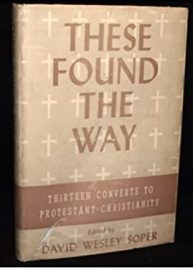 Editor David Wesley Soper’s Preface
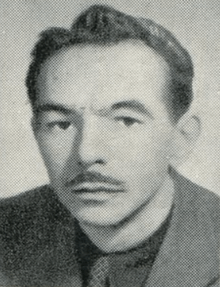
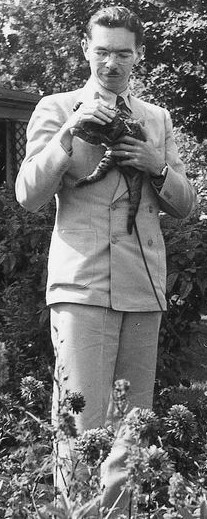
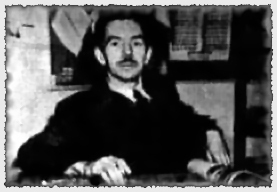
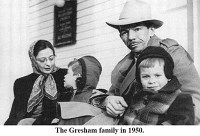
William Lindsay Gresham was born August 20, 1909, in Baltimore, Maryland. His parents were from the eastern shore of Maryland and Virginia. The family moved to New York City in 1917, and in 1926 he graduated from high school in Brooklyn.
After high school and during the early years of the depression, he held a variety of jobs and took some college courses. At one time he was determined to become a Unitarian minister. Out of a job in the spring of 1933, he sang in Greenwich Village cellar clubs for a time and then entered the Civilian Conservation Corps. After leaving the CCC he married.
For a short time Gresham was office boy and music, movie, and book reviewer for the New York Evening Post. Then he took a job as copy writer for a small advertising agency. In 1936 he started out as a free-lance writer. When one of his closest friends was killed in 1937, at the battle of Brunete in Spain, he volunteered as a soldier of the Spanish Republic.
In 1942 he was divorced from his first wife, and later in the same year married Joy Davidman. There are two sons: David and Douglas. After living ten years in Greenwich Village, the family moved, first to Westchester and then to Staatsburg, New York. His first novel, Nightmare Alley, was published in 1946, and produced later as a moving picture. Limbo Tower, his second novel, appeared in 1949.
Presbyterian Life magazine published, in three installments, the following account of his spiritual autobiography; the three installments are presented here together by permission.
“From Communist to Christian” by William Lindsay Gresham
 On a misty night in November, 1937, a hundred men from a dozen different countries climbed the Pyrenees, wearing silent, rope-soled sandals. At dawn they crossed the divide into Spain. I was one of that group. In all, 2,800 Americans served in the Army of the Spanish Republic. More than half of them were killed. I shall try to explain what took me there, for some of the same forces, in time, brought me to Christianity.
I was born in Baltimore forty years ago. My family were flotsam of the Old South, drifting through an industrial world with no guide save legends of a golden age when their ancestors had been slaveholders and gentlefolk. My mother was vaguely agnostic, vaguely Fabian Socialist. My father was a strong “company man”; what his religious beliefs were I never knew. My parents had no coherent view of the world and so could give me none.
I picked up scraps of personality where I found them. An ancient Shakespearean actress, a friend of the family, taught me manners — and manner. My high school teacher of English, the poet Florence Ripley Mastin, encouraged and guided a developing sense of beauty. My mother’s rebellion against Fundamentalism had left her rootless and distraught. What clear ethics I had came from my grandmother during early childhood, before we moved to New York.
“Grandy” was a Presbyterian, and she saw the world whole. Had she lived, she might have taught me to see it, but I was so young when she died that all I kept was her ideal of a perfect man: General Robert E. Lee. Out of that memory and my own pride I built a neurotic perfectionism for a moral standard. General Lee, I believed, led a flawless, superhuman life, and I must try to be exactly like him.
Many of my schoolmates had a materialist creed in place of religion: they worshiped prosperity. It was called “believing in America” but it was not patriotism. America was a great slot machine: drop in your talents and out would come the good things of life — cars, beautiful women, suburban homes.
But I had no confidence in possible future wealth to hold me up. The family had never been prosperous since “the War”’ they accepted lower-middle-class life with bitterness but without hope.
What happened to prosperity in 1929 we remember. When my parents separated during my teens, I drifted, doing unskilled office and factory work, and dreamed of being a writer. Life was enigma. I asked no definite questions because I was all question, ignorant that answers could be found.
In my early twenties I wanted to be a Unitarian minister—out of pride, not religious conviction. I didn’t know what true religion was. I simply felt that a socially conscious preacher could do some good in the world. But I could not afford a college degree, and the ambition raveled away.
I married; I held a number of jobs, more or less connected with writing; for years I lived in Greenwich Village, which symbolized revolt, poetry, and romance. And there, at last, I found a world view — the first coherent philosophy that I had ever met.
 A stormy old man sat for years in the British Museum, piecing it together out of German philosophy and English economics, his genius blinded by pride, bitterness, and anger against injustice. The sufferings of the poor stung him to fury; in the whirlwind of his wrath he spun fragments of early science and stories of popular uprisings into a doctrine of universal class war. With this, Karl Marx and his partner, Friedrich Engels, explained the universe. The formula, “Everything consists of matter in motion,” disposed of first and last things. But their real concern was with human history. Unable to destroy evil overnight, they dreamed of controlling the future a world in which men and nations would be the raw materials of vast scientific experiments. In their youth, one of the hobbies of the intellectuals was science: making a dead frog kick by hooking it to a galvanic battery. By analogy, this laboratory counterfeit of life was used to explain the human brain, consciousness and all; a comfortable materialist doctrine for the rising bourgeoisie, who found Christian ethics a barrier to profits.
Marx and Engels simply turned the “new weapon” against its inventors. They were atheists. They believed, like the “progressive bourgeoisie” before them who fought kings, in something called Man—the accident that made itself king. All unsuspected, their revolutionary creed was a crippled version of Christ’s injunction to love one’s fellow men: not our children only, nor our own clan, but all men. The brotherhood of man in the Fatherhood of God became the international solidarity of the working class. Its aim was to give every member of the toiling masses the material blessings enjoyed by the owner of a small factory under the capitalist system—free, of course, from business cycles and wars. Switzerland was full of small manufacturers, living in comfort and peace. The motto of Marxism might just as well be, “Every man a Swiss.”
In the beginning, perhaps, it was love that moved the Marxists. But it is a fact of human experience that love and hate combined form an unstable compound. And an atheist, cut off by his belief from the fountainhead of all love, cannot replace his store. Hate in time fills the entire man, even though it may take the outward shape of love.
It is difficult for me to write about Marxism for emotional reasons: I have known so many selfless, devoted, courageous, intelligent Marxists. Not one of them ever did me an unkind or dishonest turn. The cruelty and crookedness of “the Reds,” played up by yellow journalism, has a foundation in fact, nevertheless. It stems, not from bad people, but from a bad philosophy. The joker is the abstraction: Man.
The term “Man” is valid only in comparison with other abstractions on the same level: the great apes, plant life, inorganic matter. In dealing with human problems one can only think in terms of men. And men disagree. Men are imperfect creatures. When they disagree on how to abolish social evils, which one are you to believe: Stalin or Tito? “The majority.” Very well: Hitler’s Volk, or the tiny, anti-Nazi underground? In the end, unfortunately, Man boils down to me.
A rank-and-file Marxist has to believe in “The Leadership.” And the leaders can believe only in themselves: We are man; we are the future; all who oppose us are criminals who forfeit their humanity by standing in the way of history (what we want to happen) against the laws of social change (the way we plan to make it happen). The majority of workers distrust us? They are politically backward; they are bribed by capitalism; they are held in subjection by “sprites and hobgoblins” created by the owning class to frighten the slaves (Lenin’s answer to the religious experience of the ages).
This is sick thinking, poisoned by ignorance, anger, and pride. And the Marxists are willing to die for it.
In the year 1936 capitalism was sick too. Marxism said, ” Look — unemployment, police brutality, lynching, home relief machinery designed to humiliate the unemployed and destroy their self-respect — while the rich eat steaks.”
This much I could see.
“Only let us come to power,” said the Marxists, ” and there will be plenty for every man, with art and literature thrown in. Meanwhile we fight for home relief and against evictions. There is a country covering one sixth of the earth’s surface where we have made a start toward socialism. It’s far away — you can’t see it — but just take our word for it. What’s the worst thing you can think of right now? Unemployment, right? Well — over there they have no unemployment. You boil at outrages against Negroes? Read Stalin on the national question; over there anti-Semitism is a crime. You couldn’t go to college? Over there the state pays for it.
“Naturally we can’t seize power here now. But when the masses start to move, we will be there to lead them. All history is the struggle of exploiters against the exploited, nothing more. Take our study courses, and you will understand.”
I took the courses. In them history, philosophy, and economics were tailored to fit the theory that class struggle is the world’s power shaft. They ignored such factors as climate changes, soil exhaustion, and human originality without an ax to grind. An alchemist-monk discovered gunpowder? Then it was to serve as a weapon by which the lowly could conquer the armored knights. Or else it was a weapon the feudal lords wanted against the crossbows of the commoners. Where the doctrine seemed to vary from fact, I chalked it up to my limited education and mental confusion.
In 1936 I was thrown out of a polling place three times. I had a perfect right to be there, as poll watcher for a legal party on the ballot, but the police disagreed.
The next day I joined the Communist Party of the United States. The cop who had threatened me with his club was wrong; therefore, by my angry, black-or-white logic, the Communists were right—philosophy and all.
Our little group of middle-class dreamers and a few half-educated workers were the chosen of history. All the rest of the world was a vast conspiracy against us. We taught paranoia and called it political education. Yet we drew strength from three realities: the real misery brought by an industrial system, the real desire to help others, and a real cause: the Republic of Spain.
Most Protestant Americans—and many Catholics—admired Spain, but felt that the “civil war” was really none of our business. The Communists were right: The attack on Spain was the prelude to the Second World War.
Spain was not a Communist country. All who volunteered to fight for Spain were not Communists. But many Communists did fight there. They died there too. Father Michael O’Flanagan, the “Red priest” of Dublin, said that they were doing our Father’s will. The atheist philosophy, “dialectical materialism,” implies that self-interest is the only real basis for ethics—and that it can best be served by self-destruction: dying for the working class. I think Father O’Flanagan had more logic on his side.
I spent fifteen months in Spain and never fired a shot. Carrying a bag of bandages, I went where I was told, stayed where I was put, and ate what I could get. In the collapse of the Republic, the Internationals were hurried over the border to safety. I came home to the bitterness of a lost war, a light attack of tuberculosis, and a long nightmare of neurotic conflict within me.
My mourning for the crushed Republic had strange roots in the subconscious, I learned later: Spain was identified with the Southern Confederacy; antitank guns and orange trees became swords and roses. I had been trying to be “Marse Robert” Lee on Traveler; what came out was more like Don Quixote on Rosinante, with Marxism the barber’s basin on my head. Yet I have never regretted going to Spain. Father O’Flanagan had said, “I cannot rest while Spain is bleeding.” Those words, spoken by a Christian, took me over the Pyrenees.
My neurosis had a complicating factor. It certainly derived from an insecure childhood, but there was something else: a false attitude, assumed when I was full-grown. Deep inside me I must have begun to strip Marxism of its high-sounding generalizations and noble phrases. And what I found I kept trying to cram back into the cellar of the subconscious, for what Marxist philosophy really says is this:
“Blessed are the poor-in-goods: for theirs is the kingdom of earth. Blessed are they that mourn: for they shall be comforted by revenge. Blessed are they that do hunger and thirst after self-righteousness: for they shall be filled by the victory of the working class. Blessed are the merciless: for they shall receive worldly goods. Blessed are the revolution makers: for they shall be called the fathers of Socialist man. We say unto you, that ye resist opposition by indignant words, but whosoever shall smite thee on thy right cheek, turn to him the other also — until the kingdom, the power, and the glory are thine, and thou canst execute him. Hate your enemies, plan death or captivity for them who hate you, do harm with words and intrigues to them which despitefully use you, that ye man put a car in every garage and a chicken in every pot. For the world has no good except what ye shall eat and what ye shall drink and what ye shall wear. And death is the end of you. Rejoice, and be exceeding glad: for proletarian science will someday abolish death, after you die.”
A specter was haunting Gresham; it was the specter of reality.
As a philosophy to live by, Marxist materialism is a fair-weather friend. While a man is busy and can sink his identity in a feeling of “mass solidarity,” it may give his life an illusion of meaning. It can carry him through hunger and even police beatings. But let a crisis occur in his own mind, and Marxism will fail him. It offers the individual no personal moral guidance. Its ethical principle—the only “good” is what best serves the interests of the working class—hides at its core a contempt for the individual and his needs unless his hardships can be dramatized for propaganda.
The personal courage of some American Communists is unquestionable. They have demonstrated it in labor struggles, in organizing under every form of police and vigilante terrorism. But the majority of Party members take it out in talk:
“Comrades, we must get out a leaflet!” “Comrades, we must draw up a petition!” “Comrades, we must write letters to a Congressman!”
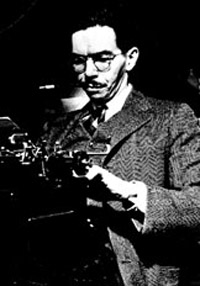 When I got back from Spain, this ritual of verbalism was hard to take. The meetings of the Party branch resembled a phonograph record with the needle stuck: endless debates on who was going to bell the cat.
Ignorant of philosophy, I could not understand why the whole process rang false. I blamed myself and my weakness of character. The Spanish Republic was lost; its leaders were in flight, in prison, or murdered. Some of the veterans of the Brigade managed to bounce back like rubber balls and plunge into labor organizing. I could not. My first wife and I had parted by mutual consent; I was alone, and I had neither strength nor courage enough even to get out of bed. My will was paralyzed; the prospect of action of any sort filled me with panic. I realized that I was mentally ill.
Fortunately for me, through our Veterans of the Abraham Lincoln Brigade organization, I met a social worker who knew what a neurosis was, and through her I got to an expert psychoanalyst after two years of disintegration and despair. I snatched at love; when my health improved, I snatched at writing; I did a little work for left-wing writers’ organizations. And I tried to control my own mind by will power; diamond cut diamond. Finally, since my mind was only “a function of matter in motion” and since it was filled with nightmare, I decided that this painful motion had gone on long enough. I hanged myself with a leather belt, to a hook in a closet.
Whether it was an accident or the intervention of a Power greater than myself, I shall never know in this life. At any rate, I came to myself on the floor — the hook had pulled out of the wall. I have tested many similar hooks since; they will hold my weight. The suicidal impulse had met reality at last; life won. The next day I called up a psychiatrist—at the urging of an educated girl Comrade—and told him that I needed help. He knew that I was a Communist, and suggested that I give up all Party work until I had put myself together again.
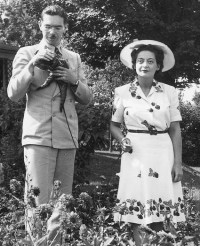
Through the next years runs a visible theme of mental healing, emotional growth, and the building of a more normal life. And, as counterpoint, a theme of spiritual seeking. I was psychoanalyzed intermittently, according to advanced Freudian technique, over a period of six years. My first stretch of analysis allowed me to remarry successfully. My wife, the poet and novelist Joy Davidman, was then a Communist like myself and is now, like myself, a Christian. Later sessions with my analyst adjusted me to fatherhood. Eventually, the false attitudes assumed in my childhood as defenses, and intensified by the Spanish war, were brought to consciousness and dispelled. Anxiety stopped; I was discharged as cured.
Without analysis I should not be alive today. Yet I have come to suspect that the psychic injuries of childhood are only half the story of neurosis. It seems to me that a false philosophy, a false attitude to the world, adopted consciously in adult life, may make a man just as ill as false attitudes learned unconsciously in infancy. Materialism was my disease. To a clear-sighted atheist, life can hardly be anything else than a nightmare, if he faces it squarely and brings it into sharp mental focus. There are atheists who seem to live contented, socially useful lives. But I have never known one whose days were not filled to the brim by devotion to some cause that completely occupied him: medicine, scientific research, teaching, union organizing—or his own digestive tract. Let a man sit still and think about the double mystery of time and his own consciousness, and his atheism will crumble or his personality will take the blows and be beaten out of shape.
 My chance to think came in a tuberculosis hospital: “What am I? What is life? death? matter? energy? time?” In the end I could not endure the answers that reason kept thrusting at me. I left the hospital in panic and went to live on the kindness of a friend. A year later came the suicide attempt. And after six years of treatment, the neurosis did not vanish until I realized, in one last great flash of insight, that I no longer believed Marxism to be true.
Even then I was not a well man, for neurosis had left an aftermath. During years of analysis, editorial work, and the strain of small children in small rooms, I had controlled anxieties by deadening them with alcohol. When I no longer had the anxieties, I found that I could not stop drinking; I had become physically an alcoholic. And against alcoholism in this stage, Freud is powerless. Seventeen months ago I stopped drinking — by the grace of God and the fellowship of a group of other alcoholics, men and women, who have made a decision to turn their will and their lives over to God.
During my analysis, however, I was a long way from believing in God or accepting Christ. I still believed in Marxist theory, though my discouragement with the Party and its shrill, self-justifying confusion made it impossible for me to work at it. The first wedge in my materialism was driven, strangely enough, by Yoga. Sometimes the longest way round is the shortest way home.
Before I came to psychoanalysis, Yoga seemed to offer a technique of courage, of mental discipline! The Party insists: “You must have courage! You must have discipline!” It doesn’t tell you how to get them, except to “read the theoretical literature and throw yourself into the Movement.” In other words, the way to develop these virtues is to have them already.
I discovered that ages ago in India men had faced the problem of using the mind to change itself and had worked out a technique for it. The mental discipline could be separated from the theology of Yoga and used by an atheist. For a time it actually brought me some peace and detachment. But as I grew more disciplined, another phase of reality, hitherto unsuspected, rose up to haunt me. It was this:
Convinced, consciously at least, that mind was a “function of matter in motion,” I had never dreamed of separating myself from my stream of thoughts. Yet the first mental exercise of Yoga is to sit still, eyes closed, and practice quieting the thoughts. Months of intense effort brought me to the point where I could actually do this, sometimes for a quarter of an hour; the mind would be free from thoughtforms, yet alert, fully conscious —of what? I became aware of the mysterious watcher behind thought. The watcher does not change, does not move; it can be separated from thought, from emotion, from all save consciousness alone. At this point what happened cannot be stated in words, but it was like a window opening on another dimension.
More concretely I saw something else — that happiness is within us, a spiritual state, not the enjoyment of a pile of physical comforts.
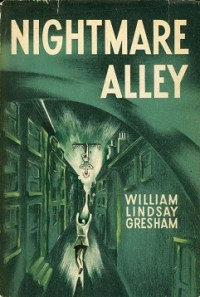 During my analysis I had a brief period of prosperity: I managed to write a novel, savage, violent, and neurotic, which made money. Yet with a temporary release from financial worries, my own inner nightmare grew worse. It was not true, then, that men live by bread alone?
While doing research for the novel, I had discovered the writings of the Russian mystic and occultist, P.D. Ouspensky. This remarkable man, who devoted a lifetime to esoteric study of the fourth dimension — time — came back in his last book to repentance, grace, and Christian love as the real answer to the problems of life. Two things in his work particularly excited me. The first was his speculation on time: The world of “solid” experience, which I had taken to be all of reality, might be only a three-dimensional section of a multidimensional world. A thin slice, from the center of a carrot, would tell us nothing about the true shape of a carrot if we had never seen one. In yogic meditation I had come dangerously close to perceiving this “seventh side of the cube.” My certainties began consciously to crack. Materialists seemed like adults who insisted on staying in kindergarten, frightened of anything more complex than blocks which they could pile up with their fingers. I saw at last a great Mystery at the heart of the world, and my Marxist arrogance split at the seams and fell away, piece by piece.
The second thing I learned from Ouspensky was the existence of the tarot cards. The tarot deck, ancestor of our modern playing cards, is now used mainly by fortunetellers. These cards owe their origin to ancient religious mystics, who embodied their revelations in symbolic designs which became the figures for the face cards in the tarot deck. These mystics, casting about for a way of perpetuating their ideas in a barbarous age, hit upon the card game as having as great longevity as anything else in a world in which all things seem to perish. And they may have been pretty shrewd at that, for the tarot is now the oldest card deck in the world.
The twenty-two picture cards — pictorial statements of spiritual truths derived, possibly, from Neoplatonism — suggested a host of ideas about human life and thought; they seemed to unlock the subconscious and release a new kind of mental energy. I have always found it easier to think in images and analogies than in abstractions, and here I had a pictorial vehicle for thought.
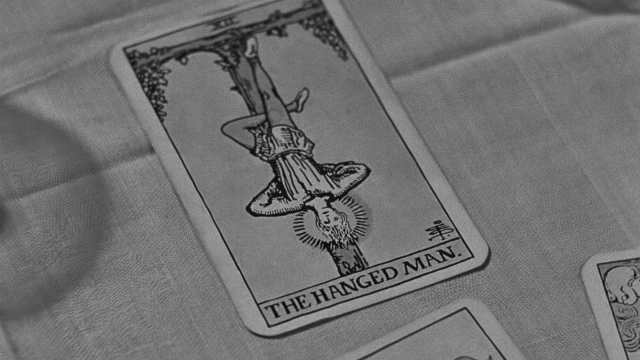 This is not the place for an essay on tarot symbolism, but I must describe one card. It is called “The Hanged Man.” A youth is suspended by one foot from a T-shaped cross. His hands are bound behind his back. He hangs upside down, but on his face is an expression of unearthly peace; from his head radiate spokes of light. And the cross is putting forth shoots of green—living wood, in the spring of the year. The card fascinated me. Slowly, without realizing it, I was coming toward Christ.
My days were filled with neurotic problems, writing problems, and the needs of my children. Then, in the spring of 1946, I developed a painful bone infection, osteomyelitis of the jaw. I had another mental breakdown, during which all the ground gained by analysis seemed lost. And my wife had a spiritual experience so definite that it threw my own vague wonder into sharp focus.
Joy had been raised by dogmatically atheist parents, and was more inflexible in her materialism than I—until in a moment of panic, out of fear for me, she let her defenses drop and became suddenly aware of the presence of God. This was the turning point in both our lives. She was completely astonished, but she had to believe it; she had no choice. The sudden awareness gave her no comfort in her anxiety about me—it simply threw her life into a new perspective; it made her see that her attitudes had been wrong, running against the current, all her life. I knew something of mystical experience, through accounts I had read, and I received the news with a great surge of hope. Together, accepting God, we started tentatively, and at first unwillingly, to remake our spiritual lives.
 In 1946 I had reached the frame of mind that C.S. Lewis calls “Christianity and.” A person suffering from this ailment comes to link Christ with some pet cause of his own: Christianity-and-Social-Reform, Christianity-and-Prohibition, Christianity-and-Vegetarianism. At first, perhaps, he values social reform because it seems to embody Christ’s teaching; later he is likely to value Christ as support for social reform. He is lucky if he does not end by perverting the Gospels for his private altruistic purpose.
I had Christianity-and-Revolution. I inflated the incident of Christ and the money-changers until it obscured the real message of Jesus. The gentle communism of the first Christians seemed to me only a foreshadowing of the violent Communism of Marx, Engels, Lenin, and Stalin. Though, as an atheist, I had been discouraged about Marxism and annoyed by the more strident Marxists, my new duty to God apparently demanded that I force myself back into the Communist Party. It was the only channel I knew of serving my fellow men, and obviously Jesus had insisted on service.
I did not, at first, understand the divinity of Christ. There seemed to have been many prophets and God-filled men. I had to find out what the other great religions contained. I was romantically attracted by the mystic East (early influence of Kipling), and I did owe a great deal of mental discipline to Yoga. My wife, Joy, was at first drawn to the Judaism of her grandparents, as was natural. The beauty of the Seder, the Passover supper, with its rich symbolism of the release from bondage, struck a powerful answering chord in the heart of a girl who was both a poet and a Communist. Together we began an unsystematic but intense course of study and debate—history, philosophy, formal logic, the scriptures of half a dozen nations, the Bible itself and its modern interpretation. Never had I been so conscious of my lack of education, but for the first time in my life my mind was clear enough to do something about it.
No story of our spiritual growth would be complete without a tribute to C.S. Lewis. His books exposed the shallowness of our atheist prejudices; his vision illumined the Mystery which lay behind the appearances of daily life. We used his books as constant reference points, and though it was long before I could accept his arguments for the divinity of Christ, Lewis’ clear and vivid statement of Christian principles served as a standard by which to measure the other religions we studied. Christianity outshone them as the sun outshines smoky torches.
In the Sermon on the Mount and in certain epistles of Paul we found what seemed to be the ultimate truths of human life, ethical and spiritual. They were so revolutionary, in a spiritual sense, that men could not have made them up.
Joy and I, as fiction writers, approached the Gospel story from our own angle: we knew something about fiction, about legend, myth, and folklore. Our critical sense told us that the story of Jesus, from internal evidence, really happened. The way it is reported is the most eloquent proof: the Gospel authors are trying to set down something that transcended human experience on every side. They could not believe their own eyes. Yet they had each other’s word that it happened. This is not the supernatural hero myth of antiquity. It is a bare chronicle, by sensible men, of an event out of space and time.
I still took it for granted that Marxism contained economic truths. So I turned to people who were trying to organize a revolutionary Christian socialism.
 Joy and I were invited to a meeting of left-wing clergymen who were working, with the best of intentions, to spread Marxist policies inside their churches. Their immediate objectives were worthy enough: world peace, equality of opportunity for the Negro, education of the Southern sharecropper away from lynching and prejudice—above all, the rights of labor. The sincerity of their desire to help their fellow men was unquestionable.
And yet… The meeting made us faintly uneasy at the start. It began without a word of prayer. Presently it turned to considering ways and means of effective fund-raising; wouldn’t it be wise to drop the word “Christian” from the title of the committee, since the name of Christ might offend the New York liberals—most of them atheists and many of Jewish descent—who were likely to be the most generous financial contributors?
After the meeting we adjourned to the home of some friends, where the leader of the movement climaxed everything for us by demonstrating in the best backwoods preaching style that Saint Paul was really a Roman spy, sent into Christianity to destroy its revolutionary character. His proof was the famous number of the Beast of The Revelation; 666, he declared, was Paul’s official number in the Roman FBI.
It was a fine illustration of how Marxism, and thinking that echoes Marxism, can pervert Christianity. The “Christ of Revolution” fell out of my mind. Instead, I began to see the Good Shepherd. He was dim, but he grew clearer with time.
Meanwhile some study of philosophy showed up the naïveté of the materialist, assuming that we know all about the nature of the universe. His proud “mastery of the laws of nature” boiled down to nothing but fancy carpentry, kiteflying, and bonesetting: all good things, but nothing for a sane man to worship.
When I was willing to take God on faith—that is, as an unavoidable conclusion derived from the total of the evidence—I was surprised to learn that a disproof of God is logically impossible, but that there is good logical proof that God does exist.
Most shattering of all was the fallacy at the heart of dialectical materialism. Ignorant of philosophy and logic, I had been unable to see it before. Now I found this: The Marxist claims that man is the product of material forces acting upon him, directly or indirectly, but that man has, “within the limits of necessity,” the power to change his own destiny. Fatalism I could grasp, for I could not as yet understand free will in myself. And, on the other hand, I could at least follow the logic of those who insist on a man as a free creature of God with moral responsibility. But the Communists believe in both free will and determinism at the same time.
They get around it by protesting that they are not “mechanical determinists,” that free will has evolved with the development of man’s brain, which, somehow or other, has started to go in business for itself. How this break in the iron chain of causation came about they will explain with eloquence—and nothing more.
 Driven by logic into a corner of contradictions, the Marxist has several resources: He can label his opponent’s arguments bourgeois (i.e., bad); he can divert the argument into other channels by introducing a topic heavily laden with emotion, such as lynching; he can assume that there is something intrinsically funny about his opponent and try to laugh the whole thing off; he can try to awe his opponent by using unfamiliar Marxist jargon; and, as a last resort, if he is modest, he can admit that he is unable to defend his position, but that other Comrades, more developed than he, know the answers; he will ask them and return to the battle. He never returns.
I could no longer consider myself a Communist, though I thought that Marx had correctly analyzed the decay of capitalism and the source of capitalist profits: the difference between what a worker is paid and what his labor is worth in terms of new value. Also, I still followed Lenin’s views on imperialism. But I was now living in farm country, learning the importance of agriculture. When I read Vogt’s Road to Survival, it dawned upon me that Marx and Lenin had mistaken symptoms for the disease. We Communists were city dwellers; down deep we really believed that milk comes out of milk bottles and bread originates in a bakery. Seeing only the inequalities of an unchristian system of distribution, we forgot that the real physical problem of the human race is, and always has been: “Where’s the food going to come from?” There is just so much arable land, and it is shrinking. The population is growing, come Communism or not.
I have come to believe that what matters in life is the relation of the individual soul to God. The species is not my responsibility. The behavior of Bill Gresham is my responsibility. And if I can help a neighbor, that I must do. I decided to leave the species in God’s hands.
My difficulties were not quite over. I was still arrogant; I had difficulty in praying; I refused to admit that I had enough free will to be morally responsible for anything I did. I had carried such a load of false neurotic guilt for so long that I was reluctant to accept the smaller burden of real guilt which a Christian must admit that he bears. For a year I had been trying to write a novel about Spain from a Marxist point of view, and when, in the autumn of 1947, I suddenly burned all my work and notes in the furnace, not only the Marxism but my neurosis vanished with it. Alcoholism, which began sometime in my years of neurotic conflict, stayed with me.
By the spring of 1948 my drinking had begun to frighten me. Then something happened which is, I think, more important to the Christian than his own search for God.
God sought me.
I was panicky when I realized at last that I couldn’t stop drinking. A chemical change had taken place inside me. Drinking was no longer fun; it was a bitter necessity. And my personality was being poisoned by it. I had always been a genial, expansive drunk; now I was getting pugnacious and irrational. In despair my pride burst and God could reach through to me. I admitted that I was powerless over alcohol; I admitted my defects of personality; I asked God to remove my faults and to help me to stop drinking. And my prayer was answered. Up until now I have never taken another drink. If ever do, it will mean that I have let anger or fear blot out God in my mind or have cut myself off from the company of other alcoholics who have had the same experience and who must suck together to reinforce God’s will in each of them.
I no longer doubted the divinity of Christ—the Helper who had come to me was unmistakable. At this point I felt that a task had been assigned to me: the building of a rational Christian faith.
Superstition can be defined as “a belief or notion entertained regardless of reason or knowledge.” This is also a description of much that passes as faith. If a boy’s first encounter with the theory of evolution “shatters his faith,” he obviously had no long-range faith to start with. His approach to the book of Genesis was on a par with believing that a horsehair, placed in a jar of water, will turn to a snake.
 My assignment seemed to be one of reasoning – more intensely and clearly than I had ever reasoned before. This sort of religious discipline is like a series of exercises to strengthen the spiritual muscles of the inner eye; it is the only thing—aside from an overpowering mystical experience — that can cure the self-focused myopia of materialism.
I also discovered this: No person with scientific training is likely to disagree with the basic theories on which the sciences conduct their endless search. The hypotheses, founded on observation, experiment, and deduction, stand until new facts call for their expansion. Yet there are leading physicists and astronomers who are to be found every Sunday morning in the family pew, putting in a lusty baritone on hymns their grandsires sang. The smug, man-centered cosmos has its greatest following in such fields as sociology, anthropology, and psychology—useful studies, certainly, but not sciences at all, since they deal with an unpredictable quantity—the human mind. The thinner the guesswork, the more thunderously positive the guesser is in presenting his guesses as if they were facts.
Theology, also, is only one man’s guess, or so it seems to me. Revelation is something else again: a truth about the world and man’s place in it which is self-evident, once we can peel the scales of self-worship from our eyes. Revelation is different for every man, but it is a force to sustain and a light to direct us all. There is much theology in the New Testament, but the light of revelation is there, burning gloriously down the centuries.
I began to see that a Christian must strive constantly to know God’s will for him, day by day. One of the terms that always stung me to fury in my atheist years was “original sin.” Now I saw it as nothing more hideous than the gap between what I ought to do and what I do. The Helper, of course, is always there, ready to give us a hand if we ask him with an honest and humble heart, after we have done the best we can under our own power. This asking is prayer. All those years I had been loathing a specter—a false notion of prayer created out of my own ignorance; I had thought prayer was a whining plea for God to work miracles in providing a raise in salary or a new car.
Real prayer is the beginning of an alcoholic’s salvation. I am glad, indeed, that I am an alcoholic—otherwise I might never have found it.
Sober at last and able to face reality happily for the first time in my life, I began to consider church membership. Having accepted the grace of God and the help of other people whose alcoholism was arrested, I was no longer too proud to accept the help of other Christians in a community of worship. But what church should I join?
 I felt that I belonged in a conservative church, trinitarian in doctrine, whose worship avoided extreme drabness, extreme individualism, and ungoverned self-dramatization, with the consequent spiritual pride that goes with them. On the other hand, I wanted to avoid corporate self-righteousness and dependence on ritual, which so easily becomes ritual magic.
I could be at home in any of several denominations. But a Christian should not pick and choose his fellow worshipers. To select a congregation because it is of our own social class or congenial intellectual type, or is similar in its politics or composed of personal friends, seemed wrong. It is our neighbors who are our fellow men—not our fellow Republicans, or fellow music lovers, or fellow whites—just our neighbors. I didn’t think this out for myself: I learned it from the works of C.S. Lewis.
Our neighborhood church is Presbyterian—a lovely old Doric building, set in a farming countryside. There my wife and children were baptized, and there I joined the body of Christ, which lives not between walls but in the heart.
Baptized an Episcopalian, raised an agnostic, in turns a Unitarian, a hedonist, a Stoic, a Communist, a self-made mystic, and an eclectic grabber after truth, I had at last come home.
Note: This is my own transcription from 2022. Please contact Brenton if there are errors: junkola[at]gmail[dot]com.






 Film Reviews


 There was no greater friend of The Hobbit in the early days than C.S. Lewis. In “








































 A Pilgrim in Narnia