My Foolish Wisdom about Don Quixote, Urban Tuxedo Cat, and Edith Grossman’s Excellent Translation, with a Note from Harold Bloom Beyond the Grave

I have finally completed Miguel de Cervantes Saavedra’ The Ingenious Gentleman Sir Quixote of La Mancha. It is my first time completing this classic of Western literature, except for all of those other times I’ve read it.

As I have not read much early modern Spanish with so many archaisms and Castillian influences since my years of captivity by Ottoman corsairs following the Battle of Torpiditolingua, I decided to consult an English translation. Thus, I searched all the known lands of knight-errantry for the best English translation of all the English translations that have ever been made, are being made, or will be made.

Sancho Panza, illustrious squire of the Knight of the Sorrowful Face, would tell us that

“if the pitcher hits the stone or the stone hits the pitcher, it’s bad for the pitcher.”

It is a thoughtful reflection upon translation theory. Tobias Smollett’s version captured most successfully a unique combination of traits, being the least accurate and most unreadable of all the versions I could find. John Ormsby’s translation was better, though required both more madness and more lucidity than I possess. Sancho says,

“the fool knows more in his own house than the wise man in someone else’s.”

In Ormsby, I found myself a homeless fool and a wise anchorite, so I needed another option.

Because fortune favours the fortunate, Sancho Panza might have said, but did not, though as Don Quixote did say, “because of my evil sins, or my good fortune,” I found a most beneficent translation of Don Quixote, the recent work of Edith Grossman. Grossman provides breathtaking clarity in her translation, allowing Don Quixote and Sancho Panza and all the rest to live on the page.

In literary criticism, Harold Bloom is perhaps the least praise-inclined of all those in the courts of praise for this translation. And he is a long-time lover of Cervantes’ great work. For my edition of Grossman’s Quixote, he retooled his Cervantes section of The Western Canon to provide a preface for the reader. It is a most puzzling preface to the reader, designed most clearly to be an epilogue for the critic and an encomium for the writer rather than a preface to the reader. But he does provide a more expertly evaluation of Grossman’s work than I could have done, providing even more praise than even Don Quixote for his Lady Dulcinea of Toboso:

 Though there have been many valuable English translations of Don Quixote, I would commend Edith Grossman’s version for the extraordinarily high quality of her prose. The Knight and Sancho are so eloquently rendered by Grossman that the vitality of their characterization is more clearly conveyed than ever before. There is also an astonishing contextualization of Don Quixote and Sancho in Grossman’s translation that I believe has not been achieved before. The spiritual atmosphere of a Spain already in steep decline can be felt throughout, thanks to the heightened quality of her diction.

Grossman might be called the Glenn Gould of translators, because she, too, articulates every note. Reading her amazing mode of finding equivalents in English for Cervantes’s darkening vision is an entrance into a further understanding of why this great book contains within itself all the novels that have followed in its sublime wake. Like Shakespeare, Cervantes is inescapable for all writers who have come after him. Dickens and Flaubert, Joyce and Proust reflect the narrative procedures of Cervantes, and their glories of characterization mingle strains of Shakespeare and Cervantes.

Granted, it may be as Sancho says, that “hunger is the best sauce in the world,” and I have just fallen for a translation that I happen to like, good or no. I am not inclined to think so, however, for there is no jewel in the world as valuable as a translation that can bring out all of the nuances of a text without mourning what of complexity is lost in translation.

And Harold Bloom agrees with me, which says something, for he has been dead for some years.

And, as Sancho Panza says,

“a bird in the hand is better than a vulture in the air, and if you have something good and choose something evil, you can’t complain about the good that happens to you.”

So I have appreciated this translation by Edith Grossman.

It could be that all my reading has addled my brain, but I have not been able to find a way to capture Don Quixote by review or character study or literary criticism. As we learn from Sansón Carrasco, who must be very wise for he is a Bachelor, tells us that

“it is one thing to write as a poet and another to write as a historian: the poet can recount or sing about things not as they were, but as they should have been, and the historian must write about them not as they should have been, but as they were, without adding or subtracting anything from the truth.”

Observing my cat, Juno, while reading Don Quixote in the winter sunshine, I suddenly understood the Ingenious Gentleman Sir Quixote of La Mancha much better. To ask whether Don Quixote–or a cat–is either wise or insane is the wrong question of this book. Thus lacking all history and being a very poor poet, I endeavoured to capture Don Quixote in verse.
Bachelor Sansón also says that

“The wise man … left nothing in the inkwell; he says everything and takes note of everything.”

This is perhaps why I have written so little.


My Cat Like Don Quixote by Don Brentonio Dickvinci, Governor of The ínsula del Principe Eduardo

My cat like Don Quixote,
Windmill-tilting on window sills,
Stalking flocks of garden birds through lancet panes:
Dander raised, with animal ire,
Or neighbourly curiosity,
At every passing friend or fiend….

It is hard to know what a cat sees,
Who pricks forth at people feet with lance at ready,
Slaying giants with easing grace,
While showing unyielding loyalty
To Lady, Knight, and Squire–

Who sees in all his quixotic feline madness
A castle where a humble home resides,
And, unbidden, stands a-guard by night,
Driven by some gentry vow,
Hunting shadows and flashes of light,
Enthralled by wads of paper and threads askew,
Full-fleshed in kittens’ eyes–

And then morning comes to the castle,
Leaving evidence of wineskin giants
Defeated by night in shrouded spells.

And yet, when that morning comes,
With table open to all befitting the generosity of a knight,
The hero passes with leonine stride,
A purring smile, a pussy’s pride, that feline right (like Sancho)
To sleep now the day away in sunbeam’s bright,
Content, surrounded by the chaos his night’s errand left behind.

For who in any tale
Heard of any knight errant
Who surrendered to the long dark hours and slept
While those within the castle dream?

Posted in Memorable Quotes, Reflections, Reviews | Tagged , , , , , , | 11 Comments

Thoughts from Different Angles on Joel Coen’s Macbeth with Denzel Washington and Frances McDormand, and Is This Why I Can’t Sleep?

I have no pretense of being a Shakespeare scholar, by any means. As I was educated primarily in Canadian public schools, my path of learning going into university had been embarrassingly narrow (so much so that I cannot spell the word “embarrassing,” but I really mean that I missed much of what an education could offer). I also have the disadvantage of living on the edge of a continent where it is rare to see Shakespeare on stage.

In order to make up for my lack of scholarship or stage access, in 2021, I launched a “Shakespeare Play a Month” personal challenge. Last year, I fell short of the challenge by a couple of plays, but did pretty well otherwise. At the beginning of the challenge, I was alternating comedies and tragedies–presuming that I like the comedies best and wanted to warm up before reading the histories. I read The Tempest, The Merchant of Venice, As You Like It, The Taming of the Shrew, and Twelfth Night (comedies), Hamlet, Othello, and King Lear (histories) before turning to the History Cycle.

I am still trying to situate the histories, filled with brilliant speeches and characters, but occasionally puzzling to me. I’ll finish the first History Cycle quartet with a rereading of Henry V in the next month or two (which I have seen performed beautifully). What surprised me is how deeply I found myself wound into the tragedies. While I am still uncertain what to think about The Tempest (which I am ensured is genius), I found myself disconnected from As You Like It. Instead, I was reaching for Hamlet and Othello out of a desire for more.

My tragic shading is not without exception, of course. The Taming of the Shrew is just so much fun (as is A Midsummer Night’s Dream, which I have read a few times). My favourite comedy, though, is most certainly The Merchant of Venice, which I taught last week for the first time. It was a bit of a tragedy, admittedly, to only have 90 minutes for such a deceptively complex play. I find this work of Shakespeare so rich in ideas and images, so playful with language, so experimental in its inversions of role, and filled with elegant speeches that combine wisdom and passion and some element of cultural criticism that I haven’t quite yet defined.

For the sake of honesty, I must admit to having an intellectual crush on Portia the female protagonist. I know that some other Shakespeare characters are “greater” in the ways that critics weigh the matter–Shylock in this play, Iago, Falstaff, Hamlet, Macbeth and his Lady (or Lady Macbeth and her man)…. Maybe Prospero or King Lear or Henry V (in his most desperate speeches). The characters pop in Romeo & Juliet and Midsummer Night’s Dream and Much Ado About Nothing. But it is Portia whom I admire the most, if admiration can be considered a category for greatness.*

I’m still figuring out The Merchant of Venice, as my post last year confesses. The play just astonishes me. But, I chose to teach it because it is a great piece of literature for talking about culture, gender, race, and different kinds of love. In the end, I brought those elements out. However, I chose to use a careful study of words to do so, digging into certain Germanic-rooted words that Shakespeare uses early in the script and plays with throughout, like “sad,” “weary,” “bond,” “kind,” and “blood.”

I think we had a brilliant conversation.

As I have been caught up by tragedies–and Merchant of Venice has tragic elements–I decided to return to Macbeth after some years away. From my first introduction in high school, I have had trouble finding sympathy with the play. I have never been sure why–though having seen two pretty terrible performances has not been able to be overcome by a pretty good Shakespeare in the Park performance a few years ago. Macbeth has some iconic speeches and is one of the more intensely character-driven plays (Harold Bloom said somewhere that 1/3 and 3/8’s of the lines in Macbeth and Hamlet, respectively, are spoken by the protagonist). I know it is one of the “greats,” so I picked up Macbeth this month to try again.

I quite enjoyed the play, though there is a spooky element to my Shakespeare reading this month. I was struggling to get to sleep earlier in January. After tossing and turning for a couple of hours, I turned on the light and reached for a book. I opened Shakespeare’s King Henry IV, Part 2 (my first time ever reading the play). It isn’t irony but Shakespeare’s genius, I’m sure, but I began to read this passage:

How many thousand of my poorest subjects
Are at this hour asleep! O sleep, O gentle sleep,
Nature’s soft nurse, how have I frighted thee,
That thou no more wilt weigh my eyelids down
And steep my senses in forgetfulness?

“O sleep, O gentle sleep,” how indeed have I frightened away what even the richest man cannot afford to purchase? I still don’t have the answer to that question–despite its importance both for my insomniac life and in that play of awakenings and endarkenings. It is this sleepless passage that begins the king’s decline. After the long complaint about sleep, the play ends with this Sword of Damocles line of Shakespearean thrift:

Uneasy lies the head that wears a crown.
I wonder what I am up against?

Once again, reaching for Macbeth in the middle of the night last Thursday, I read:

Methought I heard a voice cry ‘Sleep no more!
Macbeth does murder sleep’, the innocent sleep,
Sleep that knits up the ravell’d sleeve of care,
The death of each day’s life, sore labour’s bath,
Balm of hurt minds, great nature’s second course,
Chief nourisher in life’s feast

It is not conscience that keeps me awake, I believe. Even still, with restless Macbeth who has murdered sleep even as his wife has called for everlasting night, I suffer the same dis-ease: my sleeves of care are still unravelled, my sore labour remains unbathed, and unceasing are the thoughts which course fruitlessly through my mind.

So Macbeth has walked with me in the wee sma’s this winter, and I have enjoyed (if one can claim such things) Macbeth’s journey in an entirely fresh way.

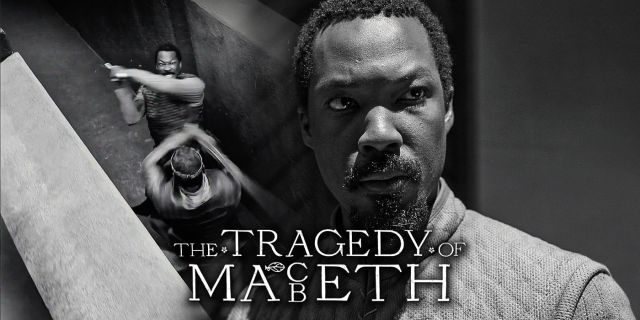
As a chance to re-experience the play within an unending closure of our stages, I watched the Joel Coen Macbeth. This 2021 production stars Denzel Washington as Macbeth and Frances McDormand as Lady Macbeth. I like the Coen Brothers’ work and was intrigued by this Americanization of the Scottish play. Though less than a month since its release, it has already received a number of award nominations and wins, especially for Washington’s lead performance, Kathryn Hunter’s strange and brilliant support work on stage, and aspects of art direction, adaptation, and cinematography.

The design of this film is immediately striking. It is a stage performance of Macbeth, not an adaptation. Stefan Dechant’s set design creates a stage-on-screen of stark simplicity that successfully highlights the actors’ performances. Almost without fail, Coen uses light and darkness in deft shadowplay and angular contrast and symmetry in the architectural scenes, and with great patience and depth in the travel and crossroads scenes. I am not certain this works as effectively in the “Tomorrow” monologue upon Lady Macbeth’s death as it does in the other great speeches–and some of the rear shots are out of sync with the dialogue. However, the stark minimalism and use of many camera angles have the advantage of allowing the actor a great range of possibilities in interpreting the line.

She should have died hereafter;
There would have been a time for such a word.
To-morrow, and to-morrow, and to-morrow,
Creeps in this petty pace from day to day
To the last syllable of recorded time,
And all our yesterdays have lighted fools
The way to dusty death. Out, out, brief candle!
Life’s but a walking shadow, a poor player
That struts and frets his hour upon the stage
And then is heard no more: it is a tale
Told by an idiot, full of sound and fury,
Signifying nothing.

Overall, I am won over by Denzel Washington’s performance. I was uncertain while watching whether his restrained descent could justify the kind of brutal destruction of life Macbeth perpetrates. After all, he begins as someone Lady Macbeth fears “is too full o’ the milk of human kindness.” Hag-ridden by time and possibility, he will soon become a man impatient with the limits of his dagger and harassed by daggers of the mind. Lady Macbeth will, but contrast, ultimately lose herself in the plea to the “murdering ministers” to draw on night and restrain providence as she pours words like salve or poison in her husband’s ear.

With American sensibilities and a long tradition of quiet character studies of cruel simplicity, Joel Coen creates a Romaneque tragedy from the pages of the Scottish play. And yet, with all its patience, he effectively uses sound and fury–spurred on by character innovations both weird and grotesque. Of these innovations, the fantastic figures of impossibility are the greatest. I have noted the witches, but Coen augments the role of one character, collapsing various plotpoints into a single person to allow for a satanic figure in fine clothing, an angel of shadow cloaked in light, the haunting of sin crouching at the door. Thus, it is not only Lady Macbeth who pours spirits in Macbeth’s ear. It is well done.

And the penultimate swordfight is just absolutely brilliant.

I am not fully won over. The use of birds and bushes works well, the rooky woods, but the CGI ravens and rooks and martlets seem disjointed from the actors’ movement on stage and yet are essential to their psychological development. I don’t know if Lady Macbeth is quite right–good though. I tend to be impatient with the casting of strong women on screen, perhaps because I imagine what is simply impossible when I read them in print. Denzel Washington as Macbeth is frequently excellent, including intimate moments with Lady Macbeth. To his credit–and misquoting Lewis (in his essay, “Variation in Shakespeare and Others”–it strikes me that Washington’s performance makes me believe that Macbeth really spoke as we hear him speak, that he was a creative, mimetic poet of piercing quality. To do so, though, Coen mutes the splendour of the setting–the haunting terrain and rough manners of medieval Scotland are limited to the stage.

I do not know if I was wise or not, but I chose this new Coen Macbeth film over the Trever Nunn 1979 Royal Shakespeare Company stage production, featuring Ian McKellen as Macbeth and  Judi Dench as Lady Macbeth. After all, Sir Ian McKellen’s”To-morrow” speech is now famous:

Perhaps, though, I lack the courage to have the admirable Dame Judi Dench speak to me this truth: “You lack the season of all natures, sleep.” Whether in the play this is Lady Macbeth’s regret at her own ministration of ear-spirits, an unreasonable complaint that her prayers have been answered, a rebuke against Macbeth’s madness, fear of the potency of fate, or commentary upon man’s mortal ends, the critic must decide. For me, I remain like Banquo. Though the heavens are breeding time for me to sleep, so that “heavy summons” of rest “lies like lead upon me.” Still, “I would not sleep.” So, like Banquo, I pray–not to Lady Macbeth’s ministering spirits, I not, but instead:

merciful powers,
Restrain in me the cursed thoughts that nature
Gives way to in repose!

Goodnight.

*I noted on Facebook that I think this is why I am disappointed that Lady Jessica of the Atreides disappears in the second Dune novel, for she is a Lady Portia 10,000 years in the making. I thought the Dune film captured Jessica as well as any stage could allow Portia to live. Someday I hope to find out!

**My own sleeplessness in stories of adventures puts me in mind of Mark H. Williams’ Mythopoeic-award nominated Arthurian romp, Sleepless Knights, which I review here.

Posted in Reflections | Tagged , , , , , , , , , , , , , | 22 Comments

The Rings of Power: The Lord of the Rings New Prime Video Series Title Announcement

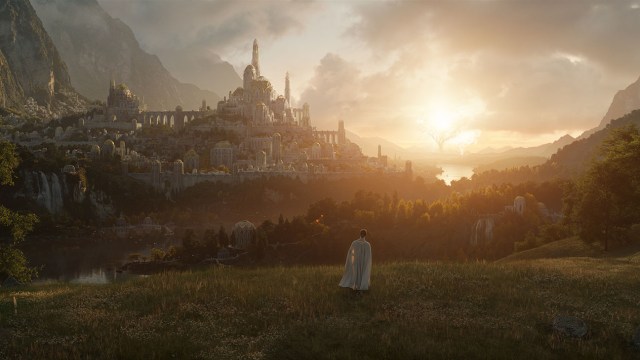
In the teaseriest of teasers–though one step beyond the single landscape image released last year that sent the digital world of Tolkien lovers scurrying into Reddit arguments or making “everything you need to know about” videos (above)–Amazon Prime has finally released the title of its new series with a one-minute teaser video.

It isn’t much, admittedly–an earnest voice evoking Galadriel of the Peter Jackson’s Lord of the Rings trilogy reading the Ring-verse.

We also have a full title: The Lord of the Rings: The Rings of Power–forged in gold, no less, which would be a significant undertaking with so few goldsmiths available locally during COVID prevention measures.

And we have a date: September 2, 2022.

My heart and mind dance between two modes about this series. I love that there is, possibly, a way to live in Middle-earth in imaginative ways. I like that we may get a Second Age Middle-earth story. However, my “Faint Hope for the Hobbit” led to a declining sense that the bright and fun film before was anything more than a high-tech dream wagon (see here and here). Moreover, my confidence is not high that this studio, in this age, is able to create a rich experience for lovers of the literature. The Dune adaptation gives me hope of the possibility of a brilliant, world-evoking film series that extends, enhances, and fills out my reading experience.

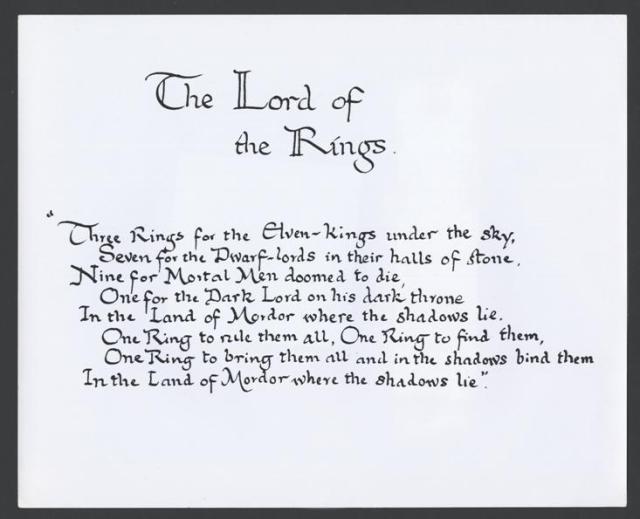
Calligraphy by J.R.R. Tolkien, from Tolkien Gateway

I do like that there is, at least, a connection to the text in this title trailer, the “Ring-verse” from The Fellowship of the Ring:

Three Rings for the Elven-kings under the sky,
Seven for the Dwarf-lords in their halls of stone,
Nine for Mortal Men doomed to die,
One for the Dark Lord on his dark throne
In the Land of Mordor where the Shadows lie.
One Ring to rule them all, One Ring to find them,
One Ring to bring them all, and in the darkness bind them,
In the Land of Mordor where the Shadows lie.

I like the text–and would have loved all of it.

Can it possibly be something that might “live on in the spine of a book next to J.R.R. Tolkien’s other classics” as show creators J.D. Payne and Patrick McKay hope (see the press release here)? We’ll have to see. They did, however, put the accent for Númenor in the right place (unlike the biggest LOTR fan ever, C.S. Lewis).

In any case, here is that title trailer–the #1 trending video on Youtube today. Below is the studio’s press release. I hope you enjoy this little bit of something.

Amazon Studios’ forthcoming series brings to screens for the very first time the heroic legends of the fabled Second Age of Middle-earth’s history. This epic drama is set thousands of years before the events of J.R.R. Tolkien’s The Hobbit and The Lord of the Rings, and will take viewers back to an era in which great powers were forged, kingdoms rose to glory and fell to ruin, unlikely heroes were tested, hope hung by the finest of threads, and the greatest villain that ever flowed from Tolkien’s pen threatened to cover all the world in darkness.

Beginning in a time of relative peace, the series follows an ensemble cast of characters, both familiar and new, as they confront the long-feared re-emergence of evil to Middle-earth. From the darkest depths of the Misty Mountains, to the majestic forests of the elf-capital of Lindon, to the breathtaking island kingdom of Númenor, to the furthest reaches of the map, these kingdoms and characters will carve out legacies that live on long after they are gone.

Posted in News & Links | Tagged , , , , , , , | 14 Comments

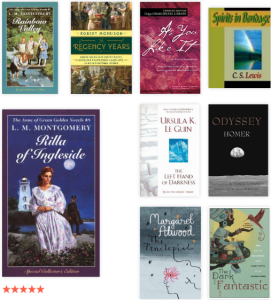
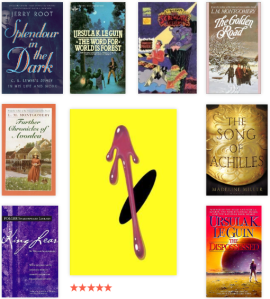
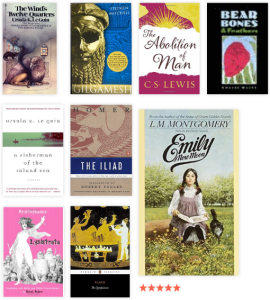
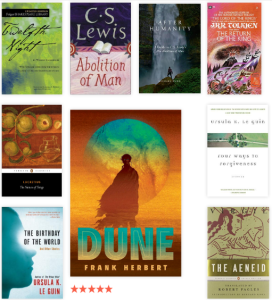
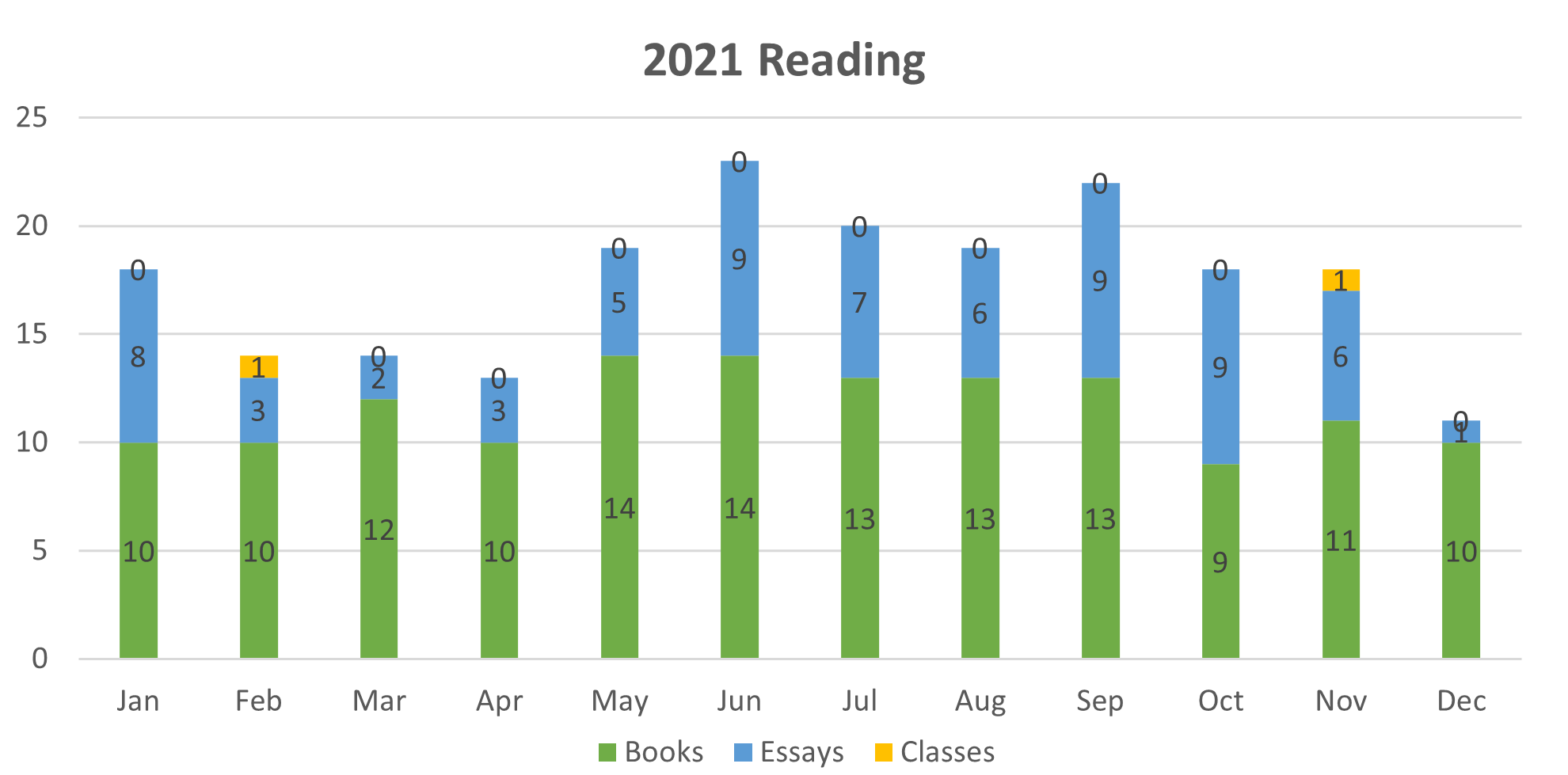
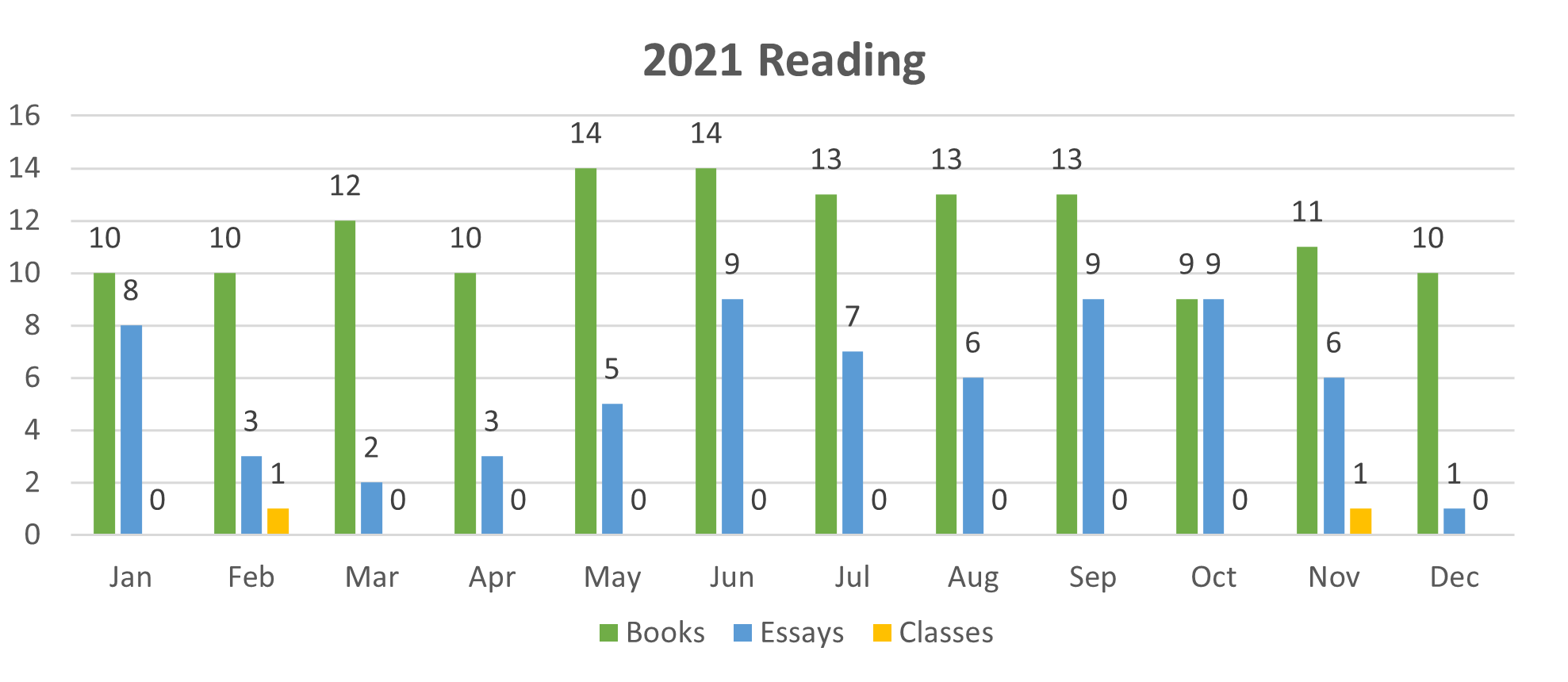
2021: A Year of Reading: The Nerd Bit, with Charts

“… in reading great literature I become a thousand men and yet remain myself. Like the night sky in the Greek poem, I see with a myriad eyes, but it is still I who see. Here, as in worship, in love, in moral action, and in knowing, I transcend myself; and am never more myself than when I do.” 
~ C.S. Lewis, An Experiment in Criticism

2021 was, I must admit, a very difficult year. I just never felt like I could get ahead of my work, with to-do lists and unfulfilled requests and unfinished tasks on every desktop–physical, digital, and mental. When it comes to reading, 2021–like 2019–was a tonic year, where reading was a salve for the soul, an attempt at recovery and quiet while still feeling the drive forward. I spent many summer hours by campfires and in living room chairs with a book in my lap. Unfortunately, I also spent many hours of nighttime mental roaming trying to cure summer insomnia with a story or biography. Though much of my 2021 reading was “work” in one way or other, there was a lot of rest there, a good deal of play, and some degree of distraction.  

I had a few goals for 2021:

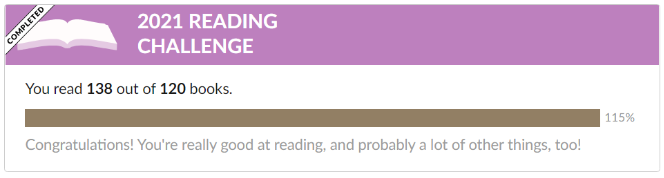
  • This year, I had a goal of reading 132 books for the year, an average of 11 books/month–a stretch, but not impossible
  • This year, I was not that attentive to how long they were (I suspect they would average 310-320 pages/book)
  • Among book reading, I aimed for:
    • 2 C.S. Lewis or Lewis studies book/month
    • 1 L.M. Montgomery book/month as part of a chronological reading of Montgomery’s fiction and letters
    • 1 theological or devotional book each month
    • 1 Black writer or author of colour/month
    • 1 Shakespeare play/month
    • Always be reading a pre-20th-century “classic” (beyond Shakespeare)
    • Continue reading through the catalogues of J.R.R. Tolkien and Ursula K. Le Guin
  • In this reading, I aimed for a 1:1 female:male ratio of authors–stretching myself beyond a 1:2 ratio that would much more naturally represent the kind of research and reading I do (a ratio I aimed for and hit in 2018 and 2019, and I came fairly close to 1:1 in 2020)
  • To do that, I was going to read through all of N.K. Jemisin’s books that I could get a hold of (this goal switched in the spring)
  • Read 75 articles, shorts stories, essays, or other short pieces
  • Listen to or watch 10 lectures series or classes

These goals for this year were really about:

  • reading for course prep in the Winter and Fall terms;
  • extending my reading of L.M. Montgomery‘s catalogue and secondary sources for a major research project, for a research grant, for my 2022 conference paper, and for my work as producer and host of the MaudCast;
  • reading a number of classical Western texts that I have never read or only read as a student;
  • increasing the voices of my reading–which is very invested in white male authors that I love (Lewis, Tolkien, Shakespeare, the classics, and authors like Stephen King) to include more women voices and BIPOC authors (BIPOC is what we use in Canada for Black, Indigenous, and People of Colour); 
  • enjoying books by reading what I wanted to read.

So, how did I do?

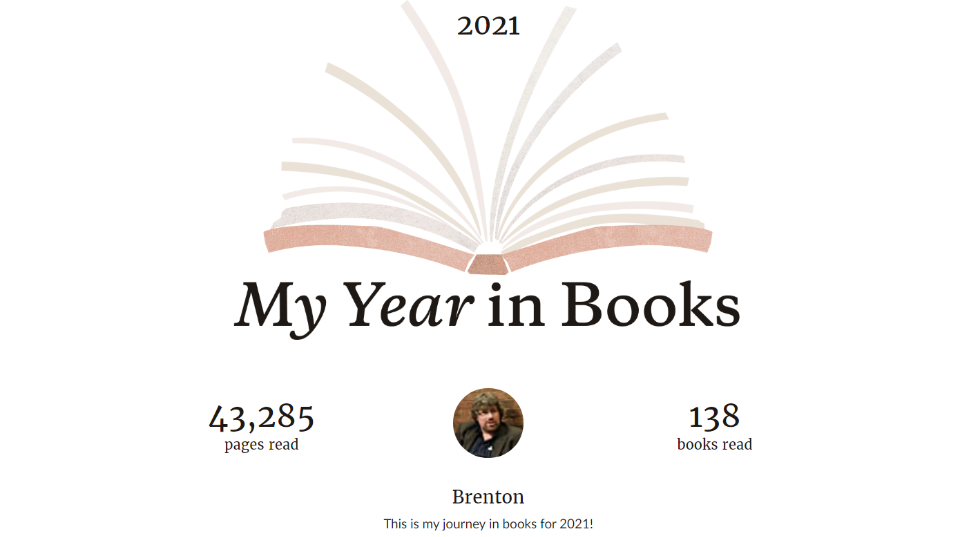
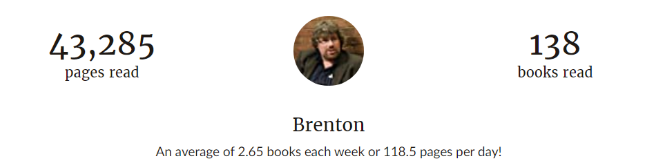
I did well in 2021, reading 138 books (my spreadsheet shows 139) and hitting most of my goals (but not all). 

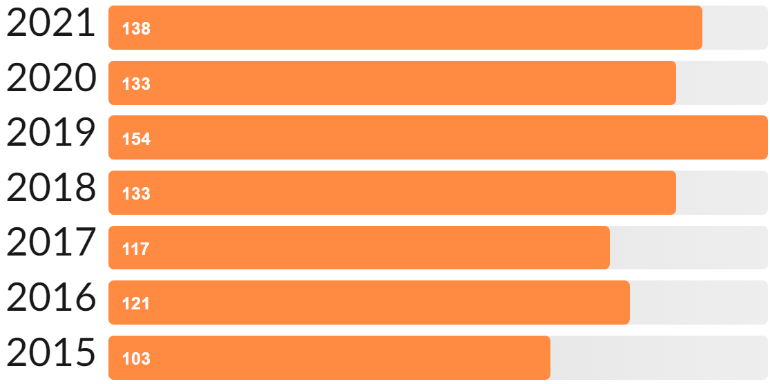
I can certainly see a pattern emerging, where a natural rhythm for me is not 154 books (as in 2019, my final PhD season), but 117-138 books per year. Indeed, the average is 128.4 books (whether tallied for the whole 7 years or leaving out high and low, 2019 and 2015, which is kind of cool, mathematically speaking). 

Reading-wise, I have come to discover that I am lazier than I would wish. I yearn for that dynamic, all-engrossing ability I had as a young adult to simply immerse myself in a book! Do you remember that time of your life? Part of my goal for 2022 is to look for bedtime readings that enthrall me.

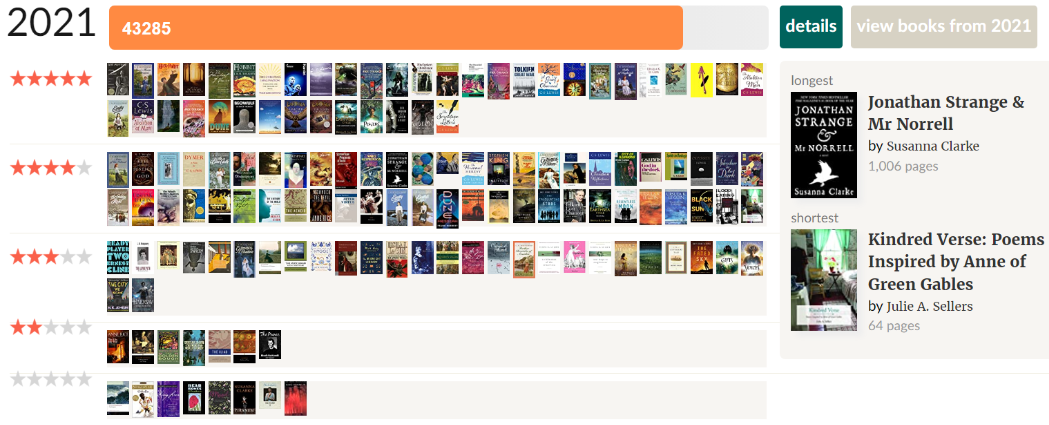
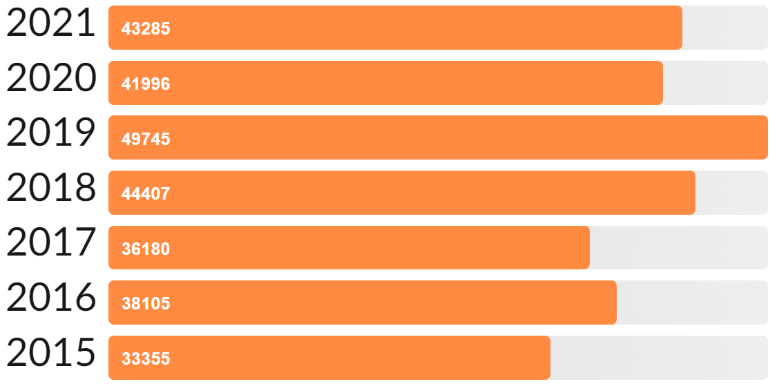
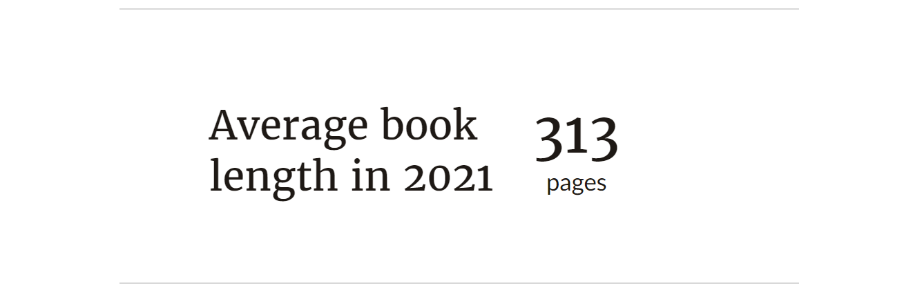
I have discovered that I tend to use the book list and page number count to spur me on. In 2021, I was up a bit in terms of books (138) and sheer page numbers (43,285), though, I saw a tiny drop in the size of books, down to 313 pages/book (from 315 last year). That is still more books than I aimed at, and though I have read fewer short pieces, overall it is still a strong year.

2021 was a much more focussed and goal-oriented year than 2020–where I realize I was making it up as I went along. I feel like I met most of my individual goals for 2021, with a couple of grand exceptions and one great switch.

Between teaching schedules and research projects, my reading was seasonal in 2020, as it usually is based on these patterns: Winter/Spring teaching session, a May-June research-focused writing period, summer projects and reading, and fall teaching.

Winter and Early Spring

  • Reading and Teaching Reading: Following my Signum University “Vampires and Big Bad Wolves” course in Fall of 2020, in January I turned my reading focus to teaching “The Fantasy and Fiction of C.S. Lewis” at the King’s College (NYC)–along with my local Greek class, my local foundation-year course, and supervising thesis students. From C.S. Lewis’ catalogue, I read through the Ransom Cycle and Screwtape, The Great Divorce, Till We Have Faces, and the Four Loves broadcast.
  • Research and Theological Reading: In early winter, I was doing the final draft of my paper “Befriending the Darkness: L.M. Montgomery’s Lived Theodicy in Anne’s House of Dreams” (published later in 2021, in November). In January, I read through a number of Montgomery books of the WWI period–for Anne’s House of Dreams is deeply invested in a WWI context–some Montgomery studies, and some theodicies–particularly Mark S.M. Scott’s Pathways in Theodicy and N.T. Wright’s Evil and the Justice of God.
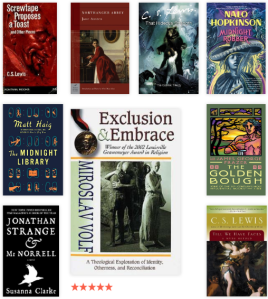
  • Thinking Theologically and Literarily about Race: This reading worked well with the new edition of Miroslav Volf’s (for me) life-changing Exclusion & Embrace, Willie James Jennings’ The Christian Imagination: Theology and the Origins of Race, Ebony Elizabeth Thomas’ The Dark Fantastic: Race and the Imagination from Harry Potter to the Hunger Games, which I reread in June, and Toni Morrison’s powerful lecture series-née-book Playing in the Dark: Whiteness and the Literary Imagination (and also my first review of 2021).
  • SFF Reading: I also began a read-through of The Hobbit and The Lord of the Rings that I finished in the summer–and paired with some Tolkien studies books and essays. Early winter included some leftovers from the previous year–continuing Anne Rice’s Vampire Chronicles and finishing Harry Potter–and enjoying some fantasy and SciFi fun books (which was a big part of my year).
  • The Shakespeare Challenge: Of Shakespeare in this first season of the challenge, I read The Tempest, The Merchant of Venice, Hamlet, and The Taming of the Shrew.
  • Finding the Classics: Other classics include Margaret Cavendish’s The Blazing World, The Brothers Grimm, Ann Radcliffe’s The Mysteries of Udolpho, Jane Austen‘s Northanger Abbey, and James George Frazer’s The Golden Bough.
  • Other L.M. Montgomery Reading: I also read some of L.M. Montgomery’s work in the 1920s, with a focus on her poetry and letters–partly because I was being interviewed for a podcast on The Blue Castle

Late Spring and early Summer

Summer

  • The Year of Ursula K. Le Guin: My summer reading continued the Le Guin project, and I finished the Hainish Cycle in September.
  • C.S. Lewis Reading: It was a quiet Lewis summer, but I read the Marvel Comics adaptation of The Screwtape Letters–as well as the Watchmen graphic novel. I also read The Abolition of Man with Michael Ward’s helpful guide, After Humanity
  • The Shakespeare Challenge: For Shakespeare, I read King Lear and Twelfth Night, before losing Shakespeare in fall reading prep.
  • SFF Reading: And I read Frank Herbert’s Dune and most of Dune Messiah this summer–preparing for the film (which I loved). I also finished my 2021 LOTR reading.
  • Finding the Classics: I intensified my classics reading with Gilgamesh, the Iliad, Lysistrata, Plato’s Symposium, Lucretius, On the Nature of Things, Virgil, The Aeneid (including some of Lewis’ translations), Ovid’s Metamorphoses, as well as bits and pieces from the ancient Mediterranean world. Atwood’s adaptation of Homer was not the only one I read, but I read and blogged about Madeline Miller’s Song of Achilles (see here and here).

Autumn and Early Winter

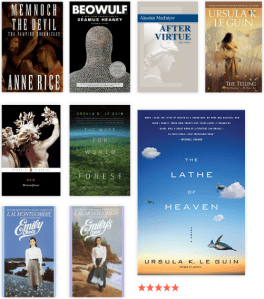
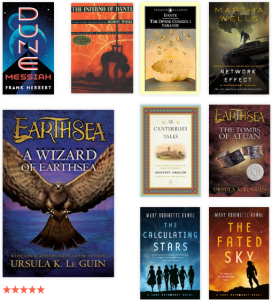
  • The Year of Ursula K. Le Guin: In the fall, I began teaching an Ursula K. Le Guin class at Signum, and so completed her Hainish Cycle, read her other science fiction novels (The Lathe of Heaven is brilliant), and then read through the entire Earthsea Cycle (including the short stories) and her YA trilogy, Annal of the Western Shore.
  • The Shakespeare Challenge: Finishing my Shakespearean year a little short, I read Richard II and Henry IV Part 1.
  • Finding the Classics: In terms of classic authors, I read Beowulf, The Inferno and Paradiso, The Canterbury Tales, Sir Gawain and the Green Knight, and, unfortunately, Machiavelli.
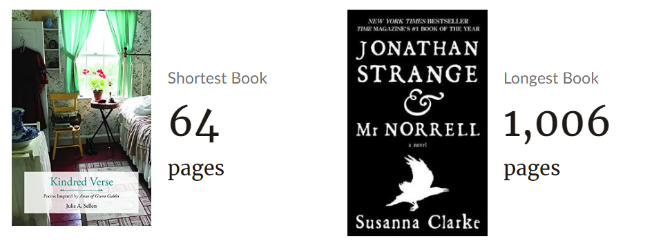
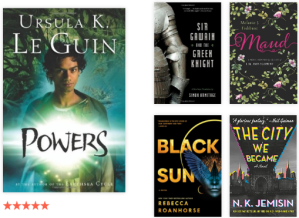
  • L.M. Montgomery Reading: I read Montgomery’s Emily trilogy in September as part of my presentation and discussion in a roundtable on Emily of New Moon (which might be my favourite work of Montgomery’s). This fall, I also read a couple of Montgomery-inspired books, Melanie J. Fishbane’s novel Maud and Julie A. Sellers’ chapbook Kindred Verse (which closed my year on Goodreads). 

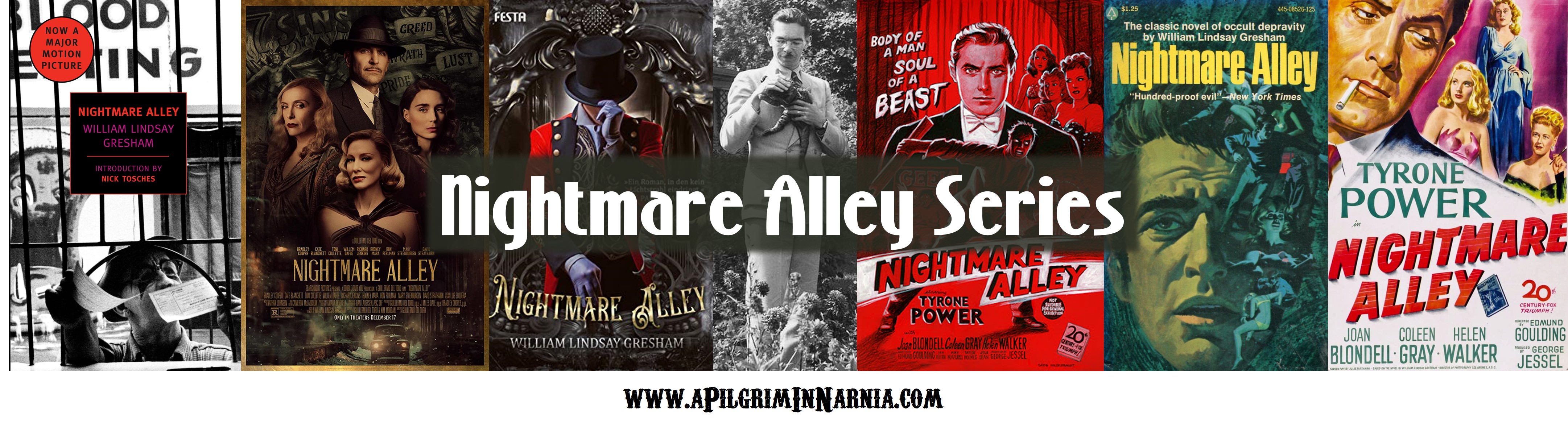
  • The Nightmare Alley Series: I finished the year reading William Lyndsay Gresham’s carny horror novel, Nightmare Alley in preparation for the “Nightmare Alley Series”–add read a number of short pieces connected to Gresham’s work.

The missed goals included my Shakespeare reading. I only managed to read 10 Shakespeare plays–plus one biography by Peter Ackroyd, as well as some individual lectures of interest. Really, it was my fall reading that threw me off, which connects to the second missed goal and the “great switch.” I intended to read N.K. Jemisin’s catalogue. However, I joined an Ursula K. Le Guin book club in the spring, and then taught the course in the fall. I ended up reading 22 Le Guin books (mostly novels)–including rereading two of them. My Jemisin reading was set aside–though I did read her 2021 Hugo-nominated The City We Became (and blogged about it here and here), and half the stories in How Long ‘Til Black Future Month. As a result, however, I missed reading one BIPOC author a month (I read 8 books by BIPOC authors, I believe). 

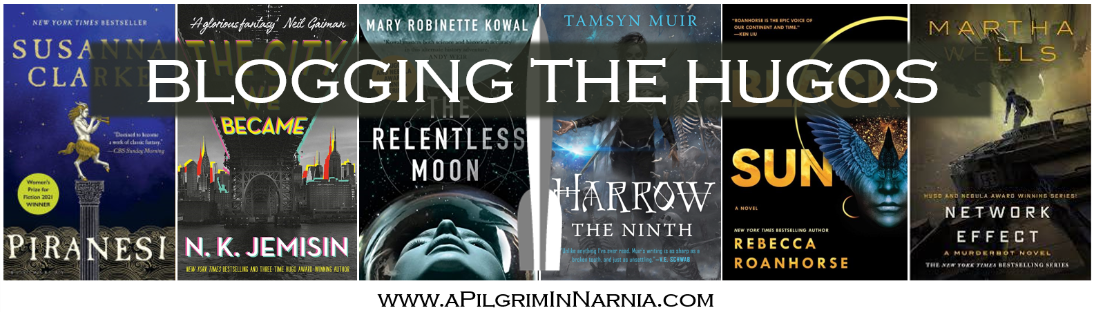
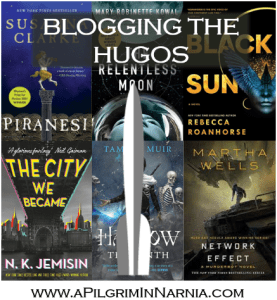
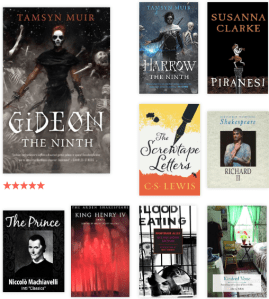
Besides teaching for reading and research–including reading Lewis (18 books, and 1 read twice) and Montgomery (17 books, and 1 read twice)–my other big reading challenge this year was a late idea. I read through all the Hugo nominees, including Black Sun by Rebecca Roanhorse, The City We Became by N.K. JemisinHarrow The Ninth and its companion Gideon the Ninth by Tamsyn Muir, Network Effect by Martha Wells, The Relentless Moon and 2 other Lady Astronaut books by Mary Robinette Kowal, and Susanna Clarke’s beautiful and evocative Piranesi. This also encouraged me to read, for the first time, Clarke’s Regency-era fantasy, Jonathan Strange & Mr Norrell. While I did not love every feature of these Hugo-nominated books, they are global-class writers–and Piranesi was such an astounding work of fiction that I am reading it for a second time, this time with a rich audio reading by Chiwetel Ejiofor.

In terms of other goals, I read 68 short pieces (rather than the goal of 75), and I fell short on my lecture series! That does not really worry me, frankly. I reach for that resource when I need it.

Throughout the year I had a few projects and some nice unintended consequences:

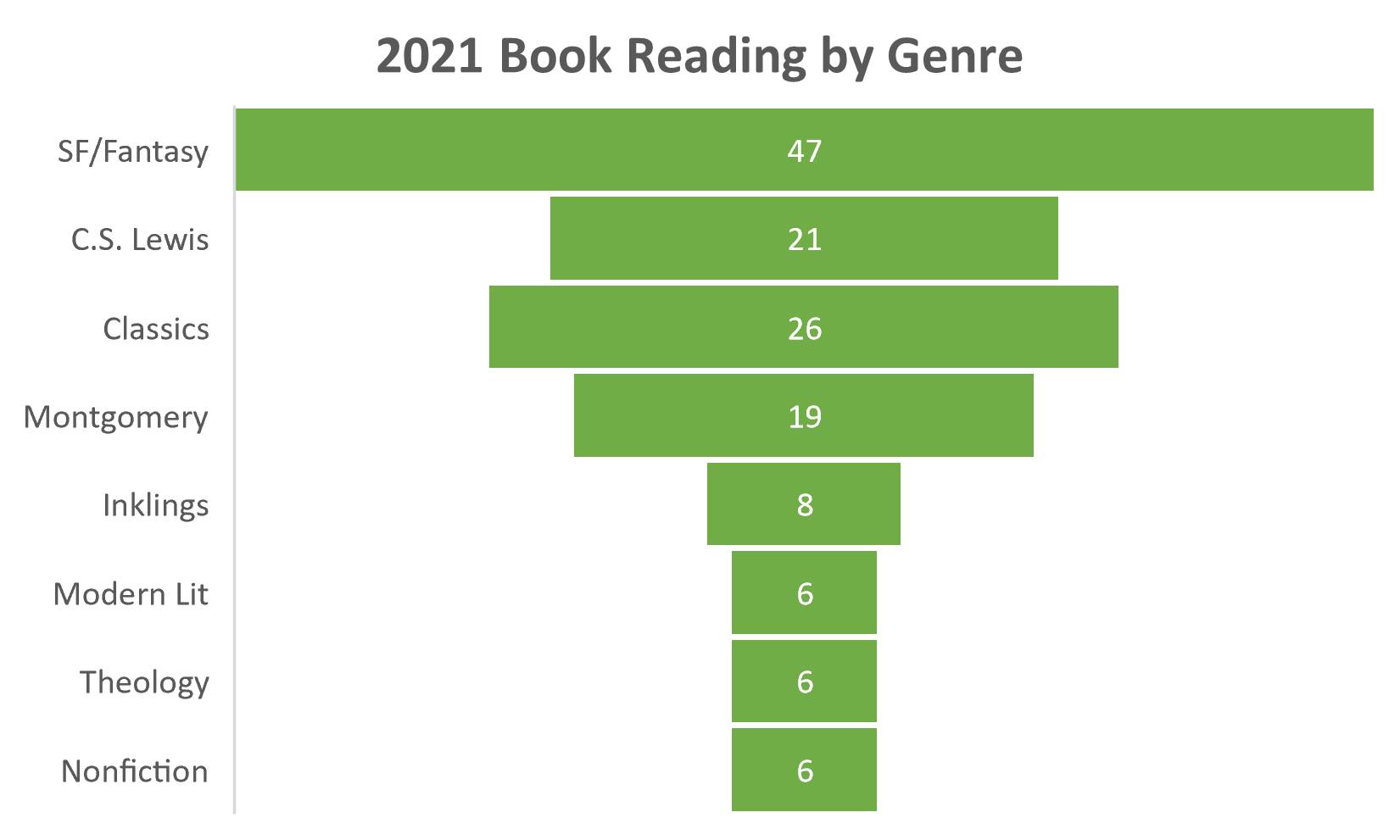
  • For only the second year, science fiction, speculative fiction, and fantasy are the largest category–and this time by a long shot. I blame Le Guin. 
  • Actually, this was a light year for C.S. Lewis reading in terms of Lewis studies, but fairly similar to the previous year. Intriguingly, I did not reread Narnia in 2021–though I am deep within Edmund’s nighttime forced march right now.  
  • Once again, I increased my reading of Montgomery’s books (supplemented by a number of studies).
  • Though I only did 10 of the 12 Shakespeare plays I intended, this is my biggest year ever for the “classics” category, with 16 non-Shakespeare books (and quite a few short pieces). 
  • Although I did read one theological or devotional book a month, I intended to be a bit more intentional about that than I was (half my theology reads are in other categories).
  • Other than Tolkien, it was a light Inklings year–and even then, I had wanted to do more of the Legendarium. I still have Barfield’s Poetic Diction at my elbow for a re-read. 
  • It clear wasn’t a self-help year! There is one book that fits that category, plus a Shakespeare biography, 2 literary studies, and 2 literary histories (all these being books that don’t fit in other categories). 


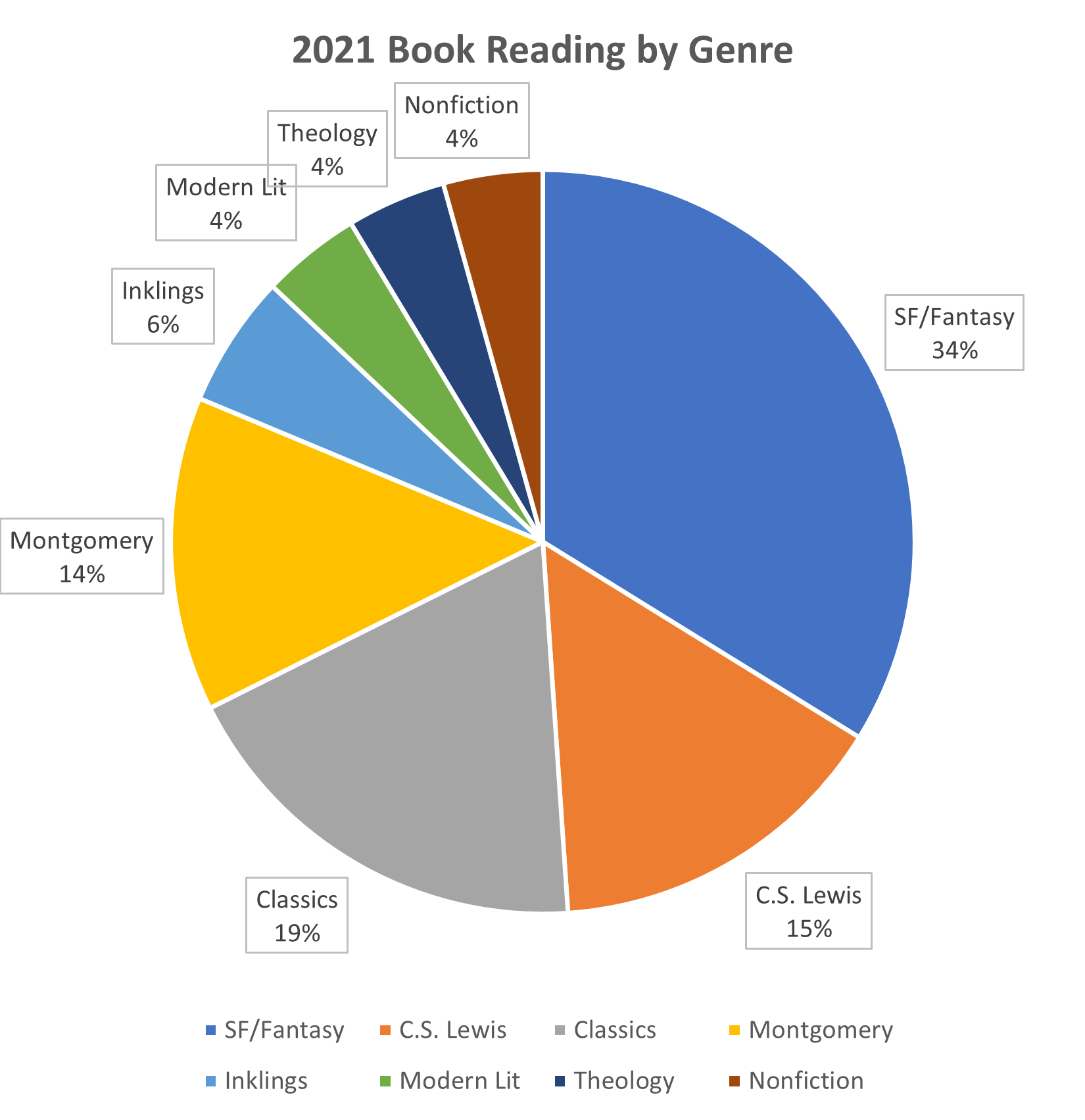
Here’s a pretty version of the same thing:

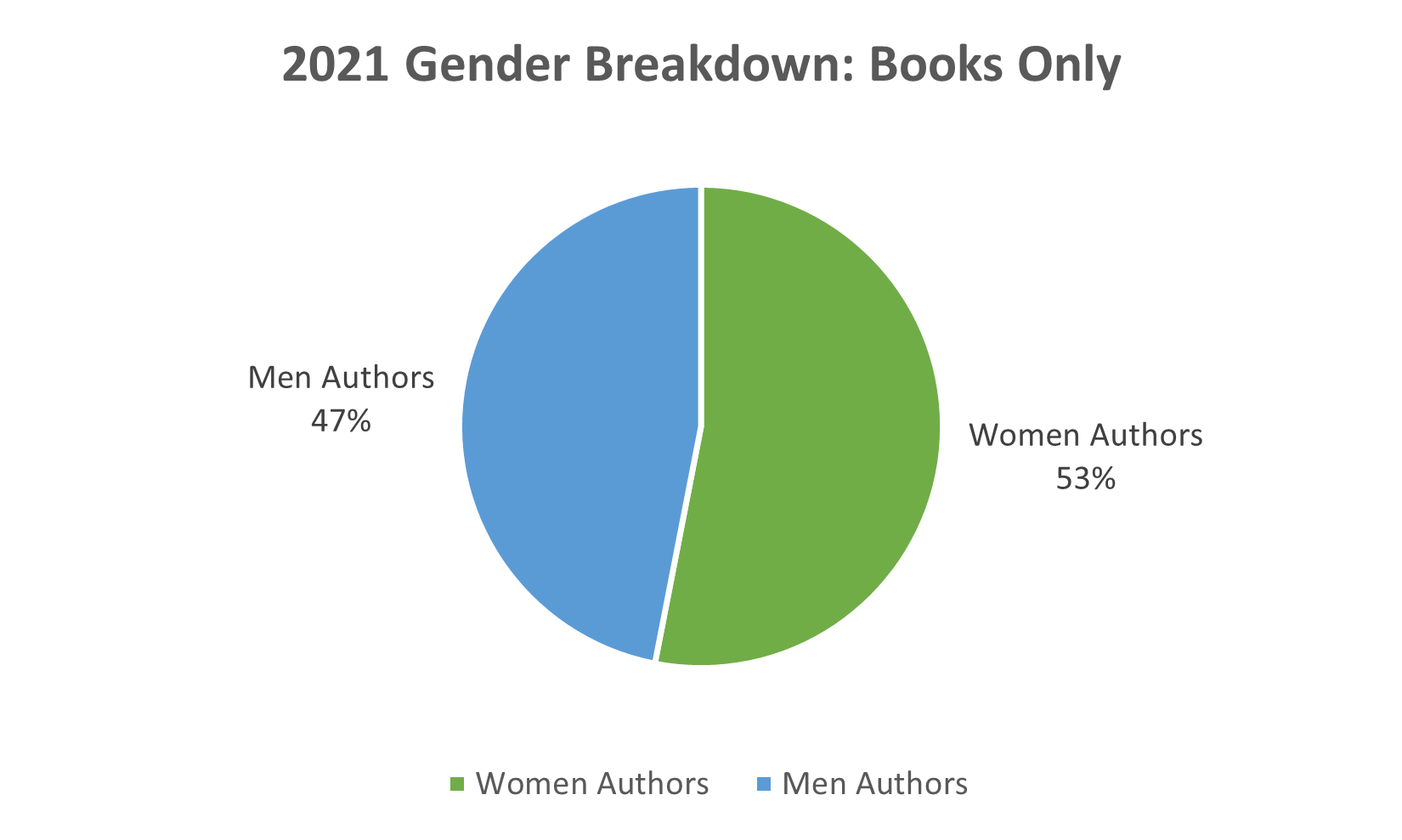
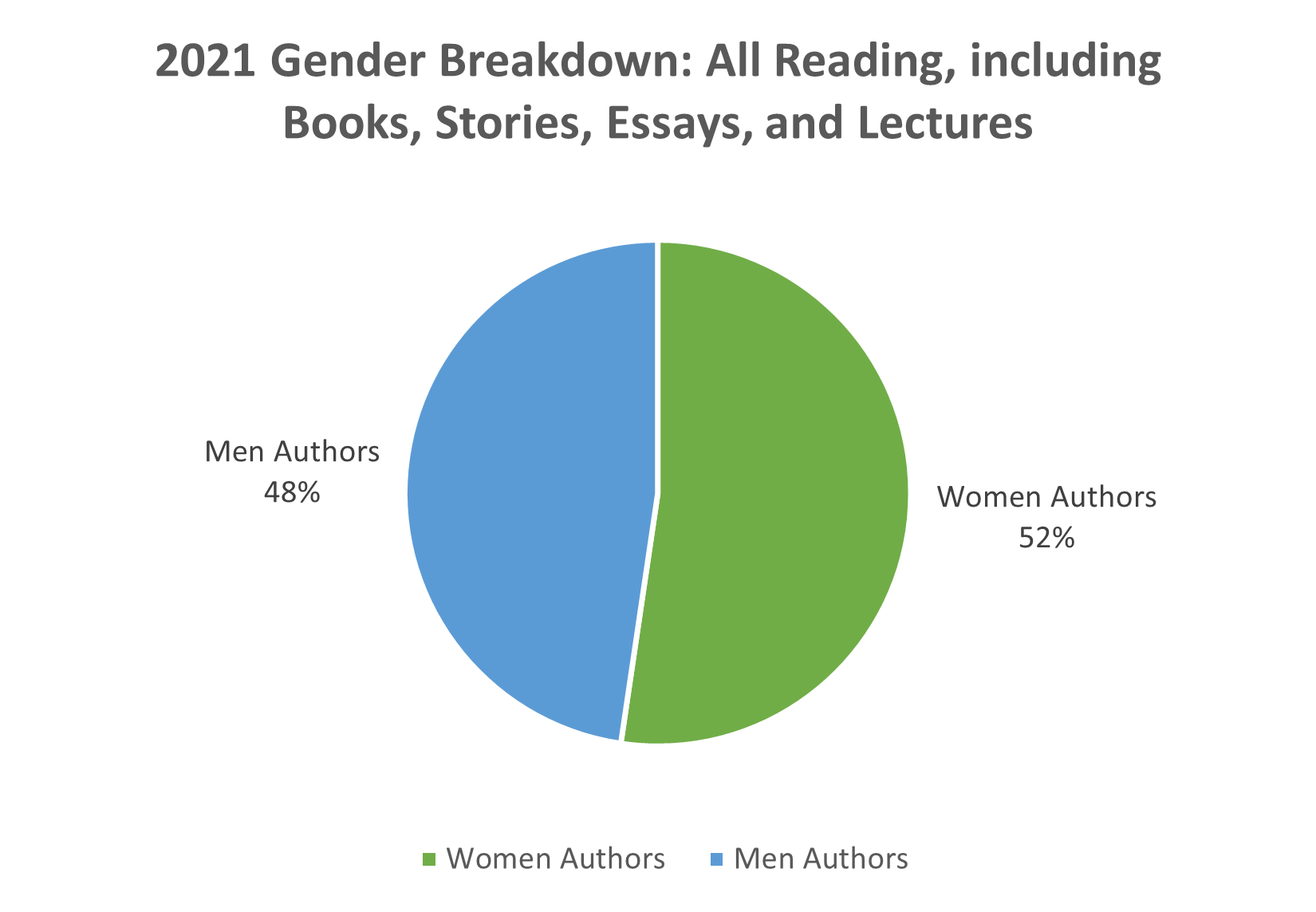
My final goal was to achieve a 1:2 ratio of women and men authors. This is tough to do when your primary author is male (C.S. Lewis), his primary partners are male (Tolkien and the Inklings), and my field has been largely male (theology). As I was extending more deeply into Montgomery studies, and reading through the catalogues of Ursula K. Le Guin, N.K. Jemisin, Octavia Butler, Marilynne Robinson, J.K. Rowling, Flannery O’Connor, and Anne Rice, I was confident I would surpass that ratio this year. Indeed, I set a goal of gender parity. And I met that goal … and then in the last month I tilted much further toward women writers. In 2021, I flipped my female:male ratio, so this year 53% of the books I read had women authors, and 47% had male authors. Including my reading as a whole, it was 52% women to 48% men. 


There are limits to how effective tracking of reading by gender (or other categories) can be, but it is a helpful reminder for me. In 2021, I intentionally set a goal and I achieved it.

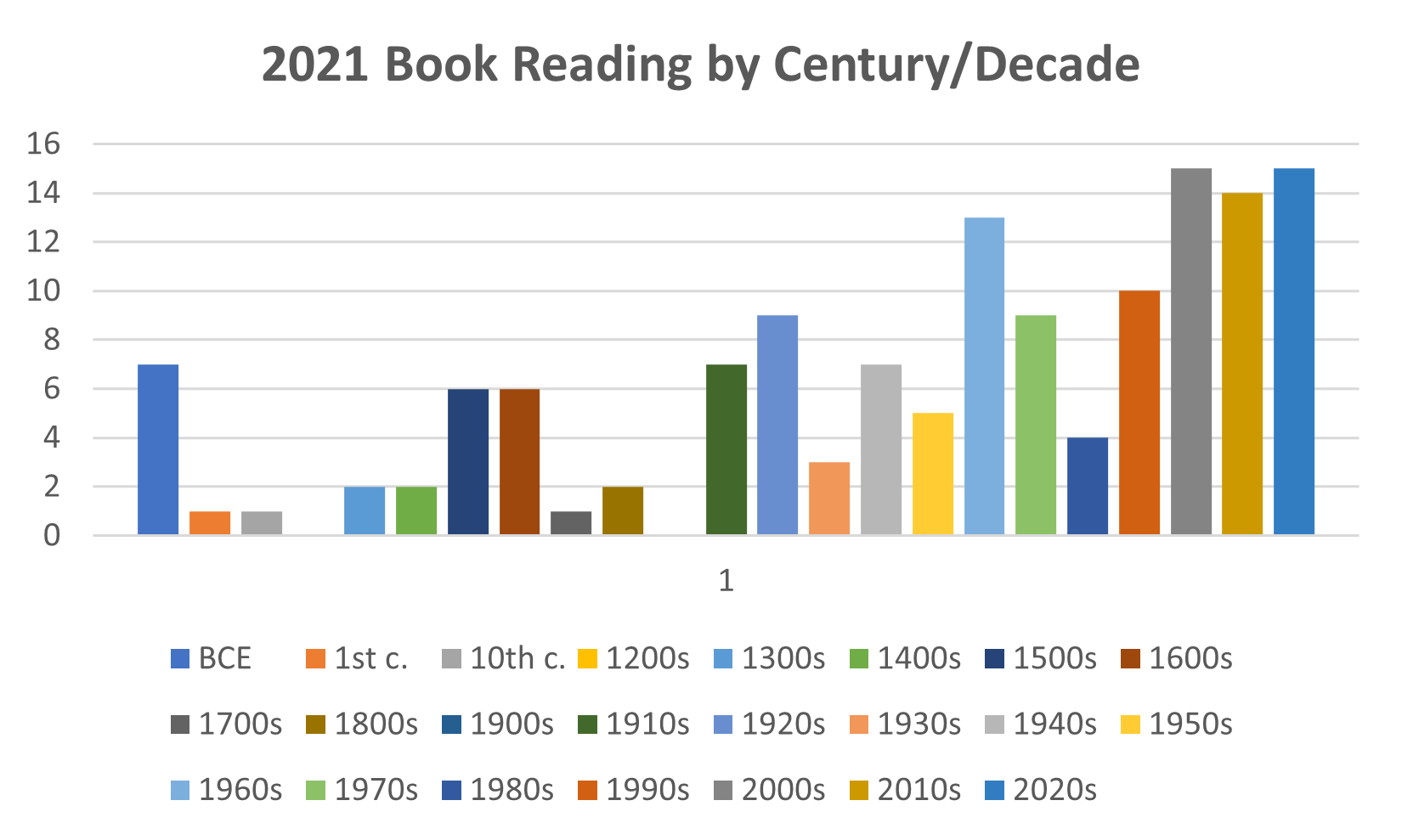
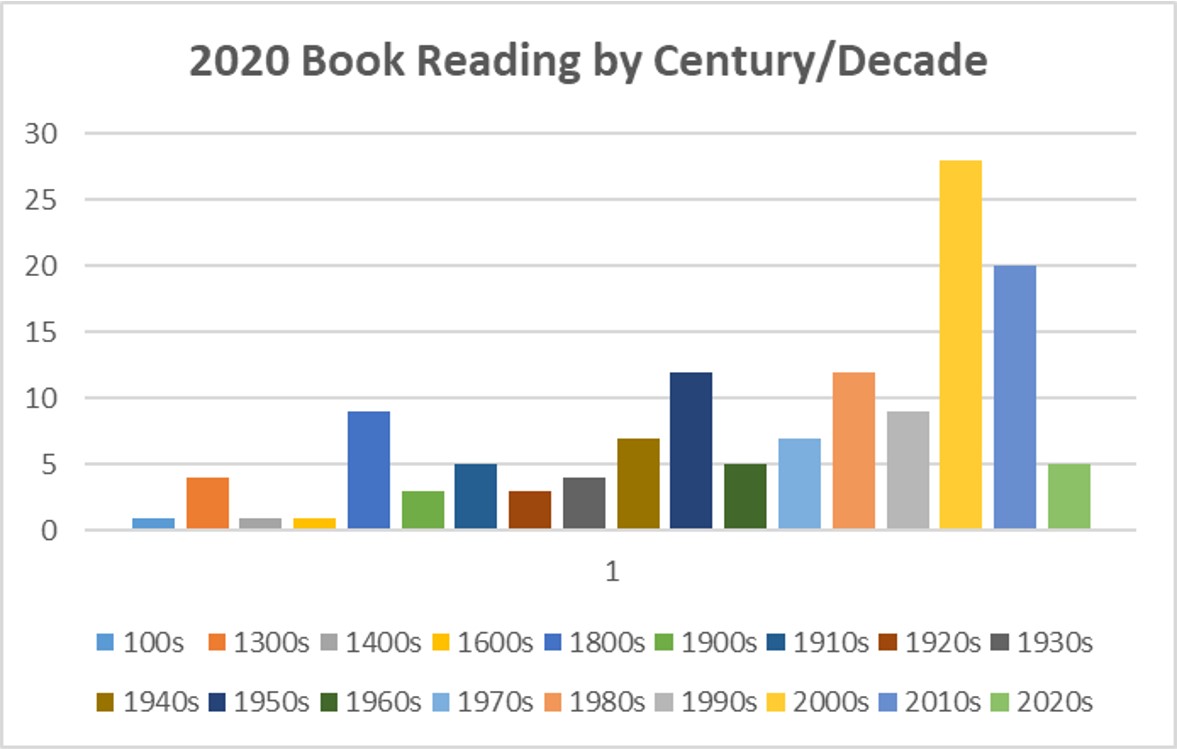
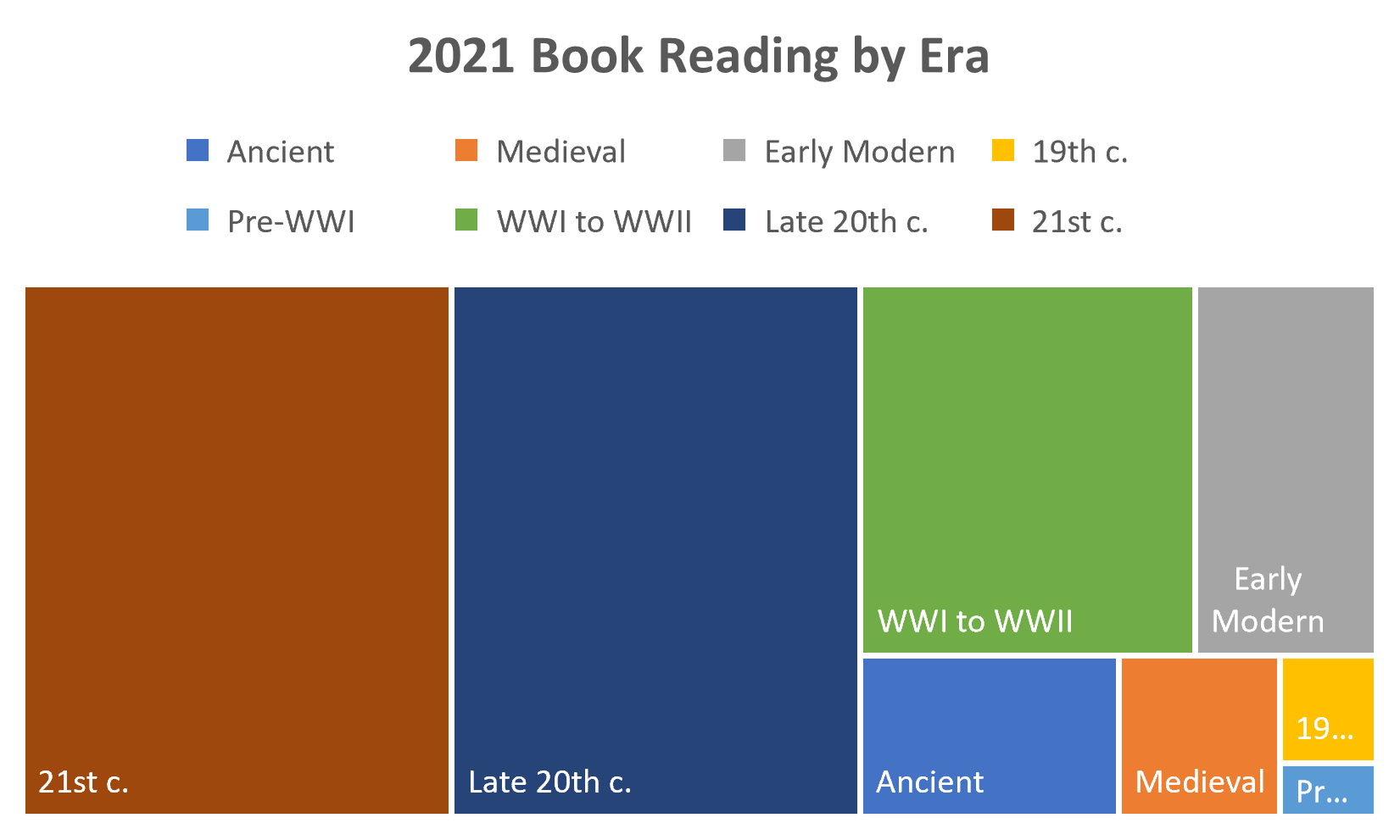
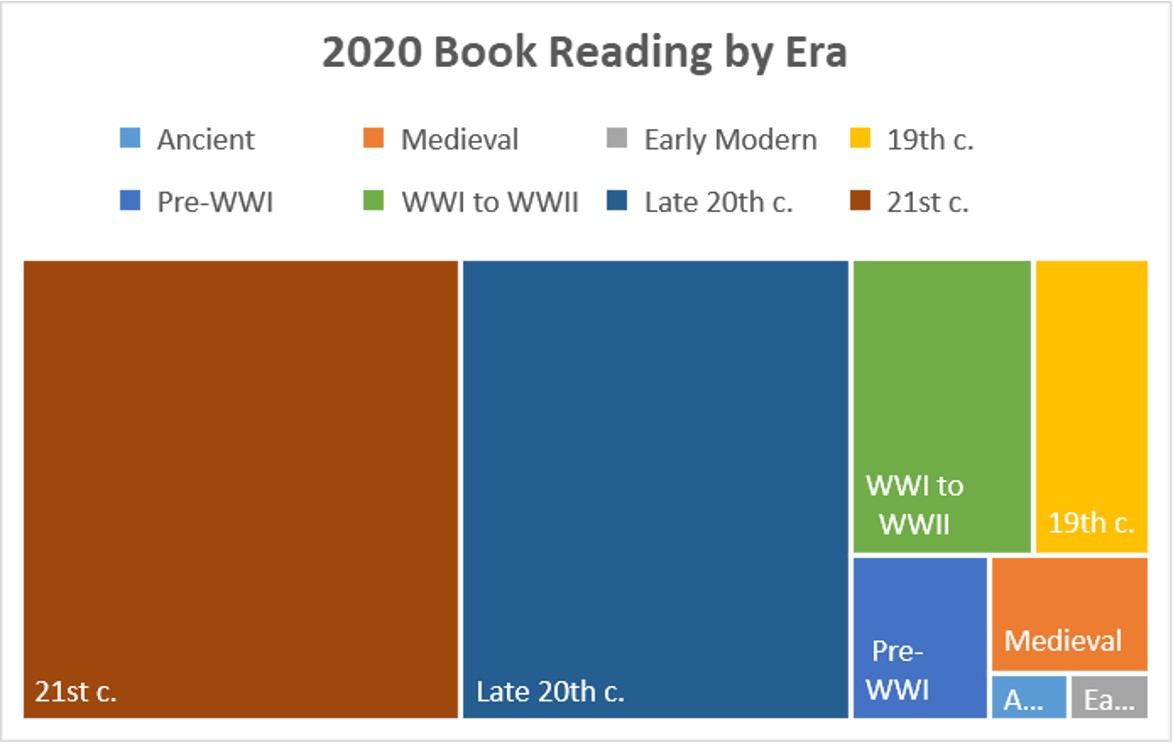
The Goodreads app is kind of limited, though you can check out my 2021 infographic. They have a thousand possibilities for creating infographics including gender, language, geography, genre, and popularity, yet they choose not to give us that power. So, in my limited way, this year I also tracked books by era. As I have upped my classic reading, you can see that reflected in my analysis. , with some mixed results. Last year, almost 3/4 of my book reading was from titles since WWII–despite studying figures that were active in the “modernist” period. This year, that has dropped to 62%. Intriguingly, my reading falls into 4 fairly neat batches:

  • 28% of my reading is before WWI
  • 17% of books I read were published in the WWI to WWII period (the second 30-years war)
  • 30% of my book reading is of titles published after WWII and before the end of the century
  • And about the same proportion of 21st-century volumes (32%)

Comparing my 2021 and 2020 charts shows a much more even distribution. 

What does 2022 look like? 

Next year, I am setting my reading goal for 132 books, once again. It is a difficult level to reach and feels right to me. I am in the midst of a number of small books right now, so perhaps the average word length will drop from 315 in 2020 and 313 in 2021 down to about 310 pages/book. For my book-reading goals, it is sort of an echo of 2021:

  • 2 C.S. Lewis or Lewis studies book/month (I am teaching two C.S. Lewis courses this winter, including a new Narnia course on leadership, communication, and culture)
  • 1 L.M. Montgomery book/month as part of a quasi-chronological reading of Montgomery’s novels, poetry, nonfiction, short stories, and letters
  • 1 theological or devotional book each month (which can include work in other categories)
  • 1 BIPOC author/month (from any category)
  • 1 Shakespeare play/month, including finishing the History Cycle (2 series of 4 plays); I’m also teaching The Merchant of Venice and Macbeth
  • Always be reading a pre-20th-century “classic” (beyond Shakespeare)–especially in this winter season
  • Read through all of N.K. Jemisin’s books that I can get a hold of
  • I am tempted to keep reading through Octavia Butler’s work, who I missed in 2021
  • Continue reading through J.R.R. Tolkien, including The Fall of Sauron (which I didn’t finish last year) and a couple of other Middle-earth collections
  • Finish the major parts of the Ursula K. Le Guin, including Lavinia and Language of the Night (and I may read some of the realistic fiction, which I don’t know well)
  • I believe that I will reread the Hugo-nominated novels this year … I just don’t know if I can blog about them again
  • I also intend to keep up with the Mythopoeic Award for Inklings Scholarship shortlisted books

I am not certain if I will achieve a 1:1 female:male ratio of authors. Now that I have met and exceeded that goal, I feel comfortable with how I am finding books. I am reaching for comfort books this coming year–especially for nighttime reading, catching up on a couple of graphic novels, and being open to more contemporary Canadian literature. Two of those three categories are more male-dominated. A lot of 2022 will depend on my choice of a major research project to begin July 1st, which will no doubt tilt the year. I also have no idea what I am teaching this coming fall. I will still aim for a rough parity of authors–which is really what happened in 2020 and 2021.

I also have the goal to read 72 articles, shorts stories, essays, or other short pieces (down from 75) and listen to or watch 6 lectures series or classes (down from 10).
Until next year, check out my brand new “discoveries” section in the 2021 infographic write-up. And here is my old-fashioned reading excel sheet list. I wish I was infographically-inclined, but I do like lists! Thanks to all of you novelists, poets, critics, bloggers, historians, reviewers, and editorialists who fill my year with great reading!

January
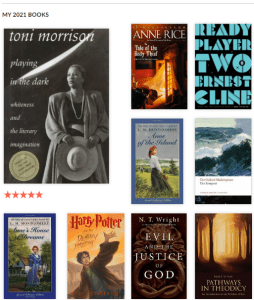
1 Jan 01 Anne Rice, The Tale of the Body Thief (1992) 
2 Jan 02 Toni Morrison, Playing in the Dark: Whiteness and the Literary Imagination (1992)
3 Jan 04 Selections from Rachel Dodge, The Anne of Green Gables Devotional (2019)
4 Jan 11 Ernest Cline, Ready Player Two (2020)
5 Jan 12 L.M. Montgomery, Anne of the Island (1915)
6 Jan 15 L.M. Montgomery, personal notes from “Fiction Writers on Fiction Writing: Advice, Opinions and a Statement of Their Own Working Methodsby More Than One Hundred Authors” (1923)
7 Jan 15 Shakespeare, The Tempest (1611)
8 Jan 18 L.M. Montgomery, Anne’s House of Dreams (1917)
9 Jan 18 J.K. Rowling, Harry Potter and the Deathly Hallows (2007)
10 Jan 18 L.M. Montgomery, “Green Gables Letters” to Mr. Weber (1905-09)
11 Jan 21 N.T. Wright, Evil and the Justice of God (2006)
12 Jan 25 Melanie J. Fishbane, “’My Pen Shall Heal, Not Hurt’: Writing as Therapy in Rilla of Ingleside andThe Blythes Are Quoted” (2015)
13 Jan 25 Mark S.M. Scott, Pathways in Theodicy: An Introduction to the Problem of Evil (2015)
14 Jan 27 L.M. Montgomery, The Alpine Path: The Story of My Career (1917)
15 Jan 28 Jennifer H. Litster, “The Scotsman, the Scribe, and the Spyglass: Going Back with L.M. Montgomery to Prince Edward Island” (2018)
16 Jan 28 Carole Gerson, “L.M. Montgomery and the Conflictedness of a Woman Writer” (2008)
17 Jan 28 Jennifer H. Litster, selections from The Scottish Context of L.M. Montgomery (2000)
18 Jan 31 Selections from Perry Bacon Jr., Nate Silver, Éric Grenier, Nathaniel Rakich, Geoffrey Skelley, Laura Bronner, Julia Wolfe, Maggie Koerth, Stewart Goetz, Christopher A. Snyder, Maya Angelou, Paul F. Ford, Hildi Froese Tiessen & Paul Gerard Tiessen, Meredith Conroy, Amelia Thomson-DeVeaux and Anna Wiederkehr, Alexander Panetta, Mark S. M. Scott, Maggie Koerth and Amelia Thomson-DeVeaux
 
February
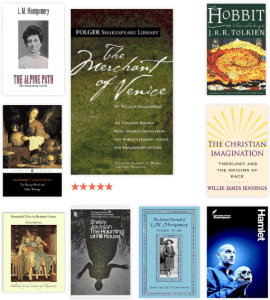
19 Feb 01 Shakespeare, The Merchant of Venice (1596)
20 Feb 01 J.R.R. Tolkien, The Hobbit (1937)
21 Feb 03 Margaret Steffler, “’Being a Christian’ and a Presbyterian
in Leaskdale” (2015)
22 Feb 03 Margaret Cavendish, The Blazing World (1666)
23 Feb 08 Willie James Jennings, The Christian Imagination: Theology and the Origins of Race (2010)
24 Feb 11 The Brothers Grimm, Household Tales (1812)
25 Feb 13 C.S. Lewis, The Four Loves broadcast (1958)
26 Feb 14 Shirley Jackson, The Haunting of Hill House (1959)
27 Feb 19 Tony Dekker, “Planet Narnia: A Book Review” (2010)
28 Feb 19 L.M. Montgomery, Mary Henley Rubio, Elizabeth Waterston, The Selected Journals of L.M. Montgomery, Volume III: 1921-1929 (1921-29; 1988; 2014)
29 Feb 23 Shakespeare, Hamlet (1599-1601)
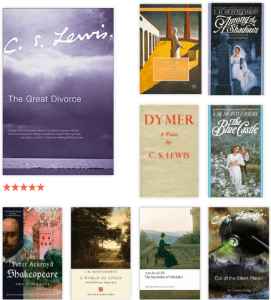
31 Feb 27 C.S. Lewis, The Great Divorce (1944-45)
32 Feb 28 Selections from Perry Bacon, Jr., Geoffrey Skelley, Jenny Litster, Julia Azari, Josh Hermsmeyer, Deirdra Dawson, Jane Chance, Tom Holland, Ralph Wood, Alison Millbank, Stephen Yandell, Christopher Garbowski, Amy Amendt-Raduege, Rita Bode, Dani Inkpen, Jess Zimmerman, Elizabeth Iwunwa, Subby Szterszky, C. Christopher Smith,  
 
March
33 Mar 03 Jane Chance, Tolkien, Self and Other: “This Queer Creature”  (2016)
34 Mar 04 Joe Ricke, “The Archangel Fragment: Identifying and  Interpreting C. S. Lewis’s ‘Cryptic Note’” (2020)
35 Mar 09 Ann Radcliffe, The Mysteries of Udolpho (1794)
36 Mar 11 C.S. Lewis, Dymer (1922-6)
37 Mar 11 L.M. Montgomery, Among the Shadows (1992)
38 Mar 15 L.M. Montgomery, The Blue Castle (1926)
39 Mar 18 Peter Ackroyd, Shakespeare: The Biography (2005)
40 Mar 20 L.M. Montgomery, Benjamin Lefebvre (ed.), A World of Songs: Selected Poems, 1894-1921 (2019)
41 Mar 23 C.S. Lewis, Out of the Silent Planet (1937)
42 Mar 25 Shakespeare, The Taming of the Shrew (1593)
43 Mar 26 L.M. Montgomery, The Watchman & Other Poems (1916)
44 Mar 26 J.R.R. Tolkien, The Fellowship of the Ring (1954)
45 Mar 27 Meik Wiking et al., The Little Book of Hygge: The Danish Way to Live Well (2016)
46 Mar 31 Selections from C.S. Lewis, Perry Bacon Jr., Mary Beth Cavert, Devin Brown, David Downing, Diana Glyer, George Puttenham, Phyllis Tickle, Zoë McLaren, Bonnie Tulloch, Laura Schmidt, Nate Silver, Robert C. Stroud, Katelyn Knox, Karen Kelsky, Carly Cantor, Neil Lewis Jr., Tim & Ann Evans, Bobby Ross, Jr., Scot McKnight, Geoffrey Skelley,
 
April
47 Apr 01 C.S. Lewis, Perelandra (1942-43)
48 Apr 03 C.S. Lewis, Screwtape Proposes a Toast, and Other Pieces (1941-59; 1965)

49 Apr 06 Jane Austen, Northanger Abbey (1817)
50 Apr 09 C.S. Lewis, That Hideous Strength (1943)
51 Apr 11 Nalo Hopkinson, Midnight Robber (2000)
52 Apr 19 Matt Haig, The Midnight Library (2020)
53 Apr 21 Miroslav Volf, Exclusion & Embrace: A Theological Exploration of Identity, Otherness, and Reconciliation, revised and updated, plus “Gender” chapter from 1st edition (1996; 2019)
54 Apr 23 Susanna Clarke, Jonathan Strange & Mr Norrell (2004)
55 Apr 25 James George Frazer, The Golden Bough (1922)
56 Apr 27 Jim Stockton and Benjamin J.B. Lipscomb, “The Anscombe-Lewis Debate: New Archival Sources Considered” (2021), w. new material from Elizabeth Anscombe and Ludwig Wittgenstein
57 Apr 27 C.S. Lewis, Till We Have Faces (1954)
58 Apr 30 Jennifer Cognard-Black, “Lip Service” (2008)
59 Apr 30 Selections from John Stackhouse, Jr., Jennifer Neyhart, Suzanne Bray, Bruce R. Johnson, James P. Helfers, Gale Watkins, Joel Heck, Stephen Beard, Crystal Hurd, Sarah Waters, Nathaniel Rakich, Perry Bacon, Jr., Steve Mollmann, Dale Nelson, Brian Melton, Devin Brown, Sandra Richter, Kris Swank, David Bratman, Melody Green
 
May
60 May 03 Sandra L. Richter, Stewards of Eden: What Scripture Says about the Environment and Why It Matters (2020
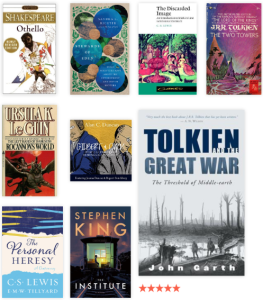
61 May 06 C.S. Lewis, The Discarded Image: An Introduction to Medieval and Renaissance Literature (1964, 1930s-50s Lectures)
62 May 11 C.S. Lewis, “Screwtape Proposes a Toast” (1959)
63 May 13 Ursula K. Le Guin, “Inventing a Universe is a Complicated Business” (2016)
64 May 14 Alan C. Duncan, with Joanna Duncan and Rupert Stutchbury, Gilbert & Jack: What C.S. Lewis Found Reading G.K. Chesterton (2020)
65 May 16 Ursula K. Le Guin, Rocannon’s World (1966)
66 May 18 J.R.R. Tolkien, The Two Towers (1954)
67 May 19 John Garth, Tolkien and the Great War: The Threshold of Middle-earth (2005)
68 May 20 C.S. Lewis and E.M.W. Tillyard, The Personal Heresy (1933-39)
69 May 21 Heather Walton, selections from Writing Methods in Theological Reflection (2014)
70 May 22 Stephen King, The Institute (2019)
71 May 24 Heather Walton, “Introduction” to Literature, Theology and Feminism (2014)
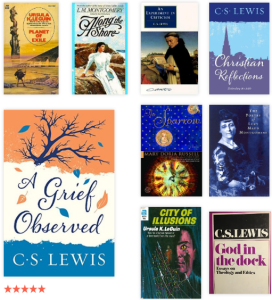
72 May 24 Ursula K. Le Guin, Planet of Exile (1966)
73 May 25 L.M. Montgomery and Rea Wilmshurst, Along the Shore: Tales by the Sea (1897-1935; 1989)
74 May 26 C.S. Lewis, An Experiment in Criticism (1960-61)
75 May 28 C.S. Lewis, A Grief Observed (1960-61)
76 May 28 C.S. Lewis, Christian Reflections (1939-1963; 1967)
77 May 30 Mary Doria Russell, The Sparrow (1996)
78 May 31 Selections by L.M. Montgomery, C.S. Lewis, Russell Perkin, Northrop Frye, Heather Walton, M.D. Aeschliman, Éric Grenier, Dan Hamilton, Gabriel Connor Salter, Steve Hayes, Priscilla Tolkien, Michael J. Gorman, Sam Joeckel, Dawn Llewellyn, Elaine Graham, Pete Ward, Lauren Umstead, Mineko Honda, James P. Helfers, Jerry Root, Verlyn Flieger, Walter Hooper,  David J. Leigh, Gi!bert Meilaender, Jeff Wright, Dan DeWitt, Wayne G. Hammond & Christina Scull
 
June
79 Jun 01 L.M. Montgomery; John Ferns and Kevin McCabe, eds., Poetry of Lucy Maud Montgomery (1893-1933; 1987)
80 Jun 02 Michael J. Gorman, “Reading Paul Missionally” (2017)
81 Jun 03 Ursula K. Le Guin, City of Illusions (1967)
82 Jun 04 C.S. Lewis, God in the Dock: Essays on Theology and Ethics (1940-1963; 1971)
83 Jun 07 L.M. Montgomery, Rainbow Valley (1919)
84 Jun 07 Don King, “Introduction to The Quest of Bleheris” (Sehnsucht, 2020)
85 Jun 07 Norbert Feinendegen, selections his philosophical work on C.S. Lewis (2021)
86 Jun 08 Katharine Sas and Curtis Weyant, “’Ever-Defeated Never Altogether Subdued’: Fighting the Long Defeat in Tolkien’s The Lord of the Rings and Whedon’s Angel” (2020)
87 Jun 08 Shakespeare, As You Like It (1599)
88 Jun 08 Tom Shippey, “Fighting the Long Defeat: Philology in Tolkien’s Life and Fiction” (2002)
89 Jun 08 Robert Morrison, The Regency Years: During Which Jane Austen Writes, Napoleon Fights, Byron Makes Love, and Britain Becomes Modern (2019)
90 Jun 08 C.S. Lewis, The Quest of Bleheris, with notes by Don King (1916; 2020)
91 Jun 09 C.S. Lewis, Spirits in Bondage, with an introduction by Gordon Greenhill (1919; 2017)
92 Jun 13 L.M. Montgomery, Rilla of Ingleside (1921)
93 Jun 14 Ursula K. Le Guin, The Left Hand of Darkness (1969)
94 Jun 14 Shakespeare, Othello (1603)
95 Jun 16 Edward Said, “Introduction to the Fiftieth-Anniversary Edition of Mimesis: The Representation of Reality in Western Literature by Erich Auerbach” (1996)
96 Jun 16 Homer, The Odyssey, translated by Stanley Lombardo, introduction by Sheila Murnaghan (8th c. BCE: 2000)
97 Jun 17 Erich Auerbach, “Odysseus’ Scar” ch. 1 of Mimesis: The Representation of Reality in Western Literature (1930s-40s)
98 Jun 17 Margaret Atwood, The Penelopiad (2005)
99 Jun 23 Ebony Elizabeth Thomas, PhD, The Dark Fantastic: Race and the Imagination from Harry Potter to the Hunger Games (2020)
100 Jun 28 Jennifer Cognard-Black, Becoming a Great Essayist (2016)
101 Jun 30 Jerry Root, David Downing, C.S. Lewis, Miho Nonaka, Jeffry C. Davis, Mark Lewis, Splendour in the Dark: C.S. Lewis’s Dymer in His Life and Work (1922-26; 2020)
102 Jun 30 Clyde S. Kilby, “Preface” to The Screwtape Letters (1940-42; 1982)
103 Jun 30 Selections by L.M. Montgomery, C.S. Lewis, Letitia Henville, Louis Markos, S.L. Jensen, Julianne Johnson, Jacob E. Meyer, Rachel M. Roller, J.D. Wunderly, Maya Maley, Daniel Z. Hsieh, Evangeline M. Prior, Marco Giugni, Mary M. Balkun and Susan C. Imbarrato, Jessica Eise, Pat Thomson, Peter Webster, Janet Salmons, T.S. Eliot, Karise Gililland, Dale Nelson 
July
104 Jul 01 L.M. Montgomery, The Golden Road (1913)
105 Jul 02 Ursula K. Le Guin, “Winter’s King” (1969)
106 Jul 04 C.S. Lewis, Charles Hall (Adapter), Pat Redding (Illustrator), John Kalisz (Illustrator), The Screwtape Letters: Christian Classic Series, Marvel Comics (1941; 1994)
107 Jul 05 Ursula K. Le Guin, The Word for World Is Forest (1972)
108 Jul 08 Crystal Hurd, “An Imaginative Tale from the Father of C.S. Lewis” (2020)
109 Jul 08 Selections from L.M. Montgomery’s journals, poetry, and novels (1898-1923)
110 Jul 12 Alan Moore and Dave Gibbons, Watchmen (1987; 2014; 2020)
111 Jul 12 Madeline Miller, Song of Achilles (2011)
112 Jul 13 Maximilian Hart, “The Other Word: Truth and Lies in Le Guin’s Old Speech” (2021)
113 Jul 15 L.M. Montgomery, Further Chronicles of Avonlea (1904-14; 1920)
114 Jul 19 Ursula K. Le Guin, The Dispossessed (1974)
115 Jul 20 Shakespeare, King Lear (1605)
116 Jul 24 Ursula K. Le Guin, The Wind’s Twelve Quarters (1964-75)
117 Jul 26 Anonymous, Gilgamesh: A New English Version (18th c. BCE; 2013) 
118 Jul 26 Anonymous, “The Great Hymn to the Aten” and “Enuma Elish” (c. 1350 BCE and 18th c. BCE) 
119 Jul 26 Maximilian Hart, “Draconic Diction: Truth and Lies in
Le Guin’s Old Speech” (2021)
120 Jul 28 Louise Bernice Halfe, Sky Dancer, Bear Bones and Feathers (1994)
121 Jul 28 C.S. Lewis, The Abolition of Man (1943)
122 Jul 30 Ursula K. Le Guin, A Fisherman of the Inland Sea (1994)
123 Jul 31 Selections from C.S. Lewis, L.M. Montgomery, Hélène Cixous, Monika Hilder, Melanie Fishbane, Ursula K. Le Guin, Stephen King, Daniel P. Jaeckle, Charlotte Spivack, Umberto Eco, Elizabeth Epperly, Mary Henley Rubio and Elizabeth Waterston, Harold Bloom, Rebecca Rosenblum, William B. Yeats, Paul Huebener
 
August
124 Aug 01 Anonymous, “C.S. Lewis: Don vs. Devil” (1947)
125 Aug 01 Homer, Iliad (8th c. BCE)
126 Aug 02 Ian Brown, “Virtual churches, real prayers: How COVID-19 is changing the holy seasons” (2021)
127 Aug 05 Aristophanes, Lysistrata, translated by Jack Lindsay, Sarah Ruden, Alex Struik, et al. (411 BCE)
128 Aug 06 Plato, Symposium, translated by Tom Griffith, some notes by Jane O’Grady, Tom Griffith (385-370 BCE)
129 Aug 06 Hesiod, selections from Theogony and Work and Days (c. 700 BCE)
130 Aug 06 L.M. Montgomery, Emily of New Moon (1923)
131 Aug 09 Shakespeare, Twelfth Night (1601)
132 Aug 10 J.R.R. Tolkien, Return of the King (1955)
133 Aug 11 C.S. Lewis, The Abolition of Man (1943)
134 Aug 14 Michael Ward, After Humanity: A Guide to C.S. Lewis’s The Abolition of Man (2021)
135 Aug 17 Lucretius, On the Nature of Things, translated by Rolfe Humphries (mid-1st c. BCE)
136 Aug 17 Frank Herbert, Dune (1965)
137 Aug 18 Albert J. Lewis, “The Story of a Half Sovereign,” with notes by Crystal Hurd (1890; 2020)
138 Aug 20 Ursula K. Le Guin, Four Ways to Forgiveness (1995)
139 Aug 24 Ursula K. Le Guin, The Birthday of the World and Other Stories (2002)
140 Aug 29 Selections from Sørina Higgins’ modernist study (2021)
141 Aug 30 Virgil, The Aeneid (trans. Fagles; 29-19 BCE)
142 Aug 31 Selections from C.S. Lewis, L.M. Montgomery, Monika Hilder, Elizabeth Epperly, Jennifer H. Litster, Benjamin Lefebvre, Elizabeth Waterston, A. Wylie Mahon, Dale Nelson, G. Connor Salter, Daniel Whyte IV
 
September
143 Sep 01 Ovid, Metamorphoses, with an introduction and translation by David Raeburn (8 CE)
144 Sep 01 Lord Dunsany, ” A Dreamer’s Tale: Poltarnees, Beholder of Ocean” (1910)
145 Sep 01 Ursula K. Le Guin, “A Citizen of Mondath” (1973)
146 Sep 01 Ursula K. Le Guin, “World-Making” (1981)
147 Sep 01 Ursula K. Le Guin, “Imaginary Countries” (1976)
148 Sep 07 Anne Rice, Memnoch the Devil (1995)
149 Sep 08 Ray Bradbury, “The Naming of Names, or Dark They Were and Golden-Eyed” (1949)
150 Sep 08 Cordwainer Smith,  “Alpha Ralpha Boulevard” (1961)
151 Sep 09 Anonymous, Beowulf, translated by Seamus Heaney (8th-11th c. CE) 
152 Sep 09 Alasdair MacIntyre, After Virtue: A Study in Moral Theory (3rd ed., 1982; 2007)
153 Sep 13 Ursula K. Le Guin, “Semley’s Necklace” (1964) 
154 Sep 13 Ursula K. Le Guin, The Telling (2000)
155 Sep 19 L.M. Montgomery, Emily of New Moon (1923)
156 Sep 21 Ursula K. Le Guin, The Word for World Is Forest (1972)
157 Sep 22 Ursula K. Le Guin, The Left Hand of Darkness (1969)
158 Sep 23 L.M. Montgomery, Emily Climbs (1925)
159 Sep 25 L.M. Montgomery, Emily’s Quest (1927)
160 Sep 27 Ursula K. Le Guin, “Vaster Than Empires and More Slow” (1971)
161 Sep 28 Ursula K. Le Guin, The Lathe of Heaven (1971)
162 Sep 29 Ursula K. Le Guin, The Dispossessed (1974)
163 Sep 30 Frank Herbert, Dune Messiah (1969)
164 Sep 30 Selections from C.S. Lewis, L.M. Montgomery, Ursula K. Le Guin, Steve Hayes, Daniel Whyte IV, Jason Smith, Meredith B. McGuire, Anne S. Brown and David D. Hall, Mary McCartin Wearn, Mary Rubio, Catherine Reid, Elizabeth Epperly, Benjamin Lefebvre, Irene Gammel, David D. Hall, Jennifer H. Litster, Andrea McKenzie, Vernon Ramesar, Sam Reimer & Rick Hiemstra, Jane Urquhart, Stephen Winter, Carl McColman, Tom Hillman, David Russell Mosley, Ted Lewis, Samuel Gerald Collins, Andrew Marvell, Charlie W. Starr, Steve Hayes, Yvonne Aburrow, William O’Flaherty, Tyler Huckabee
 
October
165 Oct 01 Various, Medieval Reading Pack (Julian of Norwich, Margery Kempe, Chaucer, Langland, “Dream of the Rood”, Anselm, etc., 11th-14th c.)
166 Oct 05 Dante, Hell, trans. Robert Pinsky, foreword by John Freccero, notes by Nicole Pinsky (1308-1320; 1996)
167 Oct 06 Philip K. Dick, “Exhibit Piece” (1954)
168 Oct 06 C.S. Lewis, “Dante’s Similes” (1940)
169 Oct 06 C.S. Lewis, “Imagery in the Last Eleven Cantos of Dante’s Comedy” (1948)
170 Oct 06 Dante, The Divine Comedy 3: Paradise, translation, notes, and introduction by Dorothy L. Sayers and Barbara Reynolds (1220; 1962)
171 Oct 11 Martha Wells, Network Effect (2020)
172 Oct 12 Ursula K. Le Guin, A Wizard of Earthsea (1968)
173 Oct 13 Ursula K. Le Guin, “The Word of Unbinding” (1964) 
174 Oct 13 Ursula K. Le Guin, “The Rule of Names” (1964)
175 Oct 16 Geoffrey Chaucer, The Canterbury Tales, trans. Burton Raffel; intro. John Miles Foley (1387-1400; 2008)
176 Oct 18 Mary Robinette Kowal, The Calculating Stars (2018)
177 Oct 19 Ursula K. Le Guin, The Tombs of Atuan (1971)
178 Oct 26 Mary Robinette Kowal, The Fated Sky (2018)
179 Oct 27 Ursula K. Le Guin, The Farthest Shore (1972)
180 Oct 29 Jonathon Lookadoo, “A Preview of the Inklings? A Note on the Early Correspondence of C.S. Lewis and Arthur Greeves” (2018)
181 Oct 29 Janet Brennan Croft, “The Purest Response of Fantastika to the World Storm,” Introduction to Baptism of Fire: The Birth of the Modern British Fantastic in World War (2015)
182 Oct 31 Selections from C.S. Lewis, L.M. Montgomery, Joy Davidman, Ursula K. Le Guin, Walter Hooper, Mark S.M. Scott, Jennifer Rogers, Oronzo Cilli, Benjamin Lefebvre, Jane Goodall, Daniel Whyte IV, Katelyn Knox, Jonathan Poletti, Victoria S. Allen, MariJean Wegert, Michael Travers, Jane Hipolito, Colin Manlove, David C. Downing, John Haigh, Joel Heck, James W. Menzies, Kirstin Jeffrey Johnson, Daniel Sutton, Rachel McLay & Howard Ramos, Mary Rubio, William B. Bynum, Elizabeth Millie Joy, Julie M. Dugger, Andrew Cuneo, Don W. King, Stephen Logan, Andrew Krostrom, Brian Melton, Courtney Ellis
 
November
183 Nov 01 Ursula K. Le Guin, Tehanu (1990)
184 Nov 02 Ursula K. Le Guin, “Children, Women, Men, and Dragons” (1992)
185 Nov 03 John M. Bowers, Tolkien’s Lost Chaucer (2019)
186 Nov 04 Mary Robinette Kowal, The Relentless Moon (2020)
187 Nov 07 Ursula K. Le Guin, Gifts (Annals of the Western Shore 1, 2004) 
188 Nov 09 Ursula K. Le Guin, The Other Wind (2001)
189 Nov 10 Ursula K. Le Guin, “Firelight” (2018)
190 Nov 10 Ursula K. Le Guin, “The Daughter of Odren” (2014)
191 Nov 10 Ursula K. Le Guin, Tales from Earthsea (2001)
192 Nov 12 Ursula K. Le Guin, Voices (Annals of the Western Shore 2, 2006) 
193 Nov 17 Ursula K. Le Guin, Powers (Annals of the Western Shore 3, 2007) 
194 Nov 18 Mark Williams Roche, Selections from Why Choose the Liberal Arts? (2010)
195 Nov 21 Melanie J. Fishbane, Maud: A Novel Inspired by the Life of L.M. Montgomery (2017)
196 Nov 22 The Pearl Poet, Sir Gawain and the Green Knight (trans. Simon Armitage; late 15th c.; 2007)
197 Nov 23 Ursula K. Le Guin, “The Ones Who Walk Away from Omelas” (1973)
198 Nov 24 Kris Swank, “Ursula K. Le Guin: World-builder” (with a lecture by Robert Steed, Signum University, 2021)
199 Nov 24 Rebecca Roanhorse, Black Sun (2020)
200 Nov 30 Selections from C.S. Lewis, L.M. Montgomery, Ursula K. Le Guin, Chaucer, Jonathan McGee, Christopher Benson, Juan Siliezar, Fairouz Gaballa, Kirstin Jeffrey Johnson, Mary Rubio, Elizabeth Bishop
 
December
201 Dec 01 N.K. Jemisin, The City We Became (2020)
202 Dec 04 Tamsyn Muir, Gideon The Ninth (2019)
203 Dec 11 Tamsyn Muir, Harrow The Ninth (2020)
204 Dec 14 Susanna Clarke, Piranesi (2020)
205 Dec 14 Shakespeare, Richard II (1595)
206 Dec 16 Niccolò Machiavelli, The Prince, trans. W.K. Marriott (1532)
207 Dec 26 Shakespeare, Henry IV, Part 1 (1596-97)
208 Dec 28 Julie A. Sellers, Kindred Verse: Poems Inspired by Anne of Green Gables (2021)
209 Dec 31 C.S. Lewis, The Screwtape Letters (1940-42)
210 Dec 31 William Lyndsay Gresham, Nightmare Alley (1946)
211 Dec 31 Selections from C.S. Lewis, L.M. Montgomery, Ursula K. Le Guin, James Deutsch, Robert Browning, James Smoker, Andrea MacKenzie, Benjamin Lefebvre, Malcolm Guite, G. Connor Salter, John Stanifer, Wayne G. Hammond & Christina Scull, David Llewellyn Dodds, Joy Davidman, Abigail Santamaria, Don W. King, Alan M. Wald, William Lindsay Gresham, Liz Rosenberg


Posted in Original Research, Reflections | Tagged , , , , , , , , , , , | 1 Comment

“Stuff We Liked in 2021” by the Rabbit Room (Friday Feature)

I have mentioned before that I am a fan of the good folks at The Rabbit Room, including songwriter and storytelling brothers Andrew and Pete Peterson. Last fall they Hutchmoot: Homebound online, a digital conference of thoughtful speakers, sesssions, and resources for and by Christian artists and writers. Last years Hutchmoot included talks and performances by Diana Glyer, Malcolm Guite, and a number of other folks I love or admire, like The Gray Havens, JJ Heller, Jerry Root, and Sho Baraka. Two years ago, the Hutchmoot keynote speaker was Steve Taylor, and it was kind of brilliant.

Conceived “as an experiment in creative community” inspired by Andrew Peterson’s first visit to the Kilns, C.S. Lewis’ home in Oxford, the Rabbit Room emerged to encourage Christian artistry. The Rabbit Room was the name of the back room of the Eagle and the Child, the pub where C.S. Lewis, J.R.R. Tolkien, Charles Williams, and the other Oxford Inklings shared their work, challenging and encouraging one another. Inspired by the possibilities for a contemporary movement, Peterson’s Rabbit Room developed with this mission in mind:

“The Rabbit Room cultivates and curates stories, music, and art to nourish Christ-centered communities for the life of the world.”

Besides Hutchmoot and other events, the Rabbit Room website is filled with resources, including articles and essays, reviews, talks, and the Rabbit Room podcast network. There is also an entire members section and a store that includes their own press. John Stanifer noted in his piece for the Nightmare Alley Series that after C.S. Lewis’ wife, Joy Davidman, died from cancer, her previous husband, Bill Gresham, took a trip to England to visit with his sons and to meet Lewis. While at the Kilns, Gresham asked permission to make an audio recording of Lewis. Lewis read aloud from Chapter 3 of Perelandra, Chapter 13 of That Hideous Strength, and the prologue to The Canterbury Tales. The Rabbit Room recently made that recording available to the public, and the proceeds are being donated to the Marion E. Wade Center at Wheaton.

I have not yet gotten to a live in-person Rabbit Room event, but I have had the pleasure of being referenced by Andrew Peterson in his Hutchmoot talk, “The Delightful Shiver“–and the second part with Lanier Invester is lovely too.

https://omny.fm/shows/the-hutchmoot-podcast/the-delightful-shiver-part-1-of-2/embed?style=cover

In a radically understated blog post title, “Stuff We Liked in 2021,” the Rabbit Room team share their book, film, TV, and music discoveries of the last year. I just thought it was a great, long, chatty piece with all kinds of potentially great things to discovery–from The Princess Bride by William Goldman to My Octopus Teacher to Madeleine L’Engle inspired polyphonic choral music. There are nods here to Frank Herbert, Dorothy L. Sayers, Austin M. Farrer, Loren Wilkinson, The War On Drugs, Brandi Carlile, Robert Farrar Capon, Steve Guthrie, Hannah Hubin, Olivia Rodrigo, Jon Foreman, The Killers, Bruce Hornsby, Needtobreathe, Andrew Osenga, Dallas Willard, Pedro the Lion, James K. A. Smith, Lana del Rey, Marilynne Robinson, Sufjan Stevens & Angelo De Augustine, Taylor Swift, The Beatles, Mary Doria Russell’s The Sparrow, Susanna Clarke’s Piranesi, numerous references to Spiderman: No Way Home, and space for that crazy and beautiful adaptation of The Green Knight. And I suspect any Rabbit Room artist conversation couldn’t miss Wendell Berry.

You can find the full write-up here. Perhaps there is something here to add to your 2022 literary and artistic discoveries.

Posted in Feature Friday | Tagged , , , , , , , , , , , , , , , , , , , , , , , , , , , , , , , , , , , , | Leave a comment