 I have struggled in the past to understand C.S. Lewis’ complicated relationship with WWI–the Great War, as they called it. In my piece, “Marching as to War: C.S. Lewis on His Way to the Front Line,” I tried to show that although Lewis minimizes his experience of the trenches and battles both in his letters and his memoir, Surprised by Joy, you can see how the war impacts his growth and development as he finishes his teenage years. In a more sophisticated piece, “The Transformative Power of Memory: Lewis and the World Wars,” I argued that Lewis may not have faced all the ways that the war had shaped him. Lewis seems to want to minimize his experience of war, at one point panning it as “even in a way unimportant” (Surprised by Joy, XII).
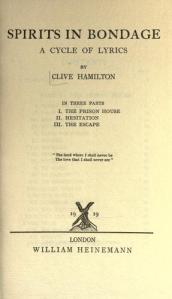 Despite this minimizing of the Great War in his later reflections, Lewis was clearly marked by the experience. While in convalescence near the end of the war, Lewis pulled his poetry together for publication as Spirits in Bondage: A Cycle of Lyrics, published in 1919 as Lewis was matriculating at Oxford. In the short poem that begins the book–and really one of the strongest in the interesting but uneven collection–we can see how Lewis wrestles with his evolving philosophical outlook and a world in which WWI is not just allowed, but normative.
Satan Speaks
I am Nature, the Mighty Mother,
I am the law: ye have none other.
I am the flower and the dewdrop fresh,
I am the lust in your itching flesh.
I am the battle’s filth and strain,
I am the widow’s empty pain.
I am the sea to smother your breath,
I am the bomb, the falling death.
I am the fact and the crushing reason
To thwart your fantasy’s new-born treason.
I am the spider making her net,
I am the beast with jaws blood-wet.
I am a wolf that follows the sun
And I will catch him ere day be done.
The title is not unimportant, as Lewis’ walks through a world of discomfort and death to Ragnarök, where the war is one of the final apocalyptic moments before the winking out of all reality.
 In a minor way, Lewis could be read as one of the “War Poets,” a collection of writers who pinned readers to the harsh realism of the war, often leaving a bitter taste in the mouth, or even hopelessness. L.M. Montgomery anticipates the importance of poetry for grappling with the realities of this great, transformative war. Her character, Walter Blythe–a son of Anne and Gilbert’s–is both a prophet of doom and a Tennysonian hero. His war poem was to do in fiction what “In Flanders Fields” by Dr. John McCrae has done in Canada and abroad: set the theatre of war in its realities, but give the people back home a way to remember. It is one of the few liturgies left in Canada, the public reading of “In Flanders Fields” on Remembrance Day.
However, the War Poets were not interested in “remembrance” as such, but in “seeing.” They wanted to show the way the war destroys everything, including poets and poetry. And Lewis was certainly not interested in creating a liturgy for the people in his war poems–though Spirits in Bondage is strangely tinted by hope near the end of the cycle. It is hard to read Wilfred Owen, Robert Graves, Siegfried Sassoon, and the other War Poets and not feel a desperate cry at the idea of war. Even in its sadness, Tennyson‘s “The Charge of the Light Brigade” is of a world that has passed away, of heroes that can never rise again. What is valiant or eternal about leaping out of a fox hole to be mowed down is mass slaughter by an enemy technopolis? What were they even fighting for, there in the fields of France?
WWI was not the end of all worlds as Ragnarök foretold, but it was the end of one world for many–a world of romance and chivalry and hope in men, though writers like L.M. Montgomery try to keep that disappearing world alive. And for many, WWI was Götterdämmerung, the Twilight of the Gods, the end of an age where you can confidently believe that this world of fox holes and lost friends is the best of all possible worlds.
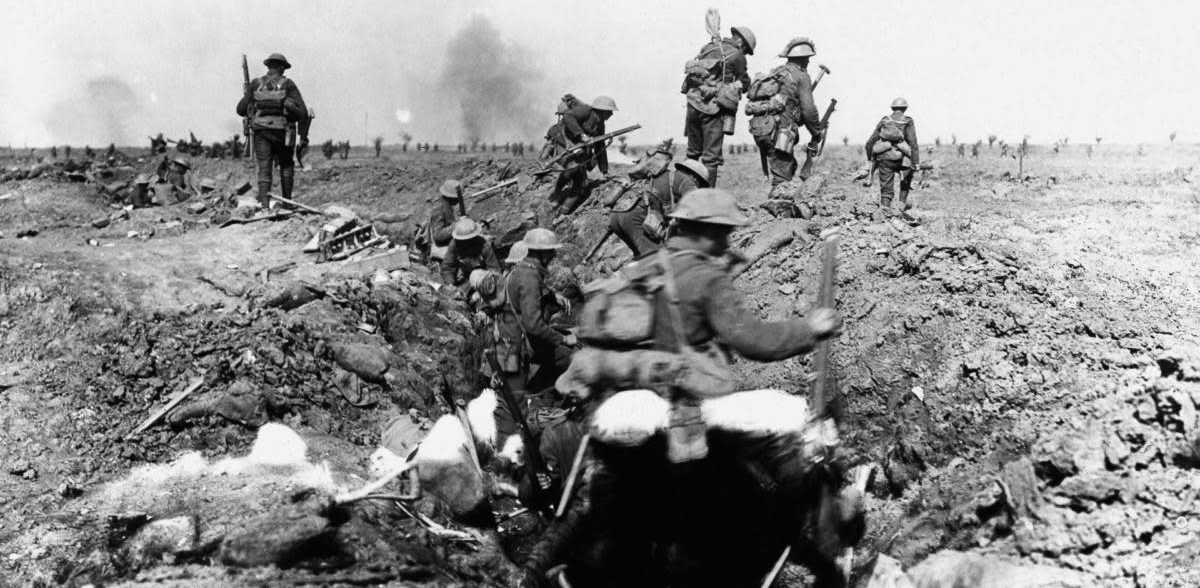 The War Poets were well entrenched in irony, and it is perhaps a kind of irony that for C.S. Lewis, WWI was one of the precipitating moments in his turn toward faith. Lewis’ story is one where that haunting dusky light forebodes a Dawn of the Gods, and a life lived toward re-enchantment of the 20th-century technocratic world. As he came to the end of his fairy tale series, The Chronicles of Narnia, Lewis told his story in Surprised by Joy.
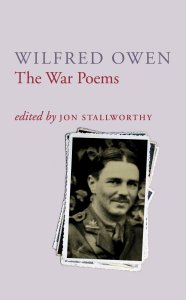
I have said that Lewis pans on the war and perhaps misunderstands how deeply he is shaped by the experience. But he does describe in vivid detail some aspects of the war, and in doing so points the reader back to the War Poets and chroniclers of WWI. Recently, a colleague of mine, Arthurian expert Gabriel Schenk, recited a poem that filled in some of the background of war that Lewis is pointing us to in his writings and invited me to look at again at Wilfred Owens work. Here, in remembrance of the war that broke the world, I quote from Lewis in Surprised by Joy and Wilfred Owen’s “Anthem for Doomed Youth” and “Dulce et Decorum Est.: The Latin that titles and closes the first Owen poem, “Dulce et decorum est / Pro patria mori,” is from Horace, I believe, and could be translated as “Sweet and fitting it is to die for one’s country.”
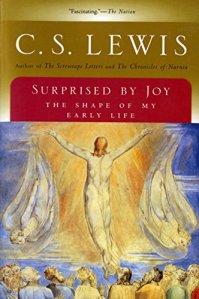 From Surprised by Joy by C.S. Lewis
The war itself has been so often described by those who saw more of it than I that I shall here say little about it. Until the great German attack came in the Spring we had a pretty quiet time. Even then they attacked not us but the Canadians on our right, merely “keeping us quiet” by pouring shells into our line about three a minute all day. I think it was that day I noticed how a greater terror overcomes a less: a mouse that I met (and a poor shivering mouse it was, as I was a poor shivering man) made no attempt to run from me. Through the winter, weariness and water were our chief enemies. I have gone to sleep marching and woken again and found myself marching still. One walked in the trenches in thigh gum boots with water above the knee; one remembers the icy stream welling up inside the boot when you punctured it on concealed barbed wire. Familiarity both with the very old and the very recent dead confirmed that view of corpses which had been formed the moment I saw my dead mother. I came to know and pity and reverence the ordinary man: particularly dear Sergeant Ayres, who was (1 suppose) killed by the same shell that wounded me. I was a futile officer (they gave commissions too easily then), a puppet moved about by him, and he turned this ridiculous and painful relation into something beautiful, became to me almost like a father. But for the rest, the war—the frights, the cold, the smell of H.E., the horribly smashed men still moving like half-crushed beetles, the sitting or standing corpses, the landscape of sheer earth without a blade of grass, the boots worn day and night till they seemed to grow to your feet—all this shows rarely and faintly in memory. It is too cut off from the rest of my experience and often seems to have happened to someone else. It is even in a way unimportant. One imaginative moment seems now to matter more than the realities that followed. It was the first bullet I heard—so far from me that it “whined” like a journalist’s or a peacetime poet’s bullet. At that moment there was something not exactly like fear, much less like indifference: a little quavering signal that said “This is War. This is what Homer wrote about.” (Surprised by Joy, ch. XII).
 “Dulce et Decorum Est” by Wilfred Owen
Bent double, like old beggars under sacks,
Knock-kneed, coughing like hags, we cursed through sludge,
Till on the haunting flares we turned our backs,
And towards our distant rest began to trudge.
Men marched asleep. Many had lost their boots,
But limped on, blood-shod. All went lame; all blind;
Drunk with fatigue; deaf even to the hoots
Of gas-shells dropping softly behind.
Gas! GAS! Quick, boys!—An ecstasy of fumbling
Fitting the clumsy helmets just in time,
But someone still was yelling out and stumbling
And flound’ring like a man in fire or lime.—
Dim through the misty panes and thick green light,
As under a green sea, I saw him drowning.
In all my dreams before my helpless sight,
He plunges at me, guttering, choking, drowning.
If in some smothering dreams, you too could pace
Behind the wagon that we flung him in,
And watch the white eyes writhing in his face,
His hanging face, like a devil’s sick of sin;
If you could hear, at every jolt, the blood
Come gargling from the froth-corrupted lungs,
Obscene as cancer, bitter as the cud
Of vile, incurable sores on innocent tongues,—
My friend, you would not tell with such high zest
To children ardent for some desperate glory,
The old Lie: Dulce et decorum est
Pro patria mori.
 “Anthem for Doomed Youth” by Wilfred Owen
What passing-bells for these who die as cattle?
— Only the monstrous anger of the guns.
Only the stuttering rifles’ rapid rattle
Can patter out their hasty orisons.
No mockeries now for them; no prayers nor bells;
Nor any voice of mourning save the choirs,—
The shrill, demented choirs of wailing shells;
And bugles calling for them from sad shires.
What candles may be held to speed them all?
Not in the hands of boys, but in their eyes
Shall shine the holy glimmers of goodbyes.
The pallor of girls’ brows shall be their pall;
Their flowers the tenderness of patient minds,
And each slow dusk a drawing-down of blinds.
I believe in open access scholarship. Because of this, since 2011 I have made A Pilgrim in Narnia free with nearly 1,000 posts on faith, fiction, and fantasy. Please consider sharing my work so others can enjoy it.

 I am pleased to be hosting a conversation about my blogging here at A Pilgrim in Narnia on Friday, hosted by Dr. Joe Ricke. All are welcome to join in. I have gone to about a dozen of these Friday afternoon events since the spring, and I quite like the dynamic. To prepare for the event, you might be interested in one of these posts:
 Join the conversation as Lindsay specialists and enthusiasts celebrate the novel and its major influence on key fantasy authors of our time, including
  Douglas A. Anderson, a Lindsay and Tolkien scholar, who has worked extensively with Lindsay’s manuscripts and is currently preparing a new edition of A Voyage to Arcturus. He blogs at:
  The event is free but ticketed. Please book your ticket here:




 A Pilgrim in Narnia