
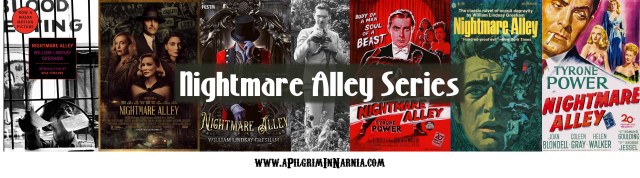
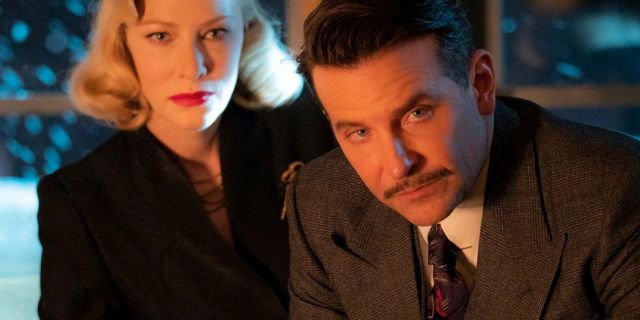
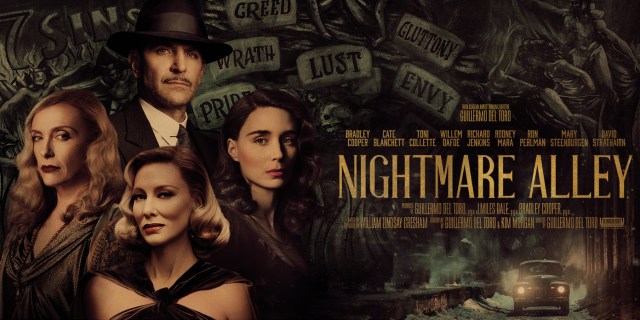
 This is the second post in our “Nightmare Alley” series, where a Pilgrim in Narnia looks at Guillermo del Toro’s critically acclaimed new film, Nightmare Alley, and its connections to the past. The 2021 film, which John Stanifer reviewed last week, is an adaptation of the 1946 novel by William Lindsay Gresham, the husband of Joy Davidman–the enigmatic poet and prose writer who found her way into an unlikely and tender late-in-life marriage with C.S. Lewis. Today’s piece is a provocative essay by faith and culture writer, G. Connor Salter, that looks at loss and redemption in the mid-1940’s work of Lewis and Gresham.
The Nightmare Alley of That Hideous Strength: A Look at C.S. Lewis and William Gresham by G. Connor Salter
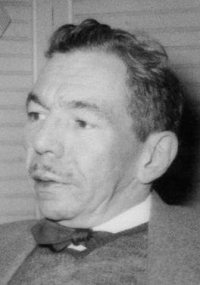
William Lindsay Gresham plays an important but complex part in C.S. Lewis’ story. As Joy Davidman’s first husband and father of her sons, the story of his marriage ending set the stage for Lewis’ marriage happening. As noted in Philip and Carol Zaleskis’ The Inklings, Gresham’s unstable behavior not only ended his marriage, it led to Lewis becoming his sons’ guardian after Joy’s death (404-405, 457). This created the second part of the Shadowlands narrative: Lewis as unexpected father figure. Lewis’ late-life fathering led to Douglas Gresham becoming a key defender and guardian of his legacy. Without William Gresham and his many unwise choices, Lewis’ life and scholarship about Lewis would look very different.
However, not much has been said about something Gresham had in common with the Inklings: he wrote fiction. Partly this is because Gresham’s work doesn’t seem to connect with the Inklings’ work. Here is how Centipede Press described Gresham in 2013 when they released a collection of his short stories:
“Whether writing for the detective pulps of the 1940s, the sci-fi digests of the 1950s, or the lowbrow men’s magazines of the early 1960s, Gresham relentlessly indulged his fascination with crime, psychology, magic, and spiritism, investing each of these almost-forgotten pieces with his dark wit and fatalistic sense of doom.”
“Magic, and spiritism” may remind some of Charles Williams, and in fact Gresham wrote a preface for Williams’ The Greater Trumps. Some scholars may know that Lewis contributed two short stories to sci-fi digest The Magazine of Fantasy & Science Fiction, which also published at least two Gresham stories. Douglas Anderson establishes in Tales Before Narnia that Lewis read an issue of the digest containing Gresham’s story “The Dream Dust Factory.”
However, sci-fi short fiction didn’t dominate the Inklings’ output. What stands out more in this description is Gresham’s detective pulp background and his interest in “doom” and “dark wit.” This suggests someone writing hardboiled and noir fiction, a scene dominated by writers like Raymond Chandler and Cornell Woolrich. In short, Gresham’s literary scene appears far removed from Oxford dons and their (very British) tales of the fantastic.
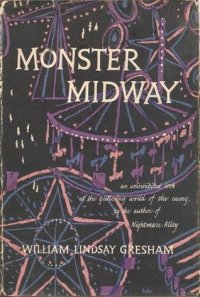 Another reason not much has been said about Gresham and the Inklings is that Gresham wasn’t very successful during his life. His nonfiction book on carnivals, Monster Midway, has been praised but is long out of print. His Houdini biography did well and still gets mentioned today, but has been superseded by later biographies. His two novels – Nightmare Alley and Limbo Tower – have fans, but only Nightmare Alley did well. After coming out in 1946, Nightmare Alley went through multiple editions and a 1947 film adaptation from a major studio. The film didn’t score well with contemporary critics or audiences, and other than a new edition in 1986, the novel disappeared for a while.
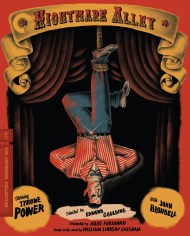
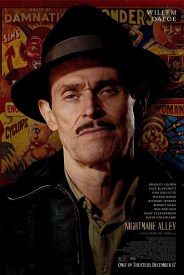
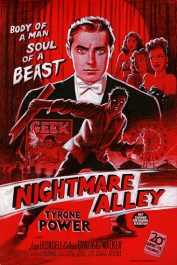
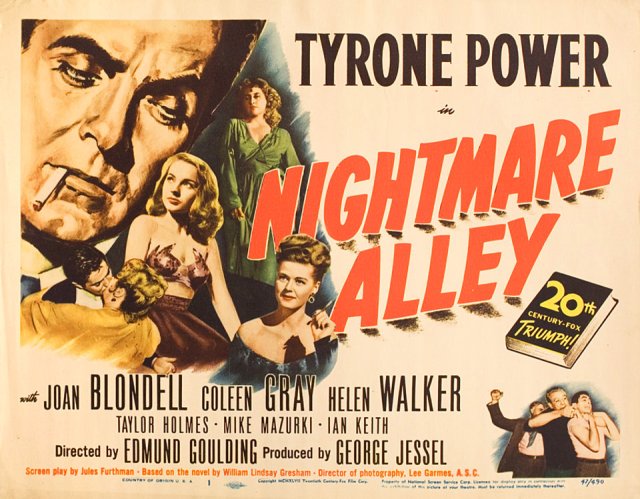
Over the last twenty years, Nightmare Alley has returned to the spotlight. It’s been reprinted several times, most notably in a 1997 Library of America crime collection and a 2010 edition by the New York Review of Books. After various legal disputes, the 1947 film came out on DVD in 2005; critics now consider it a classic. A graphic novel adaptation appeared in 2003, and a stage musical in 2010. Most recently, Guillermo del Toro directed a remake of Nightmare Alley with an all-star cast, which hit theaters this month (December 2021). Perhaps to capitalize on this, Criterion released a remastered version of the 1947 film in May 2021.
Given this resurgence, it’s worth looking at Nightmare Alley again. This essay will look at Nightmare Alley in connection with a novel Lewis published a year prior (1945), using imagery from a speech he presented in 1944.
But first, an introduction.
 Carnival Freaks and Geeks: The Beginning
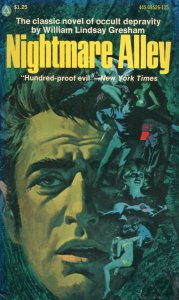
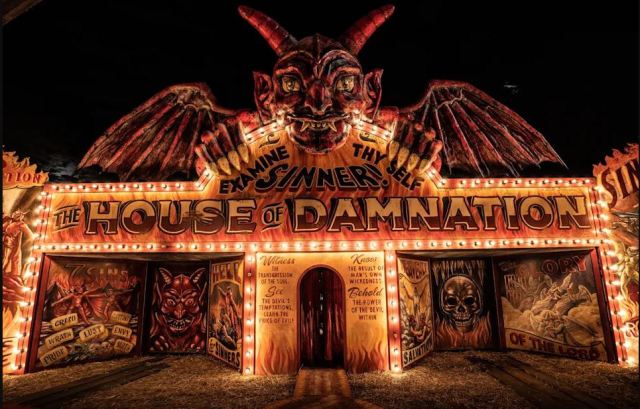
Nightmare Alley opens with Stanton “Stan” Carlisle, working at a carnival with a tasteless attraction:
“This geek was a thin man who wore a suit of long underwear dyed chocolate brown. The wig was black and looked like a mop, and the brown greasepaint on the emaciated face was streaked and smeared with the heat ad rubbed off around the mouth.” (Nightmare Alley 3)
“Geek” is believed to come from the Low German geck (“fool”). In 1940s American slang, it referred to a “carnival freak” who ate live animals. Stan watches the geek in his pen, where “snakes lay in loose coils” (ibid). Snakes have pagan and Satanic overtones, which Lewis used in The Silver Chair. Stan observes that he likes snakes, but doesn’t like seeing them “penned up which such a specimen of man” (ibid). After another “carny” collects the audience’s money, Stan drops a chicken into the pen and the geek bites its head off. There’s something Gollum-ish about this scene, a life reduced to
“endless unmarked days without… hope of betterment,” (The Hobbit 87).
After the act, Stan asks his colleague Hoately, “How do you ever get a guy to geek?” Hoately reluctantly explains how the carnival boss finds an alcoholic drifter and offers him a “temporary job.” With a hidden razor, the drifter can make it look like he’s biting heads off chickens or rats, and the job pays well enough to buy liquor. After a week, the carnival boss tells the drifter he’s not good enough and fires him. “He comes following you,” Hoately says,
“begging for another chance, and you say, ‘Okay. But after tonight out you go.’ But you give him back his bottle” (7).
From there, the drifter “will geek” as long and as well as he can.
Stan’s response to this information is not disgust, but satisfaction at learning a secret. As customers leave the geek show, he
“watched them with a strange, faraway smile on his face. It was the smile of a prisoner who has found a file in a pie” (7).
 That metaphor of escape proves important. Later chapters describe Stan’s upbringing, his mother leaving when he was young and Stan leaving his hometown. The carnival gives him a new community, but to him, it’s just a stepstone. He has an affair with “Madam Zeena – miracle woman of the ages” (21), and learns a two-person code system that Zeena’s husband Pete used in mentalist acts.
Having learned Pete’s system (and “accidentally” killing Pete by giving him wood alcohol), Stan drops Zeena for a younger girl named Molly and leaves the carnival. Stan and Molly become a mentalist double act but eventually Stan decides the real money is in religion. He recreates himself as Reverend Stanton Carlisle of “the Church of the Heavenly Message” (138), using poltergeist acts and psychic readings to con rich people. Molly tries to make Stan drop it, but he says he’s waiting for the big score:
“one live John and we’re set” (152).
While preparing an elaborate job targeting an industrialist, Stan assures Molly,
“if this deal goes over, we’re set. And every day is Christmas” (212).
Molly thinks,
“He had said that so many times… Always something. She didn’t really believe it any more” (ibid).
Mark, Stan and the Fellowship of the Inner Ring
 If one had to sum up Stan’s quest, the best label would be something Lewis described in a 1944 speech: “The Inner Ring.” Each change that Stan makes takes him into a more lucrative sphere. Each new role is also smaller, because Stan drops people he’s used with each transition. When Stan starts conning the industrialist, his ring has shrunk to three people: himself, Molly, and the industrialist’s psychoanalyst, Dr. Lilith Ritter. As Stan and Ritter plan the con, Stan admits he needs Molly to pull it off, but calls her “a rock around my neck” (204). Stan’s view of people matches Harry Lime, shameless drug smuggler in The Third Man. When Lime’s friend Holly Martin confronts him about people that he’s hurt, Lime replies,
“Nobody thinks in terms of human beings. Governments don’t, why should we? They talk about the people and the proletariat, I talk about the suckers and the mugs. It’s the same thing.”
Thematically, Stan’s journey resembles Mark Studdock’s journey in Lewis’ 1945 novel That Hideous Strength. Like Stan, Mark deeply cares about joining an inner ring – first Bracton College’s “Progressive Element,” then the inner circles of the N.I.C.E. Lewis doesn’t share Gresham’s interest in “spook rackets” (although some of Reverend Straik’s transhumanist dialogue reads like Stan’s spiritualist jargon). However, the line between reality and perception is key to Mark’s journey. In Mark’s first scene, his Bracton colleague Curry reveals that circumstances almost kept Mark from getting his fellowship. Mark is shocked, it had
“never occurred to him that his own election had depended on anything but the excellence of his work in the fellowship examinations: still less that it had been so narrow a thing” (That Hideous Strength 17).
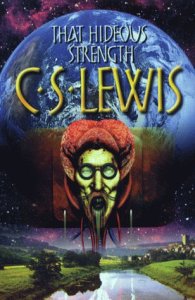 When Mark visits the N.I.C.E.’s headquarters, he tries to learn if they are formally offering him a position and who he will work with. No one clarifies either point, and his demands for clear answers only lead to rumors that Mark is resigning his Bracton fellowship. Mark tracks down the rumor’s source, Lord Feverstone. When Mark asks him to straighten things, Feverstone replies,
“Do you know, I find your style of conversation rather difficult” (109).
The key to being in NICE is never asking direct questions. Presumably, “their sort of chap” has the sort of mind to make it in this environment.
Mark’s N.I.C.E. duties also involve misperception. Feverstone tells Mark they need “a sociologist who can write” to “camouflage” the N.I.C.E.’s agenda (41). Later, he’s asked to write two articles about a riot that N.I.C.E. has planned. His new colleagues laugh when Mark asks how he can write about events that haven’t happened, and Feverstone declares,
“You’ll never manage publicity that way, Mark” (127).
Once Mark finishes his articles, he does not “awake to reason, and with it to disgust” (132). Instead, he justifies it, rationalizing that
“he was writing with his tongue in his cheek – a phrase that somehow comforted him by making the whole thing appear like a practical joke. Anyway, if he didn’t, somebody else would” (ibid).
The Magic is Over: Facing Reality
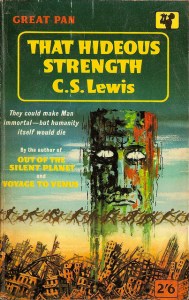 Ultimately, both Stan and Mark have their illusions crushed when they meet people from their pasts. For Mark, this happens when he meets Dr. Cecil Dimble and asks where his wife is. Dimble observes that
“Studdock’s face appeared to him to have changed since they last met; it had grown fatter and paler and there was a new vulgarity in the expression” (214).
Mark tries to get Dimble on his side, but Dimble refuses to play. He confronts Mark with the fact that his wife is hiding because N.I.C.E. has “insulted, tortured, and arrested her” (216). Mark asks if Dimble really thinks he would arrange for police to manhandle his own wife, trying to “insinuate a little jocularity” (216). Dimble doesn’t find it funny. He makes it clear that he knows what Mark has become:
“I don’t trust you. Why should I? You are (at least in some degree) the accomplice of the worst men in the world. Your very coming to me this afternoon may be only a trap” (219).
Dimble finally tells Mark that while he doesn’t trust him, “If you seriously wish to leave the N.I.C.E., I will help you” (ibid). Lewis describes this moment in religious terms:
“One moment it was like the gates of Paradise opening – then, at once, caution and the incurable wish to temporize rushed back. The chink had closed again.” (219-220).
Mark asks for time to think, and Dimble replies, “If you insist. But no good can come of it” (220). the N.I.C.E. captures Mark immediately afterward and as he contemplates his life in a cell, he realizes “what a fool – a blasted, babyish, gullible fool- he had been!” (242).
 For Stan, this moment of truth and offered grace happens after his con game has failed. He abandons Molly and Dr. Ritter to live on the run, and finds Zeena’s address in a magazine. Zeena has left the carnival, she now owns a farm with her second husband, ex-carny Joe Plasky. When Zeena first sees Stan (like Dimble seeing Mark), she doesn’t recognize him: Stan has lost his distinguished looks, becoming “a tall figure, gaunt, with matted yellow hair” (262). Once she recognizes him, Zeena tells Stan where Molly is and rebukes him for mistreating her: “I hope she’s forgotten every idea she ever had about you” (263). Stan tells Joe and Zeena all, justifying a recent crime but admitting his other mistakes:
“I had my chance, and I fluffed, when it came to Molly” (265).
Once Zeena and Joe offer to connect him to a nearby carnival, Stan’s demeanor changes:
“The Great Stanton ran his hands over his hair…in his face Zeena could see the reflection of the brain working inside it. It seemed to have come alive after a long sleep” (265).
Once Joe leaves the room, Zeena tells Stan she’s guessed that he poisoned Peter and asks him to “come clean.” Rather than confess, Stan does a mentalist act, appearing to read Zeena’s mind for Pete’s last name (which he learned earlier from Dr. Ritter’s research). Gresham describes the transformation as Stan gets into his act:
“The Great Stanton stood up and thrust his hands into his pockets. He moved until the sun, shining through the wind of the kitchen door, struck his hair. Soap and hot water had turned it from mud to gold. His voice this time filled the kitchen; subtly, without increasing in power, it vibrated” (Nightmare Alley 266).
Like Mark, Stan throws away the offered grace. He prefers to hold onto the inner ring identity he’s acquired. As with Mark, things get worse after Stan rejects grace: he goes into a bar before interviewing at the new carnival, wearing a suit and a straw hat which “added class” (270). One drunken binge later, Stan arrives “hatless, shirt filthy” (274) to his interview.
Inferno or Purgatorio: Is There Any Way but Down?
 After their descents, Mark and Stan have different reactions. Mark realizes his mistakes after the N.I.C.E. captures him, and finds an escape via what Stan would call a “spook show.” the N.I.C.E. delegates Mark to watch someone they think is N.I.C.E., “a useful test” (273) to prove his loyalty. The man, not unlike Stan, is “very allusive” (308). Eventually, Mark discovers that the man is a “tramp” – or, in Gresham’s language, a hobo, like Stan becomes. The hobo doesn’t care about telling the N.I.C.E. who he is, or demanding release. For him,
“the main thing, obviously, was to eat and drink as much as possible while the present conditions lasted” (310).
Mark plays along with the hobo, realizing he has joined a new circle, only
“with no more power or security than that of ‘children playing in a giant’s kitchen’” (ibid).
Eventually, the real Merlin shows up posing as a translator and the N.I.C.E. follow his suggestions. Mark plays along, and ends up at the grand N.I.C.E. banquet with his co-conspirators. Eventually, Merlin’s powers make people babble “gibberish in a great variety of tones” (343), creating panic. Just when the panic reaches its height and people are fighting, animals break into the banquet hall. Carnage follows, with some people killing each other and others devoured by animals they were experimenting on previously.
 If Stan were in Mark’s place at these events, it’s hard to say how he would see things. The pantomime, initiation into a new inner ring, and references to magic are all things Stan would be familiar with. Given that, he would likely accuse Mark and his pals of orchestrating it all, asking them who tamed the animals to arrive at just the right moment. To him, it would be the nuttiest spook show ever assembled… but unlike all of his stunts, here the magic is real. And like the hero returning from a strange magic world, Mark gets away from the carnage and at last arrives at “some place of sweet smell and bright fires, with good and wine and a rich bed” (380) where he reconciles with Jane.
In contrast, Stan doesn’t achieve confession and reconciliation after his descent. When he arrives drunk to interview at the carnival, the owner dismisses him at first. Then before Stan leaves, the owner changes his mind:
“I got one job you might take a crack at. It ain’t much, and I ain’t begging you to take it; but it’s a job. Keep you in coffee and cakes and a shot now and then. What do you say? Of course, it’s only temporary – just until we get a real geek” (275).
The fact Nightmare Alley returns to the geek show may make it seem nihilistic. However, that assumes the characters (or the audience) haven’t learned anything. What Gresham does is present a hero who sees how degraded people can become, and the hero’s search to get ahead brings him to that level. Stan learns early on that alcoholism creates a geek. He knows from talking with Zeena how drinking ruined Pete (who, like Stan, was a talented performer once upon a time). Despite these warnings, Stan starts drinking about halfway through the novel. When his grand plans fail, his bottle is all he has left. This is the story of a man avoiding every clear warning and paying the penalty.
Given how Mark’s redemption involves him finding healthy inner rings (the “children in the kitchen” ring of him and the hobo, the renewed marriage when he returns to Jane) it’s worth noting that Stan’s descent involves entering a new inner ring. However, Stan’s last inner ring (the geek pen) is the logical extension of all the negative inner rings he has entered. Every ring that Stan entered meant hurting more people, and each seemed to offer new treasures. Instead, each one left him lonelier, more degraded. The geek pen is the most degrading (and most exclusive) carnival position: none other is so vulgar. Like the final location in the innermost circle of Dante’s Inferno, this last inner ring is a lonely spot with only one inhabitant.
Conclusion: Notes on Fairy-Tale and Noir
 Nightmare Alley and That Hideous Strength both explore the temptations of the inner ring. Both Lewis and Gresham create heroes who sacrifice their morals to enter inner rings, and use the motifs of reality versus perception, deception versus magic. George Orwell said in his review of That Hideous Strength that despite the magic elements, “in essence, it is a crime story.” Given that Nightmare Alley is a crime story and how Mark and Stan’s journeys parallel each other, it’s interesting that Lewis and Gresham’s heroes take such different directions in the end.
Granted, Nightmare Alley’s characters are skeptical of all things supernatural. One could argue the difference boils down to Gresham and Lewis’ differing worldviews – one believing in the spiritual world where a benevolent God offers redemption, the other in a material world where no God offers redemption. Ryder W. Miller and others have read Stan as a stand-in for Gresham, highlighting Stan’s alcoholism and his wife leaving him. The Wade Center reportedly contains a 1959 letter where Gresham wrote that “Stan is the author” of Nightmare Alley.
However, claiming one-to-one parallels between Stan and Gresham quickly runs into problems. Joy Davidman had a spiritual experience in spring 1946, several months before Nightmare Alley’s publication in September 1946. Diana Pavlac Glyer notes that when Joy told her husband about her experience, he said “he, too, was interested in Christianity” (11). This marks it hard to say if Gresham was a committed materialist when writing the book. Furthermore, Glyer notes that Joy “had a hand in” both of Gresham’s novels (ibid), which complicates whether Nightmare Alley only shows Gresham’s worldview. As Lewis would say, we must avoid “the personal heresy.”
 Perhaps the simplest reason why Mark and Stan converge at the end is genre constraints: they are heroes of two different journeys, set in different story traditions which each has organic rules about how a journey can end. G.K. Chesterton wrote in 1936 that many readers misunderstood The Man Who Was Thursday because
“they had not read the title page… The book was called The Man Who Was Thursday: A Nightmare. It was not intended to describe the real world as it was” (The Man Who Was Thursday, 180).
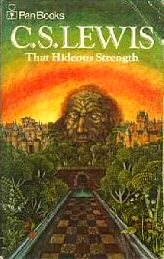
Lewis makes a similar comment in the preface to That Hideous Strength: A Modern Fairy-Tale for Grownups:
“I have called this book a fairy-tale in the hope that no one who dislikes fantasy may be misled into reading further” (8).
Reading That Hideous Strength as a fairy-tale gives Mark’s last act some context. It’s a strange twist of events, veering from a seemingly realistic world to something more dreamlike, from one tone to another. However, this tonal shift isn’t unusual in traditional fairy-tales. The Grimms’ first version of “Red Riding Hood” goes from terror (the wolf swallows Grandma and Red Riding Hood) to gore (the huntsman opens the sleeping wolf’s belly) to triumph (Grandma and Red Riding Hood emerge from the wolf’s belly) to slapstick (the heroes fill the wolf’s belly with rocks and he falls down dead) (Zipes 87). If this isn’t bizarre enough for modern readers, an epilogue says “it’s also been told…” that another wolf came later, which Red Riding Hood tricked into drowning (Zipes 87-88).
Granted, “Red Riding Hood” is an oral story collected in print, not composed for print. However, it’s not too different from the tonal shifts in George MacDonald fairy-tales like “Cross Purposes.” Heroes using trickery to defeat the enemy (a prince disguising himself to meet the princess) also appear in many fairy-tales. Fairy-tales allow for shocking twists where implausible redemption happens. The last act of Mark’s story, complete with him playing at being a magician’s escort and a real magician making it all better, fits the fairy-tale tradition.
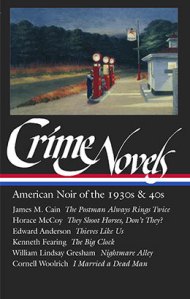 Nightmare Alley is not fairytale but noir, a label that requires some unpacking. Library of America republished Nightmare Alley in their 1997 collection Crime Novels: American Noir of the 1930s and 40s. The book jacket describes noir as “evolving out of the terse and violent hardboiled style of the pulp magazines,” which is fairly accurate. Hardboiled fiction, developed after World War I through writers like James M. Cain and Raymond Chandler, emphasizes tough attitudes and corrupt urban institutions. Chandler’s seminal essay “The Simple Art of Murder” criticizes Golden Age Detective Fiction writers like Dorothy L. Sayers for making crimes and solutions too neat. However, Chandler adds that “in everything that can be called art there is a quality of redemption.” He finishes the essay arguing the detective must be a moral figure in an immoral setting. Thus, hardboiled novels like The Maltese Falcon are bleak yet have a moral center.
Noir, hardboiled fiction’s descendant, comes from roman noir, a French term which referred to gothic thrillers before it described crime thrillers. Whether this change happened in the 1920s, or in 1940 to market Cornell Woolrich’s The Bride Wore Black, or in 1945 when publisher Marcel Duhamel started the imprint Serié Noire, depends on which scholar you ask. Things got more complex in 1946 when Nino Frank used film noir to describe a new kind of American crime film, often adapted from hardboiled novels like Chandler’s The Big Sleep. Chandler himself worked on a noir film, co-writing Double Indemnity.
Thus, the line between hardboiled fiction and noir is complex. To some extent, they are each linked to particular wars – hardboiled comes after World War I, noir during and after World War II. Paul Schrader argues in “Notes on Film Noir” that noir films vocalized returning veterans’ disillusionment, and Sheri Chinen Biesen takes a similar angle in Blackout: World War II and the Origins of Film Noir.
 Megan Abbot argues the key difference is that hardboiled fiction is “an extension of the wild west and pioneer narratives.” Terrible things happen in those stories, but they generally end with justice restored. This theory fits Chandler’s idea that the hardboiled detective brings morals to an immoral world: like a Wild West sheriff, he keeps the peace. Noir is more ambiguous. Wrongdoers generally get punished, but that doesn’t mean all things are redeemed. Thomas S. Hibbs argues that noir flirts with nihilism, but something else happens:
“Nihilism has arrived, not when we cease to have happy or obviously just endings, but when the human longing for happiness, communication, love and justice is mocked as unintelligible, pointless, and absurd. However much noir may flirt with or engage the possibility of nihilism, it typically resists succumbing to it. Noir persists in depicting the human longing for love, for truth, and for communication as noble and admirable, as constitutive of what it means to be human. What noir precludes is a happy ending that restores all that has been lost. It denies that the slate can be wiped clean, that costs and consequences can be averted.” (Arts of Darkness 63-64)
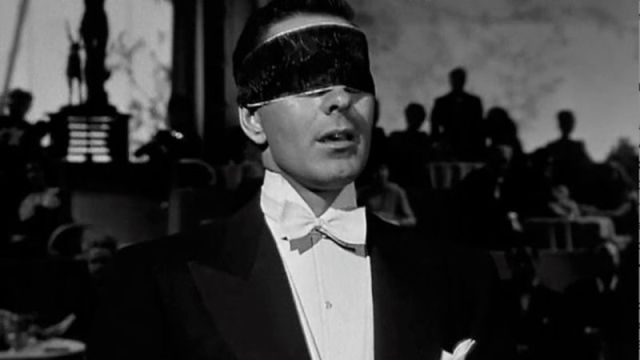
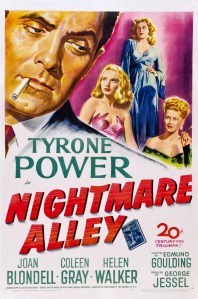 Even noir films with happy endings are often bittersweet. On producers’ insistence, the 1947 film version of Nightmare Alley ends differently than the book. After becoming a geek, Stan runs around the carnival in a drunken rage and discovers Molly, who’s been looking for him. Molly forgives Stan and says she’ll care for him. On the 2005 DVD commentary, film historians James Ursini and Alan Silver call this ending “somewhat redemptive” – Stan doesn’t return to the top, but he’s got hope again. This may be true, but as Kim Morgan points out, there’s something dark here. Earlier scenes showed Zeena caring for Pete and Pete admitting he’d be a geek without Zeena. Thus, Molly saying she’ll care for Stan feels like a foreshadowing. The story has gone in a circle, and it’s not clear whether they will relive the last couple’s fate.
As demonstrated earlier, Fairy-tales can have shocking redemptive twists. In noir, redemption is partial or penitential. Some noir films near fairy-tale territory with “it was all a dream” twists (The Woman in the Window) and similar devices. Still, even those heroes never achieve anything like Mark’s turnaround in That Hideous Strength. Noir is more interested in penance than triumph. Thus, Stan must bear the full weight of his choices. Things may get better in some unwritten future, but for the moment, Stan walks the dark path he brought on himself.
 Connor holds a Bachelor of Science in Professional Writing from Taylor University, and lives in Colorado. His writing has included award-winning journalism, an article on T.H. White’s legacy for A Pilgrim in Narnia, and over 300 book reviews for The Evangelical Church Library Association. He presented an essay on C.S. Lewis and Terence Fisher at Taylor University’s 2018 Making Literature Conference, and released a short story series, Tapes from the Crawlspace, in 2020.
 Dear John,
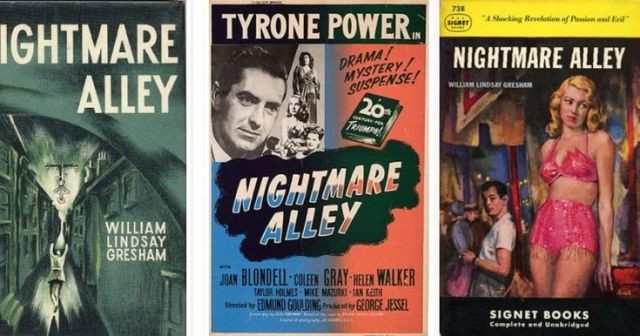
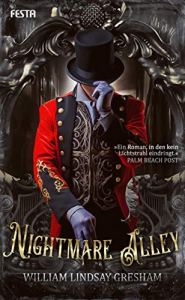

 Nightmare Alley, published on September 9 [1946] had begun generating press as early as July 7, with the Washington Post promising a “sinister and compelling piece of fiction” that would “shock some readers but send the public clamoring to the bookstores.” And it did. The novel, a work of brilliance, would become a noir classic with a cult following for decades to come.






 A Pilgrim in Narnia