
 Splendour in the Dark: C. S. Lewis’s Dymer in His Life and Work by Jerry Root
My rating: 4 of 5 stars
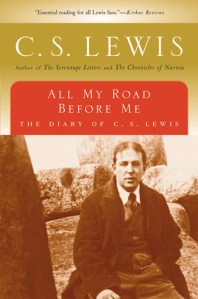
I keep finding myself drawn to C.S. Lewis’ strange and challenging long narrative poem, Dymer. Written in the early 1920s as Lewis is first a student and then a tutor at Oxford, it captures an energetic and quick-moving period of Lewis’ philosophical, religious, and literary development. Though we have more notes about its writing than any of Lewis’ other books–his diary of the period in published and named for a line in the introduction to the poem; see All My Road Before Me–and although Lewis left us a preface in a 1950 reprinting of Dymer, it remains somewhat of a puzzle in Lewis studies.
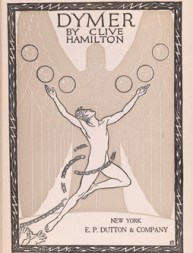 David Downing calls Dymer “obscure and artistically undistinguished.” (Most Reluctant Convert, 118). Chad Walsh calls it a failure as a whole (Literary Legacy, 46), while A.N. Wilson suggests that only the most dedicated Lewis enthusiasts “have bothered to press on with Dymer” (C.S. Lewis, ch. 9). Without praise for the poetic wholeness of the piece, Lewis poetry expert Don King considers Dymer his “most important poem” (“Dymer,” in The C.S. Lewis Readers’ Encyclopedia, 144), while Downing admits that “it gives powerful evidence of how far Lewis had moved” along a spiritual path during his first years at Oxford (Most Reluctant Convert, 118). Dymer is, Joel Heck claims, a “reflection of Lewis himself” (From Atheism to Christianity, 124) in the period, providing an important conversation point for the effect of Lewis’ conversion. The pre-Christian Lewis is so prevalent in the poem that Monika Hilder remarks that Dymer represents the “classical male who rejects the spiritual female,” an approach that lacks the inversive nature of Lewis’ later work (Surprised by the Feminine, 36). Idiosyncratic, difficult, and problematic, Dymer is nevertheless a helpful starting point for considering Lewis’ use of narrative patterning.
The story of Dymer begins with the eponymous character casually murdering his teacher in a utopic community. This act ignites a bloody revolution, while Dymer flees naked into the wilderness, impregnates a monster, and after disturbing adventures often connected to birds, gardens, or roads, Dymer must kill or be killed by his monstrous son. Every Lewis scholar agrees that Dymer is a journey of discovery of some kind, but there is not much agreement about what Dymer (or the reader) discovers. As the material is so philosophically threaded and yet difficult to manage, I was pleased to see that Jerry Root published a series of lectures on the topic, part of Wheaton College’s Hansen Lecture series, held in partnership with the Marion E. Wade Center.
 As it turns out, Splendour in the Dark: C. S. Lewis’s Dymer in His Life and Work is a much fuller volume than most lectureship publications. The volume is actually authored by C.S. Lewis and Jerry Root, as we might imagine, but also by David Downing, Miho Nonaka, Jeffry C. Davis, Mark Lewis, and Walter Hansen–as well as some strong, secret editorial hand(s) at the Wade Centre or Wheaton College or IVP–creating a strong, single, forward-facing book for scholars and curious, engaged readers of Lewis’ works. This volume collects:
- a good text of C.S. Lewis’ 20-something narrative poem, Dymer (the Kindle text is flawless and reasonably priced)
- Lewis’ 1950 preface to the poem
- annotations of definitions and literary links in the occasionally obscure poem, provided by David Downing within the Wade Annotated series
- a series of 3 lectures on Dymer by Jerry Root of Wheaton College for the Hansen lectures
- 3 responses, by a dramatist, a poetic critic, and a visually artistic and literary scholar
- a note from the Hansen lecture family member
- reading support appendices
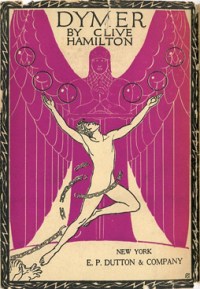 This is a striking volume in key ways. Each annotation was clear and helpful, the appendices support scholars of the poem, and the responses to Dr Root’s lectures are creative and engaging. It is not very often that a book like this creates a single reading experience. I actually listened to the recent Dymer audiobook, read by Dr Gordon Greenhill, then read the lectures and responses, and then read the Dymer preface, text, and annotations, making my own notes along the way. While some might want to tackle the book in a single day, I found it worked with a shortish daily reading schedule. Lewis’ “Preface,” the nine individual cantos of the poems, and the three responses to the lectures each take about 15 minutes to read, and Dr Root’s three lectures each take 45-60 minutes to read.
At the core of the material, Root’s three-lecture argument about Dymer comes down to a single thesis worked out in three different ways. Root argues that, for Lewis, “reality is iconoclastic. Following a strong description of a complex poem, Lewis’ lifelong idea that reality–nature, in this poem especially, but as his life goes on it includes logic, love, loyalty, hands set to a good task, ethical choices in the real world, the stories we tell, and ultimately a certain image of God–will pull down false edifices of self-delusion, cultural fog, philosophical nonsense, and spiritualistic detours.
Honestly, this is the first really convincing argument about Dymer I have read (beyond generally strong and interesting work connecting Dymer to Lewis’ biography and philosophy of the period). Root’s lectures are well done and helpful overall. Though the argument can be a bit single-minded, he offers correctives to a number of misreadings along the way (despite it being a book largely but not totally without references to the academic literature).
I will offer some critiques, though.
 With such a complex poem and one that is often neglected, more work is needed than Root brings out. Some of this has to do with what I was trying to talk about in my Oxford C.S. Lewis Society talk on the “Dive” in 2018, and will be a book I am now shopping to publishers. I feel like the political philosophy needs more conversation, though, and I really don’t know what this poem does within its genre. What is this? Why is the language such a combination of high and low diction? Why an old metre but a new theme. Although I find the poetry bracing and the narrative intriguing, I don’t know why Lewis reduces the poetic value of so many phrases, interrogatives, and verbal points. With a thin scholarly conversation with other sources (which is appropriate to this lecture genre from a senior scholar), many questions are unanswered. Moreover, some of the literary references and even simple lines are still obscure to me.
This leads to my second critique: I would like more annotations, particularly regarding Lewis’ diary entries of the period or other literary links from the classical and medieval world. The temptation when annotating is to overdo it, so I’m pleased that Downing shows restraint. Still, I still wanted more.
 And then, third, though I liked reading the three particularly well-written responses from a relatively diverse set of perspectives within that tight Wheaton world, these responses were pretty peculiar and none took the lecturer’s argument and responded to it by augmenting it, challenging it, breaking it down, opening up a point or two, making a line elsewhere, providing more (or different) context, or problematizing it–as one expects in a lecture series! It was clear that Dymer puzzled these smart and relatively knew as much as it has puzzled me over the years.
With some mixed concerns and cheers, I will admit that this reading of the poem was my most productive reading ever. It’s a peculiar poem and I’m not done with Dymer. And I am certain that Dymer is not done with me!
Here is the video of the book’s “launch” at the Wade centre in the springtime of 2021 (an appropriate launch season for this book, incidentally).


 Wade Centre Virtual Book Launch: After Humanity: A Guide to C.S. Lewis’s The Abolition of Man by Michael Ward (Thurs, Jun 17, 4pm CDT/5pm EST)
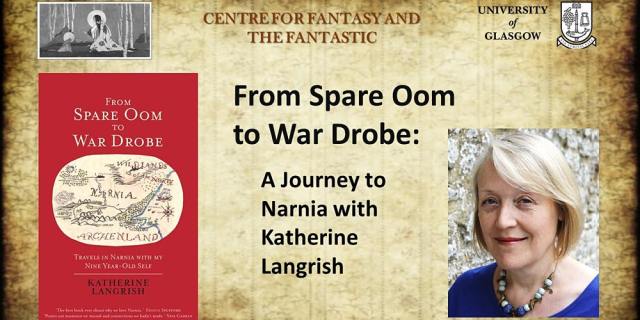 Centre for Fantasy and the Fantastic at the University of Glasgow Book Launch: From Spare Oom to War Drobe: A Journey to Narnia with Katherine Langrish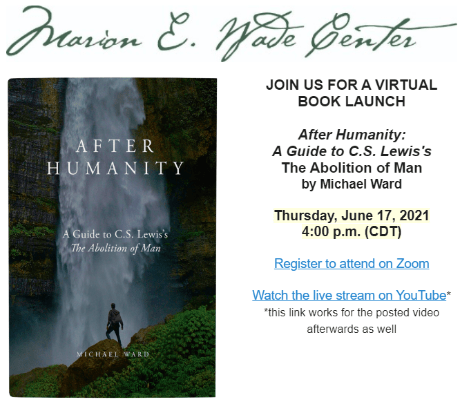







 A Pilgrim in Narnia