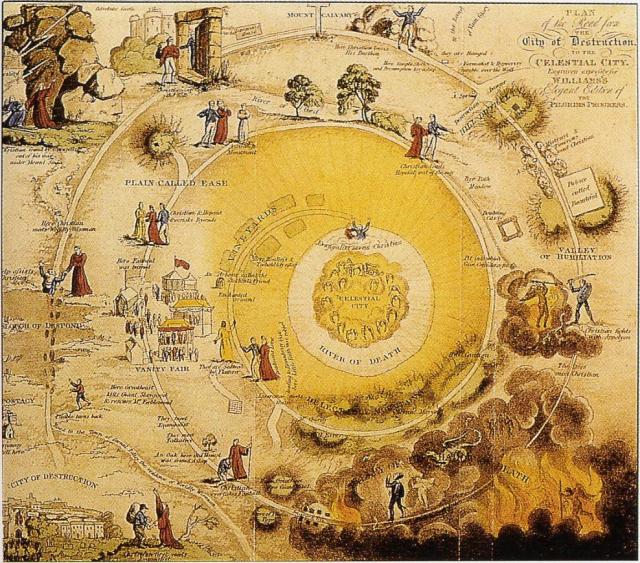
John Bunyan’s Apology for his Book with a Note from C.S. Lewis on Writing as Holistic Discovery–and How Narnia Achieved the Bigness You See

In my blog post last week, “Bunyan and Others and Me: Vicarious Bookshelf Friendship and a Jazz Hands Theory of Reading,” I offered two “Theories of Reading” from my experience of trying to find sympathy with John Bunyan’s The Pilgrim’s Progress. I know, I know … I seem to be writing a lot about a book I don’t love. Before this reading theory piece, I rewrote my older piece, “The Pilgrim’s Progress and the Nursery Bookshelf: A Book’s Journey“–and I do think this little allegory has a striking pilgrimage as a book. And as I admitted in my reflection piece, “The Sloo/Slow/Sluff of Despond,” there is a good deal of psychological and spiritual truth in John Bunyan’s Pilgrim’s Progress–even if I have to work hard to read the book profitably.

Well, let me write one more reflection on something I like in this book that eludes my sympathies.
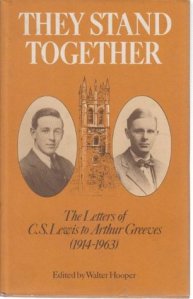
In that “Theories of Reading” posts, I teased up the idea of how we become book friends with authors through other book friends. So many of the writers I like have appreciated The Pilgrim’s Progress. Thus, I keep picking up the book and seeing if this time it will be different.

C.S. Lewis is one of those book friends. Indeed, as a seventeen-year-old describing the his experience of reading, he describes Bunyan’s tale in exactly those terms of friendship:

I am reading at present, what do you think? Our own friend ‘Pilgrim’s Progress’. It is one of those books that are usually read too early to appreciate, and perhaps don’t come back to. I am very glad however to have discovered it. The allegory of course is obvious and even childish, but just as a romance it is unsurpassed, and also as a specimen of real English. Try a bit of your Ruskin or Macaulay after it, and see the difference between diamonds and tinsel (Mar 11, 1916 letter to his father).

Later that year, Lewis tells his friend Arthur Greeves that he was awfully “bucked” to have reread The Pilgrim’s Progress. As with so many other books he discovered in his critical period of faith-loss in 1915 and 1916, Lewis returns to Bunyan in that period of faith-return of 1930-31 before writing his own allegory, A Pilgrim’s Regress, in Arthur’s home in 1932.
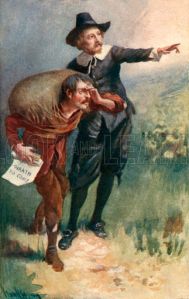
In the “Vicarious Bookshelf Friendship and a Jazz Hands Theory of Reading” piece last week, I shared a little of what Lewis does with Bunyan from his later perspective as a literary historian and critic. Intriguingly, Lewis as a teenage Bunyan critic is largely in agreement with Lewis writing as a professional critic in the last months of his life.

For one, Lewis draws Bunyan into the centre of what he thinks is essential Western literature, setting Bunyan next to Dante and Milton and others. While Dante, Spenser, Milton, and Bunyan vie for pride of place in understanding what Lewis was doing in his fiction and scholarship, Lewis connects much more personally to Bunyan, drawing Bunyan’s story into his own emotional life.

And, as we see in the brief note above, from the time he was seventeen, Lewis was able to read The Pilgrim’s Progress at a level deeper than the religious allegory. In his 1962 essay, “The Vision of John Bunyan,” Lewis goes on to consider the allegorist Bunyan, sectarian and fantastic and writing in a chivalric mode, as a model realistic prose writer.

There is another aspect of Lewis’ writing about Bunyan that is worth noting, and that is his observation about how Bunyan found himself writing The Pilgrim’s Progress. Here Lewis explains:

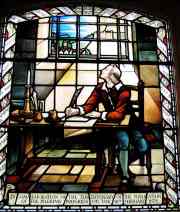
To ask how a great book came into existence is, I believe, often futile. But in this case Bunyan has told us the answer, so far as such things can be told. It comes in the very pedestrian verses prefixed to Part 1. He says that while he was at work on quite a different book he ‘Fell suddenly into an Allegory’. He means, I take it, a little allegory, an extended metaphor that would have filled a single paragraph. He set down ‘more than twenty things’. And, this done, ‘I twenty more had in my Crown’. The ‘things’ began ‘to multiply’ like sparks flying out of a fire. They threatened, he says, to ‘eat out’ the book he was working on. They insisted on splitting off from it and becoming a separate organism. He let them have their head.
It is already an organic process of writing: a little image that becomes many images, sparks lovely and dangerous leaping from a fire, a horse that is ready to gallop and a steady rider who gives it its head. But Lewis narrows in on the humble discovery that speaks to writing beyond the poet Bunyan or his chosen genre. Lewis writes:

Then come the words which describe, better than any others I know, the golden moments of unimpeded composition:

“For having now my Method by the end; Still as I pull’d, it came.”

It came. I doubt if we shall ever know more of the process called ‘inspiration’ than those two monosyllables tell us.

“It came,” which is “the golden moments of unimpeded composition.” Wow, yes. I suspect for most readers, Bunyan captures in two words and Lewis captures in a paragraph of reflection what I was still only grasping at in my 1,500-word essay, “The Thieves of Time and Waking Wonder: Writing as Discovery and the Stone-Carver’s Art.”

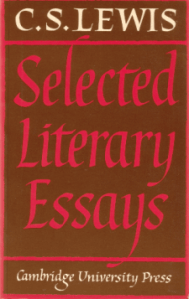
Lewis’ entire essay, “The Vision of John Bunyan,” is worth reading. This reflection originated as a BBC lecture before being published first in The Listener and then in Selected Literary Essays (1969). Unlike most of Lewis’ BBC work, the recording of this piece is available in the archives (with actors reading the Bunyan quotations). Lewis’ voice has a buoyant tone in reading his piece; a “wink” is never far from the surface of the text.
Lewis’ piece, written and recorded at his home at the Kiln’s about a year before he passed away, is an essay in the older sense: an attempt, a teasing out of the implications of an idea. And, if we go to the root of the Latin, it is an idea set in motion, on the way–an experiment of thought set on the road of pilgrimage, if you will. In this essay, Lewis is testing out an argument about Bunyan as a realistic writer rather than specifically a religious writer, and thus is worth reading in full.

So although you need the whole piece to get the full sense of Lewis’ interest in the book, I thought it would be useful to provide a bit more of Lewis’ reflections on The Pilgrim’s Progress. Following this, I include Bunyan’s “Apology for his Book,” which makes up in literary self-reflection what it lacks in poetic artistry. It has become my favourite part of the book (which I keep saying, perhaps unconvincingly by now, that I don’t like).

In these selections, we see not only what Lewis noted–the sublime description of “it came” to describe artistic discovery–but also one of the (perhaps unrecognized?) aspects of what Lewis admires in literary art. With no exceptions that I can think of, Lewis has a love of integrative poetry and fiction. In discussing Bunyan, Lewis describes it here as “the whole man,” the bringing together of the “poet” as maker and creator of art, with the “person” as moral agent, wanting to do something in the world. This is, for Lewis, the transcendental combination of “the beautiful” with “the good” that makes a text “true.”

And … can you see it? What Lewis was attempting in Narnia was not as an allegorical or didactic tale. Instead, what he allowed to take place in his own artistic discovery is the integration of the creative writer and Christian neighbour. Lewis’ fairy tales and his spec fic stories are not meant not simply to inspire religious or philosophical or moral or creative ideas, but to also put the story in a new light. In Narnia, this means imagery and story that is not filtered through stained glass.

Thus, there is a striking connection between Lewis’ comments on Bunyan and his own reflections on writing Narnia in pieces like “It All Began with a Picture” and “Sometimes Fairy Stories May Say Best What’s to be Said“–pieces where he describes finding himself falling into a fairy tale, where “it came,” the story emerged, and the moral person took the work of the creative poet and made it into something whole. Or, in Bunyan’s terms, “the bigness which you see”:

For, having now my method by the end,
Still as I pulled, it came; and so I penned
It down: until it came at last to be,
For length and breadth, the bigness which you see.


Selection from C.S. Lewis, “The Vision of John Bunyan”
Perhaps we may hazard a guess as to why it came at just that moment. My own guess is that the scheme of a journey with adventures suddenly reunited two things in Bunyan’s mind which had hitherto lain far apart. One was his present and lifelong preoccupation with the spiritual life. The other, far further away and longer ago, left behind (he had supposed) in childhood, was his delight in old wives’ tales and such last remnants of chivalric romance as he had found in chap-books. The one fitted the other like a glove. Now, as never before, the whole man was engaged.

The vehicle he had chosen – or, more accurately, the vehicle that had chosen him – involved a sort of descent. His high theme had to be brought down and incarnated on the level of an adventure story of the most unsophisticated type – a quest story, with lions, goblins, giants, dungeons and enchantments.

But then there is a further descent. This adventure story itself is not left in the world of high romance. Whether by choice or by the fortunate limits of Bunyan’s imagination – probably a bit of both — it is all visualized in terms of the contemporary life that Bunyan knew. The garrulous neighbours; Mr Worldly-Wiseman who was so clearly (as Christian said) ‘a Gentleman’; the bullying, foul-mouthed Justice; the field-path, seductive to footsore walkers; the sound of a dog barking as you stand knocking at a door; the fruit hanging over a wall which the children insist on eating though their mother admonishes them ‘that Fruit is none of ours’ — these are all characteristic. No one lives further from Wardour Street than Bunyan. The light is sharp: it never comes through stained glass.

And this homely immediacy is not confined to externals. The very motives and thoughts of the pilgrims are similarly brought down to earth…

The Author’s Apology for his Book

{1} When at the first I took my pen in hand
Thus for to write, I did not understand
That I at all should make a little book
In such a mode; nay, I had undertook
To make another; which, when almost done,
Before I was aware, I this begun.

And thus it was: I, writing of the way
And race of saints, in this our gospel day,
Fell suddenly into an allegory
About their journey, and the way to glory,
In more than twenty things which I set down.
This done, I twenty more had in my crown;
And they again began to multiply,
Like sparks that from the coals of fire do fly.

Nay, then, thought I, if that you breed so fast,
I’ll put you by yourselves, lest you at last
Should prove ad infinitum, and eat out
The book that I already am about.

Well, so I did; but yet I did not think
To shew to all the world my pen and ink
In such a mode; I only thought to make
I knew not what; nor did I undertake
Thereby to please my neighbour: no, not I;
I did it my own self to gratify.
{2} Neither did I but vacant seasons spend
In this my scribble; nor did I intend
But to divert myself in doing this
From worser thoughts which make me do amiss.

Thus, I set pen to paper with delight,
And quickly had my thoughts in black and white.
For, having now my method by the end,
Still as I pulled, it came; and so I penned
It down: until it came at last to be,
For length and breadth, the bigness which you see.

Well, when I had thus put mine ends together,
I shewed them others, that I might see whether
They would condemn them, or them justify:
And some said, Let them live; some, Let them die;
Some said, JOHN, print it; others said, Not so;
Some said, It might do good; others said, No.

Now was I in a strait, and did not see
Which was the best thing to be done by me:
At last I thought, Since you are thus divided,
I print it will, and so the case decided.
{3} For, thought I, some, I see, would have it done,
Though others in that channel do not run:
To prove, then, who advised for the best,
Thus I thought fit to put it to the test.

I further thought, if now I did deny
Those that would have it, thus to gratify.
I did not know but hinder them I might
Of that which would to them be great delight.

For those which were not for its coming forth,
I said to them, Offend you I am loth,
Yet, since your brethren pleased with it be,
Forbear to judge till you do further see.

If that thou wilt not read, let it alone;
Some love the meat, some love to pick the bone.
Yea, that I might them better palliate,
I did too with them thus expostulate:–
{4} May I not write in such a style as this?
In such a method, too, and yet not miss
My end–thy good? Why may it not be done?
Dark clouds bring waters, when the bright bring none.
Yea, dark or bright, if they their silver drops
Cause to descend, the earth, by yielding crops,
Gives praise to both, and carpeth not at either,
But treasures up the fruit they yield together;
Yea, so commixes both, that in her fruit
None can distinguish this from that: they suit
Her well when hungry; but, if she be full,
She spews out both, and makes their blessings null.

You see the ways the fisherman doth take
To catch the fish; what engines doth he make?
Behold how he engageth all his wits;
Also his snares, lines, angles, hooks, and nets;
Yet fish there be, that neither hook, nor line,
Nor snare, nor net, nor engine can make thine:
They must be groped for, and be tickled too,
Or they will not be catch’d, whate’er you do.

How does the fowler seek to catch his game
By divers means! all which one cannot name:
His guns, his nets, his lime-twigs, light, and bell:
He creeps, he goes, he stands; yea, who can tell
Of all his postures? Yet there’s none of these
Will make him master of what fowls he please.
Yea, he must pipe and whistle to catch this,
Yet, if he does so, that bird he will miss.

If that a pearl may in a toad’s head dwell,
And may be found too in an oyster-shell;
If things that promise nothing do contain
What better is than gold; who will disdain,
That have an inkling of it, there to look,
That they may find it? Now, my little book,
(Though void of all these paintings that may make
It with this or the other man to take)
Is not without those things that do excel
What do in brave but empty notions dwell.
{5} ‘Well, yet I am not fully satisfied,
That this your book will stand, when soundly tried.’
Why, what’s the matter? ‘It is dark.’ What though?
‘But it is feigned.’ What of that? I trow?
Some men, by feigned words, as dark as mine,
Make truth to spangle and its rays to shine.

‘But they want solidness.’ Speak, man, thy mind.
‘They drown the weak; metaphors make us blind.’

Solidity, indeed, becomes the pen
Of him that writeth things divine to men;
But must I needs want solidness, because
By metaphors I speak? Were not God’s laws,
His gospel laws, in olden times held forth
By types, shadows, and metaphors? Yet loth
Will any sober man be to find fault
With them, lest he be found for to assault
The highest wisdom. No, he rather stoops,
And seeks to find out what by pins and loops,
By calves and sheep, by heifers and by rams,
By birds and herbs, and by the blood of lambs,
God speaketh to him; and happy is he
That finds the light and grace that in them be.
{6} Be not too forward, therefore, to conclude
That I want solidness–that I am rude;
All things solid in show not solid be;
All things in parables despise not we;
Lest things most hurtful lightly we receive,
And things that good are, of our souls bereave.

My dark and cloudy words, they do but hold
The truth, as cabinets enclose the gold.

The prophets used much by metaphors
To set forth truth; yea, who so considers Christ,
his apostles too, shall plainly see,
That truths to this day in such mantles be.

Am I afraid to say, that holy writ,
Which for its style and phrase puts down all wit,
Is everywhere so full of all these things–
Dark figures, allegories? Yet there springs
From that same book that lustre, and those rays
Of light, that turn our darkest nights to days.
{7} Come, let my carper to his life now look,
And find there darker lines than in my book
He findeth any; yea, and let him know,
That in his best things there are worse lines too.

May we but stand before impartial men,
To his poor one I dare adventure ten,
That they will take my meaning in these lines
Far better than his lies in silver shrines.
Come, truth, although in swaddling clouts, I find,
Informs the judgement, rectifies the mind;
Pleases the understanding, makes the will
Submit; the memory too it doth fill
With what doth our imaginations please;
Likewise it tends our troubles to appease.

Sound words, I know, Timothy is to use,
And old wives’ fables he is to refuse;
But yet grave Paul him nowhere did forbid
The use of parables; in which lay hid
That gold, those pearls, and precious stones that were
Worth digging for, and that with greatest care.

Let me add one word more. O man of God,
Art thou offended? Dost thou wish I had
Put forth my matter in another dress?
Or, that I had in things been more express?
Three things let me propound; then I submit
To those that are my betters, as is fit.
{8} 1. I find not that I am denied the use
Of this my method, so I no abuse
Put on the words, things, readers; or be rude
In handling figure or similitude,
In application; but, all that I may,
Seek the advance of truth this or that way
Denied, did I say? Nay, I have leave
(Example too, and that from them that have
God better pleased, by their words or ways,
Than any man that breatheth now-a-days)
Thus to express my mind, thus to declare
Things unto thee that excellentest are.

2. I find that men (as high as trees) will write
Dialogue-wise; yet no man doth them slight
For writing so: indeed, if they abuse
Truth, cursed be they, and the craft they use
To that intent; but yet let truth be free
To make her sallies upon thee and me,
Which way it pleases God; for who knows how,
Better than he that taught us first to plough,
To guide our mind and pens for his design?
And he makes base things usher in divine.

3. I find that holy writ in many places
Hath semblance with this method, where the cases
Do call for one thing, to set forth another;
Use it I may, then, and yet nothing smother
Truth’s golden beams: nay, by this method may
Make it cast forth its rays as light as day.
And now before I do put up my pen,
I’ll shew the profit of my book, and then
Commit both thee and it unto that Hand
That pulls the strong down, and makes weak ones stand.

This book it chalketh out before thine eyes
The man that seeks the everlasting prize;
It shews you whence he comes, whither he goes;
What he leaves undone, also what he does;
It also shows you how he runs and runs,
Till he unto the gate of glory comes.
{9} It shows, too, who set out for life amain,
As if the lasting crown they would obtain;
Here also you may see the reason why
They lose their labour, and like fools do die.

This book will make a traveller of thee,
If by its counsel thou wilt ruled be;
It will direct thee to the Holy Land,
If thou wilt its directions understand:
Yea, it will make the slothful active be;
The blind also delightful things to see.

Art thou for something rare and profitable?
Wouldest thou see a truth within a fable?
Art thou forgetful? Wouldest thou remember
From New-Year’s day to the last of December?
Then read my fancies; they will stick like burs,
And may be, to the helpless, comforters.

This book is writ in such a dialect
As may the minds of listless men affect:
It seems a novelty, and yet contains
Nothing but sound and honest gospel strains.
Wouldst thou divert thyself from melancholy?
Wouldst thou be pleasant, yet be far from folly?
Wouldst thou read riddles, and their explanation?
Or else be drowned in thy contemplation?
Dost thou love picking meat? Or wouldst thou see
A man in the clouds, and hear him speak to thee?
Wouldst thou be in a dream, and yet not sleep?
Or wouldst thou in a moment laugh and weep?
Wouldest thou lose thyself and catch no harm,
And find thyself again without a charm?
Wouldst read thyself, and read thou knowest not what,
And yet know whether thou art blest or not,

By reading the same lines? Oh, then come hither,
And lay my book, thy head, and heart together.

Posted in Memorable Quotes, On Writing, Reflections | Tagged , , , , , , , , , , , , | 8 Comments

Trees, Leaves, Vines, Circles: Reading and Writing The Layered Worlds of J.R.R. Tolkien’s Fiction: A Note on “Athrabeth Finrod ah Andreth” and “Leaf by Niggle”

When I was teaching J.R.R. Tolkien‘s “Athrabeth Finrod ah Andreth” for the first time a couple of years ago, we had a strong conversation around the “Debate between Finrod and Andreth.” For those who have not yet discovered it, the Athrabeth has been for me one of the richest parts of that great gift of Elves to Men that is the History of Middle-earth.

Even then, in the midst of a busy term and reading with a pencil in hand, I couldn’t help wondering if “Dialogue” is a better term for the Athrabeth than “Debate.” Finrod is the son of Finarfin, great Elven King of the Noldor, brother to Galadriel and Aegnor, and a friend of the race of Men. Andreth is a woman of that race, a wisdom speaker of the House of Bëor who fell in love with Finrod’s brother. Her love was requited, but the love itself was forbidden as Elves are may not wed during times of war. Nearly half a century after the Athrabeth, Andreth dies alone and childless.

As Andreth was one of the Lore Masters of Bëor, Finrod relishes in spending long evenings at her fireside, One of their conversations was recorded and ultimately published in Morgoth’s Ring, the 10th volume of the History of Middle-earth, edited by Christopher Tolkien.

The Athrabeth is a gorgeous and troubling piece of work. Its beauty lies in its ability to capture a lore-rooted theological debate that still evokes the relational depth of two friends. The text combines the great and bitter longing of Andreth for her lost lover Aegnor and a delicate blend of fear and daring hope as Elves and Men consider their fates.

The Athrabeth is troubling because it challenges one of the critical concepts of Middle-earth, that the gift of Men is mortality (see Tolkien letter #131 to Milton Waldman; see the Quenta Silmarillion in The Silmarillion). According to Andreth, though, wisdom reveals that death for Men is a wrong–an unnatural breaking of body (hröa) and soul (fëa):

“dying we die, and we go out to no return. Death is an uttermost end, a loss irremediable. And it is abominable; for it is also a wrong that is done to us” (Morgoth’s Ring, 311).

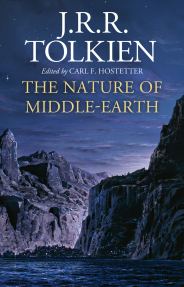
This is a stunning statement, unlike anything I have read in Tolkien’s papers–though I have The Nature of Middle-earth, edited by Carl Hostetter, queued up to begin reading in a couple of weeks. This collection of Tolkien’s nonfiction will no doubt extend the conversation. Two of the three major parts of that collection are “Time and Ageing” and “Body, Mind and Spirit,” and there are particular chapters on “Elvish Life-cycles” (Pt. 1.XIX), “Elvish reincarnation” (Pt. 2.XV), and “Death” (Pt. 2.XVII), as well as an appendix on “Metaphysical and Theological Themes.”

Meanwhile, though, Andreth’s statement resounds in my mind: “dying we die … a loss irremediable.”

Besides the questions of mortality and the gifts of Eru, the “Athrabeth Finrod ah Andreth” brings us more deeply into the Sindarin idea of Estel, hope, which is one of the names of Aragorn the hoped-for king. “Hope” is perhaps too thin of an English word to capture the concept as we discover it in the Athrabeth. As the word “longsuffering” was invented to capture a concept in St. Paul, perhaps “hopetrust” or “longhope” is the right way to translate estel.

Though it was a rich personal discovery, my reading of the “Athrabeth Finrod ah Andreth” was for a purpose: to guide a discussion of Signum University students. Rather than reading simply for leisure, I was reading with a pencil in hand. My screen and keyboard were not far away and student learning was on my mind.

Thus, I also had some other volumes open as I hunted down some of the many links within the legendarium. Have you seen these Middle-earth histories? It isn’ simply that Christopher Tolkien gave us his father’s work with an introduction and index. Rather, there are J.R.R. Tolkien’s writings, sometimes presented as a variorum capturing the various versions and drafts. Beyond the variant and experimental texts, there are also marginal notes and footnotes that J.R.R. Tolkien makes upon his own texts. Christopher Tolkien then draws our attention to deeper meanings in these texts and in the notes with his own footnotes and commentaries, which include also his clarifications and comments about curiosities, unanswered queries, and even occasional corrections of the corrections.

Thus, as I was writing a note in my copy of Tolkien’s letters–having been sent there from an endnote Christopher wrote to one of his father’s own self-commentaries–I realized how ridiculously implicated these stories are for writers and editors and readers. I wrote a note like this in my journal:

When I think of it, in reflecting upon a lecture for students, I am writing a blog post about marginal notes I wrote next to a letter J.R.R. Tolkien wrote to a Lord of the Rings fan, which I found in Christopher Tolkien’s endnote to an author’s note his father wrote to an inserted episode from the 12-volume History of Middle-earth, which is the Legendarium, that is both the foundation of and the prequel to the published story, The Lord of the Rings.
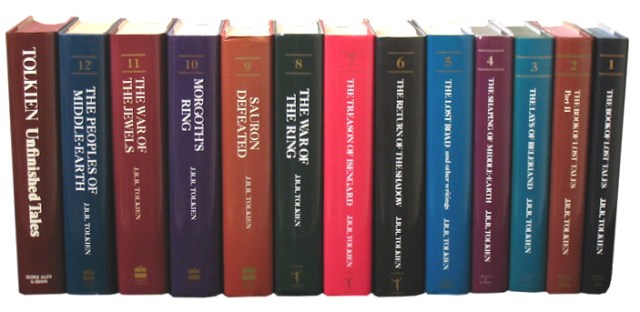
And so the circle goes.

As they have come to us through eight decades of publication by father, son, and scholars, Tolkien’s works are deeply implicated with one another, interwoven, interconnected, layered to an almost infinite degree in language, poetry, story, history, legend, and myth. My circular experience of reading is not unique to me, I think.

But although Tolkien’s works are like circles, and layered in complex ways, the works are also “rhizomatic”–a word some of my favourite teachers have been using lately, but that we see the idea of in the Inklings‘ own work. Like a wild tree or creeping vine, Tolkien’s writings are like vines that send out roots and shoots as they move out into the world.

More deeply still, Tolkien was not just the writer of his work, but a kind of discoverer–a gardener who plants and watches what grows. C.S. Lewis describes this kind of rhizomatic project in his commentary on fellow-Inkling Charles Williams‘ poetry, where, in Lewis’ estimation, Williams’ writing

is more a dove-like brooding, a watching and waiting as if he watched a living thing, now and then putting out a cautious finger to disentangle two tendrils or to train one a little further toward the support which it had almost reached, but for the most part simply waiting (Arthurian Torso, 279).

Is there a better description of at least one part of Tolkien’s writing project? There, in the past, Tolkien is watching the roots of ideas shoot out across the garden wall, while he trains the vine, disentangling some tendrils and bringing others together.

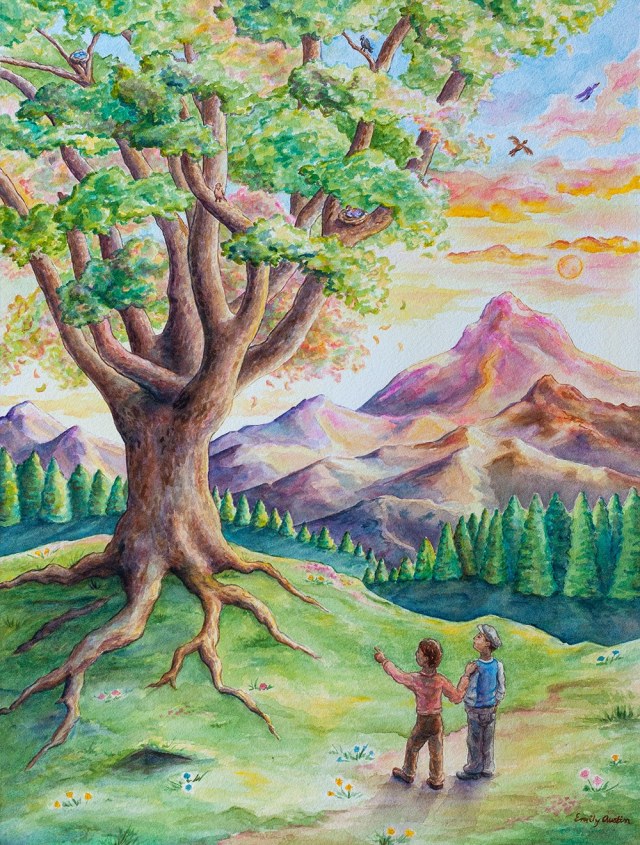
Tolkien himself used a similar metaphor in “Leaf by Niggle,” an allegorical tale about life as a subcreator. Niggle is a painter, but as his life goes on he cannot feel any real interest in any of his paintings except this one tree:

It had begun with a leaf caught in the wind, and it became a tree; and the tree grew, sending out innumerable branches, and thrusting out the most fantastic roots. Strange birds came and settled on the twigs and had to be attended to. Then all round the Tree, and behind it, through the gaps in the leaves and boughs, a country began to open out; and there were glimpses of a forest marching over the land, and of mountains tipped with snow. Niggle lost interest in his other pictures; or else he took them and tacked them on to the edges of his great picture (Tales from the Perilous Realm, 286).

And so the tree grows–such an elegant metaphor for Tolkien’s own work.

Trees, Leaves, Vines, Circles, the loom where the Weaving takes place–I suppose our metaphors for the work could spread out from here in their own branches, tree-like, rhizomatically.

Thus, it strikes me at such a time as this, on Tolkien Reading Day, how deeply layered Tolkien’s works are, and how we as readers are invited into the intricate patterns of his interwoven and implicated worlds and thus become, in a certain sense, part of that great circular, rooted, vine-ish, and Niggle-like imaginative experience of discovery of Tolkien’s great project.

“Leaf by Niggle” by Emily Austin. Adding to the layers of our reading experience, you can find Emily’s Inklings-inspired art here.

Posted in Reflections | Tagged , , , , , , , , , , , , | 29 Comments

Bunyan and Others and Me: Vicarious Bookshelf Friendship and a Jazz Hands Theory of Reading

I have been quite open about the fact that I have had some difficulty finding true sympathy with John Bunyan’s The Pilgrim’s Progress. I even went so far as to admit that the text at one time had been for me a kind of literary Slough of Despond (or a Slough of other kinds, if you see the conversation in and after this post, “The Sloo/Slow/Sluff of Despond“). And yet I remain somewhat attached to this allegory for two reasons that I want to put forward as “theories of readings.”

At the root of my desire to desire to read Bunyan is the fact that I played the Pilgrim, Christian, as an undergraduate in my college’s musical performance, The Upward Way. At the time, I had some designs on stage performance as a career–or, at least, as a field in which to begin my vocational life. I had worked as an actor locally, including my roles as Sir Charles Tupper and Colonel John Hamilton Gray in our “Fathers and Mothers of Confederation” program in Prince Edward Island (the place where a vision for Canada as a nation was formed). I appeared frequently in amateur plays through high school and college, and I would even go on to write and produce (and star in) a 12-episode children’s television show in Newfoundland called “Patches and Friends.”

It was not out of the question, then, that I won the lead role in the Maritime Christian College spring musical, even though I was a mere freshman. 

That’s Me in 19th c. Plaid

However, even then I had some doubts about my core skills as a performer. I have found that it is intensely difficult in the artistic world to know whether one has the skills–not just the artistic eye and acumen and artist’s toolkit, but also the commercial transferability of skills. Even as a high school senior, I had come to suspect that much of my acting success was because I could memorize lines, I had a voice that would project to the back of a room, I could speak passable French and strong (local) English, I had a certain kind of up-front courage and interest in making a fool of myself that was less-than-common among boys my age, and I could grow a beard before I was 16. 

Ultimately, I did not send in my theatre college applications because I was not, in the technical words of the craft, good at it. I was a bearded fish with a bright voice and very little shame in a very tiny, somewhat reserved, pond where pubescent beards were rare.

So, though I have some suspicion that I was given the only non-singing part in the troupe for reasons other than my skills as a thespian, I was able to gain something lasting from the performance of The Upward Way. Between stage sword fights, amateur choreography, long monologues, and the psychology of spiritual life in choral splendour, I made a connection. As I drew Christian into my own life–as I spoke his translated words, moved with his re-staged body, projected his fear and courage and hope to the back of the room–I was somehow drawn into that foreign text of The Pilgrim’s Progress

This experience–when we draw a text into our lives in a very embodied and physical way so that it ultimately draws us into the text–this is my Jazz Hands Theory of Reading

While Bunyan comes to me as one embodied, he also comes in cloaked fellowship.

More often than I can fathom, I find Bunyan kinship in the authors I love to read. For example, I appreciate in an almost physical way how one of my book friends, George MacDonald takes up and transforms the pilgrim tale in his work–but that is an image of MacDonald’s writing that I will need to share another day. Some of my favourite stories–like Dickens‘ work, or Charlotte Brontë‘s Jane Eyre, or Mark Twain‘s Huckleberry Finn, or Louisa May Alcott’s Little Womento select a short 19th-century period as an example–are stories that somehow embody The Pilgrim’s Progress (a fact that can be confirmed by greater scholars of the subject than myself, as I am working in this case just as a curious reader).

Beyond shaping the broad vision of a tale, Bunyan provided a translation of the medieval mode of allegory for modern pilgrims who keep trying to retell their own stories, like Enid Blyton’s The Land of Far-Beyond or C.S. LewisA Pilgrim’s Regress. I shared last week about how another book friend, Shannon Murray, shared the story of The Pilgrim’s Progress as a book, moving from philosophical subterfuge to the nursery bookshelf, and from the nursery to the university classroom as a classic. And we shouldn’t forget that Christian is, at least briefly, a member of the League of Extraordinary Gentlemen

Thus, it seems that I keep getting The Pilgrim’s Progress through other books on my bookshelf, whether I want to or not. So let me draw out in a bit of detail two examples of how I experience The Pilgrim’s Progress through these book friends.

Let me begin with a local connection, L.M. Montgomery‘s somewhat autobiographical title character of Emily of New Moon. Emily, an early adept of the imaginative life whose whole world is thrown into disarray by her father’s death, finds solace in her ability to read well:

So Emily had curled herself up in the ragged, comfortable old wing-chair and read The Pilgrim’s Progress all the afternoon. Emily loved The Pilgrim’s Progress. Many a time had she walked the straight and narrow path with Christian and Christiana — although she never liked Christiana’s adventures half as well as Christian’s.

I admire Emily’s ability to walk inside a book, an exercise that takes great energy and intention for me to succeed in. When it comes to her delight in the tale, I would have immediately presumed that the difference between Christian’s and Christiana’s story was one of sword fights and monster slaying. However, for Emily it was about atmosphere:

For one thing, there was always such a crowd with Christiana. She had not half the fascination of that solitary, intrepid figure who faced all alone the shadows of the Dark Valley and the encounter with Apollyon. Darkness and hobgoblins were nothing when you had plenty of company. But to be alone — ah, Emily shivered with the delicious horror of it!

Emily is Montgomery’s most extensive story of the writer as pilgrim, thus it is fitting that this Bunyan reference is one of the early moments in the novel, framing the Emily tale in a particular kind of way.

Emily is also, I must confess, the character with whom I feel the most spiritual connection in Montgomery’s fiction. Anne awakens me and the Story Girl enchants me. Valancy Stirling makes me laugh and hope that there is liberty. Jane Victoria Stuart makes me believe again that old pictures tell new truths. And Felix Moore makes me awake as a teacher to the possibility that we may all find a way to speak in tongues. It is Emily, however–the poet, the writer, the mystic–who captures for me the essence of the spiritual journey. 

There is Emily of New Moon, literary pilgrim. There is another reader and writer, C.S. Lewis. Lewis’ ode to Bunyan–A Pilgrim’s Regress, peculiar and elusive and poetic–is a story for another day. But as a reader of Bunyan from his youth, Lewis makes for a striking critic in adulthood. 

For one, Lewis draws Bunyan into the centre of what he thinks is essential Western literature. Harold Bloom includes Bunyan in the conversation in his Western Canon, including reading Middlemarch and the American poetic tradition as influenced by Bunyan. C.S. Lewis goes further, however, setting Bunyan next to Dante over and over again. There is perhaps no other individual writer more important to Lewis than Bunyan, save Dante himself. It is a bold claim, and there is a strong argument to be made for Milton or Spenser having pride of place. However, I make the claim for a couple of reasons. 

First, the academic exploration of Lewis and Bunyan remains somewhat open, not having been covered in detail by scholars like Dante has been (by Marsha Daigle-Williamson), or explored at length by Lewis as he does of Spenser (in The Allegory of Love and English Literature in the Sixteenth Century) or Milton (in A Preface to Paradise Lost … and really almost anywhere, so maybe I have overspoken Bunyan as both source and influence…). 

Second, Lewis connects personally to Bunyan on a level deeper than the religious allegory, drawing Bunyan’s story into his own emotional life. As a child forced into residential schools that were filled with abuse and weariness, Lewis equated the longing of term’s end with Christian’s longing-while-actually-there experience of Beulah-land in The Pilgrim’s Progress: “Christian with desire fell sick.” Lewis later writes about his response:

How well I know that sickness! It was no mere metaphor. It thrilled and wobbled inside: passed along the spine with delicious, yet harrowing thrills: took away the appetite: made sleep impossible. And the last morning never betrayed one. It was always not less, but more, than desire had painted it: a dizzying exaltation in which one had to think hard of common things lest reason should be overset. I believe it has served me ever since for my criterion of joy, and specially of the difference between joy and mere pleasure. Those who remember such Ends of Term are inexcusable if ever, in later life, they allow mere pleasure to fob them off. One can tell at once when that razor-edged or needlepointed quality is lacking: that shock, as if one were swallowing light itself (“My First Schools”).

Like Bunyan, within his fiction, Lewis himself is a creator of literary scenes that are more than metaphors in the reader. And as a Christian intellectual, it is fitting that he ends that passage in “My First Schools” with something like an altar call to real joy.

However, while Lewis made a personal connection of delight and longing with Bunyan, he was not such a fan as to miss the faults. In his BBC essay on The Pilgrim’s Progress which gets published as “The Vision of John Bunyan,” Lewis admits that he finds the doctrine of the tale “somewhat repellent.” Humorously, Lewis notes that:

“The long conversation, near the end of Part 1, which Christian and Hopeful conduct ‘to prevent drowsiness in this place‘–they are entering the Enchanted Ground–will not prevent drowsiness on the part of many readers. Worse still is the dialogue with Mr Talkative…. Mr Talkative is not allowed to talk much.”

While Lewis admits that Bunyan wouldn’t care much for literary criticism of that sort as it is outside his purpose. But Lewis is right that there are too many times in the Progress where the allegory is bent by direct preaching. Readers like Emily of New Moon, who lived in a time and place where moral tales were more integrated into great storytelling, will be more able to receive the tale than those of us who read in lands thereafter. Lewis’ observation about Bunyan falling out of allegory into preaching leads to one of his most perceptive (and oft-forgotten) notes about allegory as a form:

“Allegory frustrates itself the moment the author starts doing what could equally well be done in a straight sermon or treatise. It is a valid form only so long as it is doing what could not be done at all, or done so well, in any other way.”

It is a lesson that creators of moral fiction should remember even when working outside of formal allegory (which almost none of us write anymore, at least as novels).

And yet, Lewis returns to the point of admiration of Bunyan as a master realistic prose-writer and storyteller:

If such dead wood were removed from The Pilgrim’s Progress the book would not be very much shorter than it is. The greater part of it is enthralling narrative or genuinely dramatic dialogue. Bunyan stands with Malory and Trollope as a master of perfect naturalness in the mimesis of ordinary conversation.

Leave it to Lewis to point to Bunyan as a master of “mimesis” when the masterwork, Auerbach’s Mimesis, never mentions him. 

Thus, these are my two contributions to theories of reading. First, having brought Christian into my heart as a young actor, as I embodied the tale, the tale came to embody me, thus the Jazz Hands Theory of Reading. 

Second, when I look to my bookshelves, I find myself wanting something of MacDonald’s pilgrim heart and Emily’s shiver of delight and Lewis’ “more than metaphor” in my life. Thus, it is helpful to think of this as a Vicarious Bookshelf Friendship Theory of Reading. 

For both these reasons, I find myself picking up Pilgrim’s Progress again and again.

Posted in Reflections | Tagged , , , , , , , , , , , , , , , , , , , , , , , , | 9 Comments

The Pilgrim’s Progress and the Nursery Bookshelf: A Book’s Journey (Throwback Thursday)

At A Pilgrim in Narnia, we have an occasional feature called “Throwback Thursday.” By raiding either my own blog-hoard or someone else’s, I find a blog post from the past and throw it back out into the digital world. This might be an idea or book that is now relevant again, or a concept I’d like to think about more, or even “an oldie but a goodie” that I think you might enjoy.

In rereading John Bunyan’s classic spiritual journey tale, The Pilgrim’s Progress, I wrote a piece that was a way of sideways speaking about the book: “The Sloo/Slow/Sluff of Despond: Today’s Word of the Day and a Spiritual Truth in John Bunyan’s Pilgrim’s Progress.” I kind of like that whimsical piece. I struggle to find sympathy for this book–despite the fact that people I respect and read find him life-giving and provocative and influential. After my “Sloo/Slow/Sluff” reflection, a remarking conversation in the comments has popped up. In the midst of a busy term, I tried both to enjoy those comments and to write a more substantial reflection on my reading experience of Bunyan. Both faltered, and yet I wanted to reflect somehow on the book before the pages become more distant in my mind. Thus, I decided to update this 2013 piece, “What Bunyan’s Pilgrim’s Progress Teaches us about English and Education“–perhaps reminding the reader to remember that I have read the book a few times since, but didn’t want to lose the heart of this reaction.

How the decades go as we are on the road! I hope this adds some opportunity for reflection on your journey.


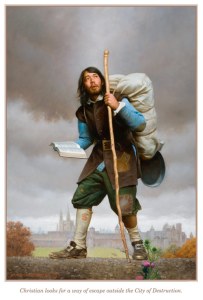
Evangelist points the way

Way back in the heady days of the early 2010s, one of my first posts on A Pilgrim in Narnia was the confession that I had not really ever read John Bunyan’s classic The Pilgrim’s Progress (1678). I am pretty sure that I have pretended to read it over the years, nodding knowingly when it was brought up in classes or book talks.

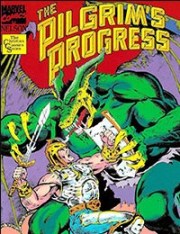
And yet, new the story pretty well. People do talk about the book, I had read parts of the story at points in my life, and I had enjoyed the Marvel Comics adaptation as a graphic novel. Especially, I had played the protagonist, Christian, in an amateur musical in college–certainly a deep immersion in the tale.

But the truth is that I had never really sat down and gone through Bunyan’s book–even when preparing for the stage part. I had always, like the weak-willed character Pliable, became mired in the text somewhere around the Slough of Despond (page 23 in my edition), and found myself turning back. Like Pliable in his way, I shouted out to all who had recommended this book:

“Is this the happiness you have told me all this while of?”

As a Pliable reader, I had never progressed. As I admitted in that early blog post, “The Pilgrim’s Regress and the Reader’s Progress,” may have been one of the reasons I felt so lost in first reading C.S. Lewis’ own allegorical journey tale, The Pilgrim’s Regress (1932).

Whether it is a literary accomplishment or not I have (speaking here in 2013), finally, read Bunyan’s allegorical travelogue—not just the story of Christian, but the sequel about Christiana (his wife) and her children. I was spurred on to Bunyan again by a local colleague, Dr. Shannon Murray, who studies Bunyan’s work as children’s literature.

What surprised me about Murray’s scholarship is the journey of The Pilgrim’s Progress as literature itself. At a recent presentation she gave, she noted that Bunyan’s illicit conversion narrative was met with indignation by his educated coreligionists. People who liked the content of the Progress—those who agreed with Bunyan’s work as a spiritual handbook—blamed it for not being Milton. Almost immediately there was an adaptation published in Miltonic verse to counter the “vulgar” Bunyan original.

Over time, through myriad editions and adaptations, hat began as a dream narrative in everyday, simple language eventually found its way to the children’s lit shelf, as Murray notes:

“For over two centuries, The Pilgrim’s Progress was essential reading not in the university classroom but in the nursery, adopted by children who, like Louisa May Alcott’s Jo March in Little Women (1868), revelled in the journey and the adventure of Bunyan’s allegory. As a children’s book, it was so common that Frances Hodgson Burnett, L.M. Montgomery and Mark Twain could assume a basic knowledge of Christian’s journey from the City of Destruction to the Celestial City…. While Emily in Montgomery’s Emily of New Moon (1923) is proud to have both read and enjoyed Bunyan’s allegory (the only book her devout aunts let her read on Sundays), Huckleberry Finn famously judged that the allegory is ‘about a man that left his family, it didn’t say why. I read considerable in it now and then. The statements was interesting, but tough’” (Shannon Murray, “A Book for Boys and Girls: Or, Country Rhimes for Children: Bunyan and Literature for Children,” in The Cambridge Companion to Bunyan, 120).

Though I probably had an advantage going into the book, like Huck Finn I thought there were some tough things in it. There are pages of doctrinal discussions, where the allegorical characters are splitting hairs over issues that even I—who have studied evangelical theology—can’t see the significance of the distinctions.
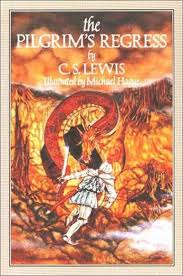
My biggest struggle might be that I found the middle fifty pages of each book to be a bit dull. I can’t for the life of me figure out why everyone gets married near the end of Christiana’s tale. Moreover, the Progress doesn’t capture the subtleties of temptation that make the path of Christian pilgrimage so very dangerous. Vanity Fair, for example, is garish and obvious. The real temptation of consumerism, as I perceive it, is the warm bath of normalcy, where the shocking reality that we treat people like transferable commodities is a simple matter of everyday policy. I suspect that an allegory simply can’t capture these subtleties without losing its universal appeal.

Rather than “tough,” though, when I got past the doctrinal minutia I actually found much of the book easy to read. “Vulgar” language has not changed much in the 325 years since it was written. I only had to look up a couple of words and I knew all of the allegorical allusions.

And yet, As Murray notes, Bunyan’s Christian allegory is now part of the university curriculum, and I suspect many students find it a challenging read. The Pilgrim’s Progress is also the benefactor (or victim!) of adaptations designed to make it more accessible. Most people who encounter Christian’s story, I would guess, encounter it through popular versions like Enid Blyton’s The Land Far Beyond (1942) or the Marvel Comic adaptation (1993)—both of which I have actually read!

So the literary history of The Pilgrim’s Progress is an intriguing one. It began as a street-language Christian handbook, and then migrated toward the nursery, being one of the few good books that children could read (especially on Sundays). By Mark Twain’s time, even though the story is well known, a Huck Finn character might find the language a bit of a challenge. A generation later Lucy Maud Montgomery’s Emily character can be proud that she is able to read and understand what was once a children’s book. About that time The Religious Tract Society of London is printing an evangelistic version, with some obsolete words translated and eight colour illustrations, for “readers of every class” (4)—the version that I have, incidentally. As the century moves on, the university takes up Bunyan’s Dream as an academic study. Now Bunyan is hard, intellectual, historical, and best fed to us in short bits with colourful pictures (or stage musicals with a bad actor as the leading man).

I write this not to brag at my own accomplishment in reading the original (or blush at my heretofore embarrassing display of literary cowardice), but to show the nature of how language works. It was Tyndale, I believe, whose work was developed into the King James Bible. And it was Tyndale who once quipped,

“I defy the pope and his laws! If God spares my life, in a few years a plowboy shall know more of the Scriptures than you do.”*

Tyndale imagined his translation as “vulgar,” and now the King James is the height of English poetry and requires a sophisticated readership. We ease into Shakespeare in high school, training our brains to appreciate plays that were enjoyed by the street class illiterati who paid a penny to stand and watch.

plgrim's regressI wonder if there is more to our struggle with the classics, though, than the normal evolution of language.

When I read C.S. Lewis’ The Pilgrim’s Regress for the first time in 2011, it was a real struggle. With hundreds of often un-translated French, Italian, German, Latin, and Greek words and phrases, Lewis’ little spiritual allegory is intimidating. Rereading it again this year, having educated myself in Lewis’ world and works, and it is much more approachable. This realization leads me to suspect that had I taken up Bunyan’s travelogue two years ago I would have struggled more than I did.

Not only has language moved on, but so has education. We are simply less educated than the readers of the past. Snd yet, as a reader, my education continues, and I can find my way into texts that were “tough” in the past.

In either case, despite having conquered Bunyan’s “Similitude of a Dream,” I have more literary backfilling to do. It makes me wonder if Marvel Comics has turned yet to James Joyce.

Actually, according to Foxe, he said, “I defy the Pope, and all his laws; and if God spares my life, ere many years, I will cause the boy that driveth the plow to know more of the Scriptures than thou dost!” But, as you know, language does evolve!

Posted in Reflections, Reviews | Tagged , , , , , , , , , , , , , , , , , | 7 Comments

The Literary Magic of L.M. Montgomery’s Storied Domains: The King Orchard and The Story Girl

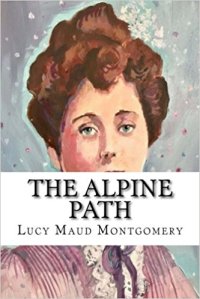
While Lucy Maud Montgomery was a prodigious journal-keeper, leaving us thousands of pages of material to study in the decades after her death, she was far less dedicated as a memoirist. Thus, it is sometimes hard to know how to evaluate Montgomery’s self-portrait in the perky, breezy, and all-too-brief 1917 serial memoir that later became The Alpine Path. From what I can discern, though, there is truth in L.M. Montgomery‘s claims that The Story Girl is

“my own favourite among my books, the one that gave me the greatest pleasure to write, the one whose characters and landscape seem to me most real.”

A short story-centred coming-of-age tale told by one of the main characters reflecting back on his childhood, The Story Girl was Montgomery’s fourth book, written just a couple of years after Anne of Green Gables stunned the world–and Montgomery, no less–as a bestseller. As she writes The Story Girl and moves it toward publication, her grandmother passed away–the woman who had become Montgomery‘s charge and whose death finally sealed in Montgomery’s orphanhood. Within months, Montgomery would close up her childhood home with her writing nook under the gable window, marry, tour Scotland and England, and move to a small town in Ontario. The Story Girl sequel published in 1913, The Golden Road, was Montgomery’s sixth book, and she had completed nine books by the time she writes the story of her “career” for Everywoman’s World, later published as The Alpine Path (1974).

Written in the intensity of her life’s moments, The Story Girl had a second intimate connection for Montgomery:

“It was the last book I wrote in my old home by the gable window where I had spent so many happy hours of creation.”

Although the eight children at the centre of the tale were purely imaginary creations, the funny and frightening figure of Peg Bowen emerged from Montgomery’s history–

“a half-wined, gypsy-like personage who roamed at large for many years over the Island and was the terror of my childhood.”

The other character most clearly from Montgomery’s real history was the old “King Orchard”–a mental blend of the two orchards in the places she called home: her be-gabled grandparents’ home in Cavendish and the Park Corner home where she found her closest friend and where she was married (and, incidentally, the home becomes the fictional “Silver Bush” of the Pat books).

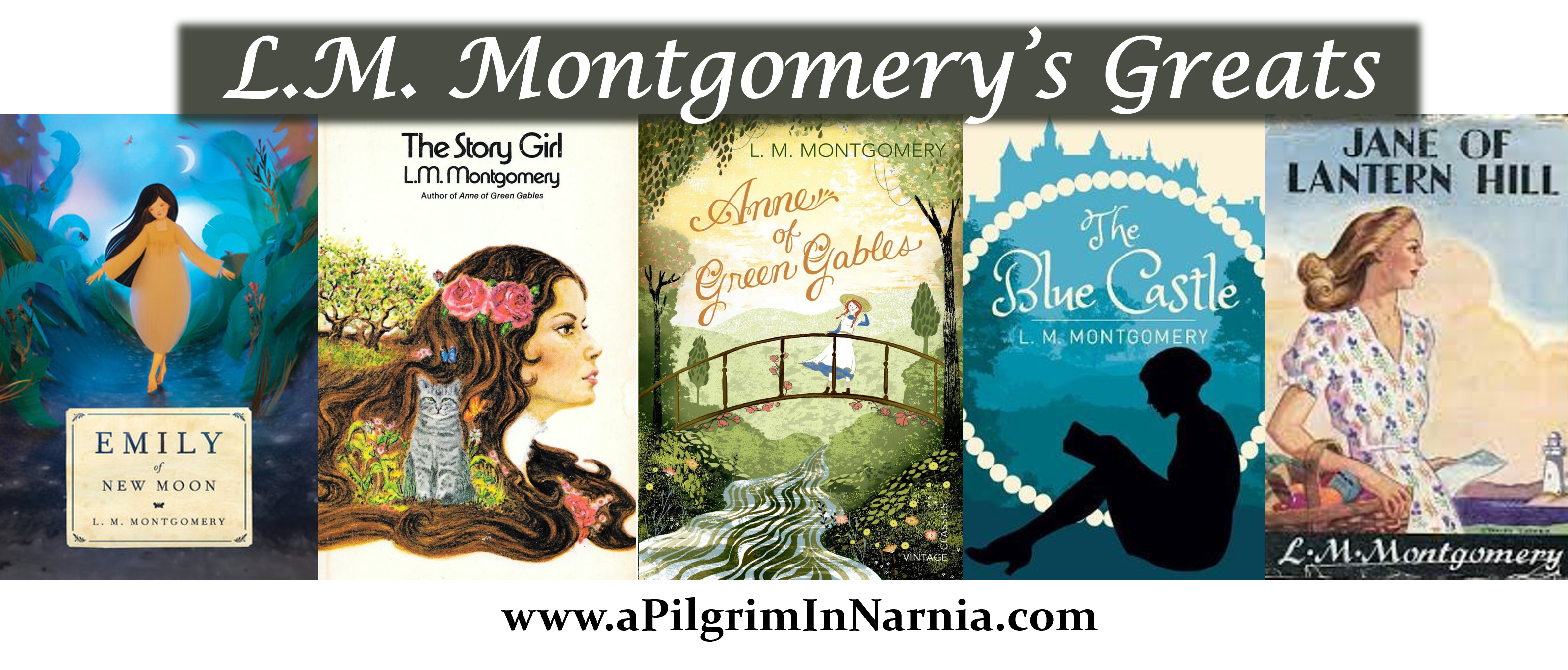
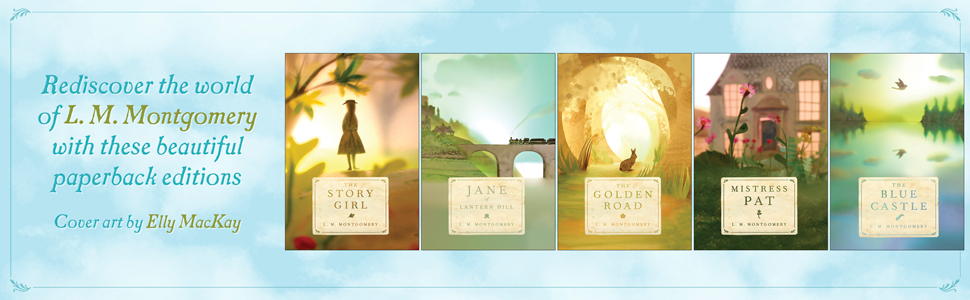
In opening my Seal Books edition of The Story Girl the other night–a few weeks behind in the L.M. Montgomery Readathon, though I’m catching up–I was struck once again by Montgomery’s imaginative wordplay, her exquisite natural description, and her intensely empathetic storytelling perspective. All of these features–and her capacity for evoking both “journey” and “home” without residual tension–is presented to us with remarkable literary simplicity. Montgomery’s Emily of New Moon startles me every time I read it. Anne of Green Gables is a wondrous creation, and Anne’s House of Dreams is a moving novel of literary and philosophical depth. The Blue Castle and Jane of Lantern Hill are overlooked Canadian classics–and endlessly curious novels for the perceptive reader, though in quite different ways.

These are the “greats” of Montgomery’s writing desk and “go-to” books for many. But The Story Girl warrants its place as first among equals.

It is beyond my ken to know whether or not the local witches and wanderers of Prince Edward Island‘s history had the technical capacities for which they are variously famous and infamous. Otherwise, though, The Story Girl and The Golden Road are entirely realistic works of fiction, mimetic books of psychological insight and personal growth within the adventures and curiosities on the golden road of youth.

While presenting itself as a work of realism, however, there is something of magic about The Story Girl–something of rapture and fancy that stretches our imaginative sense of the possible.

In the opening pages of The Story Girl, Montgomery delicately introduces the fantastic possibilities. The memoir-writer, Beverly, is going with his brother Felix to their ancestral home in Prince Edward Island. With memory, movement, landscape, colour, taste, and fragrance, Montgomery draws us the reader into the King homestead of nostalgia and memory, which for the narrator is a return to home that is also a setting out.

Following train rides and family meetings and kinship at table, Felix and Bev awake at dawn to explore the countryside on their first morning in Prince Edward Island. Their first destination is the King Orchard–the re-creation of Montgomery’s childhood that has become for the King family a legend in the age. In an era of reading filled with faërie stories, narrative poetry, and pilgrim allegories, one must watch the garden gates, for they are the thresholds into other worlds of fancy, hope, and spirit. Stepping out the front door with a rare south breeze and swelling hearts, Bev and Felix find their way to the spruce hedge that borders the King Orchard:

“we had only to open that little whitewashed gate in the hedge and we might find ourselves in its storied domain.”

So close, and yet they do not yet enter that space of enchantment. For at that moment–in the domain of the wondrous wayfaring wizards the worlds over–Felix and Beverly are good-morninged by the Story Girl.

The reader’s charm in encountering the Story Girl is no less than Felix and Bev, who are enthralled by their cousin. More than bodily grace and a buoyant charismatic charm–but not less than these–the Story Girl weaves a spell in their meeting. We know this spell in other storied worlds, don’t we? The Story Girl beckons, names, and makes a fellowship with the adventurers on the way.

As Montgomery reveals the enthralling magic of the Story Girl’s spell, we can never forget how closely linked that older English word “spell” is to “story”–the story we are reading, the Story Girl herself, and the “storied domain” of the old King orchard. For the storytelling pilgrim’s hand was nearly at the garden gate when the Story Girl called, and now she leads them across the threshold:

“The latch of the gate clicked under the Story Girl’s hand, and the next moment we were in the King orchard.”

The chapter that follows, chapter three, is “Legends of the Old Orchard.” And so the story begins. But the spell itself is already in place. So I leave for you this delicately entwined enchantment of Montgomery’s imagination, the old King Orchard and the Story Girl.


Then we opened the front door and stepped out, rapture swelling in our bosoms. There was a rare breeze from the south blowing to meet us; the shadows of the spruces were long and clear-cut; the exquisite skies of early morning, blue and wind-winnowed, were over us; away to the west, beyond the brook field, was a long valley and a hill purple with firs and laced with still leafless beeches and maples.

Behind the house was a grove of fir and spruce, a dim, cool place where the winds were fond of purring and where there was always a resinous, woodsy odour. On the further side of it was a thick plantation of slender silver birches and whispering poplars; and beyond it was Uncle Roger’s house.

Right before us, girt about with its trim spruce hedge, was the famous King orchard, the history of which was woven into our earliest recollections. We knew all about it, from father’s descriptions, and in fancy we had roamed in it many a time and oft.

It was now nearly sixty years since it had had its beginning, when Grandfather King brought his bride home. Before the wedding he had fenced off the big south meadow that sloped to the sun; it was the finest, most fertile field on the farm, and the neighbours told young Abraham King that he would raise many a fine crop of wheat in that meadow. Abraham King smiled and, being a man of few words, said nothing; but in his mind he had a vision of the years to be, and in that vision he saw, not rippling acres of harvest gold, but great, leafy avenues of wide-spreading trees laden with fruit to gladden the eyes of children and grandchildren yet unborn.

It was a vision to develop slowly into fulfilment. Grandfather King was in no hurry. He did not set his whole orchard out at once, for he wished it to grow with his life and history, and be bound up with all of good and joy that should come to his household. So the morning after he had brought his young wife home they went together to the south meadow and planted their bridal trees. These trees were no longer living; but they had been when father was a boy, and every spring bedecked themselves in blossom as delicately tinted as Elizabeth King’s face when she walked through the old south meadow in the morn of her life and love.

When a son was born to Abraham and Elizabeth a tree was planted in the orchard for him. They had fourteen children in all, and each child had its “birth tree.” Every family festival was commemorated in like fashion, and every beloved visitor who spent a night under their roof was expected to plant a tree in the orchard. So it came to pass that every tree in it was a fair green monument to some love or delight of the vanished years. And each grandchild had its tree, there, also, set out by grandfather when the tidings of its birth reached him; not always an apple tree—perhaps it was a plum, or cherry or pear. But it was always known by the name of the person for whom, or by whom, it was planted; and Felix and I knew as much about “Aunt Felicity’s pears,” and “Aunt Julia’s cherries,” and “Uncle Alec’s apples,” and the “Rev. Mr. Scott’s plums,” as if we had been born and bred among them.

And now we had come to the orchard; it was before us; we had only to open that little whitewashed gate in the hedge and we might find ourselves in its storied domain. But before we reached the gate we glanced to our left, along the grassy, spruce-bordered lane which led over to Uncle Roger’s; and at the entrance of that lane we saw a girl standing, with a gray cat at her feet. She lifted her hand and beckoned blithely to us; and, the orchard forgotten, we followed her summons. For we knew that this must be the Story Girl; and in that gay and graceful gesture was an allurement not to be gainsaid or denied.

We looked at her as we drew near with such interest that we forgot to feel shy. No, she was not pretty. She was tall for her fourteen years, slim and straight; around her long, white face—rather too long and too white—fell sleek, dark-brown curls, tied above either ear with rosettes of scarlet ribbon. Her large, curving mouth was as red as a poppy, and she had brilliant, almond-shaped, hazel eyes; but we did not think her pretty.

Then she spoke; she said,

“Good morning.”

Never had we heard a voice like hers. Never, in all my life since, have I heard such a voice. I cannot describe it. I might say it was clear; I might say it was sweet; I might say it was vibrant and far-reaching and bell-like; all this would be true, but it would give you no real idea of the peculiar quality which made the Story Girl’s voice what it was.

If voices had colour, hers would have been like a rainbow. It made words live. Whatever she said became a breathing entity, not a mere verbal statement or utterance. Felix and I were too young to understand or analyze the impression it made upon us; but we instantly felt at her greeting that it was a good morning—a surpassingly good morning—the very best morning that had ever happened in this most excellent of worlds.

“You are Felix and Beverley,” she went on, shaking our hands with an air of frank comradeship, which was very different from the shy, feminine advances of Felicity and Cecily. From that moment we were as good friends as if we had known each other for a hundred years.

Posted in Fictional Worlds, L.M. Montgomery | Tagged , , , , , , , , , , , | 9 Comments