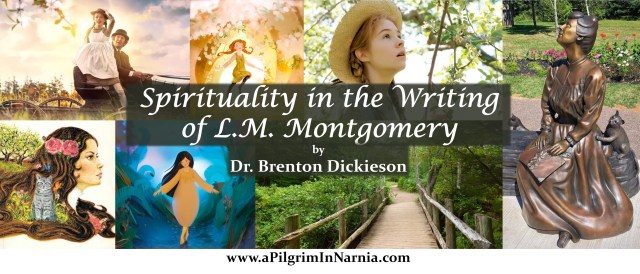
My New Online Short Course: “Spirituality in the Writing of L.M. Montgomery” at AST in May, 2022

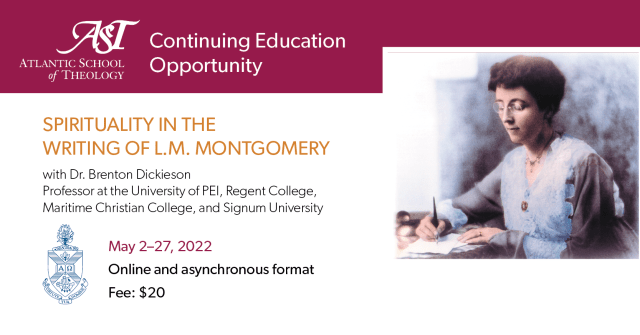
Happy Friday fair readers! I am super pleased to announce my new Short Course with the Atlantic School of Theology: “Spirituality in the Writing of L.M. Montgomery.” This May 2022 4-week online audit course is completely open to anyone who is interested. There is still time to sign up and it has an incredibly low registration fee of $20.

If you have been following A Pilgrim in Narnia, you will have seen that for about 5 years I have been publishing the occasional L.M. Montgomery blog post, resource list, review, academic essay, or event. Almost from the first page of rediscovering Montgomery’s literature as an adult, I have been struck by the way that she invites readers into a more vivid vision of the spiritual life and a more capacious theological imagination. This course is a chance for me to test my ideas with eager and open readers from around the world.

I have the full course announcement below, as well as a list of lectures and weekly readings. I think it is important to acknowledge a couple of striking points.

First, kudos to AST–a multidenominational seminary in Halifax, NS–for continuously offering quality local and online theological and pastoral education. AST reaches not just those who fill future pulpits and podiums, but also the folks in the pews–and, in the case of this course on L.M. Montgomery’s literature, people who are likely to have a novel in their hand as the sun sets on the day. It is also striking that AST’s leadership caught the vision of my work with Montgomery as a “theological storyteller” (and this may have had something to do with Rob Fennell, who published my first academic chapter ever).

Second, $20 for a 4-week online course! How do they do that? This is a radical discount from the cost of running a high-quality continuing education course at the Atlantic School of Theology. It is made possible by great sponsors working in partnership with AST: the Pollok and MacKinnon memorial funds of Pine Hill Divinity Hall. For those of you with the means, have you considered supporting local and online education so that as many people who can are able to access it?

“Spirituality in the Writing of L.M. Montgomery” is designed for everyday folks with a curious mind and an interest in Montgomery’s writings. Thus, the course has deep lectures, readings, and discussions with a light design–all hosted on Facebook. I can’t wait to see how great readers like yourselves react to my unusual approach to Montgomery’s life and works and help me experience her stories in deep and resonant ways. I hope to see you soon!

Full details below. Email me at junkola[at]gmail[dot]com if you have questions.

Spirituality in the Writing of L.M. Montgomery

by Brenton Dickieson

Course Description

Lucy Maud Montgomery’s iconic Canadian novel, Anne of Green Gables, has been translated into 40 languages and has sold 50 million copies. Montgomery was an author, Presbyterian minister’s wife, and church leader, and her 21 novels and 500 short stories include conversations about faith and are deeply attentive to spirituality and social morals. Yet she is rarely studied as a Christian public figure or as a writer of theological interest.

This program takes Montgomery seriously as a conversation partner for theological exploration. Participants will study Montgomery’s religious space, her hopes and dreams, her fears and darkness, and the unresolvable tension between her journals and her public writings. We will read her fiction as an “invitation to spiritual life,” discovering the spiritual theology Montgomery invites us to imagine.

Program Details

Sponsor: This program is offered by the Atlantic School of Theology and sponsored by the Pollok and MacKinnon memorial funds of Pine Hill Divinity Hall.

Dates: May 2 to May 27, 2022

Course Format: Asynchronous

Lectures: Lectures are pre-recorded and available when participants are ready to watch them. There will be about 1-1.5 hours of lecture material each week (usually in multiple mini-lectures).

Readings: See the lecture outline and reading notes below.

Book Discussions: There will be a discussion group on Facebook where participants can respond to questions in the lectures, tease out ideas in Montgomery’s writings, and chat with one another and the professor.

Instructor: Brenton Dickieson is a Professor at the University of PEI, Regent College, Maritime Christian College, and Signum University. He curates the literature, faith, and culture blog, http://www.aPilgrimInNarnia.com.

Fee: $20

Registration: https://www.eventbrite.ca/e/spirituality-in-the-writing-of-lm-montgomery-tickets-269735485097?aff=ebdsoporgprofile

Course Outline

Week 1: Montgomery and the Spiritual Imagination

  • A Brief (Religious) Life of L.M. Montgomery
  • Anne, Emily, and the Story Girl as Gateways to Fairyland
  • Anne of Green Gables: Being Next Door to a Heathen and the Awaking of the Religious Imagination
  • Reverent Irreverence: Images of God and Montgomery’s “Pilgrims on the Golden Road of Youth”

Week 2: Rainbow Valley and the Invitation to Spiritual Life

Week 3: Darkness as Friend and Foe

  • Belief, Doubt, Mental Illness, and the Cultural Moment: Montgomery’s Tensions and Her Fiction
  • Befriending the Darkness: L.M. Montgomery’s Lived Theodicy in Anne’s House of Dreams

Week 4: Vocation, Artistry, and Spirituality

  • The “Flash” and Numinous Experience in Emily of New Moon
  • Vocation, Artistry, and Spirituality in “Each in His Own Tongue”

Reading List

Week 1:

Week 2:

Week 3:

  • Core Text: Anne’s House of Dreams
  • Referenced Texts: References to Montgomery’s journals and selections from The Watchman and Other Poems

Week 4:

Posted in News & Links, Original Research, Reflections | Tagged , , , , , , , , , , , , | 2 Comments

Which Image Triggered C. S. Lewis’ Enthusiasm for Wagner’s Ring Cycle? A Proposal by Norbert Feinendegen

Since the first time I read C.S. Lewis’ peculiar and beautiful memoir, Surprised by Joy, I have been fascinated by Lewis’ numinous experience of joy that came with his encounter between a moment in Wagner’s Ring Cycle and one of Arthur Rackham’s illustrations. In a sense, A Pilgrim in Narnia has become a curated sandbox to think about the spiritual and artistic importance of this moment in Lewis’ life. 

One of my early blog posts was, “Balder the Beautiful Is Dead, Is Dead: C.S. Lewis’ Imaginative Conversion.” I really should rewrite that piece. However, I was correct in making links to the Elder Edda–which I connect to my review of Canadian poet Jeramy Dodds’ translation of The Poetic Edda and a note on J.R.R. Tolkien’s Sigurd and Gudrún in what I think to be one of my favourite and least helpful blog titles, “Ragnarök’n’roll!” And I was right to share Henry Wadsworth Longfellow’s version of Tegner’s Drapa, for that is where Lewis’ literary imagination had provided the story for what he saw on the page.

While I had some good instincts, I did not find my way to the bottom of the story. I keep writing about it, and it is even behind experimental blog posts like “Lewis, Wagner, and Frankenstein: Literary Accident or Reader’s Providence?” I have also opened this moment of encounter up for some of our guest writers. This encounter is a key feature in Yvonne Aburrow’s piece on Lewis and paganism, “Gods or Angels?“, and is critical to Josiah Peterson’s piece in the “Inklings and King Arthur” series, “Thor: Ragnarok and C.S. Lewis’ Mythic Passions.” Justin Keena moves us even deeper in his paper, “C.S. Lewis and J.R.R. Tolkien: Friendship, True Myth, And Platonism.” Indeed, all the biographers include this moment in Lewis’ life. For student and friend George Sayer, the “Northernness” that Lewis and Tolkien shared moved deeply inside of him and became part of his own romantic attraction to the Inklings (which I talk about here).

And yet, as this piece by Norbert Feinendegen shows, there is a mystery that has remained unsolved. Norbert is a German philosopher with a particular eye for detail in the most important historical moments of C.S. Lewis’ intellectual journey. As he provokes new questions and finds new clues in the archives, I hope Norbert’s proposal can help fill out this famous moment of Lewis’ teenage life with new richness.


Which Image Triggered C. S. Lewis’ Enthusiasm for Wagner’s Ring Cycle? A Proposal by Norbert Feinendegen
In his autobiography Surprised by Joy, C. S. Lewis recounts a seminal moment that occurred quite early in his life but had an enormous impact on his spiritual development. This encounter of art and imagination has become famous, and yet the image at the centre of the story has remained a mystery.

Between January 1911 and July 1913, Lewis was educated at Cherbourg House, Malvern, a preparatory school southwest of Birmingham, England. At some point during these 2 ½ years, his eyes happened to fall on an advertisement in a literary magazine that promoted Volume 2 of Arthur Rackham’s illustrations of Richard Wagner’s Ring des Nibelungen cycle.[1] He saw one of Rackham’s paintings and at the same time read these words: Siegfried and The Twilight of the Gods. This quick glance resulted in an intense experience of Joy – the first since his childhood days – and established his lifelong fascination with Norse mythology.

Lewis gives two accounts of the event. The first is the well-known passage in Chapter 5 “Renaissance” of Surprised by Joy (SbJ):

“This long winter broke up in a single moment, fairly early in my time at Chartres [Cherbourg House]. (…) Someone must have left in the schoolroom a literary periodical: The Bookman, perhaps, or the Times Literary Supplement. My eye fell upon a headline and a picture, carelessly, expecting nothing. A moment later, as the poet says, ‘The sky had turned round’.

“What I had read was the words Siegfried and the Twilight of the Gods. What I had seen was one of Arthur Rackham’s illus­trations to that volume. I had never heard of Wagner, nor of Siegfried. I thought the Twilight of the Gods meant the twilight in which the gods lived. How did I know, at once and beyond question, that this was no Celtic, or silvan, or terrestrial twilight? But so it was. Pure ‘Northernness’ engulfed me: a vision of huge, clear spaces hanging above the Atlantic in the endless twilight of Northern summer, remoteness, severity… and almost at the same moment I knew that I had met this before, long, long ago (it hardly seems longer now) in Tegner’s Drapa, that Siegfried (whatever it might be) belonged to the same world as Balder and the sunward-sailing cranes.”

The second account is a passage in “Early Prose Joy” (EPJ), an autobiographical sketch Lewis wrote in late 1930/early 1931 (published by Andrew Lazo in VII, Vol 30 [2013], p. 13-40):

“For two school years of busy and unprofitable boyhood, nothing befell me that con­cerns the subject of this book. Then all in a moment the frost broke up. I saw one day in a newspaper the reproduction of some picture that Arthur Rack­ham had drawn for Wagner’s Ring. I suppose that what I was looking at must have been a publisher’s advertisement, for my eyes, at the same moment, took in the words Siegfried and The Twilight of the Gods printed close beside the pic­ture. I had never heard of Wagner, nor of Siegfried: and I thought that ‘the twi­light of the gods’ meant the twilight in which the gods lived. It is a little re­mark­able that though I knew nothing of the Northern mythology till then, save what could be learned from Longfellow, I spontaneously set this twilight and these gods in a place quite apart either from the Celtic or from the Grecian stories. Per­haps the flavour of Rack­ham’s drawings is truly Germanic and guided me aright. Whatever the cause, those printed words flashed instantly up­on my mind a riot of imagery which later know­ledge has shown to be sur­prisingly correct. I saw that twilight hanging pale and motionless over the Atlantic, slowly fading through the endless summer evening of the North: I saw those gods wheeling through it aloft on flying horses: I think (but of this I am uncertain) [that] even then, from some forgotten source, I supplied them with winged helmets.”

Lewis does not say in these two passages which of Rackham’s illustrations he saw, but he assumes in SbJ that the advertisement appeared in The Bookman or The Times Literary Supplement. In both SbJ and EPJ, he emphasises that he saw the illustration and read the words Siegfried and The Twilight of the Gods next to it. Intriguingly, the way that these words sit with the illustration is a fact that has received little attention until now.

According to the Roger Lancelyn Green and Walter Hooper biography of C.S. Lewis (p. 31 in the revised 1994 edition), it was the Christmas edition of The Bookman (December 1911) that fell into Lewis’ hands, which contained a supplement printed in colour with several Rackham illustrations of the Ring.[2] However, a little historical searching shows that this is not so. The “Christmas Double Number” of The Bookman (which is also the December issue) was accompanied by a 138-page “Christmas Supplement” in black and white, as well as by a “Portfolio” with three colour plates by Hugh Thomson (= illustrations for R. B. Sheridan’ The School for Scandal).[3] Neither the 1911 Christmas edition nor the supplement contains any of Rackham’s illustrations for Siegfried & The Twilight of the Gods;[4] the latter does contain an advertisement for the volume on p. 127, but it is not illustrated.[5]
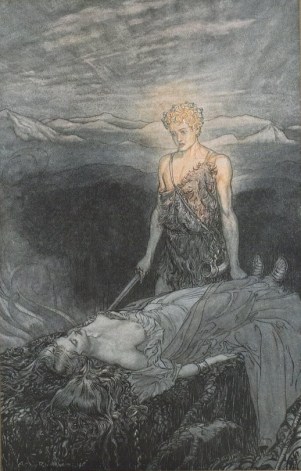
While Lewis speaks of an advertisement for the Rackham volume, Sayer in his 1988 biography Jack (p. 76 in the 1994 edition) claims that he got hold of a magazine that contained a review of the Rackham volume and featured an illustration: a painting of Siegfried looking down on the sleeping Brünnhilde in the light of the rising sun (whose breastplate he has removed so that her naked breasts are visible, cf. plate 13/30 of Rackham’s illustrations). However, he cites no source for this assertion;[6] on the contrary, he quotes the verses printed in Rackham’s volume on the left-hand page (facing the illustration)[7] and adds that these verses were presumably not reproduced in the review. It therefore appears that Sayer never saw the review himself, which he claims was the trigger for Lewis’ experience.

The actual source of Lewis’ teenage encounter with Northernness appears to have eluded biographers thus far.

After an exhaustive search, I have only been able to find one issue of a contemporary literary journal that contains the combination of illustration and the words Siegfried and The Twilight of the Gods. In the popular US magazine The Literary Digest, a reproduction of plate 29/30 from the Rackham volume appeared on 30 December 1911 with the caption Siegfried and The Twilight of the Gods. The picture shows Brünnhilde in the evening light leaping with her horse Grane onto the funeral pyre on which the dead Siegfried is being burned.
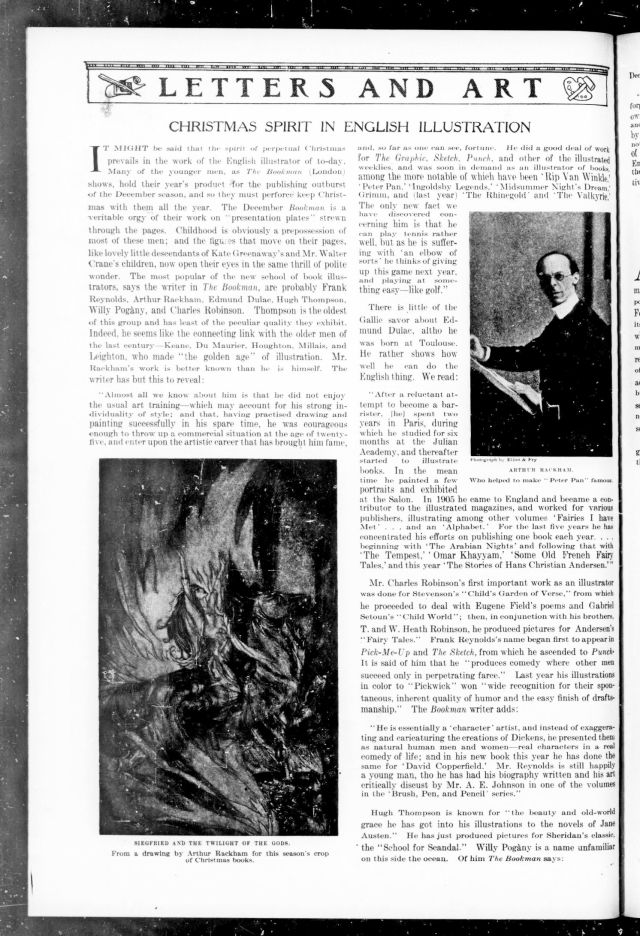
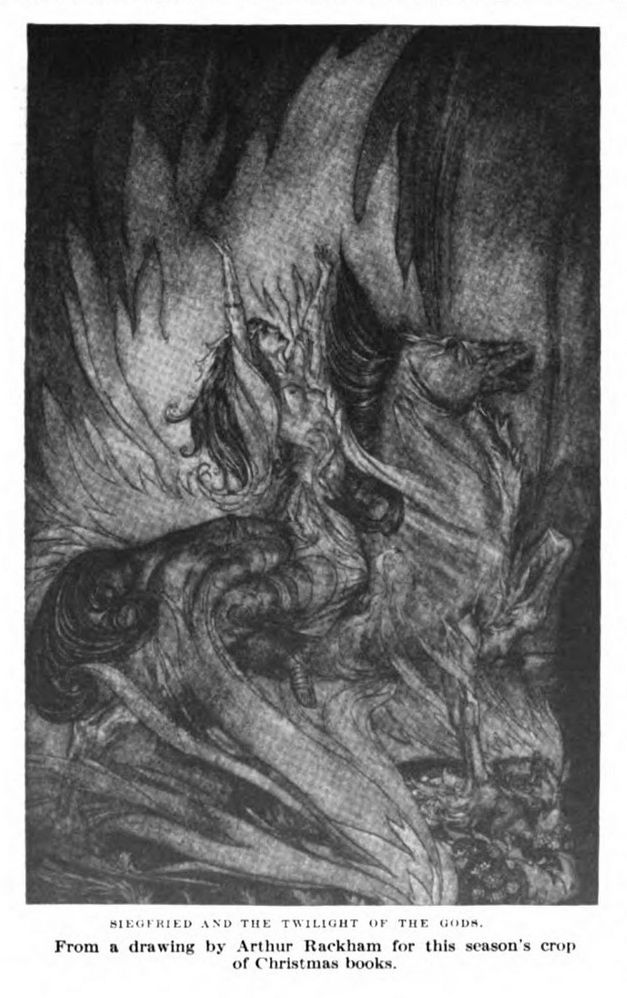
Are there reasons to suppose that it was this illustration that Lewis saw as a young adult? I believe so.

This illustration and caption include both elements of the memory of Balder that triggered joy in Lewis: Rackham’s illustration and the words printed next to it, Siegfried and The Twilight of the Gods. Tegnér’s Drapa[8] says of the dead Balder:

They laid him in his ship,
With horse and harness,
As on a funeral pyre. …
They launched the burning ship!
It floated far away
Over the misty sea,
Till like the sun it seemed,
Sinking beneath the waves.
Balder returned no more!

Here, too, a dead god is handed over to a funeral pyre (and a horse appears). And Longfellow also immerses his scene in the light of the setting sun, which may have provided an additional incentive for Lewis’ (mis)interpretation of the “Twilight of the Gods” as merely evening.[9]
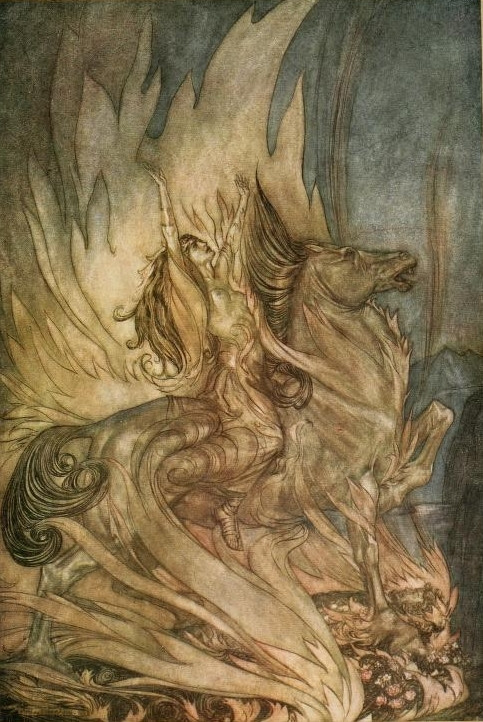
The similarity between the two scenes is unmistakable. This synchronicity could be the reason why Rackham’s image evoked the memory of the dead Balder in Lewis as he intuitively knew that Siegfried belonged to the same world as Balder (the images which came up in him apparently also resembled the imagery of Longfellow’s poem).

And there is a second (somewhat less obvious) reason this connection seems likely. In EPJ, Lewis explains his memory of the imaginative encounter:

“I saw that twilight hanging pale and motionless over the Atlantic, slowly fading through the endless summer evening of the North: I saw those gods wheeling through it aloft on flying horses: I think (but of this I am uncertain) [that] even then, from some forgotten source, I supplied them with winged helmets.”

Lewis’ hesitation about the winged helmets suggests that he was certain about the flying horses – that they were part of the original vision and not a later back-projection. Longfellow, who, according to EPJ, was Lewis’ only source for Norse mythology up to that point, does not mention flying horses anywhere. Thus, the question arises as to how Lewis came up with the idea of having his gods fly on horses – unless the picture itself gave him cause to do so.

As it turns out, Brünnhilde on Grane is the only illustration in the volume that shows a deity on a horse. This alone does not explain why Lewis, with his (very vivid) visual imagination, should have seen gods on flying horses. It is conceivable, however, that he had seen paintings of flying gods somewhere else, and that the illustration evoked the memory of these paintings in him. The Edda, which Lewis came to know only afterwards, features horses as mounts of the gods, and Wagner’s Valkyries are also often depicted on flying horses.[10]

After all, we cannot be certain that The Literary Digest was available at Cherbourg House. The Bookman and The Times Literary Supplement are more likely suspects to be found in the school’s library or common room. As we have seen, though, the archives reveal that they contain no illustrations of Siegfried and The Twilight of the Gods.

Thus, if Lewis really saw the image of Brünnhilde jumping with Grane onto the funeral pyre of the dead Siegfried, his reaction to both image and title would find an easy explanation. In the spirit of a cautious suggestion, it remains an open question whether Lewis actually saw this image in The Literary Digest or in some other unknown magazine. The combination of Lewis’ description of a Rackham illustration titled with the exact phrase, Siegfried and the Twilight of the Gods, suggests, in my opinion, that we are on the right track. It would be a striking coincidence if another literary journal had published exactly the same combination of image and caption at about the same time.

So the hunt is on: If someone should find the combination of image and title mentioned by Lewis in a British magazine (whether with the same illustration or a different one), and/or should put forward an equally plausible or even more plausible idea of what Lewis might have seen in his schoolroom at Cherbourg House, I’d be delighted – I’m sure we all would be delighted – to hear about it! Meanwhile, when we bring together the autobiography Surprised by Joy with the recently published evidence of “Early Prose Joy,” the Literary Digest advertisement remains strikingly resonant of Lewis’ profound teenage encounter with Northernness.


Norbert Feinendegen has studied philosophy and theology at the philosophical and theological faculties of the RWTH Aachen and Bonn’s Friedrich Wilhelms Universität (State Examination) and holds a PhD in Roman Catholic Theology from the FWU Bonn. He has worked for several years as a research assistant at the Theological Faculty of the University of Bonn and is a freelance author and lecturer in the field of religious education for the Archdiocese of Cologne. He is the author of two German books and several peer-reviewed articles about C. S. Lewis and has published with Arend Smilde The ‘Great War’ of Owen Barfield and C. S. Lewis Philosophical writings 1927-1930 (2015) and C.S. Lewis: Tutor and Lecturer in Philosophy: Philosophical Notes, 1924 (2021). He is advisor to the Owen Barfield Literary Estate and was a long-time board member of the German Inklings Society. His academic work focuses on the philosophy of C. S. Lewis, Christian apologetics, ethics and the relation of faith and science.


[1] Rackham’s illustrations of Siegfried and the Twilight of the Gods were published in late October 1911, together with Margaret Armour’s recent translation https://archive.org/details/siegfriedtwiligh00wagn/mode/2up. The first volume The Rhinegold and The Valkyrie was published in 1910.

[2] McGrath’s and Poe’s biogaphies make a similar claim but do not cite their sources or add further evidence. While Lewis speaks of only one image, all three (Green/Hooper too) seem to assume that Lewis saw a supplement with several illustrations.

[3] The 1906 Christmas edition of The Bookman, however, contained a Portfolio of three Rackham illustrations of Peter Pan.

[4] The title page of the Christmas Double Number states that it has a cover plate by Edmund Dulac and contains other (unspecified) full-page plates with pictures by Arthur Rackham, Charles Robinson, Claude A. Shepperson and Willy Pogány. However, such plates are neither (!) part of the portfolio, nor of the Christmas edition, nor of the supplement. I have not yet been able to solve this mystery.

[5] The US magazine of the same name (The Bookman), in its Christmas issue 1911, ran a full-page reproduction of plate 1/30 (p. 383), but with the subtitle “SIEGFRIED. BY ARTHUR RACKHAM”.

[6] It is theoretically possible that Lewis told his friend in a personal conversation that it was this painting he saw, but Sayer himself does not make this claim.

[7] “Mystical rapture / Pierces my heart; / Burning with terror; / I reel, my heart faints and fails” (Rackham p. 86). These are Siegfried’s words when, after removing the breastplate, he realises that the person in front of him is not a man but a woman. This four-liner is repeated on the left-hand page opposite the illustration (which is otherwise blank).

[8] https://archive.org/details/poeticalworksofh00long_1/page/216/mode/2up?q=balder

[9] Balder is referred to in Longfellow as the god of the summer sun, so that his burial coincides with the sunset; Lewis’s vision is marked by the fading of the summer evening of the north.

[10] Rackham’s first volume of Ring illustrations The Rhinegold and The Valkyrie also features the Valkyries riding flying horses, but Lewis didn’t see this volume until later. Whether he had a glimpse of this volume before he received it as a Christmas present from his father in 1913 is not known. The painting shown here is by Cesare Viazzi (1857-1943).

Posted in Original Research, Reflections | Tagged , , , , , , , , , , , , , , , , | 14 Comments

The Literary Past and Future in C.S. Lewis’ “The Quest of Bleheris”: My Talk Tonight at the New York C.S. Lewis Society (Fri, Apr 8, 2022, 7:30pm Eastern on Zoom)

I am very pleased to be speaking tonight at the New York C.S. Lewis Society, the world’s oldest active society for sharing the enjoyment and considering the impact of C.S. Lewis‘ life and works. The New York C.S. Lewis Society was founded in 1969, six years after Lewis passed away. A quick trip to the webpage will give you a sense of their remarkable contribution. Besides monthly meetings, they also produce CSL: The Bulletin of the New York C.S. Lewis Society–a society newsletter that never fails to provide enjoyment and profit for the reader. In each issue, you will find news, reviews, and book notes, but also an academic essay and some occasional features, like Dale Nelson–who has contributed from time to time on A Pilgrim in Narnia–and his “Jack and the Bookshelf” series (now numbering into the 50s in number). Although I have been able to purchase the back issues of CSL that I need for research, over the years, I have been gifted a handful of old copies of the Bulletin. I treasure these with my old scattered issues of Mythlore and The Canadian C.S. Lewis Society Journal.

Thus, you can understand why I have confessed that I had been hoping to one day speak to this group.

My last visit to New York was to study the manuscript of The Screwtape Letters in the Berg Collection at the New York Public Library (the lion library in NYC, or the Ghostbusters library for folks from the ’80s) and the original print run of Screwtape in The Guardian at the General Theological Seminary archive. However, that visit was in August, when the society has a hiatus.

So while I hope to gather with these great folk in person at some point soon, for now, I am pleased to be able to share some of my research on C.S. Lewis’ first attempt at prose, his 19,000-word incomplete story, “The Quest of Bleheris,” which he wrote when he was 17.

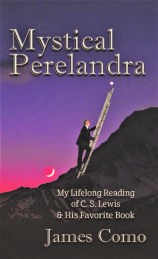
Below you can find the New York C.S. Lewis Society announcement from Facebook. Readers might also be interested in next month’s NYCSL talk by founding member of the society, James Como, and his new book, Mystical Perelandra: My Lifelong Reading of C.S. Lewis and His Favorite Book. Here is the blurb I wrote for Como’s unusual and provocative Perelandra study, which should be out by the end of the month:

“In Mystical Perelandra, Como draws us into the mysterious heart of the reader’s experience, living within rather than merely analyzing Lewis’ literary vision. The result is alchemical, poetic, and mercurial, a narrative spiritual theology where we imbibe the transcendent nature of Ransom’s planetary journey through Como’s imaginative, sacramental, life-integrated, mystical experience as a reader. And we are all the richer for his efforts. Como’s reflections on Perelandra transport us, like Ransom, to a world of myth and meaning much greater than a book.”

The Literary Past and Future in C.S. Lewis’ “The Quest of Bleheris”

This Friday, Brenton Dickieson will be speaking about C.S. Lewis’s first attempt at a novel, “The Quest of Bleheris.” Though it was only available in an archive in the decades following its composition in 1916, the full text is now available in the 2020 version of Sehnsucht: The C. S. Lewis Journal: Volume 14, 2020. The full text is about 19,000 words, and though incomplete, this teenage chivalric tale by C.S. Lewis is worth reading.

Dr. Brenton Dickieson is the author of more than 1,300 articles, blog posts, essays, and reviews, and is the curator of aPilgrimInNarnia.com, which explores the intersections of faith, fantasy, and fiction. Brenton works primarily as a theologian of literature, with a Master’s degree from Regent College and a PhD from the University of Chester. Brenton is currently an Associate Professor in Applied Communications, Leadership, and Culture at the University of Prince Edward Island, Adjunct Instructor in Literature at The King’s College (New York City), Lecturer in Theology and Literature at Maritime Christian College, Distance Education Instructor in Spiritual Theology at Regent College, and Lecturer and Preceptor in Signum University’s M.A. in Imaginative Literature program. Brenton is under contract with Oxford University Press for his forthcoming book, The Shape of the Cross in C.S. Lewis’s Narrative Spiritual Theology. Brenton lives in beautiful Prince Edward Island with his superstar kindergarten teacher wife, Kerry, and their teenage son, Nicolas, a singer-songwriter.

Follow the link for information on how to join the Zoom meeting on April 8 at 7:30 p.m: http://www.nycslsociety.com/meetings

Posted in News & Links, Original Research | Tagged , , , , , , , , | 11 Comments

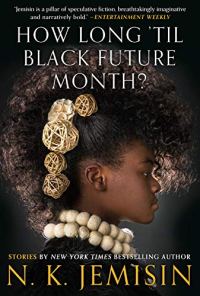
How Long ’til Black Future Month? by N.K. Jemisin (a review)

How Long ’til Black Future Month? by N.K. Jemisin
My rating: 4 of 5 stars

When I say that N.K. Jemisin is one of the most powerful writers in contemporary speculative fiction, I am making a claim of both influence and content.

In terms of influence, Jemisin is perhaps the science fiction writer with the most major awards and nominations in the last decade. Famously, N.K. Jemisin’s Broken Earth Trilogy won the Hugo awards (in the novel category) in three successive years (2015, 2016, 2017)—making her, I believe, the only author to have an entire trilogy win, the only author to win three years in a row, and one of only five writers who have three or more wins. Jemisin’s conclusion to the Broken Earth Trilogy scored the Hugo, Locus, and Nebula awards in a stunning trifecta. Finally, last year, The City We Became was Jemisin’s fifth nomination in the novel category, and it also took that year’s Locus and BSFA awards.

And these are just the novel awards. Jemisin has been nominated in other categories, including short fiction. Her 2018 short story collection that I am reviewing here, How Long ’til Black Future Month?, won the Locus Award and the American Library Association’s Alex Award, and was nominated for the World Fantasy Award. Plus, if common excellence awards are not enough, she was also the 2020 MacArthur Genius Grant fellow.

It goes beyond breaking award records. By consistently producing engaging, character-driven short stories, complexly beautiful science fiction novels, and thoughtfully prophetic nonfiction essays, Jemisin is one of a number of Black North American women speculative fiction writers who are helping to reframe readers’ expectations with genre-redefining literary fiction and speculative world-building, including folks like the legendary Octavia Butler, Tananarive Due, Nalo Hopkinson, Nisi Shawl, Nnedi Okorafor, and 2020 Hugo competitor with Jemisin, Rebecca Roanhorse.

Thus, while Jemisin has become a leading figure, her influence and prestige have come through two decades of unrelenting commitment to sophisticated world-building, culturally rich, character-driven literary prose, and a remarkable capacity for experimental writing. This concentration of character-voice combined with a disciplined approach to speculative world-building appears in some of Jemisin’s best writing in How Long ‘Til Black Future Month?

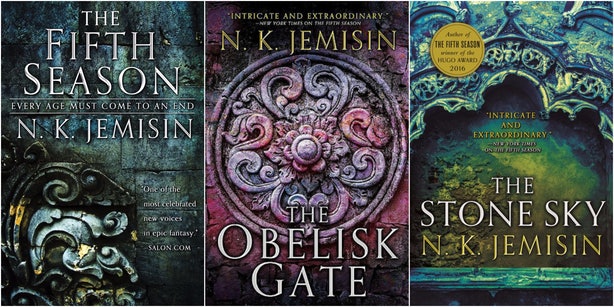
The true Jemisin fan is going to be particularly thrilled to participate in some of her short story experiments that later become novels or full series. “The Narcomancer” has a tinge of a melancholy sweetness, a story of conscience and vocational risk that becomes part of the Dreamblood series (which I haven’t read yet). “Stone Hunger” was exciting for me to read, for I was privileged to see how Jemisin began to conceptualize the extremely complex character make-up of The Broken Earth Trilogy–and how deeply implicated the characters are in that universe with the speculative world itself. And “The City Born Great” has all the terrifying brilliance and bracing goodness of The City We Became–an experiment in allegorical fiction that I have argued (here and here) is more successful in this short story than in the full novel.

Though she says it was her first professional story sale, “Cloud Dragon Skies” is a stunningly beautiful and weirdly imaginative inversion of so many CliFi tropes, a transformation of the “Ringworld” approach to science fiction that has left me in love with the main character. “Cloud Dragon Skies” is a science fiction tale, but there is an earthy, folk-wisdom that works like magic and has knowledge that sees beyond what science can measure.

For not all of her tales remain in the realm of what many call the “possible.”  Whether you decide that “Sinners, Saints, Dragons, and Haints, in the City Beneath the Still Waters” is a parable or fantasy may make little difference in the end. As a New Orleans flood tale re-imagined, however, Jemisin’s story uses speculative re-direction to hit at the heart of where climate catastrophe and the social will meet. Listen to this first paragraph:

The days which bracketed hurricanes were painful in their clarity. Sharp-edged clouds, blue sky hard as a cop’s eyes, air so clear that every sound ground at the ear. If a person held still enough, he would feel the slow, unreal descent as all the air for miles around scrape-slip-slid downhill into the whirlpool maw of the approaching storm. If the streets were silent enough, he would hear his own heartbeat, and the crunch of rocks beneath his feet, and the utter stillness of the earth as it held its breath for the dunking to come.

Soon, the shadow following Tookie to his about-to-be-deluged home will change the way that Tookie lives in his world–and invite us to do the same. There is a troubling moral complexity and problematic heroism of this New Orleans tale that also makes “The Brides of Heaven” so powerful. By using the competing internal and external tensions of ecology, religion, and gender in a tender survival scenario, in just a few pages, “The Brides of Heaven” creates a character-centred moral crisis comparable to what James Blish achieved in his A Case for Conscience.

I love N.K. Jemisin’s capacity for creating a speculative world, but there are times when her genius for invention outstrips the capacities of a particular story. For the most part, I think that is more of a plus than a minus when reading a 15-year retrospective of materials.

However, Jemisin is also a stronger storyteller in terms of character development and atmosphere the further she is away from proving a point or crying out in protest. For example, “Non-Zero Probabilities” has a genius “supposal” about a world where “luck” becomes realized and localized, but it concludes with a less-than-enthralling after-school special ending. “The You Train” is also smart, but the moral keeps overwhelming the character and her epistolary voice. “Too Many Yesterdays, Not Enough Tomorrows” has a similar message to the other two stories, except that Nemisin stays away from the pulpit throughout much of the story. Thus, the “Yesterdays/Tomorrows” altar call ending strikes me as far more organic to its life as a story.

There are times when Jemisin’s moralism works organically within the tale, but I think many of her tales that preach read well because of the sheer strength of Jemisin’s invention. “Cuisine des Mémoires” is absolutely gorgeous and preaches in the end; however, the meal in this case is worth the price. “On the Banks of the River Lex”–where humans have moved on and left all their gods and our imaginative creations adrift in the post-apocalyptic doldrums of posthuman vitality–is just so well done that I would have received any prophetic critique or moral injunction Jemisin wanted to offer. In this case, the invitation to moral reflection was deft enough, and it matches the beauty and humour of the piece. (We also, it is worth noting, get a Death that may have met Terry Pratchett once upon a time.) Likewise, there is a synchronicity of complex moral choice and inventive speculative possibility in “Walking Awake” or “The Trojan Girl” that makes both “world” and “moment” ring true, a walking together of truth and beauty.

However, it is sometimes Jemisin’s eye on a target that makes the story creak for me. “The Elevator Dancer” could be great–there are moments of greatness–but it has the strength of speculative ideological framing that we get in religious tracts. I love the main character in “Valedictorian” and the AI element is neat, but the story shares the tone of earnest rebuke one might find in the kind of commencement address that would be required for remarkbly unimaginative graduates.

And then there are some other pieces that I’m not sure what to do with–pieces that reveal what Jemisin calls her “angry” writing. I am terrified to read again “Red Dirt Witch” for the risk and the heartache and the consequence. I don’t know enough about that kind of storytelling, but I think it could be a great piece. But what do I do with Jemisin’s “pastiche of and reaction to” Ursula K. Le Guin’s brilliant and troubling “The Ones Who Walk Away From Omelas”? Jemisin’s story suggests that there are some ideas–not actions, sins, or acts of violence, but questions or thought experiments or beliefs–that must be extricated for a community to live together beautifully. And by “extricated,” I mean killed dead, with violence, intentionally and thoughtfully and without exception.

It is this sort of thinking about how communities should work that makes me so troubled by the characterization of “us” and “them” in The City We Became (my review: part 1part 2). Prophetic speculative fiction is no mean sword in the hands of a deeply moral writer, and N.K. Jemisin has some skill with the blade. My belief is that “morality” must always live within the three great transcendentals of truth, beauty, and goodness, or it becomes either the first signs of blight or the foundation for tyranny.

It could be that I have misread Jemisin, that I have made a flawed argument that she is a better fiction writer the less direct her moral vision is being portrayed to the audience. True fans and smart critics will no doubt send me back to the text.

However, if you are looking for an author who is trying to integrate the artistic creator and prophetic heart–the “Poet” and the “Man” as C.S. Lewis calls it in his essays–Jemisin is a powerful voice. And even with experiments that do not always succeed, as an inventive world-builder and character-centred prose writer, Jemisin combines the imagistic capacity of William Gibson with Ray Bradbury’s experimental tendencies. In the tradition of Octavia Butler’s inversive perspective, Jemisin applies her very own broad and diverse world-building and character-building capabilities to a story of immediacy and cultural relevance.

This is why Jemisin is one of this generation’s great speculative fiction authors. How Long ‘Til Black Future Month? is a strong and diverse collection from the leading science fiction writer of the moment.

My other reviews of Jemisin’s work:

View all my reviews

Posted in Reviews | Tagged , , , , , , , , , , , , , , , | 5 Comments

L.M. Montgomery’s The Story Girl, “Such Stuff as Dreams are Made On”: Chapter Reading, the L.M. Montgomery Readathon, a Montgomery Conference, and Other Things I am Working On (Friday Feature)

I thought I would use today’s “Feature Friday” segment of A Pilgrim in Narnia to highlight some L.M. Montgomery adventures this spring and in the months ahead.

My Chapter Reading for the L.M. Montgomery Readathon

For the L.M. Montgomery Readathon on Facebook, I recently read chapter 23 of The Story Girl. For those who haven’t joined in the fun yet, the Readathon is a COVID-era online community where we read through Montgomery’s novels one by one, taking a week to focus on each chapter. Primarily inspired by–and continuing to be fuelled by–Montgomery historian Andrea MacKenzie and Montgomery text critic and editor Ben Lefebvre, the Readathon includes book cover exhibitions, text-critical notes about the evolution of the book, historical background notes about Montgomery’s life and works, historical features about aspects of interest in the book, discussion questions, and links to relevant Montgomery society writings, archival pictures, and bits of news.

I was a late sign-up for reading a bit of The Story Girl. However, I think it was fortuitous that I was able to read the chapter, “Such Stuff as Dreams are Made On.” It’s a funny and endearing conclusion to the “Dream Journal” cycle in The Story Girl. But, because of the narrator Beverly’s precocious circumspection, it is a chapter that also provides an unusual and bittersweet depth of other possibilities in the King family.

Here is my chapter reading (which, by the way, was far harder than I thought it would be).

Note: I had the opportunity to interview Andrea for The MaudCast in season 1. Check it out:

Another Note: As I popped into the Inkling Folk Fellowship last week for Tolkien Reading Day at just the right time, I was also asked to read the first few paragraphs of the Ainulindalë–the Music of the Ainur section at the beginning of The Silmarillion. Not Montgomery-connected, but pretty sweet. Tonight’s Fellowship meeting is about the True Narnia Code, which Joe Ricke, having learned from Dan Brown, will finally reveal to all. You can find a link on Facebook.

Other Story Girl Brenton News

In the Montgomery Readathon bio below my reading, although I suggest here that Emily of New Moon is the most resonant Montgomery novel for me, I admit that I am one of those who have fallen under the Story Girl’s spell. Indeed, I argued earlier this winter in “The Literary Magic of L.M. Montgomery’s Storied Domains: The King Orchard and The Story Girl” that The Story Girl‘s “spell” is not merely a metaphor, but that we should be reading the novel with the kinds of techniques we would use in reading fantastic fiction. Well, perhaps “argue” is too strong of a word. I haven’t quite finished my work in this area, but that little “Storied Domains” piece is a model of one of the things I am trying to do.

Another one of those things is my long-term (hopefully one-day book-length) project on “L.M. Montgomery and the Spiritual Life.” I have a class pre-notice on this topic below, but I am also presenting about L.M. Montgomery on a theological theme at this spring’s L.M. Montgomery Institute 15th Biennial International Conference. This brilliant event will be held at the University of Prince Edward Island (where I have taught for 16 years and am currently serving as an Assistant Professor in our applied arts program, ACLC) on June 22-26, 2022. This year’s theme is “L.M. Montgomery and Re-vision,” and my project really is about re-visioning, re-seeing, re-considering how we think about Montgomery’s invitation to spiritual life in her fiction by noting the theological revisioning that her child theologians undergo as they image and imagine the character of God. Here is my abstract:

“Reverent Irreverence: Images of God and Montgomery’s
‘Pilgrims on the Golden Road of Youth’”

Mary Henley Rubio claims that L.M. Montgomery “retained a deep-seated reverence for the idea of God” (188). Coupled with this reverence are Montgomery’s verdant doctrinal challenges and a particular concern for the impression bad theology might make upon a child: “What a conception of God to implant in a child’s mind!” (SJ 1 378). As spiritual formation is critical to “pilgrims on the golden road of youth” (GR), and as the imagistic moments in her novels set the stage for personal discovery, it is worth considering how images of God, both reverent and irreverent, shape her fictional characters.

Immediately striking is The Story Girl, where a literal picture of God as a “stern, angrily frowning old man” is a spiritual loss of infinite value for the children (SG 61-3). Emily Starr contrasts the old-man-in-the-sky images of her elders’ Gods with her father’s God, a figure “clear as the moon, fair as the sun, and terrible as an army with banners” (ENM 23). Clarity, beauty, ferocity, and love inform Emily’s creative and subversive moral vision, her numinous experiences, and her tentative religious experiments. And Anne, a “rapt little figure with a half-unearthly radiance,” lost in a vivid chromolithograph of “Christ Blessing Little Children,” inserts herself into the picture in order to exegete it, making it a living moment of childhood theological formation (AGG 56).

What Aunt Elizabeth and Marilla call Emily’s and Anne’s “irreverence” is really their budding theological sophistication. Therefore, it is worthwhile following their peculiar theological methods. In this essay exploring the religious imagination of Montgomery’s characters as they navigate competing religious options with childlike wonder, like Anne, I will exegete Montgomery’s images of God by inserting myself into the picture. I will autographically consider the profound ways that childhood impressions shape theological expectations in Montgomery’s novels.

Other LMMI conference-related papers and projects that will be chapters or part-chapters in that currently imaginary but heretofore realized book include:

This is the perfect time to sign up for the LMMI Bienniel Montgomery conference at UPEI–to spend a gorgeous springtime in fellowship and exploring Prince Edward Island, or to join us in a hybrid event.

Online Short Course: “Spirituality in the Writing of L.M. Montgomery” by Brenton Dickieson

Finally, just a note until more details are published: I am teaching a short course at the Atlantic School of Theology in May on “Spirituality in the Writing of L.M. Montgomery.” This 4-week, online program is priced accessibly, and you can find some details here.

Posted in Feature Friday, Fictional Worlds, L.M. Montgomery, Reflections | Tagged , , , , , , , , | 7 Comments