Near-Inkling Martyn Skinner’s Near-Future Pandemic Poem: A Reading by Dale Nelson

Old Rectory or The Interview by Martyn Skinner.  Wilton, Salisbury, Wiltshire: Michael Russell Ltd., 1984.  107 pages.

Luke, known as Old Rectory, took up the hermit’s life many years ago, even before the time of the pandemic that sprang from a virologist’s laboratory.  Luke’s nickname refers to his residence near an abandoned church that he uses as a painter’s studio. The deadly Porton Sneeze killed most of the people then alive, and “progress” was held in abeyance.  Now, though, English cities have revived, but, though empty houses may still be shunned for fear of the plague, hermits have settled in “Barns, disused churches, signal-boxes, sheds.”

The journalist Fossick, and his friends Ponder and Baytre, intend to record the seldom-seen painter-recluse, Old Rectory, for a series on such folk.  The hermit psychically senses that they are coming.  He gives them drink…

The recluse and his three visitors settle in at the rectory.  The recluse talks for the tape machine (though he privately regards it as a “product of the second Fall of Man”).  Then, having put the three visitors to sleep, he mentally summons two hermit-friends.  They come and listen to the tape
Like 2021’s TV interviewers, the three visitors (at first at least) had hardly let Old Rectory open his mouth before they tumbled out their own ideas.  Fossick’s notion of fantasy versus reality is, Rectory tells his hermit-friends, the opposite of his own.  (I was reminded of Malcolm Muggeridge’s pungent late-life remarks about the pervasive unreality of journalism.)

But eventually Rectory was able to tell how, many years ago, he relocated from suburb to village – “A country lane was my Damascus Road.”  The idyll soon proved false.  It turned out that his neighbors were dull folk absorbed by gadgets and TV, and he was dismayed by their loose and noisy dogs that mobbed the roads.  He moved again.

He found treasure on earth in the remote rectory where he settled.  The simple life was beautiful.  But his credo of love of nature proved to be defective on the score of vulnerability and inadequacy.  As a solitary he was susceptible to erotic fantasies, and moreover he, so far, lacked an abiding sense of a personal God.  He groped for a divine First Cause, for the Creator; though natural beauty enchanted him, it was not enough.  He’d learned that there are similarities among the testimonies of mystics, though his quest would not stop there.

But at that point in the interview, though Rectory had not reached the nub of his argument, Fossick had suggested a halt.  One of the other visitors, the inquisitive J. J. Ponder, wanted to probe the matter of sexual temptation further and the recorder stayed on a little longer.

Old Rectory gave the visitors more to drink and soon they fell asleep.

Having listened to the tape, hermit-friend Dirk Willett grants that Old Rectory laid a foundation, and the recluse says, “It’s our Christian plight; Before re-building we must clear the site.”  Ralph Brompton Ralph, the other hermit visitor, thinks that Rectory may have been at his best when dealing with lesser matters – comparable to marginal manuscript illuminations that charm with decorative mermaids, gems, and peacocks but distract from Bethlehem and Calvary.

Rectory had hoped he could help the interviewers to consider “the verities Of death, redemption, and Apocalypse” and bear such truth into the world.  But he realized they had no interest in metanoia.  He now believes the three hermits themselves need to go forth, for the sake of a new world to be “grounded in redemptive grace.”

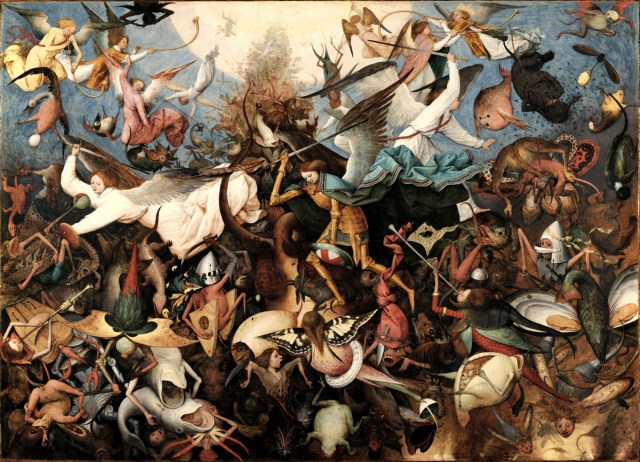
The three recluses, joined by their hermit-friend Malachi, visit Rectory’s studio in the abandoned church.  Now we readers see what Rectory has been doing during these many years.  His paintings include works derived from the masters—Breughel’s phantasmagoric Fall of the Rebel Angels, Piranesi’s Aqueduct of Nero with its image of the Cross as two intersecting, living branches growing above the ruins, and Rubens’s Adoration of the Kings.

Removed from a world enduring catastrophe, Rectory has followed what Charles Williams called the Way of the Affirmation of Images.  The poem’s allusions and references remind us of great art and books – especially the Book; what a contrast with our present culture of forgetfulness, replacement, and obliteration.  Skinner makes you want to read and view such things more gratefully.

The reveries of the four hermit-friends are interrupted by the clamor of the journalists demanding to be let in for more interviewing.  It’s evident that they represent a great many survivors who have learned little or nothing from mankind’s disaster.  The ailing Malachi volunteers to stay behind while the other three friends slip away.  What the results of their mission will be, they entrust to God.

Skinner’s fluent long poem, combining blank verse and rhyme and language-play, was dedicated to his old friends Hugh Waterman and Bede Griffiths, the trio whose real-life “experiment in common life” is described so memorably in Griffiths’ The Golden String (1954).  That was one of the first books with material about C. S. Lewis and the Inklings.

When I read Old Rectory’s praise of candlelight I was reminded of a passage in Griffiths’ book.  Like Griffiths, Skinner was a friend of Lewis; Skinner and Griffiths were in the penumbra of the Inklings.  I’m sure Lewis would have found Old Rectory to be delightful.

In 2018 I wrote about two earlier book-length poems by Skinner (1906-1993) here at Pilgrim in Narnia.  These were The Return of Arthur and Sir Elfadore and Mabyna.  You will find more about Martyn Skinner in those columns.


Dale Nelson is a columnist and reviewer for CSL: The Bulletin of the New York C. S. Lewis Society and Beyond Bree, a monthly Tolkienian newsletter.  His work appears in fanzines such as Pierre Comtois’s Fungi, William Breiding’s Portable Storage, and Bob Jennings’s Fadeaway.  He lives in rural North Dakota with his wife and four cats, and is a member of the local Lutheran Church-Missouri Synod congregation.

Note on Muggeridge

Skinner’s contemporary Malcolm Muggeridge (1903-1990) was a print and television journalist and editor.  A notorious satirist during much of his career, he was often mocked for his late-life public embrace of Christian faith.  Among his books is Christ and the Media.

“I don’t want to keep abreast of current affairs, and if I did want to, [television is] the last place in the world to look.  What you keep abreast of is not current affairs but a fantasy called ‘ the consensus’ which is presented by various interests.  The idea that people are better informed because of television is to me a most laughable thing.  They’re better informed – but with lies! …the most essential thing for human beings is to have an awareness of their Maker, God, and to see their own lives in time in relation to God and in relation to eternity.  …But in fact, partly through the media, this awareness of God has been enormously eroded and people think increasingly that man can live his life in purely mortal terms.  That he can shape his own destiny.  …the concepts of good and evil on which all law, all morality, and all transcendentalism are based have largely gone.” – Muggeridge in a 1974 interview published in the Berkeley Christian “underground paper” Right On! (May 1975).

In The End of Christendom (addresses given at the University of Waterloo in 1978), Muggeridge said, “A strange thing I have observed over many years in this business of news gathering and news presentation is that by some infallible process media people always manage to miss the most important thing.  …In moments of humility, I realize that if I had been correspondent in the Holy Land at the time of our Lord’s ministry, I should almost certainly have spent my time knocking about with the entourage of Pontius Pilate, finding out what the Sanhedrin was up to, and lurking around Herod’s court with the hope of signing up Salome to write her memoirs exclusively.  I regret that this is true.”

Muggeridge had firsthand experience of the alliance between journalism and fantasy in the early 1930s.  As correspondent in Stalin’s USSR for the Manchester Guardian, he was the first reporter to break the story of the Holodomor, the state-engineered terror famine that killed millions in Ukraine.  (Muggeridge’s reports were followed days afterwards by Gareth Jones, subject of a recent movie.)  The famine story was soon suppressed.  Instead, the infamous New York Times reporter Walter Duranty won the Pulitzer Prize for his (false) account of Russian affairs, denouncing reports of the famine, and, a few years later, defending Stalin’s show trials.

Muggeridge refers to Duranty here (about 7:30):

MALCOLM MUGGERIDGE: “Reflections on Stalin’s regime and THE HOLODOMOR” – YouTube

I wrote about Right On! in the fanzine Portable Storage #3 (the San Francisco Bay Area issue), pp. 82-87.  PS is in no way a Christian publication; but the editor has been remarkably receptive to my work.

PortableStorage-03.pdf (efanzines.com)

Posted in Reflections | Tagged , , , , , , , , , | 5 Comments

Why is Tolkien Scholarship Stronger than Lewis Scholarship? Part 1: Creative Breaks that Inspired Tolkien Readers

 tolkien vs lewis pbsIt is a question that has been nagging me for some time: Why is Tolkien Scholarship Stronger than Lewis Scholarship?

Meilaender Taste For The Other 2By this, I do not mean any particular insult to Lewis scholars. I am one, in fact. As I note in some of other writing in various places, we have critical Lewis work of significant note Colin Manlove, Charles Huttar, Gilbert Meilaender, Paul Ford, Marsha Daigle-Williamson, David Downing, Diana Pavlac Glyer, Corbin Scott Carnell, Joe Christopher, Edith Humphrey, Charlie Starr, Monika Hilder, Mary Stewart Van Leeuwen, Don King, Don Williams … oh, and Michael Ward, who some folks might have heard of. Plus the ones I have forgotten, and some that you may appreciate that I haven’t fully considered.
Beyond these critical scholars who have written books of note, there are dozens of really important journal articles. There are also some cool theses now nearly lost in the stacks and interesting popular work by folks like philosopher Peter Kreeft, professor Devin Brown, or pastor Will Vaus. Even listing them–and I have altogether left out the biographers, resource-makers, editors, reception studies scholars, those engaged with Lewis and philosophical thought, and writers of particular studies–puts me in some danger, for a reason that I note below. And there is some work I haven’t gotten to yet, like Steven Beebe’s work on rhetoric (okay, I peeked) or the writing on Lewis and education (except Joel Heck’s book).

tolkien vs lewis 3There are some truly terrible C.S. Lewis studies and popular books, too, though I don’t care to list them here. I’m sure these exist for J.R.R. Tolkien as well. However, I think it is more likely that novelists will write terrible Middle-earthish novels than popularizers bowdlerize Tolkien’s thought, popularize him beyond recognition, or otherwise measure him for peculiar procrustean beds.
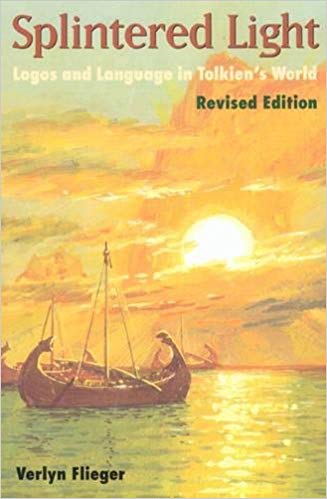
Verlyn Flieger splintered lightThough I think the biographies between the two most popular Inklings are largely comparable, there is a rich current within the best of Tolkien studies that is remarkable. I simply have never encountered something in Lewis studies like Verlyn Flieger‘s Splintered Light–a lyrically beautiful critical study, tight and thematically vibrant, invested in the entire corpus and yet completely accessible as a single study of light and darkness, word and language, using two of Tolkien’s lectures to focus the material (Meilaender’s study of Lewis is close, but not as beautifully written). Is there an historical Lewis study comparable to John Garth‘s Tolkien and the Great War? Is there a parallel within Lewis studies to the strong medievalist approach to and with Tolkien? Has there been a Lewis scholar with the prestige (and accent, well, maybe accent) of Tom Shippey–not just an Oxford and Cambridge scholar, but one who is quite literally Tolkien’s successor as a medievalist? And then there are the linguists and lexicographers: there is nothing like them in the world of literary studies, I think, let alone any study like these attending to Lewis’ work in any particular way (except perhaps Joel Heck’s chronology).
Mythopoeic AwardsGo further: take a look at, say, the Palgrave Macmillan catalogue of Tolkien studies and compare it with any imprint with a Lewis catalogue and you can see the difference in scholarly quality of the field as a hold. Or look at the last 5 years of nominees for the Mythopoeic Awards for Inklings Scholarship. It is hard to compare, frankly.
Without denigrating the good Lewis scholarship or neglecting the fact that Lewis scholars have created great popular-level materials, how do we account for the differences? Here are some of my theories as a conversation starter. In Part 1, I talk about four moments in Tolkien readership that resulted in bursts of creative scholarly energy. In Part 2, I take the daring approach of comparing and contrasting the work of Lewis and Tolkien. And in Part 3, I look at other factors, focusing especially on the tools and techniques that Lewis and Tolkien scholars have used.

I have not done anything like a full scan of Tolkien scholarship, so feel free to critique my reasons or enhance my understanding of Inklings studies. You are welcome to use the comment section or social media to challenge me or develop an idea further. If you want to write an essay in response proving me wrong or right, I’ll even give you space here to publish it (if it is well-written). But this is what I would offer as a coffee-time, conversation-starting set of reasons why the fields are different.

Frodo Lives banner1. Tolkien and Lewis Fandoms: The First Break in Tolkien Scholarship
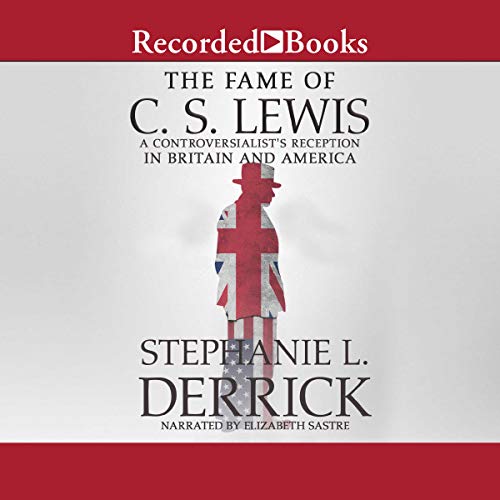
Derrick The Fame of C.S. Lewis audiobookLewis and Tolkien’s fiction has different paths in both the public and in literary studies. As Stephanie Derrick relates in her 2018 reception study, The Fame of C.S. Lewis, Lewis’ growth in popularity was slow, beginning with some note and notoriety for Lewis with Screwtape, then growth of his public profile, and finally a slow evolution of the importance of his Chronicles of Narnia in public view. In particular, it was America that seized upon Lewis as a literary light, especially in education and the Christian community. The UK was begrudging in its acceptance, so that Lewis only received a degree of admiration in the new century. By contrast, Tolkien’s popularity after the publication of The Lord of the Rings was explosive. From “Frodo Lives” movements to local societies, the commitment of Tolkien readers has been clear.
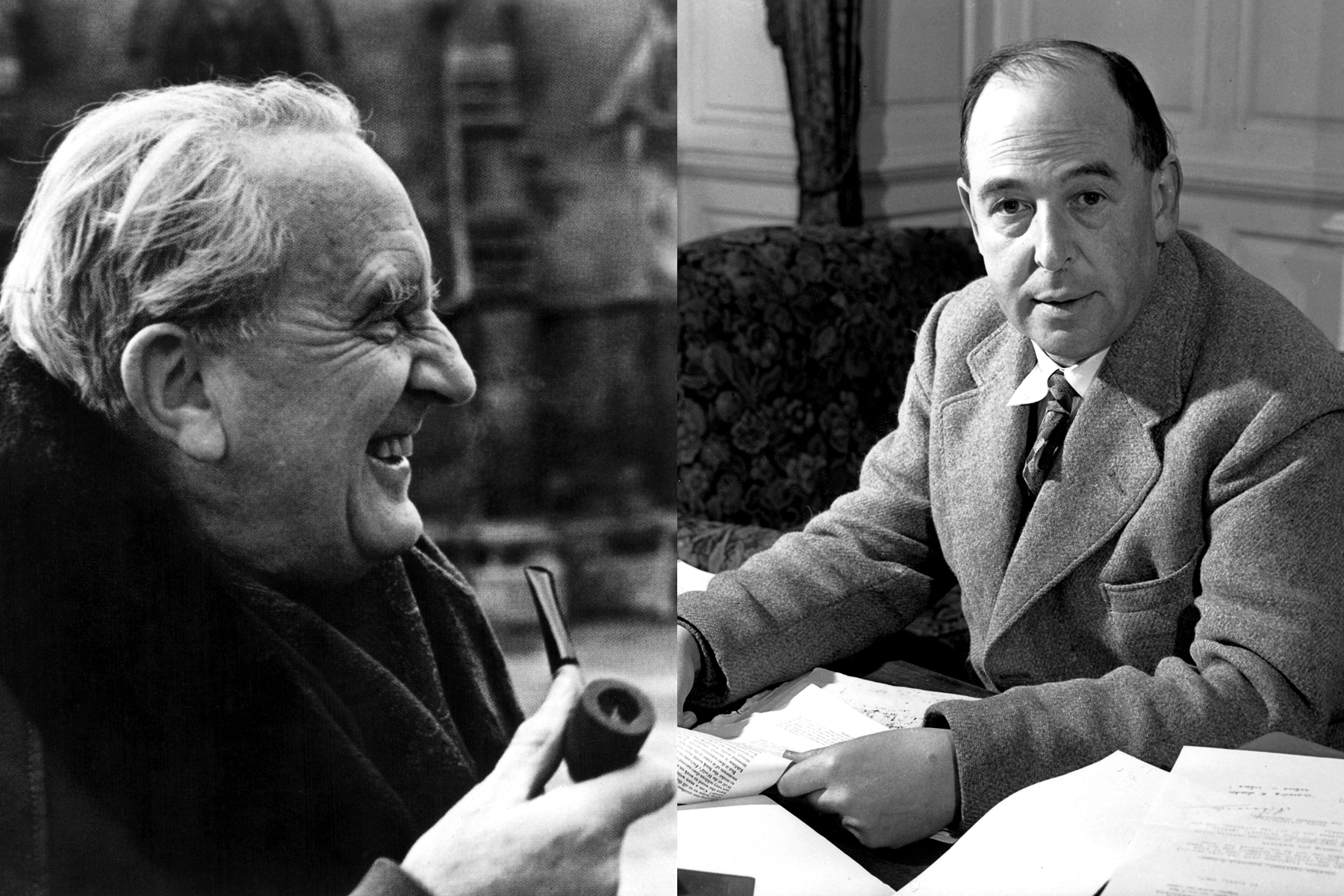
As a result, many of the 25+ posthumously published Lewis volumes and the many reprints are popular and accessible books, largely pitched to Christian readers and thus very essay-laden. Meanwhile, the 25+ posthumously published Tolkien volumes are mostly careful, scholarly tomes of archival materials that contribute to the single Middle-earth legendarium or to Tolkien’s artistic formation. While there are fans in both camps, Lewis readers of these books-after-life gifts to us are largely people trying to grow in their faith or clarify their worldview; Tolkien readers are, simply, nerds. Tolkien scholarship, then, has a built-in early-days rigour to it that Lewis studies did not need.

tolkien vs lewis 22. Tolkien and Lewis as Literary Scholars: The Second Break in Tolkien Scholarship

In the highbrow field of literary studies, the situation is more complex for two reasons: Lewis and Tolkien’s own literary scholarship and the question of whether Narnia and The Lord of the Rings are “literature.” First the question of Tolkien and Lewis as scholars.

tolkien beowulfLewis and Tolkien are each regarded as having made small-but-significant contributions in their respective field: Lewis in the literary history of the 16th and 17th centuries and Tolkien in Beowulf studies. In my reading of things, Tolkien’s work has had more critical engagement than scholars working with Lewis. Lewis’ Preface to Paradise Lost is probably read more often than Tolkien’s Beowulf lecture. In scholarship, however, the Preface is merely there as an interesting point of conversation and an accessible introduction to the poem. It seems to me that medievalists and Beowulf scholars take time to wrestle with the gauntlet that Tolkien threw down in his Beowulf essay far more than Milton scholars take Lewis’ argument serious. Thus, Tolkien’s scholarship seems to invite deeper conversation than Lewis’, which is helpful and enjoyable but does not change the nature of the game as much.

However, I think that these differences are enhanced by the fact that Lewis scholars have not always been attentive enough to what Lewis is doing on a theoretical level. Beyond these two contributions to Milton and Beowulf studies, I don’t think there is any doubt that Tolkien has been more influential in fantasy studies (with his “On Fairy-stories” lecture/essay). However, I think that scholars have simply missed the degree to which Lewis is creating a metacritical framework of thinking about speculative world-building. Likewise, Tolkien is more well-discussed in medieval studies, for excellent reasons. But I argue in my chapter in The Inklings and King Arthur that Lewis is undervalued in thinking about intertextuality, and I argue in my PhD thesis that Lewis suggests a theory of literature that is in strong conversation with the “French turn” of the 1960s. Tolkien scholars are far more adept at considering the consequences of Tolkien’s work in medieval studies than Lewis’ contribution in a quite different way to the same field. Watch the papers at Kalamazoo and you’ll see that I’m not wrong. There are missed opportunities here by Lewis scholars, I believe.

lord of the rings ballantine 23. Is this Literature? The Third Break in Tolkien Scholarship

Brian Attebery Strategies of FantasyIn Strategies of Fantasy (1992), Brian Attebery has a chapter entitled “Is Fantasy Literature? Tolkien and the Theorists.” It is quite a question. In the next Part, I will discuss the question of genre, which partly answers this question–The Lord of the Rings is “literature” in a way that Narnia is not.
However, while I know that I am overstating things a little bit, but Tolkien scholars were far better at making the case in scholarship that The Lord of the Rings is “real” literature that deserves to be taken seriously not just as a phenomenon of readership but as a literary work that warrants deep, critical study. Perhaps Lewis scholarship simply stepped to the side and did the analysis they wanted to do without worrying about what the MLA Hall Monitors thought of their work. There is something admirable about that approach. But in challenging the presumptions of literary criticism–in showing up for the fight–Tolkien reader-scholars were able to enter into a field of discourse that Lewis reader-scholars have rarely entered.

lord of the rings banner4. The Films: The Fourth Break in Tolkien Scholarship

lord of the rings film box setThere is a lot of debate about the quality and faithfulness of the LOTR Peter Jackson films–and the Hobbit films are a clear demonstration that you can indeed have too much of a good thing. There is no doubt, however, that the Peter Jackson LOTR films are far superior to the Narnia films on almost every category of comparison. While some might say that The Lion, the Witch and the Wardrobe makes a fine (though not amazing) Disney film, the trio of films go from fine to terrible to unwatchable. By contrast, the Lord of the Rings trilogy is beautiful, expansive, artistic, and evocative–if not always satisfying.

More than anything, however, the LOTR films inspired an entire generation of readers with great imaginations. Beyond sales and fan clubs, the films inspired a generation of new Tolkien scholars to put their minds and hearts to the task of thinking resonantly about Tolkien, the worlds he made, and the worlds he inspired. Young adults, especially, watched the films, bought the books, and read or reread with new eyes. I am one of these who was made to fall in love again with the Middle-earth stories. In the years after, I was slowly drawn in more and more deeply into Tolkien’s unruly and evocative imagination.

It’s true that the Narnian films and books are, by nature, for children, so may be better at forming the imagination and social life than forming vocation. Still, there is a difference in substance that enhances that development so that the Peter Jackson films have inspired any number of budding intellectuals and authors to turn their critical eye and creative pen to the task of scholarship.

Stay tuned for Parts 2 and 3, where I consider other facts inside the literature and out in the scholarly worlds.

Posted in Reflections | Tagged , , , , , , , , , , , | 70 Comments

Wounds that Never Fully Heal: An Easter Reflection on Frodo Baggins — by Laura Schmidt

Here is a smart, personal, and bookish Inklings-related piece by my friend, Laura Schmidt. Laura has served as Archivist at the Wade Center in Wheaton, IL, since 2005. She is a deep lover of Tolkien’s works and as an archivist, she has helped countless scholars and writers make connections between the authors they love and the questions in their hearts. “The Wounds That Never Heal” makes a good meditation for Good Friday–and, in our hope of ultimate healing, a thought that welcomes Easter.

wadecenterblog's avatarOff the Shelf

Broken plate Image: CHUTTERSNAP, https://unsplash.com/photos/Odc4dcsjUBw

Stories hold a special ability to deeply impact their readers. Those who enjoy reading imaginative fiction like The Chronicles of Narnia and The Lord of the Rings by the Wade Center’s authors already know the truth of that statement. From the page to the screen, from the parables Jesus used for the spiritual benefit of his audiences to the trials of two small hobbits struggling up the slopes of Mount Doom, stories engage the heart in ways that other forms of expression cannot accomplish. We yearn for that kind of engagement and feel nourished once we find it, like taking a breath of fresh spring air or a drink of water after a long thirst.

J.R.R. Tolkien calls this nourishment “recovery” in his essay “On Fairy-Stories,” explaining that stories can help us see life afresh and reawaken or illuminate spiritual truths:

“Recovery (which includes return and renewal…

View original post 2,281 more words

Posted in Reflections | 11 Comments

“Small” and “Little”, a Literary Experiment on J.R.R. Tolkien’s The Hobbit with Sparrow Alden

The Hobbit by JRR TolkienI have talked about Sparrow Alden’s work before, the creative Digital Humanities project to stage all of the words in J.R.R. Tolkien’s The Hobbit. Her “Words That You Were Saying” blog then offers up visual word studies that invite us to imagine dominant, peculiar, and hidden themes in this literary fairy tale. Digital Humanities work is not magic; we consider the data, doing all the work before we know if we will see a result. But I have found Sparrow’s word studies have consistently made me reflect on the text in fresh ways.  

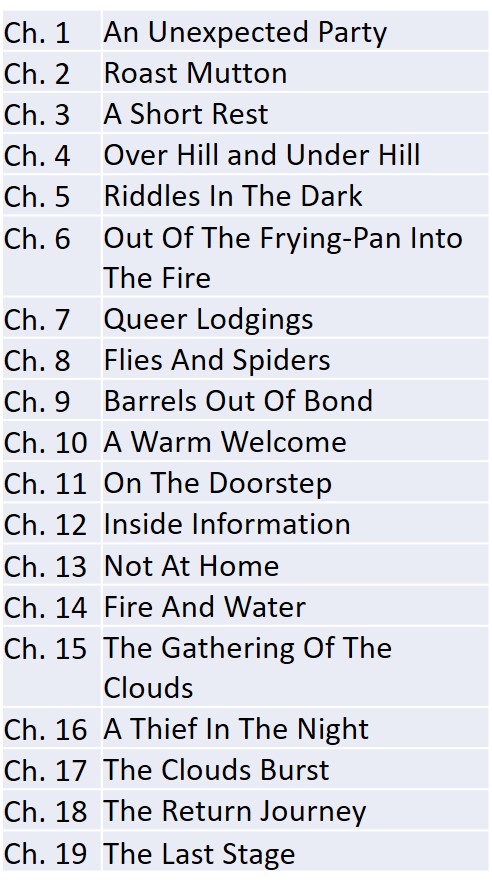
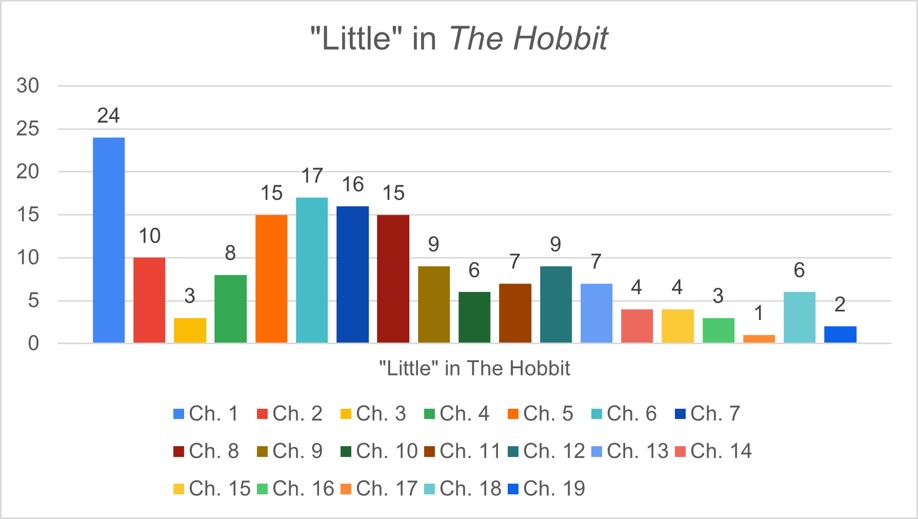
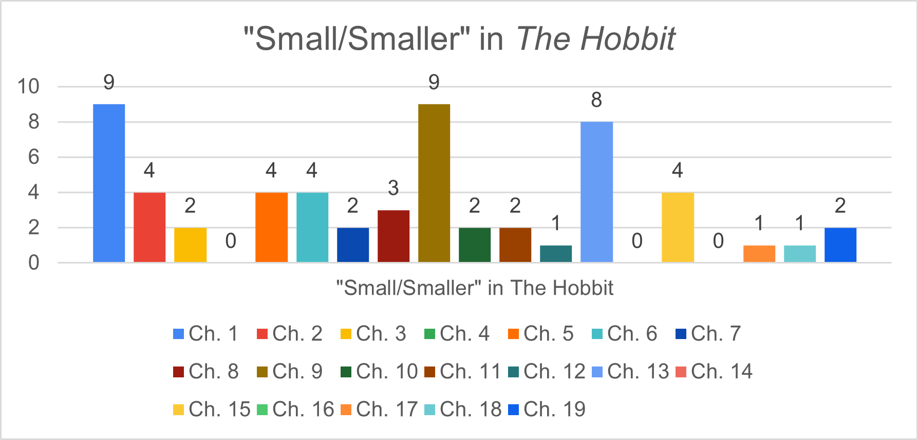
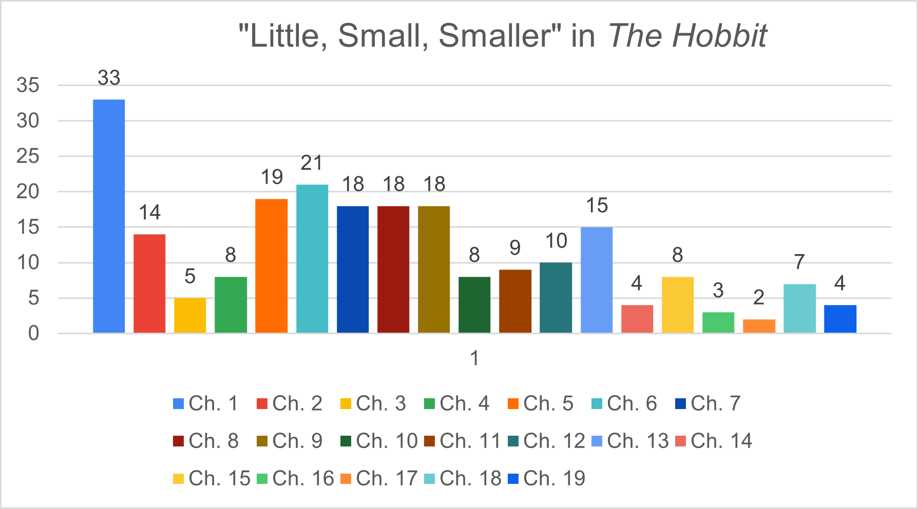
It’s a cool project, but I also have been able to make use of it in my scholarly work. In preparing for a lecture in Northwind’s Romantic Theology program, I began playing with words in the text, playing out an image that I think is a bit under-appreciated. Because she is entirely equipped, I reached out to Sparrow to see if she could run the data on “little” and “small” in her magic Digital Humanities project. This is the first part of that project and “Small,”was not far behind. I then spent some time visualizing the data, using it to enrich my close reading. The first picture is of the chapter list of The Hobbit, and some charts to capture Sparrow’s word data.

Small Hobbit Chapters

Small Little Data Chart 1 Hobbit

Small Little Data Chart 2 Hobbit


Small Little Data Chart 3 Hobbit

I think this is a good example of cooperative scholarship and digital humanities experimentation at work. Thanks to Sparrow and I hope students found the slight tilt in perspective enriched their reading as much as it did mine!

lfsaldenbirch's avatarwords that you were saying

Finally! Thanks to the Rev. Dr. Dickieson over at A Pilgrim in Narnia, I have gotten un-stuck from the word which has held me in thrall since October. I hope this is of interest to his students in their study of the power of small ones:

• 1.004 and smaller than the bearded Dwarves.
• 1.004 the small river that ran at the foot of The Hill.
• 1.006 since they were all small hobbit-boys
• 1.059 and a couple of small tables
• 1.068 he sent a smaller smoke-ring from his short clay-pipe
• 1.109 Because it is too small.
• 1.113 a small and curious key.
• 2.022 There was a very small pony,
• 2.112 very small and secret.
• 2.113 too small for trolls,
• 2.123 our small stock of provisions.
• 3.009 some of which were small,
• 3.033 in the story of Bilbo’s…

View original post 393 more words

Posted in Reflections | Tagged , , , , , , , | 16 Comments

The Other Reasons I Became a C.S. Lewis Scholar

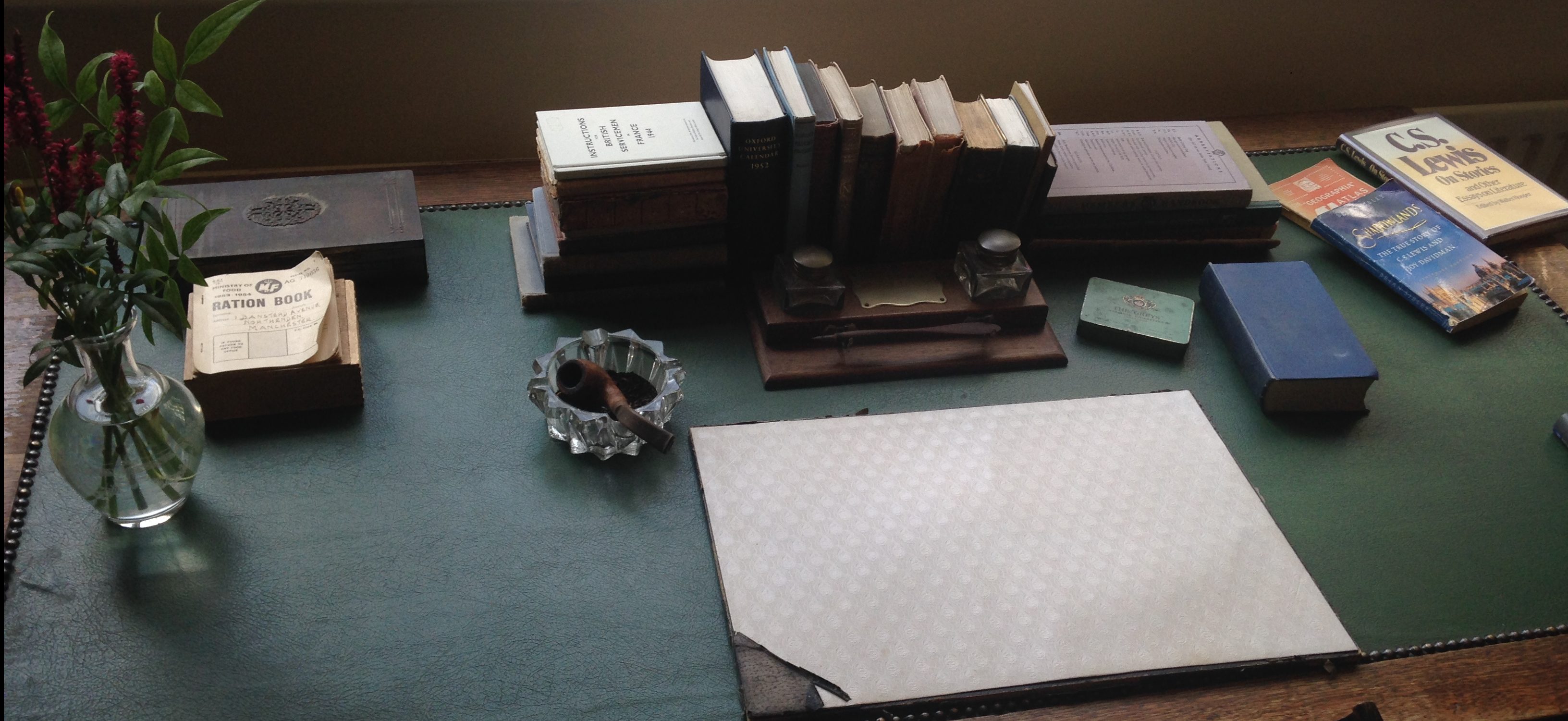
the-kilns-lewis-deskAn intriguing, fun, and occasionally perverse part of being a scholar in areas where there is a lively fandom is that I am often asked to tell my “encounter” story. This can be a bit strange in that in the scholarly worlds of the authors I love: Lewis, Tolkien, Montgomery, Rowling, Le Guin (I don’t hear it with Stephen King). These encounter stories can be so powerful that it creates a warm bubble of protection around the author. Reading-encounter stories are often like conversion stories, with all the intimacy and intensity of a revival tent altar call. Who am I to break into that sacred space with a critical thought? When your favourite authors are saints, the best way to write about them is hagiography, after all.
This is obviously less of a problem with Le Guin and Rowling, who were both cultural critics and were each skewered in society in different ways. But outside of questions about gender and violence, there can be in Lewis studies a hedge of protection about the Narnian. I remember offering a critique of Lewis’ idea of “vocation” at a C.S. Lewis and Friends conference once and felt a sudden posture of caution from the crowd.

And I get it! Lewis’ writing is able to awaken my imagination. His works provoke me to think about theology, culture, literature, and spirituality in fresh ways. I understand why, with book sales exceeding 200,000,000 copies, a billion-dollar film industry, and a bookshelf of critical, philosophical, and popular works continually in print, C.S. Lewis is both the beloved author of The Chronicles of Narnia and the leading 20th century English-speaking Christian public intellectual. I like reading his works, so I do.

Because 11 years ago someone helped me think cleverly about the way I shaped my scholarly career, I thought I would write a short piece about “The Other Reasons I Became a C.S. Lewis Scholar.” Going into Lewis studies was not just fan-blindness; I was intentional in my choice to be a Lewis scholar. Here are the reasons I don’t say aloud very often because they are entirely pragmatic. But they may be able to help others shape the way they approach grad school or a book project about C.S. Lewis, another leading writer or public figure, or about any area of study that you truly love.

cs-lewis-selected-literary-essaysC.S. Lewis as Essayist and Me the Writer
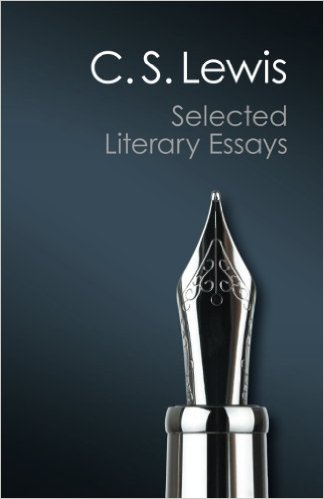
A prodigious essayist, it is this area of C.S. Lewis’ work that I find the most provocative. In terms of influence on my life, I feel this more strongly even than of his popular fiction and apologetics books. Whether inspirational or controversial, his brevity, clarity and wit strike through his reviews, lectures, published letters, editorials, sermons, public controversies, papers, and critical essays. Essay writing was an area that Lewis excelled in, leading to nearly 200 short pieces still in print. Frankly, one of the reasons I turned to Lewis was because I wanted to become a better writer of nonfiction. I still haven’t managed to be as concise, but Lewis’ essay-writing has helped me learn to see in pictures and try to capture some of what I see on the page before me.

CS Lewis Essays Presented to Charles WilliamsA Scholarly Community I Can Be Part Of

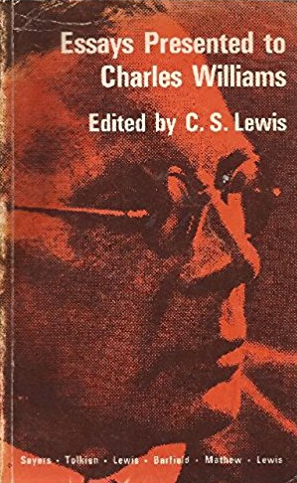
Sprinkled throughout the 1,100 articles on A Pilgrim in Narnia are dozens of references to what I think is the strongest feature of C.S. Lewis studies: the scholars. I have written here about the “Unpayable Debt” of writing friends, a “Small Circle of Blog Friends,” how senior Lewis scholars are great at mentoring emerging scholars, and dozens of reviews and notes about scholarly work I’ve found valuable. In a recent paper and my PhD thesis, I acknowledge the debt of gratitude of dozens of Lewis scholars and readers for their support, criticism, and conversation over the last decade.

Lewis scholarship is a remarkable place for inviting people to think about the intersection between Lewis and the literary age, culture, politics, gender, theology, and spiritual life. However, when I decided to enter this field, I had no idea what it would be like. The advice that a retired academic gave me was to pick a figure to study that had literary societies in place so that I could enter a conversation already in play–a place where I could present papers, test ideas, and dialogue meaningfully with others. I had no idea how rich that scholarly community would be for me.

collected letters cs lewis volume 3 ed by walter hooperFinding the Books I Need

Because of the work of C.S. Lewis scholars and his lifelong friends, and because of a hungry fanbase of book-buyers, we are in the remarkable position of having Lewis’ entire book catalogue constantly in print. It’s true, I am not always able to get a 1st edition when I need to do precise text critical work–and I own no true 1st editions. However, by keeping my eyes open, I was able to get everything that Lewis published pretty cheaply. And where something is difficult to find, such as his late ’30s essay collection, Rehabilitations, as a non-American scholar, I was able to buy an inexpensive Kindle reprint. Similarly, the 3rd volume of the Collected Letters is extremely expensive, but I was able to use the ebook until I found one at the right price.

Beyond Lewis’ book publication, circumstances have conspired to give readers a remarkable breadth of materials. Walter Hooper has published 3,800 of Lewis’ surviving letters, scholars have been continually bringing archival material to print, and Lewis’ lifetime publication of 40 books has grown to about 60 in the literary afterlife. Beyond that, Lewis’ books are available in many platforms. I can read Mere Christianity in my old paperback with Thai beach sand stuck in the crevices. Then I can reread and make highlights on Kindle, or read it by audio with Geoffrey Howard’s trusty Lewis voice (aka, Ralph Cosham–now free for US Audible subscribers) or a new version by Julian Rhind-Tutt–supplemented by a few bits of Lewis’ original BBC recordings. As Lewis is mostly out of copyright in Canada, and as Kindle is priced reasonably, I have e-copies of much of what Lewis wrote, giving me text-search capabilities I could not have of the entire œuvre of most prolific authors. In Lewis studies, we are embarrassed by the riches of availability, supplemented by resource-folks like Joel Heck and Arend Smilde. All of this allowed me to get into Lewis studies without great expense, and to launch a chronological reading project that would be much harder (or impossible) to design for many other writers.

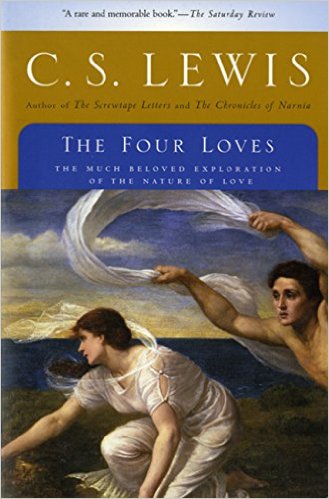
cs Lewis The Four Loves3The Hard Part of Reading

I was sitting in a campus cafe, feeling hopeless and far from home, when I got my advice to root my scholarship in the thinking of a public intellectual with established societies. I have always laughed out loud when Moses’ father-in-law, Jethro, responded to Moses’ hard work by saying, “What you are doing is not good.” Fathers-in-law can be their own challenge, but this old scholar was my Jethro. I immediately took his advice. I left the conference and walked downtown, hoping that my trusty feet would lead me to a used bookstore in a city I did not know.

I was not disappointed. I spent the rest of the afternoon standing in the aisle, reading through the great theologians who have inspired me. Perhaps I am a lazy reader, but frankly, I found their work dull on extended reading (though if I knew German I may have studied Jürgen Moltmann). Theologians I enjoyed reading were still in process (like Stanley Hauerwas) or had such a large corpus I thought I could not get into the game so late (like John Wesley). Other theologians horrified me in tone or content. Honestly, I left the bookstore disappointed.

Providentially, though, I decided to ditch the conference entirely and drive out of the way to stay with dear friends. Along the way, I put in a CD of C.S. Lewis’ lectures, The Four Loves. I was surprised by the richness of his voice, the humour, the vivid examples, the stirring quotations, and a capacity for deeper thought that could be obscured by occasionally shocking comments. When I got home, weirdly, I chose his Letters to an American Lady, and was blown away by the depth of his “accidental” spiritual direction. I then read Of Other Worlds, a collection of essays on popular literature, and The Screwtape Letters. At this point, I knew that I could read and reread Lewis for a decade. That’s how long it takes to do a PhD and get the thesis out as a book, so I needed someone who could stimulate my thinking and imagination for the entire period.

As I am beginning my second decade as a reader later this year, I have discovered that Lewis’ books get better with rereading and that I never weary of going back to the same bookshelf.

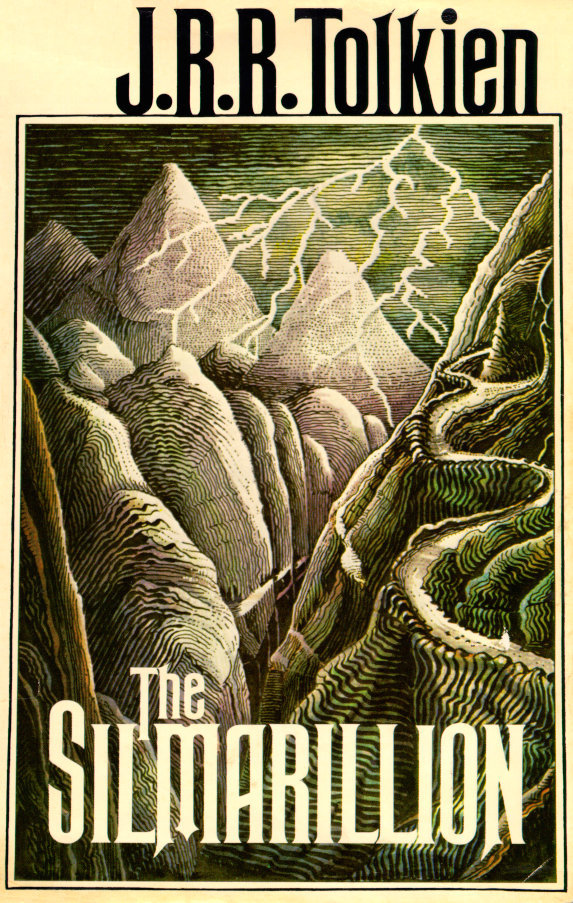
tolkien silmarillion 2Having Something to Say

For the sheer love of entering a world of myth and poetry, I read and reread J.R.R. Tolkien’s The Hobbit and The Lord of the Rings, supplemented by The Silmarillion and all manner of published archival material. It takes me years, though, before I feel I have something original to say. The most popular articles on Tolkien I’ve written are not my close-readings or theological reflections, but Inklings pieces like “The Tolkien Letters that Changed C.S. Lewis’ Life,” the publication of essential letters and poems, resource blogs like “Approaching The Silmarillion for the First Time,” and writing pieces like “The Shocking Reason Tolkien Finished The Lord of the Rings.” My more substantial work on Tolkien is read appreciatively, but not broadly. For example, I quite like this piece I worked on for a long time on (but never got much traction): “Trees, Leaves, Vines, Circles: The Layered Worlds of J.R.R. Tolkien’s Fiction, A Note on ‘Athrabeth Finrod ah Andreth’“–of course, the title may have only attracted the most serious readers! I have a similar experience in reading Ursula K. Le Guin: I find it rich and fulfilling and I love teaching her, but it takes me a long time to say anything new.

However, when I read Lewis, I am constantly making connections that I am able to talk about in my essays, lectures, and academic pieces. There is something about the way I approach the text that generates productive readings, thoughts about culture, and links to Lewis’ life and thought. And, frankly, there was a uniquely Brenton-shaped hole in C.S. Lewis studies that I am able to fill. If Lewis scholars had answered all the questions, I wouldn’t be here.

lewis letters to malcolmMind the Gap

Part of having something to say is working with an author who has not said everything there is to say. That sounds obvious, but I had certain influential theologians in my young life–Miroslav Volf, N.T. Wright, and Sallie McFague, in particular–who had helped shaped me, but I was not able to really say anything in response. As soon as I read Rosemary Radford Ruether’s work, though, I knew exactly what to say and wrote an entire master’s thesis in response. I could challenge and extend the work of Volf, Wright, or McFague now, but a decade ago they were still building into me.

Immediately in reading C.S. Lewis, I was able to think dynamically in conversation with his work. This is partly because he has gaps–generalizations he makes, limitations in his point of view, personal likes and dislikes that get in the way, little shortcuts of mind and form…. Lewis’ limitations do not destroy his utility, but increase it. At least for me. I am able to pick up where Lewis left off, producing what I hope is a richer understanding of life and letters.

In particular, I think that Owen Barfield is right about his old friend, that what Lewis thought about anything is embedded in everything he wrote. Lewis is “integrative”–a holistic thinker whose theology and cultural criticism and image of spiritual life are hard-won but instinctive, emergent, flowing out of his personality and ethic into the world at great speed. One of the services I can provide to Lewis readers is to bring into a cohesive whole Lewis’ thoughts scattered over 20,000 pages of letters, manuscript fragments, poems, journal entries, essays, lectures, sermons, and books. What makes me most excited, though, is that in this way, Lewis is also able to speak cogently to theologians, spiritual directors, literature teachers, cultural critics, social activists, and theorists. Lewis’ gaps are opportunities to think critically and faithfully about his work, and I am pleased to be someone who can help bridge those fruitful gaps.

Brenton Viva Photo 2019There are weaknesses in my work and even in my choice of study. Shockingly, universities are not clamouring to hire a C.S. Lewis expert. However, I hope my experience can provide you with a resource to explore your own paths of curiosity, wonder, and discovery.

Some other posts on PhD Preparation and Academic Writing that Might be Helpful:

And you can read my full academic biography here.

Posted in Reflections | Tagged , , , , , , , , , , , , , , , | 8 Comments