“Inventing a Universe is a Complicated Business”: Ursula K. Le Guin’s Introduction to the Hainish Cycle

I have always loved Ursula K. Le Guin‘s Earthsea Cycle and have mused once about whether I liked Ged or Arha better. Though Earthsea suits me as a fantasy reader, I recognize that Le Guin’s Left Hand of Darkness and The Dispossessed are her great works–and there is a sense of adventure, curiosity, subversiveness, and challenge to her SciFi novels that I love. And I admire Le Guin’s approach to writing speculative fiction, what she calls “lying” in her foreword to my copy of The Left Hand of Darkness–at least theoretically, as I loaned out my copy and it has slipped from my memory.

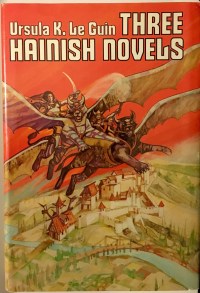
After being prodded by a couple of writerly friends, rather than pick up Earthsea again as a summer read I decided to read the Hainish Cycle in order–the world where The Left Hand of Darkness and The Dispossessed are set. In order of publication, this reading begins with Le Guin’s breakout short novel, Rocannon’s World.

The story of an interstellar anthropologist trapped in a pre-technological world under siege by a rogue superpower, Rocannon’s World is the true beginning of Le Guin’s inversive fictional experiment in science and social life. The prologue is a lovely and bittersweet true legend of one woman’s mythic quest. While I enjoy the anthropological elements and outsider-insider perspectives of this book (one of my favourite aspects of The Left Hand of Darkness), I am honestly struggling quite a bit. It isn’t often that I have basic comprehensive issues with a story. I have always wondered at Le Guin’s brevity, but I need a bit more in this text to help me understand what’s going on. What one online reviewer called a “light read” has been for me a bit of a fight.

Ultimately, I used a few of my classic coping mechanisms for hard books.

First, I made a character list–and “characters” in this book include humans, humanoids, other intelligent creatures, semi-sentient creatures, intelligent animals, and personified planets. Making the list has helped me pull the story into place.

Second, I decided to “trust” the book and just keep reading–like we used to trust the voice of the person who read to us as children even if some of the details were hazy. This lap-reading technique has helped. As I move through the story, I find that the details that puzzled me a few pages earlier begin to fall into place. So I chose to stop worrying and learn to love the obscurity.

Third, I wrote about it–just now, what you are reading. Thinking allowed about reading has the effect, for me, of clarifying and helping me enter a text.

So, fourth, I scheduled a conversation with a couple of other smart readers to chat about the novel.

My approach is good overall, but while waiting for the ad hoc book club discussion, I turned to Google for help. There isn’t much there, frankly. But in my digital wanderings, I found Le Guin’s introduction to Ursula K. Le Guin: The Hainish Novels & Stories, Volume One, which is meant to provide a bit of background to the Hainish Cycle. Unsurprisingly for Le Guin, it is an idiosyncratic introduction at best.

But what this piece–which I have retitled “Inventing a Universe is a Complicated Business”–succeeds in doing is giving the reader another invitation to the mental architecture behind the way Le Guin shapes imaginative worlds. While not one of our most precise speculative world-builders, she is one of our more important ones. The worlds she builds have meaning, not just the actions and people in the worlds. And, without fail, in this piece Le Guin offers us such strange and thoughtful ways of looking at the task of telling stories. “God knows inventing a universe is a complicated business,” Le Guin quips at the beginning of this piece–a line that has its own kind of unusual context in her light and thought.

After deprecating herself as a nonmethodical “cosmos-maker,” Le Guin invites us into the story of how her early science fiction writing came about. Here is a unique look at what sets her writing apart:

“I’d been sending fiction out for years to mainstream editors who praised my writing but said they didn’t know what it was. Science fiction and fantasy editors did know what it was, or at least what they wanted to call it. Many of the established figures of the genre were open-minded and generous, many of its readers were young and game for anything. So I had spent a lot of time on that planet.”
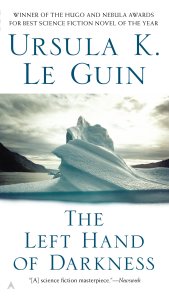
And like all emerging authors, Le Guin was haunted by doubt. Even when she sensed there was a story there, she admits that she was not always the best judge of her own work. The book that has changed the way we think about both fiction and relational life, The Left Hand of Darkness, looked to Le Guin like a “natural flop”:

“Its style is not the journalistic one that was then standard in science fiction, its structure is complex, it moves slowly, and even if everybody in it is called he, it is not about men…. The Nebula and Hugo Awards for that book came to me as validation when I most needed it. They proved that among my fellow writers of science fiction, who vote the Nebula, and its readers, who vote the Hugo, I had an audience who did recognise what I was doing and why, and for whom I could write with confidence that they’d let me sock it to them. That’s as valuable a confirmation as an artist can receive. I’d always been determined to write what and as I chose, but now that determination felt less like challenging the opposition, and more like freedom.”

There is an almost accidental and deeply personal reality to Le Guin’s greatness, it seems–and we see this in her other great work:

The Dispossessed started as a very bad short story, which I didn’t try to finish but couldn’t quite let go.”

Le Guin reveals to us something about her story-invention process that is likely not a surprise to avid readers. While her stories often begin as sketches of characters or worlds–and Rocannon’s World is limited by a love for the world more than the characters, I think–the stories develop because of certain thought experiments. Using what C.S. Lewis called “imaginative supposals,” Ursula Le Guin plays out the story by wondering what would happen if we re-thought not just gender but sex, not just war but peace, not just love but friendship, not just hatred but entwined enemyship, and so on. The result is that she can flip our expectations of what meeting another culture might be, or how morality might work in different contexts, or how heroism or love or failure can transform not just the world around us but our very selves.
These are her supposals, questions, inversions, experiments of thought for which she is famous.

But there is also what she calls her own “irresponsible” tourism. Le Guin keeps wanting to go back to the worlds she has made, taking more time to live in the environment or with the characters–or to play out in some other time and place the literary experiments that are still unsatisfied. Always the anthropologist, like Rocannon, Genly Ai, and others, Le Guin writes because she longs

“to go back to Gethen at last, and enter a Gethenian kemmerhouse, and find out what people did there. I enjoyed the experience immensely.”

Writing is a kind of discovery for Le Guin, which pleases me deeply. True, it is tougher to keep her worlds together, mentally, than with a more precise cosmos-maker. But it leads her to make sardonic and slightly shocking comments like this:

“Irresponsible as a tourist, I wandered around in my universe forgetting what I’d said about it last time, and then trying to conceal discrepancies with implausibilities, or with silence. If, as some think, God is no longer speaking, maybe it’s because he looked at what he’d made and found himself unable to believe it.”

And then there is Le Guin’s occasional need to complain in a humorous fashion even as she makes an important point, like this gem:

“The word-hound in me protests against the word “prequel”—“sequel” has honest roots, it grew out of Latin sequor, “prequel” is a rootless fake, there isn’t any verb praequor… but it doesn’t matter. What matters most about a word is that it says what we need a word for. (That’s why it matters that we lack a singular pronoun signifying non-male/female, inclusive, or undetermined gender. We need that pronoun.) So “The Day Before the Revolution” is, as its title perhaps suggests, a prequel to the novel The Dispossessed, set a few generations earlier. But it is also a sequel, in that it was written after the novel.”

So I continue with the Hainish Cycle, knowing that in the better and worse there will be some genius, some discomfort, and not a little pleasure. I would encourage you to read this piece by Le Guin. I have included just enough, I hope, to lure you into clicking the link to read on into Le Guin’s imaginative world(s).


“Inventing a Universe is a Complicated Business” by Ursula K. Le Guin

God knows inventing a universe is a complicated business. Science fiction writers know that re-using one you already invented is a considerable economy of effort, and you don’t have to explain so much to readers who have already been there. Also, exploring farther in an invented cosmos, the author may find interesting new people and places, and perhaps begin to understand its history and workings better. But problems arise if you’re careless about what things happen(ed) when and where.

In many of my science fiction stories, the peoples on the various worlds all descend from long-ago colonists from a world called Hain. So these fictions came to be called “Hainish.” But I flinch when they’re called “The Hainish Cycle” or any such term that implies they are set in a coherent fictional universe with a well-planned history, because they aren’t, it isn’t, it hasn’t. I’d rather admit its inconsistencies than pretend it’s a respectable Future History.

Methodical cosmos-makers make plans and charts and maps and timelines early in the whole process. I failed to do this. Any timeline for the books of the Hainish descent would resemble the web of a spider on LSD. Some stories connect, others contradict. Irresponsible as a tourist, I wandered around in my universe forgetting what I’d said about it last time, and then trying to conceal discrepancies with implausibilities, or with silence. If, as some think, God is no longer speaking, maybe it’s because he looked at what he’d made and found himself unable to believe it.

Usually silence is best….

Read the entire piece here, which is the introduction that Ursula K. Le Guin wrote for Ursula K. Le Guin: The Hainish Novels & Stories, Volume One, edited by that ever-productive fellow, Brian Attebery. 
Posted in Fictional Worlds, Memorable Quotes | Tagged , , , , , , , , , | 11 Comments

Novels by Christians Worth Reading

AmishnessityI was pleased last week to have G. Connor Salter provide a piece for the Lewis Scholarship Series, “Lewis and Tolkien among American Evangelicals.” These posts created a lot of discussion.

Out of our conversation about the way Americans have read Tolkien and Lewis, Connor has written a post about fiction written by American Christians that is actually … well … worth spending a few hours reading. For those that caught Connor’s first post and you are interested in what his happening artistically beyond the most visible America Evangelical fiction–i.e., the Amish and the Apocalyptic–might want to check it out.

G. Connor Salter's avatarG. Connor Salter

Some time ago I started a list of (mostly) nonfiction books that described the evangelical struggle with the arts or how to do art well from a Christian perspective. Since I recently did a series on problems with Christian Fiction novels, it seemed like a good idea to look at relatively modern novels by Christians that I have enjoyed. This list will focus on contemporary novels (i.e. published since 1979), and specifically ones by writers who are either evangelical Christians or whose work fits broadly into the evangelical genre. I’m also using the term “novels by Christians” rather than “Christian novels.” The reason for this selection are as follows:

  1. I’ve found that while plenty of people can list great Christian novels from before the 1980s (books by the Inklings, classic works like Paradise Lost) it’s hard to find anything relatively modern by Christian authors that is very good…

View original post 1,101 more words

Posted in Reflections | 20 Comments

Experimenting on Students: A Thought about Playfulness and Personal Connection in Teaching

I recently recorded a couple of lectures in my role as “Distinguished Lecturer in Romantic Theology” in the innovative Doctor in Theology and Ministry at Northwind Seminary. A heady title! I wanted to take the role seriously and do something with a bit of heft to it. More than that, though, Northwind has a collection of great minds and motivated souls gathered together to deepen their understanding of faith and practice in a peculiar, challenging, and experimental way. I had two chances–just over an hour of contact time–to leave something for these students. What would I say?

Trusting in the curriculum designed by the core faculty–creative and engaging Inkling scholars in their own particular veins–and trusting that the students would do the hard work required to dialogue with the material, I decided that I didn’t want to simply impart some information to them. Even cool, nerdy, deep-in-the-trenches information wasn’t enough for this unique opportunity.

So I decided to design my two lectures as arguments.

For a lecture on Tolkien’s theology, I did something I have never done before, which was to take a good scholarly work and use it to set up what I perceive to be a weakness in the field. Using a poorly written book or shoddy scholarship is no good for students of intellectual depth, and leaves any listener with knowledge about a resource they will never bother with again. But in taking a strong thinker and asking one critical question about what is missing in their analysis, I had a chance to provide a resource for students, model methods of research and discovery, and make an argument that is perhaps the only unique contribution I have to make in Tolkien studies. I think the result was pretty cool! (You can see some of the data I used here, by Sparrow Alden. Plus, I used Emily Austin’s Inklings art to design the slides, making it visually beautiful too)

My second lecture was a kind of gutsy argument about C.S. Lewis, offering a way to read him that reorients our entire perspective on his life and writings but that does not negate what has come before. It is the topic of my upcoming book and I had fun making it a stronger, fighting-words argument for smart students who have the capacity to assess it, challenge it, and ultimately receive it or reconfigure it for their own purposes.

I believe I was more successful with the Tolkien “Theology of the Small” lecture than the one on C.S. Lewis’ spiritual theology–not because of the core material, but because I should have finished the Lewis lecture with a key question: Do you see how profoundly this argument changes our spiritual posture as faithful pilgrims and how deeply it can shape our contexts for spiritual practice? No doubt the students–each of them leaders, teachers, ministers, or scholars–can make the link themselves, but the step is important enough that I may take the time to rerecord the lecture. We’ll see.

While I was variously successful with these two lectures, I think they are both good examples of scholarship at play. But they are also examples of the ways I have been trying to be more playful as a teacher in the classroom. In the midst of remote emergency education, Zoom weariness, administrative overload, continuing career dislocation, and the ongoing weight of the students’ stories that I feel privileged to carry, I have decided to strike at the heart of my work and challenge myself to rethink assignment and course design so that I can create the best possible experience for my students.

Choosing to become more playful with my course design means experimenting on my students–students who are already feeling dislocated and beleaguered in the world of education, vocation, and culture today. I don’t take such experiments lightly. It is also a risk for me as a teacher. To play any game means taking the chance to lose. And being playful requires a dynamic creativity and adaptive quality that is hard to conjure up in the middle of a difficult term, for me anyway.

Fortunately, I am not always alone in trying to think creatively. Beyond a pretty strong digital network of teachers–many of them nomadic scholars like myself–I often get to work in great teams.

Here at the University of Prince Edward Island, the religious studies department was an early innovator in online and blended education. When asked to teach “Japanese Religion and Culture” for winter 2020, I knew I had the space to play with the class. I made it a hybrid class, with half of the lectures pre-recorded online, followed by in-class conversations in a round-table session. I was able to give strong frameworks for thoughts about Japanese religion, history, and society, and the students were able to bring in the element of pop culture. The combined dynamic was brilliant as students took turns leading discussions about various aspects of Japan’s super cool pop culture scene–going far beyond what my knowledge and experience could provide. And when pandemic lockdown measures interrupted the semester, our move to fully online teaching was comparatively smooth. Moreover, as an inherently international group of students, they found encouragement in their interests and received support during the difficult period that followed.

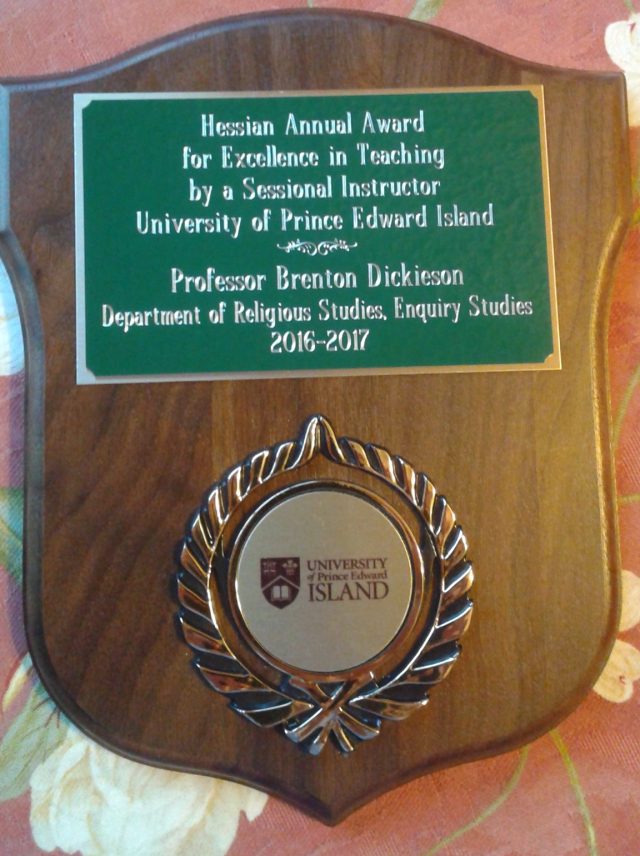
Perhaps the most playful part of my teaching at UPEI is our “Inquiry Studies” course. With a dynamic teaching and design team, we set out to create a foundation-year course that brought in the writing and critical thinking skills of our successful English 101 course with an inquiry-directed curriculum. In this course, students are given the framework and tools to design large parts of their skillset development as they navigate their way through a project-based class. We are always adapting this evergreen course, but the coolest aspect of the course for me is the blandly named “Log Project,” where students ask a question and then design both their approach to answering the question–i.e., the modes and methods of research–and create a unique way to share what they learn with their fellow students. The list of mind-blowing, moving, and motivational projects that these often eager and sometimes timorous students create is far too large to even highlight a few here.

Honestly, with 15 years of teaching foundation-year courses for students, I have never seen a course so effective at preparing students for their educational journeys or for giving them broad-based skills for life and work. I am honoured to be a part of it–and always thinking about how to make it better next year!

One of the more unusual and effective teaching teams I am a part of is the Signum University faculty. Partly, this is the nature of the school: a story-centred, nerd-friendly, online, accessible, MA program in imaginative literature, philology, and linguistics. Something of the mythopoeic and speculative nature of the books and films we study finds its way into our teaching and learning community, where the lines between faculty, staff, student, and supporter are intentionally transgressed. Always growing and learning, Signum is built to encourage creative approaches to teaching–even when many of our approaches in the literature classes are pretty traditional: read great books, lecture on the material, discuss with smart students. But, let’s be honest, this school is pretty great. I mean, they launched a scholarly study of Star Wars on May the 4th!

Within this team, I am allowed opportunities to play as a teacher–including recent chances to extend the classroom to the digital sphere and invite students in, such as open classes on “The Anatomy of the Vampire Myth” and  “C.S. Lewis, Gender, and The Four Loves,” and “An Open Class on Narnia and Friendship with Jason Lepojärvi and Diana Pavlac Glyer.”

At Signum, I am also constantly learning new ways of assessing students. As I was dissatisfied with our oral exam, a teaching colleague gave me the idea of doing a creative assignment instead, where students propose a large-scale project like a video game, TV serial, film project, novel or graphic novel, tabletop game or RPG, inner-city curriculum, long-form narrative poem in alliterative verse–really any kind of project that will allow their creative (or subcreative) juices to flow in a way that integrates the course material. Then the students design a treatment of the project, present it to the class (with discussion), and reflect on their journey of creation and discovery in the context of the class. This project complements our research-based term paper and close-reading short assignment well. More than that, it gets rid of the unsatisfying final exam and gives me an unusually good amount of indirect and direct feedback about the course.

Intriguingly, my dissatisfaction and early experiments with the oral exam at Signum led me to redesign my course on the Fiction and Science Fiction of C.S. Lewis at the King’s College (New York City). As an interdisciplinary class with a heavily theological focus in an English department, I was not satisfied with my first course design. I am always adapting this course. Feeling the material to be a bit thin, I produced pre-recorded video lectures on the material, which I then paired with online written discussion. Feeling distant from the students, I then created four small group video conversation sessions in the semester (first and last weeks discussing The Lion, the Witch and the Wardrobe and Till We Have Faces, as well as a discussion on Narnia and the Ransom Cycle).

It was in the assignments, though, where I was not fully satisfied. Two of the assignments are great. For one, the students write their own Screwtapian letter, providing a point of cultural critique or spiritual thoughtfulness. At another point, students are assigned to small groups and set about to create an 8th Narnian chronicle, including project artwork, character and plot development, sample chapters (or sample dialogue for a screen or stage version, sample pages for a graphic novel, etc.), and other aspects of a treatment.

Both of these projects hit a number of markers for the class and are pretty great to mark. Increasingly as I taught, though, I have had artists and writers in the class, and I wanted to reshape our early-class close-reading short paper. As I understand the genre well, I decided to make the early-term project a “Narnian blog post,” where they have to triangulate their own experience with a close reading from Narnia and some aspect of spiritual life. The project works well for helping students see how their lives can be part of the “data set” of research, and gives them a chance to distinguish different kinds of academic writing. This short, personally implicated and evidence-based project allows me to see writing strengths and weaknesses early in the term, so I use the opportunity to provide extensive feedback.

And then there was the final exam: this heavy-writing, full-semester, 3-hour monstrosity that students had to sit through and I had to mark. As this is a spring course, both profs and students are just “done” by the 2nd week of May. Moreover, this final did not do what I needed it to do, which was to help students pace a heavy reading list (13 books) in a long semester and then provide them an opportunity to show that they have read deeply and thought in integrative ways about the material.

So I ditched it. I designed a series of weekly short-answer quizzes that are quick to write and quick to mark, mostly about checking that students are reading and watching lectures. And I replaced the final exam with a video one-on-one meeting with the students. In these meetings, students begin the discussion by choosing from a variety of prompts. These prompts approach the material from different angles: social, cultural, theological, literary, linguistic, historical, etc. Following a short student presentation, I ask some follow-up questions, moving through the curriculum. Though I openly say this in the assignment description, students are surprised to discover that I am looking for ways that they can identify skills they have gained and discoveries they have made during the semester and look for ways to apply these to their studies, their family lives, and their friendships, as well as the work they do in vocational development, scholarship, ministry, and social justice activism. This 20-30-minute discussion is really one of the most valuable things I do as a teacher and, if testimonials are any indication, meaningful to many of my students.

And so on. I still keep reconfiguring the final paper for the Lewis course at TKC, but my real challenge there is that the reading list is pretty large with 13 novels: the seven Narnian chronicles, then The Great Divorce and Screwtape, then the interplanetary trilogy, followed by Till We Have Faces. For lit students or SciFi/dystopia lovers, this schedule works pretty well. Starting with Narnia allows me to inculcate some text-reading and discovery tools early for the nostalgic Lewis lovers who have tumbled into the class from the various programs at King’s. But if Out of the Silent is outside of your sympathy, and if Perelandra is just plain weird, then That Hideous Strength will come close to doing you in. So I am still considering ways to make the material connect even more effectively.

I have not been able to experiment in all the ways I would like. A week before lockdowns in March 2020, I was playing Lego with my writing students around a big table, talking about “building” a paper. I’d like to make that a sharper lesson someday. And I realize it has been a while since I’ve had my ukulele or Thomas the Tank Engine set in class. I would like one day to design a whole course for university students based on my Kindergarten-teacher wife’s approach to a play-based curriculum. I would also like to truly design a rhizomatic course like teaching guru Dave Cormier (@davecormier) has proposed. It’s all about finding the right time and place.

Fortunately, the schools I work with let me experiment on students. This has meant student-centred course design at Maritime Christian College, a rethinking of my religion course for students in Egypt, and being responsive to student goals in supervising MA theses at Signum University. Out of all of this experimentation in the last handful of year, there are certain principles that I have become essential to the way that I intend to teach in this coming decade:

  • I have learned that it is essential to provide early-term writing feedback–a lot of teacherly critiques and peer feedback to small assignments early in the semester that I then build into the rubric for future assignments
  • Never again will I assign projects that students hate to write and teachers hate to mark–why would I ever do this again?
  • It is critical to define learning outcomes and communicate those to students; when students understand why they are doing a project, they have an opportunity to invest in that project in ways that are meaningful to them
  • One of the beautiful things I have discovered is to extend the curriculum beyond the classroom, helping students make links to their other studies, to their work and home lives, to the shaping of their dreams and their play in digital worlds
  • Cardinal rule: If it doesn’t work, change it–and change it as soon as you can
  • Listen to student feedback; it’s true that students are the least qualified to speak to learning from an educator’s perspective, but if you are looking for meaningful change, they can teach you what you need to know
  • Find out what innovative approaches your colleagues are experimenting with; an extremely successful approach I have taken to become better as a teacher is simply asking a friend or co-teacher, “How do you do this?” or “What’s something awesome you are doing?”

Behind all of this experimentation and baby-step innovation is what I confessed was the key to my teaching strategy: caring for students. Being open to shaping and reshaping the curriculum is an extension of that care for students. It means not just being someone who constantly redesigns their teaching spaces; it means that as a teacher I am constantly being redesigned myself, challenged to see things from a new angle and move outside my most comfortable ways of working. However, seeing students connect to the material in new ways and grow in their own spaces is pretty cool, and I am thankful that I can work at schools that understand my inherent weaknesses and still give me space to excel.

Posted in Reflections | Tagged , , , , , , , , , , , , | 13 Comments

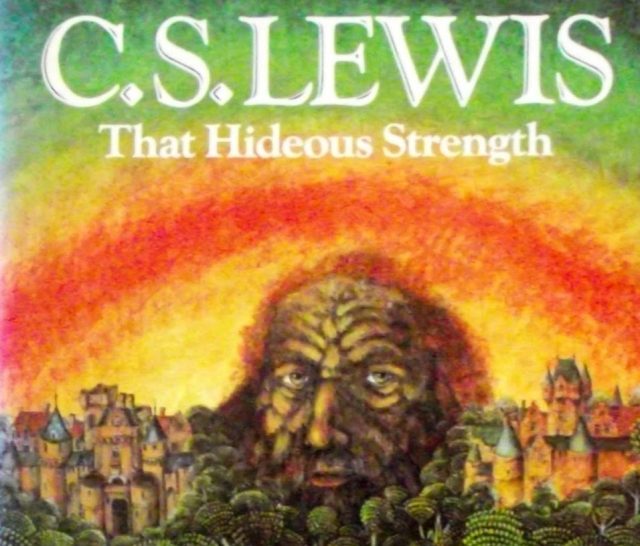
Have an extra $30,000/£22,000? 1st Edition of That Hideous Strength signed by C.S. Lewis for George Orwell–With Some Notes on Collecting C.S. Lewis

Does anyone have $30,000 USD they’d like to donate to a good cause? That’s $36,373.00 Canadian, if you are keeping track, or £22,006.50 if you are from that original land of story. If you do, you might want to consider purchasing this 1st edition of That Hideous Strength that just popped up on Abebooks.

$30,000 is a lot to drop for a 1st edition of a difficult and not terribly popular book. It is true that C.S. Lewis is a collectable author. Full Narnia collections with dustjacket in fine condition are hard to find, though there is a set available (in very good to near fine condition) for $27,500 on Abebooks. A 1st edition of The Lion, the Witch and the Wardrobe usually goes from between $5,000 and $10,000. Because of the difficulty of finding these editions, the old tradition of rebinding great books has been revived. There is a beautiful UK first edition set, rebound in finest leather with a volume signed by Pauline Baynes for just shy of $15k.

Fair enough, but 30 large for a quirky dystopia that George Orwell, among other nice words, calls “confusing” and “undisciplined.” Moreover, you can get a 1st edition with a dust jacket for less than $1000. What’s the deal?

The deal is a brilliant confluence of events that makes this copy of That Hideous Strength a story in itself.

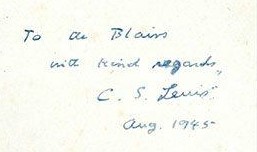
According to Raptis Rare Books who are selling the copy, this is not only a 1st edition in very good condition with a complete, very good dust jacket. C.S. Lewis’ signature carries some weight, but this particular signature comes on a presentation copy of the novel with Lewis’ own minor corrections. Moreover, it is inscribed:

 “To the Blairs, with kind regards, C.S. Lewis Aug. 1945.”

The Blairs are, it turns out, Eric and Eileen Blair. Eric Blair used the well-known pen name, George Orwell–the famous author of 1984 and Animal Farm. This was the very edition that Orwell used to write his review for the Manchester Evening News on August 16th, 1945. While not close friends, and although they clearly did not share a foundational worldview, their shared friendships, work, and interests in culture and literature led Lewis, it seems, to personalize his review copy.

This is a very, very cool edition.

That Orwell’s Animal Farm released the day after this review, and that Lewis’ conclusion to the Ransom Cycle is obviously provocative for Orwell as he wrote 1984 only heightens the story for me. I really do think that Lewis’ and Orwell’s work is in dialogue. You can see my pieces “Is Animal Farm Greater than 1984? C.S. Lewis’ Thoughts about George Orwell’s Work” and “George Orwell’s 1984 and C.S. Lewis’ That Hideous Strength: A Conversation about Influence and Pride of Place.”

Some time ago, Arend Smilde transcribed Orwell’s original review, which I have discussed here and reprint below. And here is the Abebooks sale link, pointed out to me by David Llewellyn Dodds and a friend on Facebook.

If you have it in your heart to buy this edition of That Hideous Strength and donate it, however, you will find your kindness wasted on me–a kind of book-collector lacking the grace needed for such a book. Donate it to the Marion E. Wade collection in Wheaton, where scholars and fans from around the world could admire it in a safe way. It could be a profound lift to the literary world.

I do collect some Lewis books, and I actually have a 1st edition of That Hideous Strength–not a true first edition and without a dust jacket, but a UK 2nd printing by The Bodley Head. It is in good shape, but a gently read copy signed by one of Lewis’ students. It is not overly valuable, but I have a special feeling for the book because it was given to me by Lewis’ student’s widow.

Ultimately, I collect Lewis first editions only for the words and a sense of the publishing history.

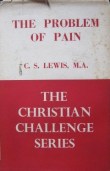
  • The Problem of Pain is my oldest Lewis book, its sixth impression printing being in October 1941. The plastic dust cover protector keeps the edition crisp and clean. Even if it reduces the resale value, I feel good about this charity store find.
  • Readers of A Pilgrim in Narnia know that The Screwtape Letters is the centre of my work. This is one of the few books I have had to purchase intentially, but I needed a 1st edition to compare the texts. Fortunately, at the time I was looking, 1st UK editions after the 3rd printing were pretty common, and I found a 6th printing (without a dustcover and just in fair shape) for £14.70, about $30 CDN. This is the 1st edition that I have reached for the most, always tenderly but knowing I have it for a reason.
  • Mere Christianity is probably the most popular Christian teaching book of the last century. Mere Christianity (1952) is made up of three WWII pamphlets printed from Lewis’ BBC talks about faith are Broadcast Talks, Christian Behaviour, and Beyond Personality. Though none of these are in collector’s shape, I have a 1st edition with taped-up dustjacket of Broadcast Talks, as well as a fifth printing of the same, also in hardback. I have a softcover 7th printing of Christian Behaviour, and two copies of Beyond Personality: a fifth printing blue hardback and a third impression blonde hardback with a damaged but near-complete cover. You can see a nice preface to Broadcast Talks that I don’t think anyone else has shared before here: “’Not Because I am Anyone in Particular”: C.S. Lewis’ Original Preface on Mere Christianity.
  • I have a ninth impression of A Preface to Paradise Lost, with Amen House noted as the publisher, a poor shape withdrawn copy.
  • I have made it part of my mission to try and create a recovery of Lewis’ The Great Divorce. It is a nice synchronicity of my life, then, that I have stumbled upon three true 1st UK editions of Lewis’ WWII-era dream vision, published in 1946. I have no dust jackets, except one inside flap–and none is in very good or fine condition. Two were given to me (I gave one away in turn), and one I found in our local library sale for $2.
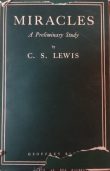
  • In a used bookstore where the owner clearly isn’t interested in selling books, I managed to pick up a first UK edition, third impression of the 1947 version of C.S. Lewis’ Miracles. My copy is, as you might expect, just in fair to good condition. The dust jacket is in bad shape, but it is hard to find them at all from the era. And it has left the book in good condition, with some yellowing on the top edge but with clear, crisp pages. Most helpful, though, is that I have access to the early edition text, which Lewis changed in 1960 (see more of this copy here).
  • What is interesting about this little pamphlet of Lewis’ 1941 sermon, “The Weight of Glory,” is not just that they printed it in the “Little Books on Religion” series by SPCK, but that they reprinted it several times. Mine is a 5th printing from 1948.
  • I have a UK Geoffrey Bles 8th printing library withdrawal of The Lion, the Witch and the Wardrobe in rough shape.
  • I have a reject bin copy of The Horse and His Boy, US Macmillan copy that puzzles me. It is the normal orange cardboard book, 9th printing. The cover, however, is the late 1960s jacket design by The Strimbans, a 10th or 11th printing of this new edition. As a library withdrawal, the tape damage is consistent that the cover and book have been together for a while. The twin version of The Last Battle is also in my keeping, earlier edition inside with the 1960s cover, library withdrawal. Of course, either of these may simply be an idiosyncratic 1960s printing of the interior book, giving the face of a 1st edition late printing while actually being a new edition. Experts would know.
  • During a used bookstore break from the sun during vacation a few years ago, I found a US 1st edition of Surprised by Joy, with a tattered dustcover and some marks inside. A good buy for $3!
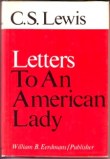
  • My 1st US edition, 2nd printing of Reflections on the Psalms is a readerly edition, given to me by a retired minister. From the same minister, I was gifted a US 1st edition with a tattered dustcover of Letters to an American Lady, edited by Clyde S. Kilby. Taking it to the beach (and tumbling into C.S. Lewis studies) is no doubt a book collector’s sacrilege, but I think Lewis would have enjoyed it. I have a 1st UK edition of Hooper’s Lewis letter collection, They Stand Together. The dust cover is slightly worn but nice, so I haven’t taken this to the beach.
  • From one of UPEI’s library discard sales, I was able to find a couple of great things. I got a copy of Lewis’ literary magnum opus, English Literature in the Sixteenth Century, Excluding Drama. Whatever value it might have had has been destroyed by my annotations. I also pulled out the posthumous Spenser’s Images of Life, edited by Alastair Fowler, who brought Lewis’ lecture notes on Spenser together into a readable book. A book that is connected to this one is C.S. Lewis’s Lost Aeneid: Arms and the Exile, edited by A.T. Reyes and including Lewis’ translation of the classic Latin epic. The edition that landed in my mailbox from some online bookstore is the uncorrected page proof version from Yale press, which is kind of neat.
  • C.S. Lewis’ An Experiment in Criticism, written at the same season he was writing A Grief Observed, is one of my favourite books of its kind and I am always trying to work out the implications. I have a 1st UK edition with a nice dust cover, price-clipped (though I have no clue where this came from as it is unsigned). You can see my reading list cribbed from this book here: “An Essential Reading List from C.S. Lewis: An Experiment on An Experiment in Criticism.”
  • My 1962 library edition of They Asked for a Paper is also in pretty good shape.
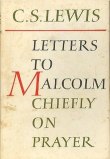
  • Letters to Malcolm: Chiefly on Prayer is a peculiar book, but I grabbed the chance to get a $20 first UK edition with a dust jacket in very good condition. When I got it home, I realized that I would probably still reach for my cheap paperback for most readings.

Weirdly, probably the most valuable book I own is The Collected Letters of C.S. Lewis, Volume 3: Narnia, Cambridge, and Joy, 1950 – 1963, edited by Walter Hooper. Too expensive to reprint, I have seen it listed for up to $800, though sometimes as low as $150. As I talked about in this piece, “A Bargain at Twice the Price,” my $40 copy came to me as a gift. If you find a version in any edition, give it to a young Lewis scholar in exchange for a digital fistbump or a home-cooked meal.

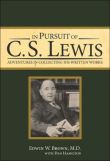
If you are curious, my piece, “Adventures in Geekland: Book Collecting and C.S. Lewis” reviews the essential Lewis book-collecting resource by Edwin Brown and Dan Hamilton. You should also get to know Gordon Greenhill’s image catalogue, “The Disordered Image“–a huge project–as well as the Wade centre and other Lewis depositories. Here is that review by Orwell–and I find that this copy of That Hideous Strength provides me a new context for reading Orwell’s review.


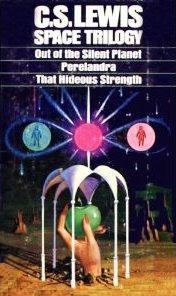
that hideous strength first trilogy edition lewis

George Orwell’s Review of C.S. Lewis’ That Hideous Strength, from the Manchester Evening News, 16 August 1945

On the whole, novels are better when there are no miracles in them. Still, it is possible to think of a fairly large number of worth-while books in which ghosts, magic, second-sight, angels, mermaids, and what-not play a part.

Mr. C. S. Lewis’s “That Hideous Strength” can be included in their number – though, curiously enough, it would probably have been a better book if the magical element had been left out. For in essence it is a crime story, and the miraculous happenings, though they grow more frequent towards the end, are not integral to it.

In general outline, and to some extent in atmosphere, it rather resembles G. K. Chesterton’s “The Man Who Was Thursday.”

Mr. Lewis probably owes something to Chesterton as a writer, and certainly shares his horror of modern machine civilisation (the title of the book, by the way, is taken from a poem about the Tower of Babel) and his reliance on the “eternal verities” of the Christian Church, as against scientific materialism or nihilism.

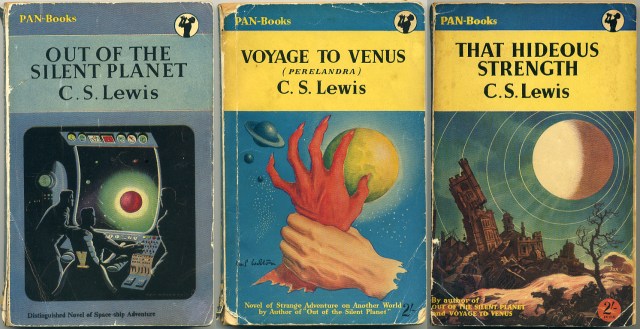
that hideous strength CS Lewis Panbooks 1950sHis book describes the struggle of a little group of sane people against a nightmare that nearly conquers the world. A company of mad scientists – or, perhaps, they are not mad, but have merely destroyed in themselves all human feeling, all notion of good and evil – are plotting to conquer Britain, then the whole planet, and then other planets, until they have brought the universe under their control.

All superfluous life is to be wiped out, all natural forces tamed, the common people are to be used as slaves and vivisection subjects by the ruling caste of scientists, who even see their way to conferring immortal life upon themselves. Man, in short, is to storm the heavens and overthrow the gods, or even to become a god himself.

There is nothing outrageously improbable in such a conspiracy. Indeed, at a moment when a single atomic bomb – of a type already pronounced “obsolete” – has just blown probably three hundred thousand people to fragments, it sounds all too topical. Plenty of people in our age do entertain the monstrous dreams of power that Mr. Lewis attributes to his characters, and we are within sight of the time when such dreams will be realisable.

that hideous strength cs lewis HeadHis description of the N.I.C.E. (National Institute of Co-ordinated Experiments), with its world-wide ramifications, its private army, its secret torture chambers, and its inner ring of adepts ruled over by a mysterious personage known as The Head, is as exciting as any detective story.

It would be a very hardened reader who would not experience a thrill on learning that The Head is actually – however, that would be giving the game away.

One could recommend this book unreservedly if Mr. Lewis had succeeded in keeping it all on a single level. Unfortunately, the supernatural keeps breaking in, and it does so in rather confusing, undisciplined ways. The scientists are endeavouring, among other things, to get hold of the body of the ancient Celtic magician Merlin, who has been buried – not dead, but in a trance – for the last 1,500 years, in hopes of learning from him the secrets of pre-Christian magic.

They are frustrated by a character who is only doubtfully a human being, having spent part of his time on another planet where he has been gifted with eternal youth. Then there is a woman with second sight, one or two ghosts, and various superhuman visitors from outer space, some of them with rather tiresome names which derive from earlier books of Mr. Lewis’s. The book ends in a way that is so preposterous that it does not even succeed in being horrible in spite of much bloodshed.

That Hideous Strength CS Lewis oldMuch is made of the fact that the scientists are actually in touch with evil spirits, although this fact is known only to the inmost circle. Mr. Lewis appears to believe in the existence of such spirits, and of benevolent ones as well. He is entitled to his beliefs, but they weaken his story, not only because they offend the average reader’s sense of probability but because in effect they decide the issue in advance. When one is told that God and the Devil are in conflict one always knows which side is going to win. The whole drama of the struggle against evil lies in the fact that one does not have supernatural aid. However, by the standard of the novels appearing nowadays this is a book worth reading.


Transcription by Arend Smilde at www.lewisiana.nl. Original review found in the Manchester Evening News, 16 August 1945. Reprinted in The Complete Works of George Orwell, ed. Peter Davison, Vol. XVII (1998), No. 2720 (first half), pp. 250–251. If you haven’t found Arend’s page (which I’ve featured before), check it out.

Posted in Reflections | Tagged , , , , , , , | 19 Comments

An Old Pictorial Map of Central Oxford (Are There Links to C.S. Lewis’ Fiction?)

Oxford Broad StreetA couple of months ago, I wrote about “‘The Country Around Edgestow’: A Map from C.S. Lewis’ That Hideous Strength by Tim Kirk.” Tim Kirk’s fantasy map was part of an early Mythlore article, “Arthurian & Cosmic Myth in That Hideous Strength” by Margaret Hannay (1970). I have confessed before that I have tried to work out some of the local (i.e., the ones on Earth) places in C.S. Lewis’ Ransom Cycle. Though I spent a day hiking with Rev. Stephen Winter–the That_Hideous_Strength Indie art by Gibberish17Wisdom from the Lord of the Rings” blogger–hoping to feel Lewis’ real schoolboy environment of Malvern and environs behind Dr. Ransom’s earthly home base, I am ill equipped to succeed in this quest. But in writing my article, “What is the Significance of Worc(h)ester in C.S. Lewis’ Ransom Cycle?,” I became intrigued by the possibilities of real places in C.S. Lewis’ mind that sit behind his fictional English towns and countrysides.

One of Lewis’ key terran fictional places is “Edgestow,” the home of Bragdon Wood, Bracton College, and the literary centre of the events in That Hideous Strength. In my reading about Lewis and Arthurian literature, I happened upon Margaret Hannay’s piece, which included Tim Kirk’s map of “The Country Around Edgestow.” As a reading tool, I have come to like this fairly detailed Edgestow pictorial map. With the help of Mythlore editor Janet Brennan Croft, Tim Kirk kindly gave me permission to share the map on A Pilgrim in Narnia. You can download a PDF of Hannay’s article with Kirk’s map in context here. And there is a clearer, zoom-able version of the map here

Continuing on my irresponsible musings like “What is the Significance of Worc(h)ester in C.S. Lewis’ Ransom Cycle?” and connections between Lewis’ real life hills and towns in his fiction, I found Tim Kirk’s map opened up some imaginative possibilities for me–even if they did not answer all the questions I would like to ask. During the pretty great discussion that followed that post, Tolkien historian John Garth–having recently written a visual and literary history, The Worlds of J.R.R. Tolkien–asked this perceptive question: “There’s quite a bit of Oxford in that map, isn’t there?”

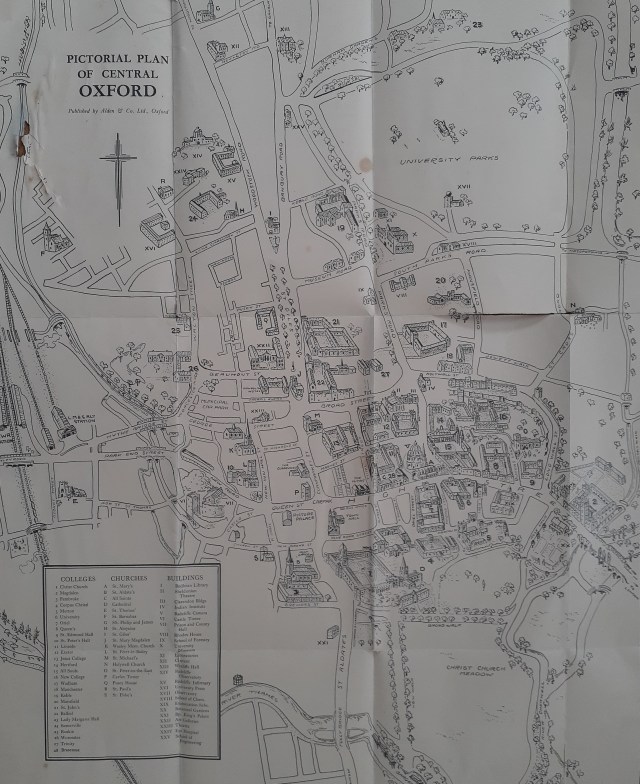
Since I lack the artistic and geographic skills to really capture that comparison or assess it if I saw it, I left the question behind. And then, in a box of materials from one of C.S. Lewis’ past students, Dr. E.L. Edmonds, I found this map tucked into an old guidebook. There is a bit of damage and my photography skills are limited, but it certainly does give some scope for imaginative comparison with Tim Kirk’s Edgestow map. I will allow you good folk to have fun making links and noting differences.

Oxford Centre Pictorial Map

If you drag and drop the map into most browsers, you should be able to make it bigger to look for details.

And because it can be fun to note a change in perspective, time, and technology, you may enjoy this interactive aerial photograph that gives a 360° view of Oxford. Scrolling over with your mouse will let you explore various sites of Oxford, but it is even cooler with your phone or tablet, as the camera rolls as you do (If your experience of WordPress does not load the interactive photo, click through to Facebook you can see the picture).

Posted in Reflections | Tagged , , , , , , , , , , , | 18 Comments