While Neil Gaiman is Still a (Super Creative and Awesome-to-behold Writerly) Jerk, he is also a Kindly Transmedial Genius, with thoughts on the Graphic Novel adaptation of The Graveyard Book (Throwback Thursday)

At A Pilgrim in Narnia, we have an occasional feature called “Throwback Thursday.” By raiding either my own blog hoard or someone else’s, I find an article or review from the past and throw it back out into the digital world. This might be an idea or book that is now relevant again, or a concept I’d like to think about more, or even “an oldie but a goodie” that I think needs a bit of spin time.

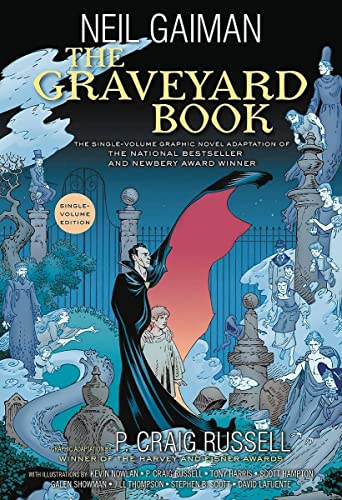
I have just finished the Graphic Novel adaptation of The Graveyard Book. It was splendid. So I am reminded of my very first Neil Gaiman review of the novel. I still remember the feeling of listening to The Graveyard Book on CD during a family trip and thinking, “I could have thought of this, and I have had thoughts like that, but Gaiman got there first.” Sad, yes, but the darker question: “I could have done it … but could I have done it so well?” In one of those literary soul-searching inspirations, I wrote this original, somewhat saucy, and marginally bitter review. I think it still works–though it seems to me that moralistic tale-telling is on the rise again in this decade.

I continue to read and think about Neil Gaiman’s work. I am in the midst of TV adaptations of Good Omens and Sandman. Back in 2021, I published another somewhat edgy but thoughtful article on the Marvel Comics adaptation of C.S. Lewis’ The Screwtape Letters, and followed it up with Neil Gaiman’s preface to that work–a set of literary finds that will be new to many. I’ve written a short piece on Neil Gaiman and Terry Pratchett on friendship, linking an early life discovery he had while reading C.S. Lewis. And I once threw up a blog post, “Neil Gaiman on Discovering the Author in Narnia (and a note on beards),” which I still quite like. I am ever more convinced that this happily mad genius has penned what I believe to be the most important American fantasy novel, American Gods. Meanwhile, I hope you enjoy this review, risen from the grave and dressed up for today.


Neil Gaiman is a jerk.

Well, I don’t really mean that. On my own bookshelf alone, I can see a dozen books by new writers with his powerful recommendations. Gaiman has a rare give for collaborating and resonating with others. And I have heard rumours that he is really quite a nice human being.

But honestly, how many beautiful ideas is a guy allowed to have in a lifetime? There’s Coroline in all its forms, and his epic, American Gods. Beyond that, he has produced an incredible array of short stories and essays, works fluidly across various media, and practically invented a genre of literature with Sandman. I even heard that his The Ocean at the End of the Lane was voted best book in the universe or something, and with every streaming service begging for his artistic signature, he has started writing adaptations of his adaptations. I mean, seriously?

All deep-rooted bitterness aside, The Graveyard Book—you may remember I’m writing a review here—is based on a pretty elegant premise. An orphaned toddler wanders into a graveyard, and it is up to the dead people who live there to raise him. Brilliant.
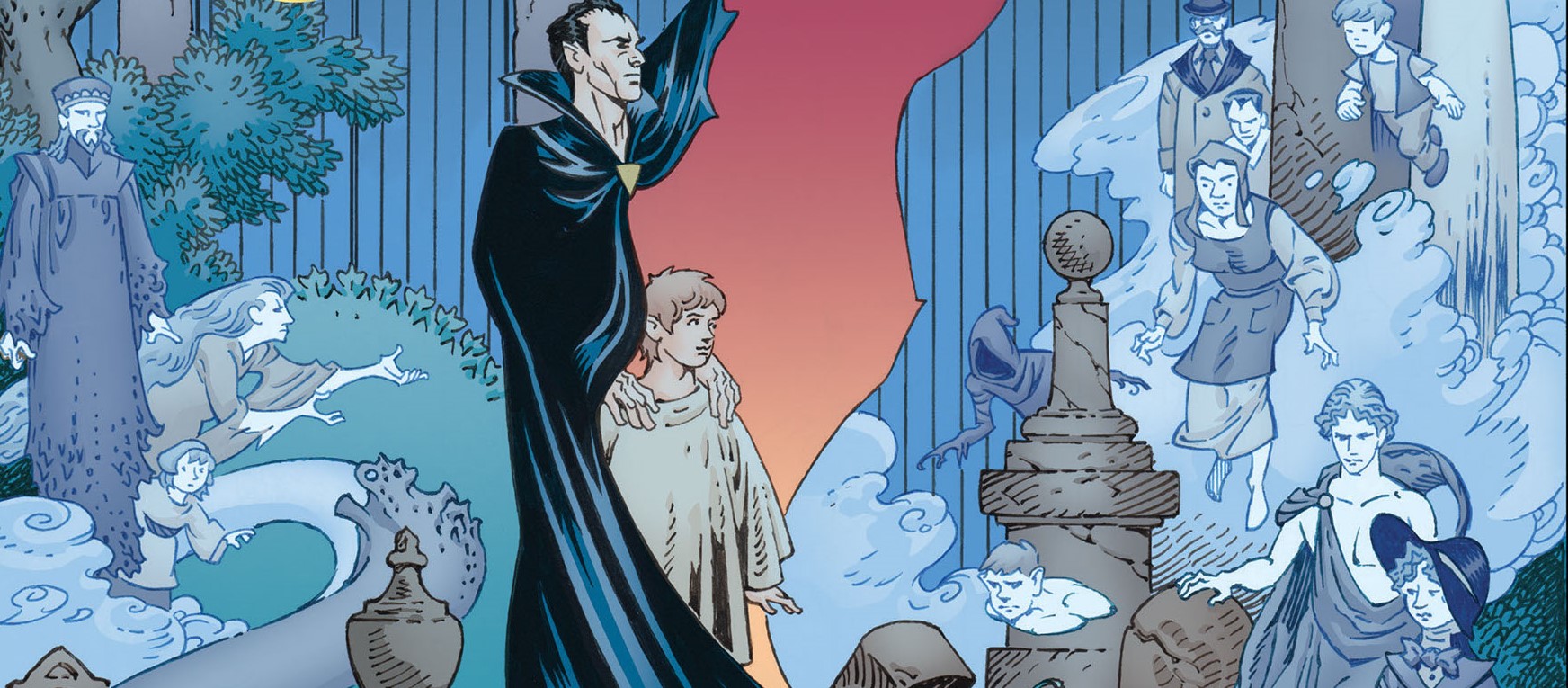
The Mowgli character in this liminal fantasy is “Nobody Owens.” He is raised by the disembodied spirits of various centuries who have remained in the graveyard and how grant “Bod” their transmortal protection. Needless to say, his education is eclectic. Because of his unique neighbourhood, Bod is able to speak the English of a hundred generations, though he has a very particular and narrow understanding of history. He learns to read English and Latin from the epitaphs on tombstones. With honourary citizenship in the graveyard, he also learns the particularly ghastly gifts of fading from view, dream walking, and haunting.

It is a very clever book, able to draw our cultural imagination of graveyards into a single bittersweet tale.
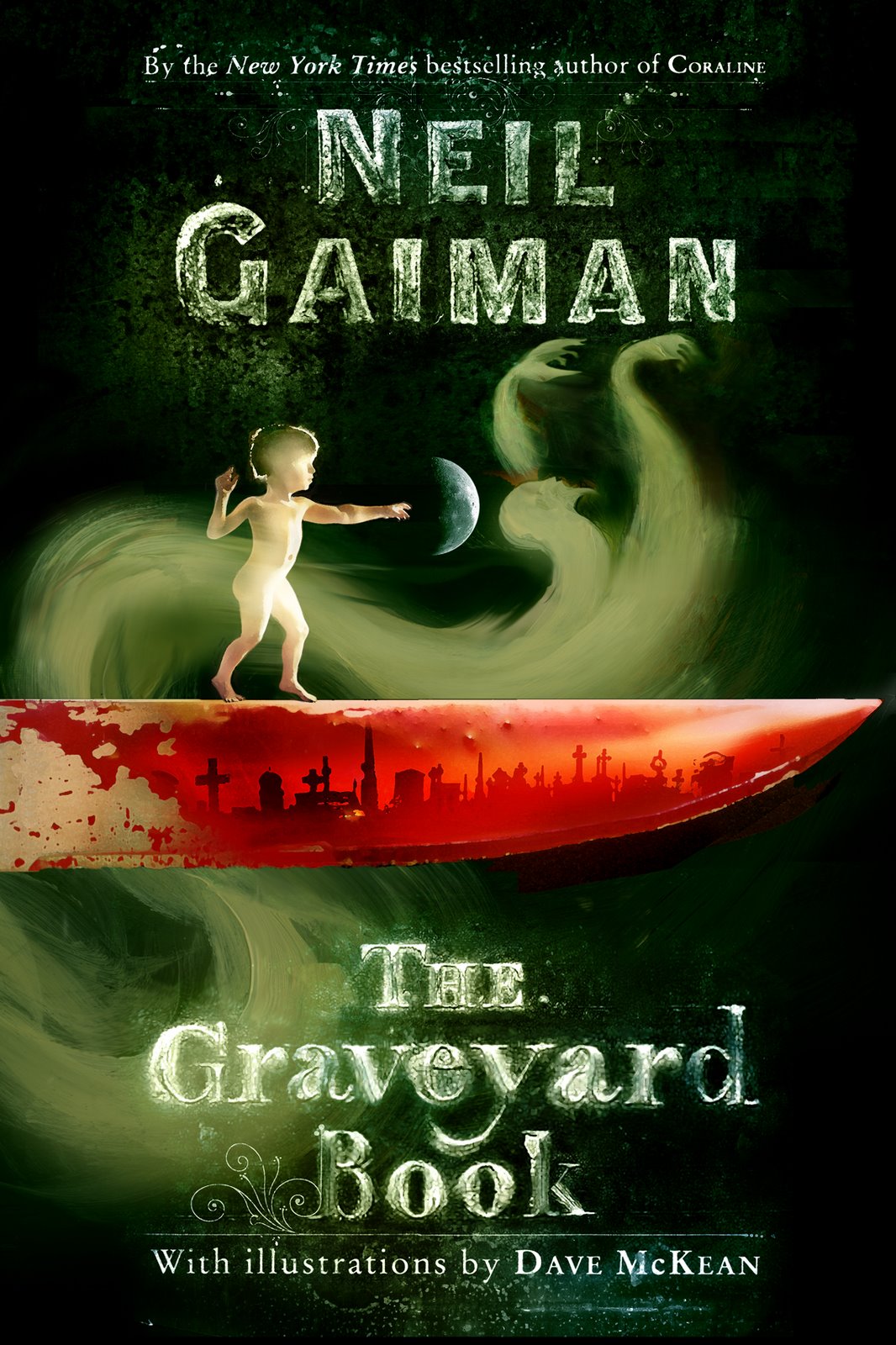
This is one of those great books that can work at various levels. I know, I know. Books that are tinged with meaning, morals, or symbolism have garnered a poor reputation as art. But The Graveyard Book does what good books should. I am always looking for a story that will capture the sense of alienation and loneliness I had when I was a child. What could be better than a boy named “Nobody” who is practically invisible to humans and lives in a place that doesn’t exist with people who can’t be there? Moreover, parents reading this book are going to be left with the haunting feeling—see what I did there?—that they are in some danger of over-protecting their children.

These morals emerge naturally from the narrative; none of them are forced. Critics of layered stories are missing the point, I think. Anyone reading Harry Potter would be a dangerously narrow reader if they didn’t see the social implications. Yet they read these books again and again because they are good works of literature that please and challenge both. The Graveyard Book is exactly that type of book, on a much smaller scale.

I’m not surprised it’s good. As soon as I heard the premise, even filled with weighty sadness of loss, I knew that it would be.

It is not a perfectly shaped book. Gaiman is a short story writer at his best, so the book is episodic, filled with flashes of Nobody’s life as he grows. They are usefully lively episodes, but, at times, the plotline feels like it is going nowhere. Gaiman makes it work here in much the same way that L.M. Montgomery‘s Anne of Green Gables is episodic and forward-moving. Like Anne Shirley, Nobody Owens’ life has a particular direction, as readers slowly come to understand. Some of the feeling of Bod’s destiny is lost in the triptych style of storytelling, so the climax and denouement are a bit quick, for me, at least. And there is the haunting question: How must a boy-in-the-graveyard coming-of-age tale end?
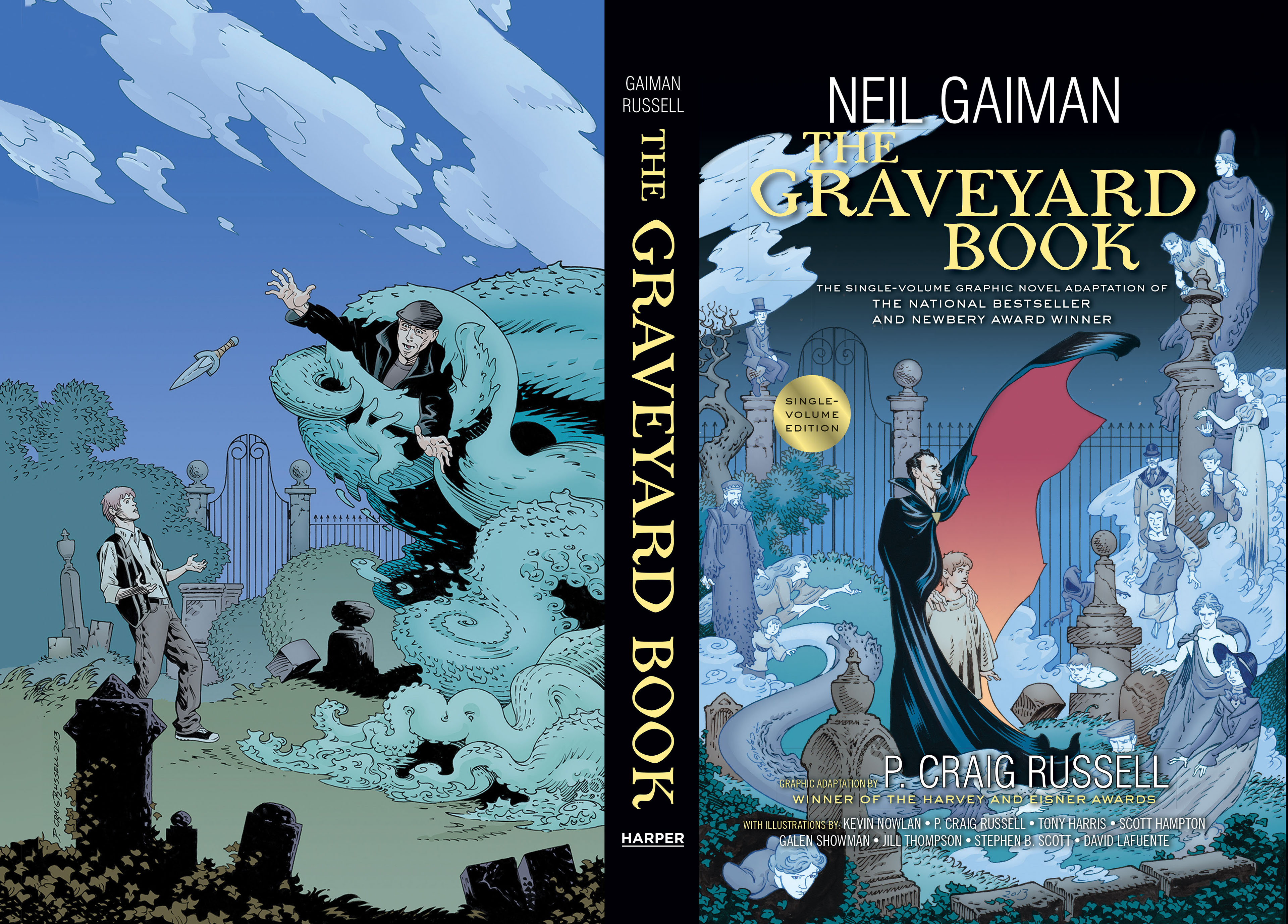
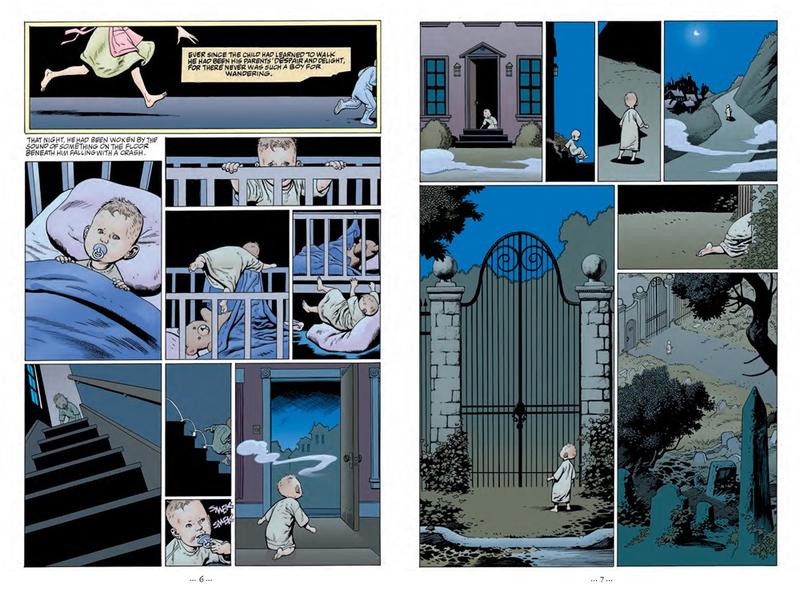
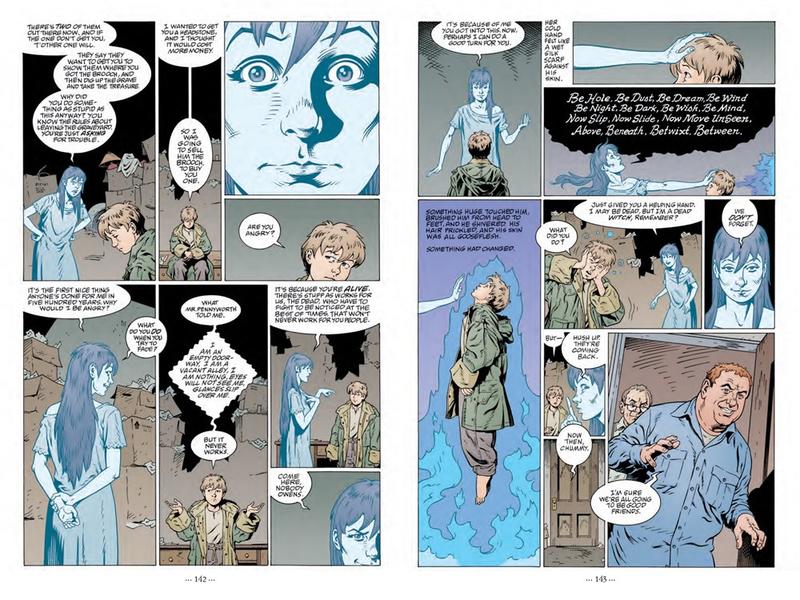
Neil Gaiman is part of the invention and growth of the adult graphic novel as a distinct storytelling artistic expression, and the adaptation is excellently done. Led by P. Craig Russell’s art direction, each of the different artists contributes a different vision of Bod’s world. Rather than visual chaos or a loss of unity, the artwork in each chapter is suited to Nobody’s personal growth and the reader’s expanding vision of his world, the graveyard. Given that there is an element of mystery here, the fact that the visualizations of the characters and scenes differ slightly keeps the visual learner from prematurely working out the clues.
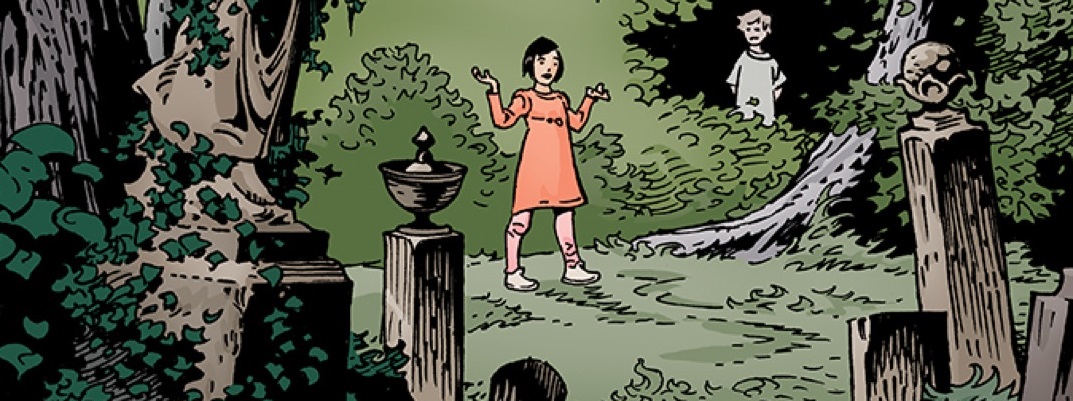
Truly, The Graveyard Book has become one of my favourite graphic novels ever. I lost nothing in the abridgement and interpretation of the text and was won over again to the powerful atmosphere of the tale. For The Graveyard Book is not derivative, though it echoes other stories. It is not merely the retelling of Kipling’s classic, nor is it simply a stock orphan tale or standard coming-of-age story. It goes deeper than these elements, for The Graveyard Book is a messianic story, laced with prophecy and legend that moves through many millennia and a few dimensions. As I reread this book in a new form, I found that the mythic elements intensified for me–either in the act of drawing the story deeper into my consciousness, or because the graphic novel enhanced my reading experience.
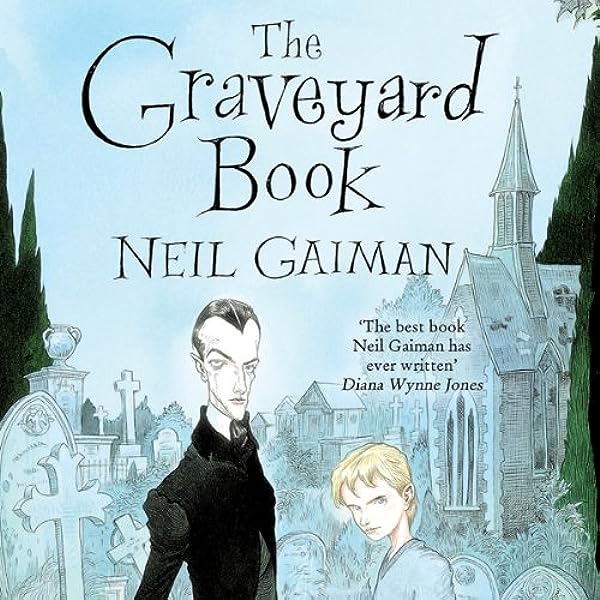
Granular criticisms within a heap of praise. My real complaint is that Neil Gaiman is a jerk. And greedy too–though admittedly generous to many writers and artists. The Graveyard Book won not only the Newbery Medal but also took the Carnegie Medal (a first double win, I believe). If that wasn’t enough, Gaiman took home the Hugo and Locus awards. How are other writers supposed to build a career when this guy is sitting down at a computer with his elegant premises, whimsical hair, and friendships with amazing illustrators?

Anyway, readers may note a touch of bitterness. I would hate for my grave feelings about Gaiman in the moment of rereading to overshadow what is a very great novel that is successfully transformed within another of Gaiman’s transmedial projects. But don’t buy it. That will just help his cause. Have your library order it but read it there to make it seem less popular. Or read it in the aisle at the bookstore or over someone’s shoulder on the bus. If you can make yourself invisible like Nobody, no one will find that creepy at all.
Posted in Reviews, Throwback Thursdays | Tagged , , , , , , , , , , | 4 Comments

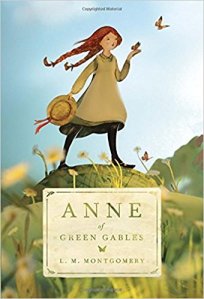
Reading L.M. Montgomery as Fantasy: Anne of Green Gables (SPACE Short Course Announcement)


Hello fellow pilgrims. Things have been quiet here on the blog front, but some great new things are happening in the background. One of these projects is a brand new short course with Signum University’s SPACE program. SPACE is an online, interactive, non-credit short course program. It is really quite a gorgeous program for folks who want to engage in great discussions and learn about things they love.

For example, there are ongoing series in creative writing, languages (like Old Norse, Old English, Latin, and Japanese), and book studies (like Herbert’s Dune and Tolkien’s History of Middle-earth). There are also new courses up for offer each month. In September, these include:

  • Le Guin’s Earthsea Series: The Farthest Shore and Tehanu by Robert Steed
  • Sir Gawain and the Green Knight: Text, Translation, Film by Liam Daley
  • The Other in the Ancient Egyptian World by Shawn Gaffney
  • The Realm of Arnor by Knewbetta
  • Tolkien and the Romantics: Nature and Ecology by Will Sherwood

The trick with course availability is one of the lovely features of SPACE. Each month, a slate of courses goes up for offer in the SPACE system. Folks that have joined the program and purchased course tokens have a chance to bid for their favourite short courses.

As I have an idea I wanted to test, I proposed “Reading L.M. Montgomery as Fantasy.” This short course will be an experiment in reading or rereading the iconic Anne of Green Gables as if it was a fantasy book rather than as realistic youth fiction (as it has traditionally been sold). In the course description and video teaser below, I make my pitch for why this experiment could turn out to be really cool.

But … my “Fantasy Anne” course is up against a whole block of amazing courses. For this short course to find its way into the world, it needs the votes. You can find the link to the course description here. Signing up is pretty easy, and tokens for classes run $100-$150, depending on how frequently you take the journey!

As I talk about in “Living in a World with Octobers,” friends of the Anne books and films know that October is a special month for Anne. If you’d like to take this new course, you can sign up here.

Reading L.M. Montgomery as Fantasy: Part 1: Anne of Green Gables (SPACE Module Description)

Within weeks of its 1908 publication, L.M. Montgomery’s Anne of Green Gables became a bestseller. Over the years, this charming orphan story put Montgomery and her imaginative Prince Edward Island on a global map.

Despite the fact that Anne of Green Gables is Canada’s bestselling novel throughout the world—or because of it—Montgomery was ignored by the literati and scholarship. Montgomery was a public intellectual, the first female Canadian fellow of the Royal Society of Arts, and invested Officer of the Order of the British Empire. Still she was dismissed as “just” a children’s writer, a regionalist, or a woman. It was 25 years after Montgomery’s death before children’s literature and feminist scholars began to recover her work as worthy of study.

While there is a robust field of Montgomery scholarship, there are areas where our focus is sometimes too narrow. One of these is the category of “realistic” fiction. While there is a kind of verisimilitude about everyday life in the late Victorian era in her work, the realism is pressed to the margins of definition as Montgomery romanticizes the worlds she creates. And can we disagree that there is something magical about Anne herself? By changing our way of approach and by looking at Anne of Green Gables as a fantasy novel, what can we unveil in this classic novel?

Native Prince Edward Islander and Montgomery scholar Brenton Dickieson will lead students through a rereading of Anne of Green Gables using the lenses we use to study fantasy and speculative fiction with the goal of allowing one of the greatest living children’s books to live in new ways.

Required Texts:

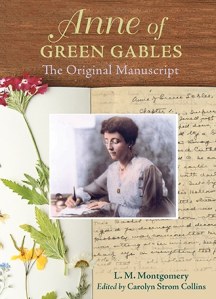
Anne of Green Gables is available cheaply in paperback, in public domain digitally as an eBook, in Kindle, and in a variety of audiobook readings. The pre-publication manuscript is transcribed in book form and is available in a full online form, with a French translation and reading resources at https://annemanuscript.ca/). Anne of Green Gables is available in 40+ languages, and students are encouraged to read in other languages, provided they know the English text well enough to comment.

Knowledge of the other eight Anne novels or Montgomery’s other work is not necessary.

Recommended text for writers, literary critics, and literature students:
• Elizabeth R. Epperly, The Fragrance of Sweet-Grass: L.M. Montgomery’s Heroines and the Pursuit of Romance (1994; 2014; available in print and eBook)

Recommended biographical resources:
• Montgomery’s selected diaries are fully available in print with an index. Her complete diaries are available in print up to the mid-1930s. There are selections of her letters available in print.
• Critical Biography: Mary Henley Rubio, Lucy Maud Montgomery: The Gift of Wings (2010; available in print and kindle)
• Young Adult Biography: Liz Rosenberg, House of Dreams: The Life of L. M. Montgomery Paperback (2020), with illustrations by Julie Morstad (available in print, Kindle, and audiobook)

Posted in L.M. Montgomery, News & Links | Tagged , , , , , , , , | 8 Comments

“Your Fingers Would Remember Their Old Strength Better, if They Grasped a Sword-hilt.” Gandalf and The Healing of Théoden by Stephen Winter

Hi folks, here is a thoughtful post on one of my favourite lines in The Lord of the Rings. I would encourage you to check it out and follow Stephen Winter‘s thought-of-the-week short essay on the trilogy. “Wisdom from the Lord of the Rings” is consistently well written, and Stephen says things that spark my imagination.

Also, just for free, in this essay, you have a Canadian blogger (me) sharing an essay from an English writer (Stephen) about an African-born British writer (Tolkien) that quotes a great American figure (Abraham Lincoln). It is the kind of nonsense link I like to make when we are generally sitting at table together talking good sense.

stephencwinter's avatarWisdom from The Lord of the Rings

The Two Towers by J.R.R Tolkien (Harper Collins 1991, 2007) pp. 671-677

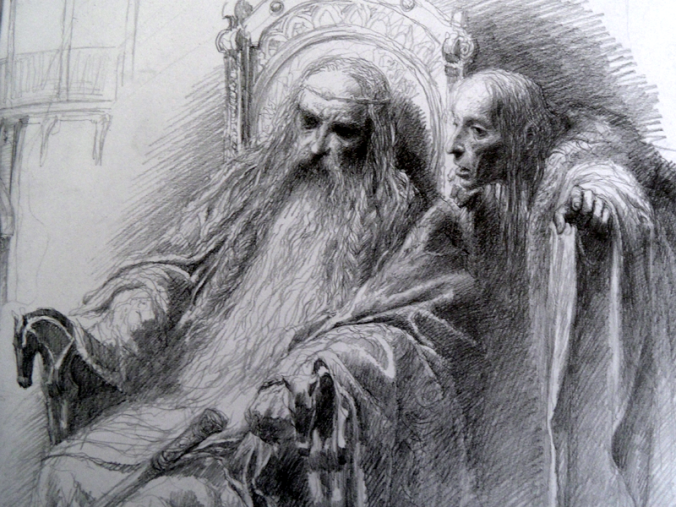
It is in the record for the 2nd of March in the year 3019 of the Third Age in the Tale of Years that we are told explicitly, “Gandalf comes to Edoras and heals Théoden.” And yet what kind of healing is this when the patient will be dead within two weeks, falling in battle before Minas Tirith, slain by the Lord of the Nazgûl? Surely if Gandalf had left Théoden to the darkness of Meduseld and the care of Wormtongue he would have lived longer. At least until the armies of Saruman overcame the defence of Edoras and he fell in his own hall.

Alan Lee’s wonderful depiction of Théoden’sdescent into death.

Last week we thought about how Gandalf overthrew Wormtongue, revealing for a brief moment something of his greatness and power, now made all the…

View original post 631 more words

Posted in Feature Friday, Reflections | Tagged , , , , | 7 Comments

A Settler’s Reflections on Indigenous Spaces (National Indigenous Peoples Day)

Images for National Indigenous History MonthToday is National Indigenous Peoples Day in Canada, when we set aside some time to recognize and celebrate the history, heritage, resilience and diversity of First Nations, Inuit and Métis across Canada. Rather than enjoy the drumming and dancing and food downtown at Confederation Landing–the legendary wharf where Canada begins as a nation–I am off to Washington, DC. My mind is full of little details about the garden and packing and the week ahead, I wanted to take a moment and share with you, dear readers, why Mr. Dickieson Goes to Washington.

I am pleased to have been selected to give a paper at Mythmoot X in Leesburg, VA. I have spoken quite a bit about teaching with Signum University, an entirely online graduate program in imaginative literature and Germanic philology. Mythmoot began as an annual gathering of Signumites and Mythgardians to meet in person, eat together, share ideas, and celebrate a fan and friend culture of hospitality. I joined Signum in 2016 because it aligns with my vision as a public intellectual: to cultivate a digital space where we can study the things we enjoy and enjoy the things we study. I have attended Mythmoot digitally in its online and hybrid formats, and I am now going to meet so many folks I know so well.

Thus, I am off to the US capital–“Warshington” as we call it here on Prince Edward Island.

The theme of the conference is “Homeward Bound”–a theme with rich possibilities for a conference on literature and film of the adventure story variety. As the theme idea was working on me, I was reading Octavia E. Butler‘s Xenogenesis Trilogy, where a sophisticated alien species saves human survivors of nuclear holocaust, and then undertakes a eugenic breeding program as they re-seed Earth. At the time, I was also reading about my Scottish Canadian heritage, our story of fleeing the poverty of early 19th-century Scotland to make a new home in Prince Edward Island. I was also teaching students about Canada’s cruel and disheartening Indian Residential School history, and the way that the education systems in Canada continue to shape morality and culture with the assumption that our civic leaders know what’s best for us. I was reading of Lilith, the heroine of Xenogenesis, who makes herself complicit with her alien saviour-captors, and what she negotiates in that hybrid, occupied space. All these things were in my head, and I read the words:

“nowhere to go, nowhere to hide, nowhere to be free.”

I decided I wanted to make my short paper at Mythmoot a reflection of my experience as a settler in Prince Edward Island–Epekwitk to the local Mi’kmaq folks, Abegweit in my dream childhood imagination growing up, the Land of the Red Soil, the Cradle in the Waves. This is my home. Although I am Scottish Canadian, when I walked the hills and lanes of Glasgow, I knew that lovely country was not my home. The beaches and fields and villages of Prince Edward Island are the places I know. I dig my fingers into the soil of my garden–where tomatoes and peas and peppers survived another cool Spring night–and I know that I am home.

Indeed, my ancestors lived as farmers on the land, cultivating the rich soil and learning to plant and harvest in the capricious rhythms of this North Atlantic ecosystem. My family fought for the land we lived upon, rising up against unjust systems and corrupt landholders. They won the land, built homes on the land, and died on the land. I have a tiny parcel of this land of my fathers next to where I watched my father, a young farmer, die in his own home.

And yet, the land my ancestors wrestled from the hands of abusers of power–this land I know and love–was not taken from people who won it honestly. PEI is the unceded territory of the ancestral and ongoing Mi’kmaq people. It was not purchased, given away in trade, or named as the spoils of battle. There was a lot of land to share in Epekwitk, local folks reckoned. Then various British lords carved the Island into rectangular plots, cutting off the Mi’kmaq seasonal movements, trapping lines, hunting trails, and meeting places. Little by little, the ancient folk of PEI discovered that they had nowhere to go, nowhere to hide, nowhere to be free.

For a lot of my life, I have been frustrated, ashamed, and even angry about Canada’s colonial history–all the while continuing to love my country, my heritage, and my homeland. I have tried to express this complexity in pieces like “An Unfinished Walking Song and Prince Edward Island’s Mi’kmaq on National Indigenous Peoples Day,” and in reflections on C.S. Lewis’ critique of European colonization of America (see here). After all, though I am the alien, I have nowhere to go. As another one of Butler’s complicit protagonists says of alien occupiers in the short story “Amnesty,” I can’t leave. There is no “back there” where I can go. This is my home.

Butler’s characters–especially the powerful and vulnerable women of colour who are the heroes of most of the novels–are always struggling to live with these kinds of complexity. You cannot escape the tension when reading Butler. She never intended for readers to wriggle free of the complex stories of shared space and hybrid peoples. Thus, I am using this moment in a suburb of the American capital–as a stranger in that land, far from my home–to reflect on my experience as a Settler in Epekwitk. Frustration, anger, and shame have their place in our spiritual journeys. However, Butler’s science fiction storytelling gives me an imaginative space to live in those tensions, to move past temptations to rage or to “just do something already.”

There is some irony in heading away from my home to a conference that is themed “Homeward Bound”–and doing so on National Indigenous Peoples Day. The purpose of my reflection is not to alienate me from my heritage or my land, but to deepen my love for my home. For, it seems, I am bound to my home. I think that is the complex reality of shared space.

Below is my abstract for the conference. No doubt you can still register for online attendance at Mythmoot here. My reflection is leaping off of Octavia Butler research by one of my Master’s students, Jens Hieber. You can see a video of our discussion here, or you can email me for a copy of his paper: junkola[at]gmail[dot]com. For those in Warshington, see you soon!

“Nowhere to go, nowhere to hide, nowhere to be free”: A Settler’s Reflections on Indigenous Spaces and “Negotiated Symbiosis” in Octavia Butler’s Literature

What happens when you cannot be homeward bound because there is no “home” to return to? What if you are bound to a new, shared home?

In Octavia E. Butler’s short story “Amnesty,” a decades-long global depression accompanies the occupation of Earth’s deserts by frighteningly intelligent and powerful beings radically different from humans. Local populations seethe, fueled by a generation of joblessness and stories of the “Communities’” human experiments. A human interpreter explains to resentful, desperate Americans why the “Weeds” cannot just leave: “They’re here to stay … There’s no ‘away’ for them” (Bloodchild 167). Similarly, in Butler’s postapocalyptic Xenogenesis trilogy, Lilith captures a haunting sentiment: There is “nowhere to go, nowhere to hide, nowhere to be free” (Dawn III.3, “Nursery”).

Jens Hieber’s Signum Thesis analyzes what he calls “Negotiated Symbiosis” in Butler—the hybridized communities developed through forced interrelationships. I want to press in on the implications of Butler’s interspecies symbiosis by considering my own situation as a Canadian settler in Mi’kmaq territory. 203 years ago, my Scottish family began farming in beautiful Prince Edward Island—known earlier as Epekwitk, the “cradle on the waves.” While Canada’s First Nations had nowhere to be free, I have nowhere to go. I am bound to this homeland of the dispossessed.

Butler is profitably read as a Black American woman science fiction writer, but the question of settler-indigenous “negotiated symbiosis” remains unexplored. Butler’s postcolonial perspective provides a thoughtful and troubling speculative framework for reconsidering indigenous displacement, hybrid identity, and shared spaces—including the trans-Atlantic colonial project of using indigenous Africans to help displace the people who first called these lands home. Rather than a final solution to a social problem, with Butler, I offer reflections as an alien bound to this strange new land I have always called home.

Posted in News & Links, Original Research | Tagged , , , , , , , , , , , , | 7 Comments

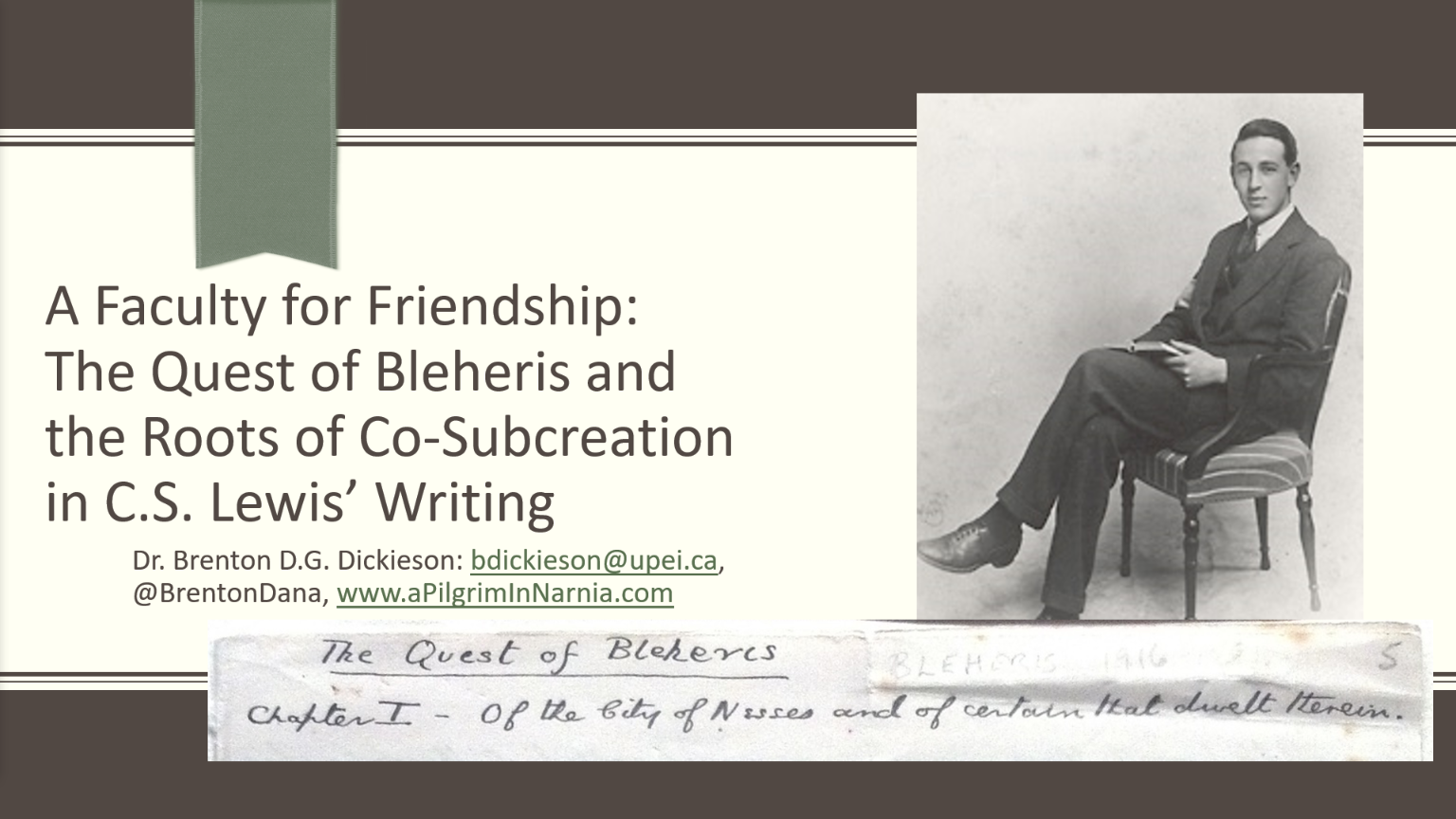
Introducing C.S. Lewis’ Unfinished Teenage Novel “The Quest of Bleheris”

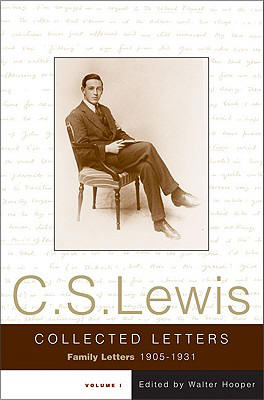
Hello friends! I want to share what I have been up to in the last few weeks. Some folks will know that I have been working for about nine years on C.S. Lewis’ unfinished teenage Arthurian novel, “The Quest of Bleheris.” Each week in the Spring and Summer of 1916, a seventeen-year-old C.S. Lewis wrote a weekly letter to his best friend, Arthur Greeves. In these weekly epistles, Lewis included a chapter of an Arthurian romance he was working on. This 19,000-word unpublished manuscript was left incomplete after seventeen chapters, but is an evocative piece. As Lewis’ first attempt at long-form prose fantasy, written in the style of William Morris, “The Quest of Bleheris” emerges out of a rich and exciting time in Lewis’s life. Studying under the Great Knock, Lewis is thriving in his literary world and testing out his authorial voice with his best friend. In this period, Lewis has just encountered George MacDonald’s Phantastes, declared his atheism to Arthur, decided to enter the war, and prepared for entrance to Oxford.

More than just teen fan fiction, “The Quest of Bleheris” is a resource for understanding Lewis’ spiritual development and charting his growth as a critic and imaginative writer.

In 2018, I led a panel with Dr. David Downing at the C.S. Lewis and Friends Colloquium (with help from Jennifer Rogers), and in 2022, I presented some findings at the New York C.S. Lewis Society. This past weekend was Canada’s annual Congress of the Humanities and Social Sciences (Congress 2023) in Toronto. In 2021, I presented some material from my forthcoming book, The Shape of the Cross in C.S. Lewis’ Spiritual Theology, to the Canadian-American Theological Association (CATA; see description and video here). I have also presented at the Christianity and Literature Study Group (CLSG) on C.S. Lewis’ instinct to write himself into stories (in 2021, see description, resources, and video here) and on language in Lewis’ Ransom Cycle (in 2022, see description here).

As the Congress–and in particular, the small academic societies within the Congress–is a fruitful place for scholarly discussion, I wanted to present some of my ideas on “The Quest of Bleheris” and what I call C.S. Lewis’ “Faculty for Friendship.” In a work-in-project peer-reviewed paper that I have brought to draft form, I am testing the implications of “The Quest of Bleheris” for  Diana Pavlac Glyer‘s theory of creative collaboration among the Inklings. I was pleased when the folk at the CLSG were kind enough to accept my proposal for what is a fairly data-heavy piece.

And then I could not go! I was sad about missing the conference as it was so close (only about a 20-hour drive to Toronto) and because I wanted to connect in real life with my friends at CLSG and CATA. My cancellation also meant, though, that I would leave a hole in the CLSG programme and lose that opportunity to test out my ideas. Again, with great scholarly hospitality, the CLSG folk allowed me to record and present my paper by video.

I am limited from sharing any aspects of the physical manuscript, some particular images, and a portion of the argument. However, I wanted to share a 4-minute segment from my talk for a couple of reasons.

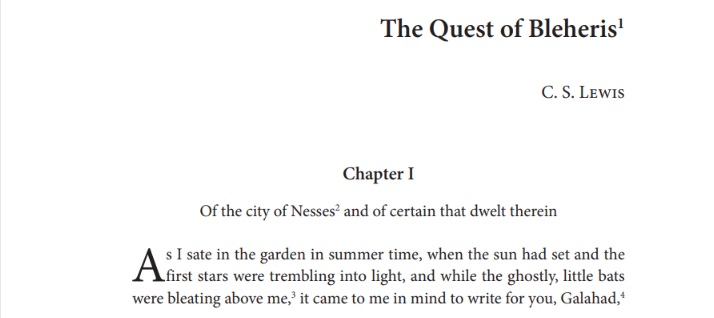
First, “The Quest of Bleheris” has historically been available only to those who could get to archives in Oxford, UK or Wheaton, IL. In 2021, Inklings scholar Don W. King was able to provide a full transcription of “The Quest of Bleheris” in Sehnsucht journal. Recently, Sehnsucht has become an open-access journal. Thus, by clicking on this link, you can find the full transcription of the tale, with critical notes and an introduction by Don King. As this story is now available to the reading world, I hope my short introductory video can give you a feeling for both the story and the manuscript history.

Second, I want to whet your appetite for the paper when I have finally concluded my work. I have spent these years working on this nearly lost piece of Lewis’ writing history because I believe it has deep value for readers and biographers of C.S. Lewis, as well as writers, literary scholars, and WWI historians.

Beneath my 4-minute video, you can find the abstract for the paper and some notes about project. I hope you enjoy, and I welcome any feedback or scholarly questions.

Abstract: A Faculty for Friendship: “The Quest of Bleheris” and the Roots of Co-Subcreation in C.S. Lewis’ Writing

When a seventeen-year-old C.S. Lewis was preparing for Oxford entrance and WWI service in 1916, he wrote seventeen chapters of a prose novel. “The Quest of Bleheris” is a letter-styled chivalric tale of heart-longing for adventure in a latter-days world. Young Bleheris must discover the true meaning of knighthood in a land where King Arthur is a distant memory and chivalry exists only as a formal social game.

Intriguingly, Lewis did not merely write “The Quest of Bleheris” in epistolary form; it is itself an epistolary novel that he mailed in weekly installments to his closest friend, Arthur Greeves. Thoughtful consideration of the extant correspondence, a close reading of the surviving 19,176-word text, and careful analysis of the manuscript show that a culture of creative collaboration goes deep in Lewis’ instincts as a writer. Arthur is implicated at many levels of this tale, both within and without the text. The formation of Lewis’ writerly habits, inspiration for the tale, the form of the novel, critical aspects of the world-building, the atmosphere of the story and the secondary world, critique and feedback, authorial commentary, text illustrations, and the preservation of the manuscript—Arthur was involved at each of these aspects of writing. Again and again, Lewis draws Greeves into the creative process—and goes further, as Lewis imagines he and Arthur, narrator and listener, living within the secondary world as characters. Arthur is there as the story begins to take form, he supports Lewis as he describes all of his doubts and insecurities along the way, and he is the one to whom Lewis announces “Bleheris is dead” some months later.

“The Quest of Bleheris” is an intertextually and autobiographically rich piece. Besides being the literary treasure of a precocious attempt at high romance by one of the 20th-century’s most famous fantasists, the Bleheris manuscript shows early signs of Lewis’ discipline and instincts as a career writer. While the story lacks the inversive elements in his later fiction, it has moments of heightened prose that capture the imagination and open a window into his youthful atheism and love of mythology. It also shows how Lewis instinctively viewed the writing process as going beyond the sole genius model of modern literature to a more capacious medieval model of collaboration, reinvention, multimodal storytelling, and symbolic play. Lewis’ friendship with Arthur extended his image of the “author” beyond the solidary desk to something more like an Arthurian round table experience.

This paper presents evidence for Lewis’ faculty for friendship in the creative process through analysis of the manuscript, the text, and the relevant correspondence. This analysis confirms the work of Diana Pavlac Glyer on collaboration among the Inklings by extending the data to include Lewis’ earliest creative endeavours. We discover the early roots of something like co-subcreation by teasing out Lewis’ instinct challenges us to re-imagining the creative process in these almost-forgotten literary remains.

Notes:

The hand-drawn facsimile of the header of “The Quest of Bleheris” in manuscript form was created by Katie Stevenson, who also did a bit of manuscript help for Sørina Higgins’  The Chapel of the Thorn during her visit to the Wade centre in 2014.

Thanks to Bronwyn Rivera for the note on the “Three Greats.”

I am always grateful to the amazing folk at the Wade and the Bodleian.


Posted in Original Research, Reflections | Tagged , , , , , , , , , , , , , , , | 17 Comments