 Sacrificial Fire for Fickle Gods (2023)
by Brenton Dickieson
O! to speak life-words of fire
In a fashion sweet and plain:
For pith-like wit, ink-painted flight,
A Titan’s theft of flame.
Lo! in conjuring these trickster lords,
Who rule not day but night,
Hermes wreathes my clarion words,
With dull quicksilver light.
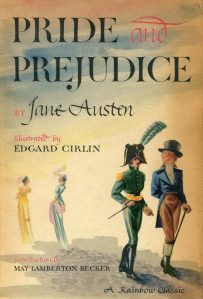
Ah well, it really is hard to say everything in the first few words. In an old piece I quite like about “Great First Lines,” I included what I think to be one of the most complex, clever, and complete first sentences of a novel I have ever encountered:
Jane Austen, Pride and Prejudice (1813)
It is a truth universally acknowledged, that a single man in possession of a good fortune, must be in want of a wife.
I also give a nod to what I think is C.S. Lewis’ best first line in The Chronicles of Narnia:
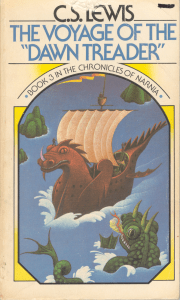 C.S. Lewis, The Voyage of the Dawn Treader (1952)
There was a boy called Eustace Clarence Scrubb, and he almost deserved it.
Each of these is brief, evocative, and humorous in its unique way, though neither is quite so abrupt and shocking as:
Herman Melville, Moby Dick (1851)
Call me Ishmael.
I tried to evoke this opening in a philosophical novella, Wish for a Stone. The book is written, not published, because I can’t quite get it right. I wanted to nuance Melville’s launch of the tale with this famously dizzying opening:
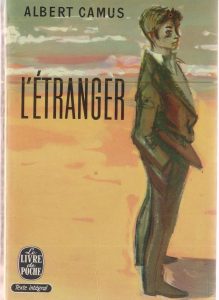 Albert Camus, L’Étranger (1942)
Aujourd’hui, maman est morte. Ou peut-être hier, je ne sais pas.
Today, mama is dead. Or maybe yesterday, I don’t know.
I have provided my own inadequate translation because no translation is quite able to capture the ambiguity of the text in French. Even the title contains this mercurial wavering that blurs the whole novel, like a hazy sun reflecting on the sand.
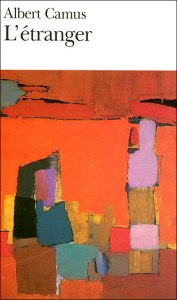 Here are some choices for translating with the novella in mind L’Étranger:
- The Stranger
- The Outsider
- The Alien
- The Estranged
- The Foreigner
- The Extraneous
- The Unfamiliar
- The Drifter
- The Wanderer
- The Outlander
Further choices become less poetic but not less apt, like The Beyonder, The Evacuee, or The Floater. The Outcomer is interesting, but perhaps the opposite of what is happening in the story. It is a tale of migration and alienation but not an exodus. Selecting the right title in English would take a Camus scholar with a remarkable poetic capacity, a knowledge of North African colonial French expression, and an intimate sense of the nuances of the kinds of French in Camus’s library (e.g., regional and from Middle French up to WWII). I am not such an one as this.
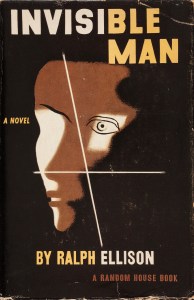
Today, I began a modern American classic that has the pith of Moby Dick but the nuance of Pride and Prejudice:
Ralph Ellison, Invisible Man (1952)
I am an invisible man.
That line, and the title, say a great deal with a handful of words. The challenge of writing that perfect first sentence is great–and can even cause confident writers to freeze in terror. But many press through. I have heard that J.K. Rowling went through more than a dozen drafts of the first chapter of Harry Potter and the Philosopher’s Stone, trying to get it right. Rowling chooses an opening that is the most anti-Harrylike characteristic of the orphan’s tyrannical upbringing:
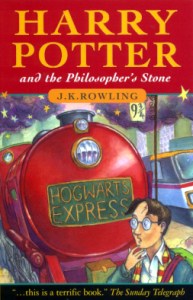 J.K. Rowling, Harry Potter and the Philosopher’s Stone (1997)
Mr and Mrs Dursley, of number four, Privet Drive, were proud to say that they were perfectly normal, thank you very much.
It is very well done, leaning on the Baggins side of the Took vs. Baggins tension, but a risk not to have either Harry or magic at the beginning of a Harry-centred fantasy.
My Wish for a Stone opening needs work, though it may be indecent to awake that slumbering dwarf. The first line is not the only challenge, and I think I could create a good opening if I set my mind to it. My own attempt to parody Austen’s genius opening is pithy but lacks the punch of its predecessor:
It is a truth universally acknowledged that the man in possession of a good wife must be in want of a fortune.
Funny, perhaps a good tale for a good teller, but a Reader’s Digest opening at best.
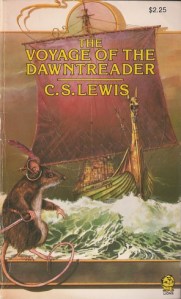 My sense is that C.S. Lewis rarely struggled to find the first line once he got the story. The scant archival evidence does not show much editing from the last draft to the published book. But none of the Narniad openings is as pithy as the “Eustace Clarence Scrubb” in The Voyage of the Dawn Treader. Like George MacDonald‘s fairy tales (certainly a model for Lewis), Narnia begins with a “Once upon a time…” feeling, though never formulaically so. I don’t find MacDonald‘s fantasy striking from the first splash of ink, but his Scottish novels are sometimes jarring to begin:
George MacDonald, Malcolm (1875)
“Na, na; I hae nae feelin’s, I’m thankfu’ to say.
And the pithiest of his tight-fisted Scottish wit:
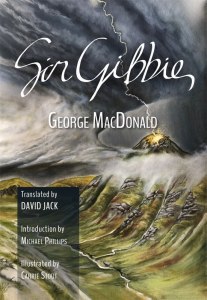 George MacDonald, Sir Gibbie (1875)
“Come oot o’f the gutter, ye nickum!”
Shocking openings work well for a certain atmosphere, and none captures the essence of the fictional world of the book better than this classic:
Dante Alighieri, Inferno (1300-13020)
Midway this way of life we’re bound upon,
I woke to find myself in a dark wood,
Where the right road was wholly lost and gone.
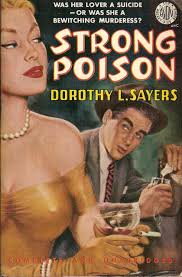 I am using Dorothy L. Sayers’ translation among the many famous ways to capture Canto 1 of the Italian verse. I have just completed all of the Lord Peter Wimsey novels, which I quite liked–though I do not read them for their first lines, specifically. The successful opening to her first novel, Whose Body (1923), contains a clipped, silent joke that adds a cutting edge to the mystery. Most of Sayers’ first lines after this are satisfying mostly to the Lord Peter insiders, but here are a couple worth noting:
Dorothy L. Sayers, Strong Poison (1930)
There were crimson roses on the bench; they looked like splaces of blood.
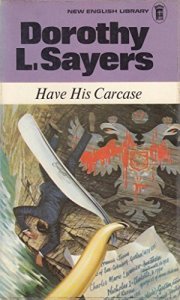 Dorothy L. Sayers, Have His Carcass (1932)
The best remedy for a bruised heart is not, as so many people seem to think, repose upon a manly bosom.
Pithy but not brief, it is very much in the line of Sayers’ humour. Likewise, another of the Detection Club authors, G.K. Chesterton, lacks brevity on the opening page, but contains all the secret of his humour:
G.K. Chesterton, The Napoleon of Notting Hill (1904)
The human race, to which so many of my readers belong, has been plaing at children’s games from the beginning, and will probably do it till the end, which is a nuisance for teh few people who grow up.
C.S. Lewis‘ nonfiction has something of this Chestertonian humour, and perhaps the “Eustace Clarence Stubbs” bit is in that vein. Of his fiction, though, it may be that the opening to his last novel, a literary myth retold, is the most sophisticated and provocative of all:
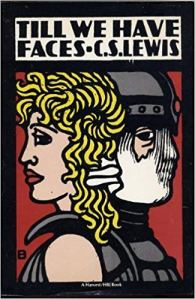 C.S. Lewis, Till We Have Faces (1956)
I am old now and have not much to fear from the anger of gods.
It is not comedic in Chestertonian or hey nonny, nonny! kinds of way. However, like the opening of Pride and Prejudice, this first line also captures layers of complexity, nuance, self-delusion, and truth. And like in Austen’s novel, there is hidden within this first line the question of whether a tragedy can become a comedy (in the classical sense).
You can read here for some of Lewis’ great first nonfiction lines, but I have argued elsewhere that the opening of his late-war dystopia captures the structure of the whole novel:
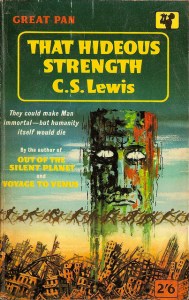 C.S. Lewis, That Hideous Strength (1945)
“Matrimony was ordained, thirdly,” said Jane Studdock to herself, “for the mutual society, help, and comfort that the one ought to have of the other.”
It is full of pathos and irony and either false or true hope, depending on how you read the tale.
Still, it is far less pithy and punchy than the novel that, though conceived independently, is in some ways an answer to Lewis’ That Hideous Strength:
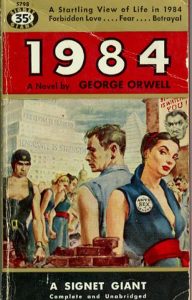 George Orwell, 1984 (1949)
It was a bright cold day in April, and the clocks were striking thirteen.
There is an art to capturing the atmosphere of a postapocalyptic dystopia in its first lines that many of the masters do well:
N.K. Jemisin, The Fifth Season (2015)
Let’s start with the end of the world, why don’t we?
Ray Bradbury, Fahrenheit 451 (1953)
It was a pleasure to burn.
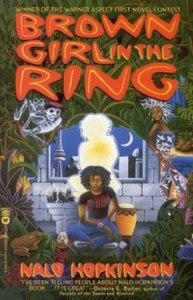 Nalo Hopkinson, Brown Girl in the Ring (1998, from ch. 1)
Ti-Jeanne could see with more than sight.
Margaret Atwood, The Testaments (2019)
Only dead people are allowed to have statues, but I have been given one while still alive. Already I am petrified.
I snuck the second line in there because Atwood has succeeded in capturing the essence of the fictional world of the Northeast US after environmental apocalypse and military rule, but she also succeeds in creating an impossible-to-write follow-up to The Handmaid’s Tale. In his Dying Earth/Long Walk 1980s apocalyptic series, Gene Wolfe also succeeds in a pithy first line that enters the voice of the whole tale:
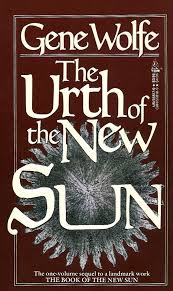 Gene Wolfe, The Urth of the New Sun (1987)
Having cast one manuscript into the seas of time, I now begin again. Surely it is absurd….
“I will not always be grave,” Aslan says to the exhausted hero, Jill Pole, near the end of The Silver Chair, after she rescues the enthralled prince and thus prevents a Narnian apocalypse. And these lines need not be either grave and earnest or whimsically philosophical. Sometimes they simply do a great job of bringing us into the story with a kind of unexpectedness:
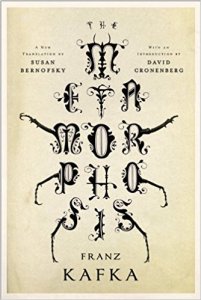 Franz Kafka, Metamorphosis (1915)
As Gregor Samsa awoke one morning from uneasy dreams he found himself transformed in his bed into a gigantic insect.
J.R.R. Tolkien, The Lord of the Rings (1954-55)
When Mr. Bilbo Baggins of Bag End announced that he would shortly be celebrating his eleventy-first birthday with a party of special magnificence, there was much talk and excitement in Hobbiton.
 Kafka’s sardonic catastrophe gets us there immediately, and Tolkien writes a lovely hobbitish opening to his epic. And Tolkien is smart to take “eleventy-first” for a spin. Still, it is nothing like his earlier tale:
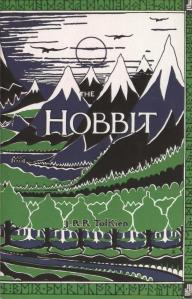
J.R.R. Tolkien, The Hobbit (1937).
In a hole in the ground there lived a hobbit.
Pithy and evasive, this line also captures something of the legendary history of how Tolkien discovered Middle-earth while writing this line on a blank piece of university examination foolscap. Like Tolkien, the reader must go on a bit to figure out what a hobbit is, what his hobbit home is like, and how he saves the world.
It is a grand ending to a swift beginning–or perhaps the opposite! This reflection, however, has been far from brief, though it has its pithy moments, and I hope I can emulate the sharp and novel minds of those who have contributed. This post is, we must admit, a long one, which makes me wonder about the great novel openings that are far from pithy. That cannot be antipathy, of course, but lines of a certain weight and heft. It is a subject of past depth worth exploring at some height at a future time.
I believe in open access scholarship. Because of this, since 2011 I have made A Pilgrim in Narnia free with nearly 1,000 posts on faith, fiction, and fantasy. Please consider sharing my work so others can enjoy it.

 Artificial intelligence is all the rage these days. While there is good reason to doubt the truthfulness of the title, GenAI–generative artificial intelligence–public attention is deeper than the media, either the social or unsocial kind. In my world, writers, artists, teachers, content providers, and designers are in some degree of distress. The first wave of 2020s AI has gobbled up a googolplex of pages of original content and republished it without consent or credit in billions of images, essays, and answers to inane questions. And with plagiarism, there is always job displacement–and I would humbly suggest that as a class, free-range artists, writers, and academics are on rocky economic ground.
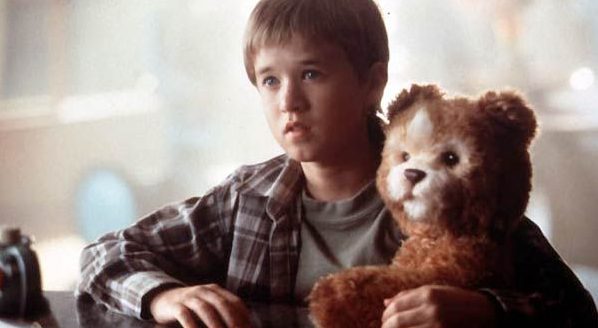 Some of this is not new. Our digital platforms have been shaping us in myriad ways for years. For example, autocorrect just corrected my “googolplex” and changed it to Googleplex.
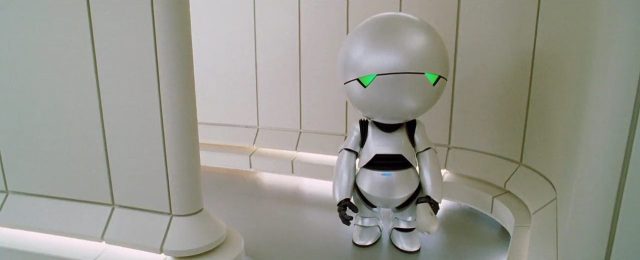 With all of these factors in mind and seeing the potential of many emerging AI tools for research and teaching, our brilliant Inquiry Studies team at UPEI set to the task of redesigning the Autumn curriculum. We set the theme as “Smart Digital Engagement,” and rewrote our foundation-year course to shape students as inquirers who can develop a healthy relationship with AI, learn to choose the right tool for the right job, and discern the frenetic voices of social culture.
 As a science fiction nerd, though, I must admit that I find little of this “sudden technological leap” surprising. Nor are the implications new. Honestly, we have been reading and writing about the possibilities and implications of human-machine hybridity for generations. The loss of one’s humanity in one’s human activity is a theme that goes back to the ancients, including the Bible. Even culture-watchers who are not SF nerds should see the signs: In North America, we have bred functionalism into the DNA of our children; is it any surprise that when given the chance, students are apt to choose function over art, ethics, or identity? We left the path of wisdom some time ago when we decided that the heart of man was composed merely of walls, cavities, atriums, and valves.
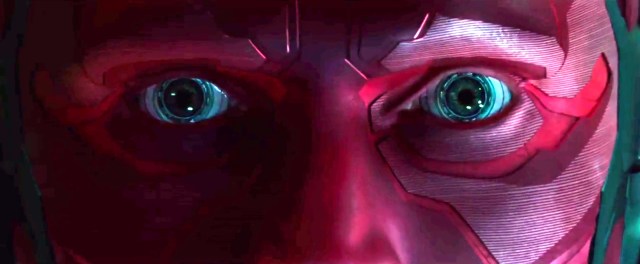 Seriously, I want my own version of J.A.R.V.I.S.–before his incarnation, of course. The sarcastic butler voice is a bonus, provided my AI tools can effectively become my executive assistant, life coach, conversation partner, debate opponent, database manager, research assistant, and grammar-checker who, by all the gods of tin and wire, can actually learn from me as a writer.














 A Pilgrim in Narnia