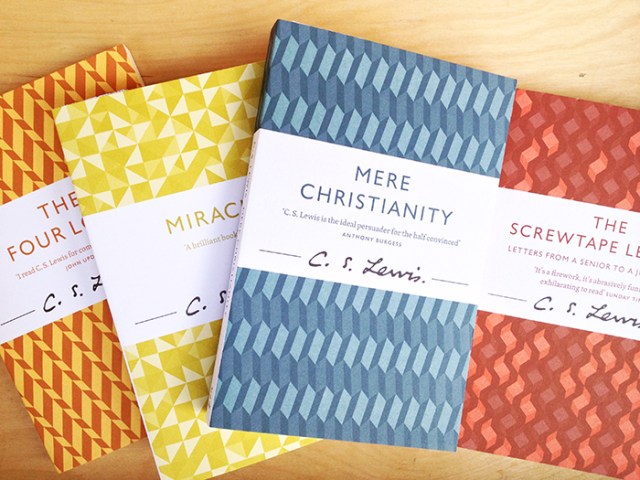
Last week, we celebrated the 80th anniversary of the first book publication (February 9, 1942) of C. S. Lewis’s first real blockbuster, The Screwtape Letters. I published my piece “All Things Screwtape: A Pilgrim in Narnia List of Resources on C.S. Lewis’ The Screwtape Letters.”
Also in the celebration, last week the Inkling Folk Fellowship did a three-hour reading of the entire book, one letter/chapter per reader. It was a monumental event! However, almost immediately I realized that this was just too big! We were chatting in the Zoom chat, thinking about ideas and sharing quotes and possibilities and concerns…. Too much very cool material to simply read and not talk about. Joe Ricke, the Inkling Folk Fellowship grand vizier thought so too and has created an event to curate a space for just that kind of conversation. I’m sharing his slightly edited invitation note here below.
I get to present on my “Cosmic Find in The Screwtape Letters“, very briefly teasing out some of the implications for connecting Dr. Ransom of C.S. Lewis’ aptly misnamed “Space Trilogy” to The Screwtape Letters. Here are some ways you can prep for my 5-minute talk teaser:
Read my publication: Brenton D.G. Dickieson, “The Unpublished Preface to C. S. Lewis’s The Screwtape Letters,” Notes and Queries 60.2 (2013): 296-298 (email me (junkola[at]gmail[dot]com) if you are a scholar, student, or researcher who doesn’t have institutional access to the original)
Email me if you would like a PDF of the handout I’ll distribute tonight
I’m presenting late in the agenda, so PM me on Facebook or email if you are trying to connect and something fails. You can also see the Facebook event here.
Pop-up Mini-Conference: The Screwtape Letters
Not more than twenty minutes into the Inkling Folk Fellowship Screwtape marathon, it became obvious that the richness, profundity, and (sometimes) perplexing nature of C. S. Lewis’s 1942 masterpiece needed more than a read-aloud (although we wouldn’t have traded that experience for a ride on the #73 to the St. Pancras/British Library stop). Too many ideas, conversations, questions were flying back and forth in our minds and in the chat to just leave them suspended in the Zoomosphere.
So. We abruptly switched our upcoming schedule (see the bottom of the page for that) and asked for proposals for five-minute response papers from various perspectives.
And . . . here we go!
Join the Inkling Folk Fellowship (aka, “Safe Place for Nerds”) via Zoom this Friday at 4 p.m. (EST) for our Pop-up Mini-Conference on The Screwtape Letters. The two-hour session will look something like this:
Panel One: Reception and Context
James Stockton: May 14, 1942 “somewhat cheeky” Review of Screwtape in Oxford Magazine.
Paul Michelson: Early Reception of Screwtape
Joe: Screwtape in War-Time
Panel Two: Screwtape as Theologian
William O’Flaherty: The Satanic Anti-Thought Police
Rob Garcia: Screwtape and the Uniqueness of Persons
John Stanifer: Iconoclastic Prayer in Screwtape
Sarah Waters: Life, Death, and the Space in-between
Panel Three: Problematizing The Screwtape Letters
Edwin Woodruff Tait: Depression and Moral Decisions in Screwtape/Lewis
Brenton Dickieson: The Ransom Connection
Grace Tiffany: Damned Language and Screwtape
Bring some tea, biscuits, and your copy of Screwtape. Cool Zoom backgrounds are optional. The Zoom link is below. Bring a friend (but please remind them — and yourself — to mute if they come in late!). Stay involved with the IFF by linking/following our Facebook page at https://www.facebook.com/InklingFolkFellowship and visiting our website at https://www.inklingfolk.org/
What’s Ahead? February 25: A Conversation with author Colleen Warren about her new book, Reentering Eden: Christian Meditation in Nature.
I believe in open access scholarship. Because of this, since 2011 I have made A Pilgrim in Narnia free with nearly 1,000 posts on faith, fiction, and fantasy. Please consider sharing my work so others can enjoy it.
TexMoot 2022: Signum University’s Fourth Annual Texas Literature & Language Symposium
26 March 2022
at the Norris Conference Center
2525 W. Anderson Ln
Austin, TX 78757
and online
What is a “Moot”?
The word “moot” refers to a meeting or legislative assembly and also the place in which that meeting is held. It’s from the Old English -mot, which could be appended to the end of a word, as in “Texmoot.” It was made famous by the “Entmoots” of the tree-shepherding Ents in J.R.R. Tolkien’s The Lord of the Rings.
Signum University sponsors regional gatherings called “moots” throughout the year. These are times of academic conversation and fellowship that often include creative presentations and special guests. Although these conferences may vary in flavor, they are united by a love of stories and the people who read them.
Starships, Stewards, and Storytellers:
How Imaginary Worlds Teach Us to Care for This One
DEADLINE: March 1, 2022
In 2022, Signum University’s Annual Texas Language and Literature Symposium (TexMoot) invites you to join us as we consider the ethical turn in speculative fiction: How do imaginary worlds teach us to care for this one?
From ecological concerns to social commentary, science fiction and fantasy offer readers a mirror through which to view our own world. For example, the struggles of a terraforming planet may remind us how precious and fragile is the one we live on. The real-world conflict between nature and technology comes to life on the page when trees march to war. We may find insights into how to interact with people around us by spending time with characters in a fellowship—or on a starship.
At TexMoot 2022, you will explore questions like: How do we relate to the Other—the “monsters” and “aliens” beyond the bulkhead door? What roles can technology play in preserving nature or reinforcing what makes us human? Do humans change the nonhuman environment, or are they inevitably changed by it? Is there really a clear line between the human and the nonhuman, anyway? And whose responsibility is it to preserve “civilization” and transmit its legacy to future generations?
TexMoot 2022 will also investigate the ways authors convey these commentaries. What literary techniques best serve the message; at what point does a work cross the line into propaganda? When does the message serve the story, and when does the story serve the message?
The TexMoot Team is looking for both traditional academic papers (of about 15 minutes) and shorter discussion prompts in which the presenter talks for 5 minutes and ends with a provocative question to start a roundtable discussion. Presentations and discussion topics can be more academic or popular, according to your preference and experience.
This year, TexMoot will be open to both onsite and offsite attendees and presenters. Please submit your proposal using the form linked here. If you would like to submit multiple ideas, please fill out the form separately for each one.
Registration
Registration for TexMoot 2022 costs $50 for on-site participants, $25 for online attendees, and $15 for students in either mode. To register, please click here.
I believe in open access scholarship. Because of this, since 2011 I have made A Pilgrim in Narnia free with nearly 1,000 posts on faith, fiction, and fantasy. Please consider sharing my work so others can enjoy it.
It was also the book that provided for me an entirely new adventure of faith and scholarship that has carried me through all the years since.
How C.S. Lewis Conceived of The Screwtape Letters
Though it is now a work of great renown, The Screwtape Letters had a humble beginning in the imagination of an Oxford don in summer vacation during “unprecedented times.”
C.S. Lewis listened to Hitler’s strangely compelling speech to the Reichstag on the radio in the summer of 1940 in that first volatile year of WWII. A couple of days later, Lewis slipped into church on Sunday morning after a few weeks’ absence due to illness and fatigue. With some reluctance, Lewis sat through a sermon preached by Rev. T.E. Blieben. While Lewis found this clergyman boring, during that very sermon he was struck by an idea for the book. He wrote about the experience to his brother:
“Before the service was over—one cd. wish these things came more seasonably—I was struck by an idea for a book wh. I think might be both useful and entertaining. It wd. be called As one Devil to Another and would consist of letters from an elderly retired devil to a young devil who has just started work on his first “patient.” The idea wd. be to give all the psychology of temptation from the other point of view.” (Hooper, Letters 2, 427).
The upside-down pattern of spiritual direction—the “other point of view” that is critical to the genius of Screwtape—was born in that moment.
You can read the whole story of Screwtape’s imaginative beginnings here, where I also try to clear up some complications in the scholarly storyline. What is clear is that from July 1940 into the spring of 1941, Lewis wrote Screwtape by hand, perhaps completing one letter a week (Sayer, Jack, 273).
How Screwtape was Introduced to the World
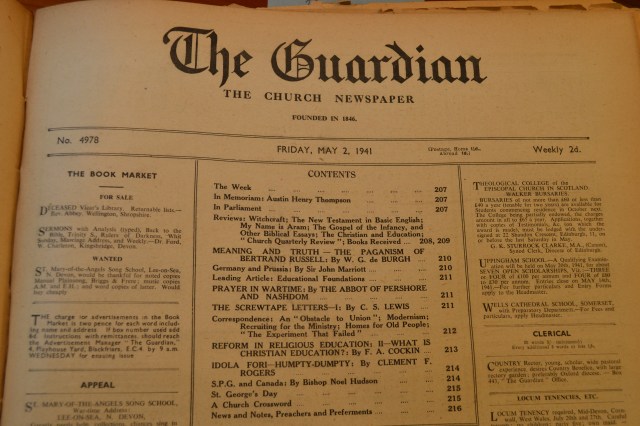
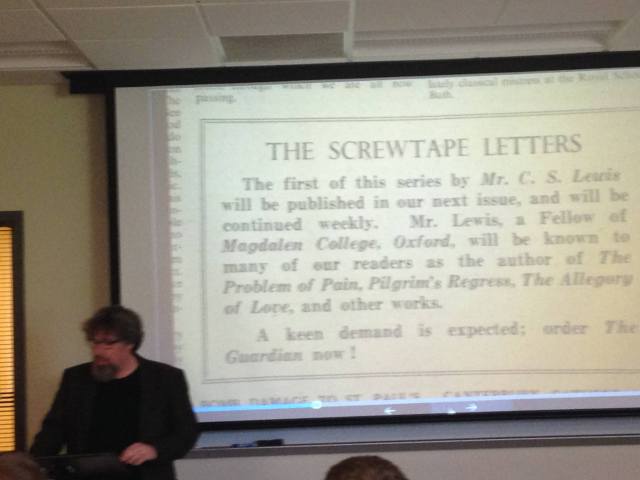
When he had finished the letters (as far as I can tell), he submitted them as a package to The Guardian, an Anglican paper where Lewis published other WWII-era essays. On Apr 25, 1941, the editor of The Guardian announced an upcoming series called The Screwtape Letters by C.S. Lewis.
From May 2 to Nov 28, 1941, the letters were published serially–a weekly burst of creativity and artistry that focussed the spiritual life during a period of fear, worry, violence, and loss.
We will return to the question of the Screwtape Preface presently, where Lewis prepares the reader in a creative way to read these pieces of demonic epistolary fiction. The preface is essential to reading The Screwtape Letters as it prepares the reader for the upside-down nature of the content within a fictionalized prefatory note. Intriguingly, the very first public release of the Letters in The Guardian offers no such preface, or even a note of explanation; it simply begins:
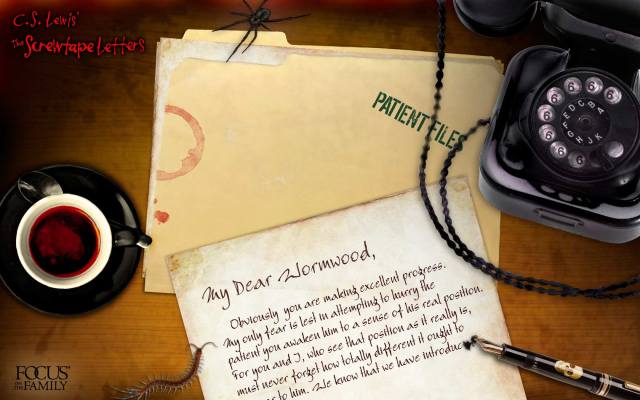
“My Dear Wormwood—I note what you say about guiding our patient’s reading and taking care that he sees a good deal of his materialist friend. But are you not being a trifle naïf? It sounds as if you supposed that argument was the way to keep him out of the Enemy’s clutches.”
As I discuss it in detail here, it is a shocking beginning for the unprepared. Who is Screwtape? Who is Wormwood? Why is Wormwood being commended for encouraging connections with materialists (atheists? naturalist? worldly people?)? Why is he rebuked for using argument as a foundation for action?
The original Screwtape Letters were an extreme use of in medias res with the potential to leave the reader completely befuddled. We all “get” Screwtape now because the genre of demonic epistolary fiction is something we might expect. It is part of pop culture. Back then, though, it was entirely new. While the editor’s little note may prepare regular readers to expect a Christian academic, readers not expecting a new, satirical genre may well be surprised.
Within a few weeks of this serial Screwtape, editor Ashley Sampson stumbled upon the Letters and convinced Geoffrey Bles to publish them. Through 1941, Lewis prepared the manuscript for publication, including writing the preface on Jul 5, 1941, sending manuscripts to friends for safe-keeping (see the story here, here, and here), and going through a revision process that is now mostly lost to us in history.
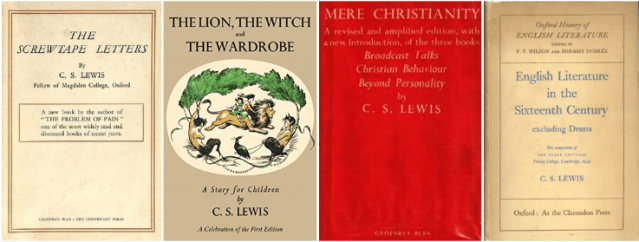
Finally, on Feb 9, 1942, The Screwtape Letters was published by Geoffrey Bles in the UK, followed by an American edition in 1943.
Screwtape Meets the World
The timeline of Screwtape meeting the world is a bit complex, from the initial moment that sparked Lewis’ imagination, to Lewis’ 1959 sequel “Screwtape Proposes a Toast” in the Saturday Evening Post, to Screwtape‘s influence in the world. For those that are interested in the details, I work them out here in this piece.
Upon publication, Screwtape was so immediately popular that it was reprinted several times a year over the next decade. I don’t know any biographer of C.S. Lewis‘ life as a writer or his afterlife as an author that doesn’t include Screwtape as a critical feature of who he was and what influence he had on the world. I have found it intriguing to put his somewhat surprising writing Screwtape in the context of his writing life (see here, here, here, and here). However, Screwtape is also important in the development of C.S. Lewis’ public profile. Although Lewis’ BBC talks and Screwtape came about simultaneously, they were each critical in Lewis’ development as a public figure.
In the 1940s, Time magazine was one of the reasons that Lewis ascended in the literary and religious imaginations of Americans. In a review of The Great Divorce, Lewis is described as a
“ruddy, balding British Author (The Screwtape Letters, etc.), a convert (1930) from well-bred skepticism to the Church of England…” (Time, 3/11/1946, Vol. 47, Issue 10).
“man who could talk theology without pulling a long face or being dull.”
I don’t know anyone who has catalogued the breadth of influence that Screwtape has had within popular culture as a whole. That Monty Python’s John Cleese narrated a Grammy-nominated audiobook of The Screwtape Letters is some indication of its impact.
But it goes deeper than just mere cultural influence, theological playfulness, or artistic possibilities for me. Screwtape was an essential part of my path to becoming a C.S. Lewis scholar in the first place, and I tell the story in some detail here.
The Screwtape preface has become a famous part of speculative literature history. In writing the preface to guide the reader into this peculiar new work, Lewis followed the long tradition of epistolary fiction–novels written as letters, diary entries, records, and the like. As we encounter the Letters, it isn’t that Lewis wrote these Screwtapian bits of correspondence; rather, as he says in the preface published in your copy of The Screwtape Letters, he has discovered them somehow:
“I have no intention of explaining how the correspondence which I now offer to the public fell into my hands.”
It is a pretty piece of work. But behind this “published preface” is an archival piece, a handwritten preface that Lewis wrote as his first attempt to invite a broader readership into The Screwtape Letters. This preface includes a deeper dimension to Screwtape in Lewis’ imagination.
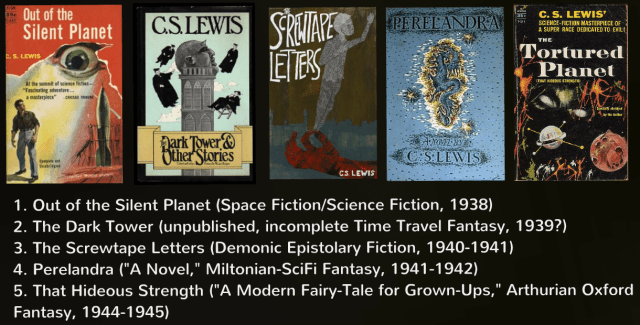
Beyond all the intriguing aspects of the handwritten preface, is the particular discovery that Lewis makes a link between Screwtape and his Ransom books–Out of the Silent Planet, published before Screwtape in 1938, and Perelandra, which he was writing at the time that Screwtape was moving toward publication.
This is the first sentence of what I call the “Ransom Preface” or the “Cosmic Preface”:
“Nothing will induce me to reveal how my friend Dr. Ransom got hold of the script which is translated in the following pages.”
This is the original discovery I made in the Wade centre archive at Wheaton college in 2012. Since that point, I have spent years working on the implications of a “Ransom Cycle” that includes Lewis’ ineptly named “Space Trilogy” combined with Screwtape and other writings in the Ransom universe.
In 2013, I published the entire Ransom Preface in Notes & Queries. In 2014, I travelled to Mythcon at Wheaton College in Norton, MA, to share my discovery and initial thoughts with the fantastic (in more ways than one!) community of myth-lovers and fantasy fans. Then, in 2016, I returned to the C.S. Lewis and friends conference at Taylor University with some further analysis in a paper I entitled, “When Screwtape Haunts in Eden: Testing the Possibilities of the Screwtape-Ransom Speculative Universe” (see more here and here). I then worked this material into a lecture for my students, which I have published on Youtube.
Eventually, I was able to publish “A Cosmic Shift in The Screwtape Letters” in Mythlore–the journal of the society that hosted the original Mythcon where I presented my initial findings. This paper is the culmination of several years of doing analysis and testing the material in writing, teaching, and conversation. Beyond formal conferences and academic journals, I have occasionally been able to speak about my findings in a more popular setting, including local college courses, university classes, and events like my “Pints with Jack” conversation in 2020.
My work with The Screwtape Letters and the Ransom Cycle has continued since. Recently, I teamed up to do some archival work with Charlie W. Starr–C.S. Lewis handwriting expert and the first person to note in print that a Ransom Preface even existed. Charlie and I did some work on what we think to be the “Archangel Fragment,” Lewis’ single attempt to answer Screwtape with letters of angelic advice. You should be able to see bits of our paper, “The Archangel Fragment and C.S. Lewis’s World-Building Project” here, but you can order a copy on Amazon.
How to Work on The Screwtape Letters Yourself
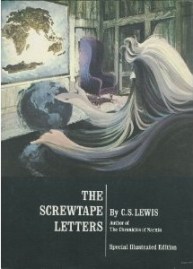
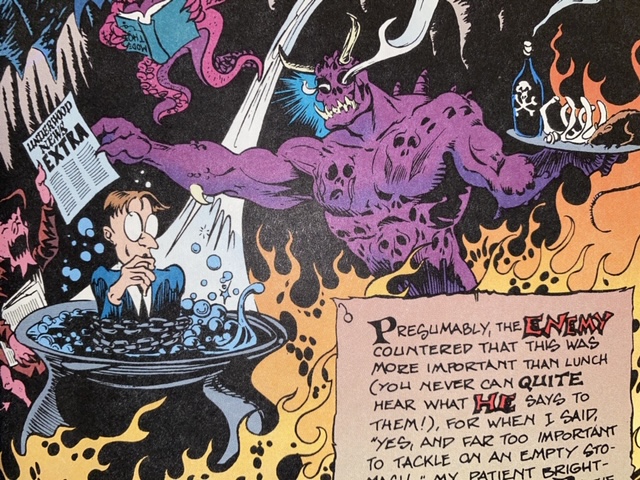
Of course, the best way to study The Screwtape Letters is to ignore everything I have said and to pick up the book and read. Once you have read it in your cheap, well-worn used copy, you can find Screwtape in various editions–like audiobooks or stage performances or graphic novel adaptations. And when you have read it until has begun to work on you, you may want to think about finding resources to walk with Lewis in his unusual experiment in spiritual theology and cultural criticism.
Then, and only then, I may be of some help. Here are some pieces that may support your work:
The Screwtape Letters as a Manuscript and Archival Research on C.S. Lewis
I believe in open access scholarship. Because of this, since 2011 I have made A Pilgrim in Narnia free with nearly 1,000 posts on faith, fiction, and fantasy. Please consider sharing my work so others can enjoy it.
Following a day of rest after weeks of weary toil, I did not hasten to my bed last evening. I had succeeded in finding repose over the weekend–a discovery that had been dear these last few weeks. Nighttime sleeplessness of late has sent me to the text by lamplight. One night last month, after tossing and turning for a couple of hours, I opened Shakespeare’s King Henry IV, Part 2 and read:
How many thousand of my poorest subjects
Are at this hour asleep! O sleep, O gentle sleep,
Nature’s soft nurse, how have I frighted thee,
That thou no more wilt weigh my eyelids down
And steep my senses in forgetfulness?
Unfortunately, I am not one of the King’s subjects who purchases in toil and poverty what the King cannot afford in intellectual perspective and material riches. Though I have no crown, but merely a small golden sceptre of the little maker’s art, the king is clearly correct about the weight of care:
Uneasy lies the head that wears a crown.
I wonder what I am up against?
“O sleep, O gentle sleep,” is this how I have frightened thee away? I still don’t have the answer to that question–despite its importance both for my night-wandering.
Then a couple of weeks ago, I reached for Macbeth in the middle of the night:
Methought I heard a voice cry ‘Sleep no more!
Macbeth does murder sleep’, the innocent sleep,
Sleep that knits up the ravell’d sleeve of care,
The death of each day’s life, sore labour’s bath,
Balm of hurt minds, great nature’s second course,
Chief nourisher in life’s feast
When I first turned that startling page, I was worried that sleep may be gone for good. However, it is not my conscience that keeps me awake. Though sleeplessness and madness sound the hours of the clock in Macbeth like a hammer on anvil, I have chosen not to seek the ministering spirits to cloak night and encourage murderous thoughts to their ends. This is not how I want to find the end of my life’s prophecy or curse. Still, with restless Macbeth who has murdered sleep even as his wife has called for everlasting night, I suffer the same dis-ease: my sleeves of care are still unravelled, my sore labour remains unbathed, and unceasing are the thoughts which course fruitlessly through my mind.
And then last night, rested but ready for sleep, sleep would not come. I wandered the corridors of my mind before giving up and reaching for a book.
It was a good reading time. I finished a good, hard book in manuscript form that was long past due. But in closing the page and winking off the light, I found myself mentally sitting at my desk. For having finished the book there are now two days of work to do on it. Good work, to be sure. Work I love.
It is the two days that I lack.
And so this morning, waking late with only a couple of hours of sleep, I made coffee and opened Shakespeare‘s sonnets with little expectation. I was puzzled by the bard’s summer day comparison, so I flipped on. Then in Sonnet #27, I read:
Weary with toil, I haste me to my bed,
The dear repose for limbs with travail tired;
But then begins a journey in my head
To work my mind, when body’s work’s expired…
Yes, yes, there it is, “a journey in my head.” I don’t understand this poem at this bleary-eyed moment–even with coffee in hand. Perhaps the beloved is actually a lover and not a poem or friend or heart’s ambition. But I am struck by the good thing, the beautiful thing, the “soul’s imaginary sight” that is “like a jewel hung in ghastly night.” This dream or friend or lover “Makes black night beauteous” and renews his vision of the beloved. And yet this beautiful image is the “zealous pilgrimage” that keeps his “drooping eyelids open wide” and causes him to meet the darkness with an unquiet mind.
It is a striking problem: Not the weight of the world (like Henry) or the burden of conscience (like Macbeth). Instead, it may be the Good out of reach that worketh on my mind and “begins a journey in my head.”
Do I dare turn the page?
Well, there it is again, Sonnet 28: I am debarred the benefit of rest. Day’s oppression is not eas’d by night but now day and night oppress each other as “enemies to either’s reign” who have agreed to torture me in their civil war. Day is brutalized by toil while night weaponizes the complaint of toil in the face of a starless, swarthy space of pain. The fight, the fight:
But day doth daily draw my sorrows longer,
And night doth nightly make grief’s length seem stronger.
Well, if I cannot quiet the mind at night I must take up the toil of day. So I write.
And because of the beauty of the lines–and in case there are others who walk the mind-halls of sleeplessness, I leave you this pair of sonnets with the help of Sir Patrick Stewart. I turn now to some other poet–someone other than Shakespeare, who eclipses the days and nights and centuries between us with a prophecy (or curse) of the journey in my head.
“Sonnet 27: Weary with toil, I haste me to my bed,” by William Shakespeare
Weary with toil, I haste me to my bed,
The dear repose for limbs with travail tired;
But then begins a journey in my head
To work my mind, when body’s work’s expired:
For then my thoughts, from far where I abide,
Intend a zealous pilgrimage to thee,
And keep my drooping eyelids open wide,
Looking on darkness which the blind do see;
Save that my soul’s imaginary sight
Presents thy shadow to my sightless view,
Which like a jewel hung in ghastly night
Makes black night beauteous, and her old face new:
Lo, thus, by day my limbs, by night my mind, For thee, and for myself, no quiet find.
“Sonnet 28: How can I then return in happy plight,” by William Shakespeare
How can I then return in happy plight,
That am debarred the benefit of rest?
When day’s oppression is not eas’d by night,
But day by night and night by day oppressed,
And each, though enemies to either’s reign,
Do in consent shake hands to torture me,
The one by toil, the other to complain
How far I toil, still farther off from thee.
I tell the day, to please him thou art bright,
And dost him grace when clouds do blot the heaven:
So flatter I the swart-complexion’d night,
When sparkling stars twire not thou gild’st the even.
But day doth daily draw my sorrows longer,
And night doth nightly make grief’s length seem stronger.
I believe in open access scholarship. Because of this, since 2011 I have made A Pilgrim in Narnia free with nearly 1,000 posts on faith, fiction, and fantasy. Please consider sharing my work so others can enjoy it.
Here is a little piece on a special day: the anniversary of the death of my father and brother on a villainously cold night when I was fourteen, and on the eve of the anniversary of my mother’s passing in 2016.
This January in Prince Edward Island, we have had the kind of frightful cold snap that reminds my me of that childhood night of terror–though the cold has now broken into snow and storm. While the weather has changed, on this day, February 4th, it is hard not to go back to that night when my whole life changed, where my awakening into young adulthood was linked with horror and grief.
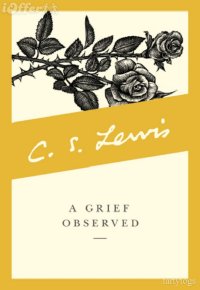
Since encountering Lewis’ stunning book, A Grief Observed, some year ago, I have been using his memoir to shape my experience and support others in times of loss. This is a brief reflection and video talk from 2018, where a cold snap froze us in early February like it had done in 1990. With a sombre tone and a personal approach, I draw out seven key lessons from Lewis’ A Grief Observed. I have been surprised by the response to this video, which continues to be viewed daily and is my most popular Youtube resource.I hope it can be helpful to those of you who are mourning a loss or guiding others along the way of grief.
It was somewhat eerie returning home on Saturday in the crisp darkness of a Feburary evening. My wife and I went to see Guillermo del Toro‘s Oscar-winning dark SF Fairy Tale, The Shape of Water. The night was cold, terribly cold. With the wind chill it was approaching -30 Celsius (below -20 Fahrenheit). As I got out of the car I smelled wood burning in the frozen air, and I remembered the night of Feb 4th, 1990.
That night was bitter cold–even colder than the early hours of Saturday. My father and his girlfriend had been out for the evening, while my siblings and I watched hockey and found our way to bed. In the middle of the night I was awoken by the smell of wood burning, and then my sister was in my room. The house was on fire and my father was battling the flames in the kitchen. In terror and confusion, we found our way into the Arctic night. In the seconds that it took to move away from our burning home, the cloth I had dappened for breathing through the smoke was frozen in my hand. My father stood for a moment on the threshold, looked at us, then went into the house for my baby brother.
We never saw either of them again. My father was nearly 34, and my brother was nearly 3. I was just 14.
The 4th of February continues to be that day of memory for me. I’ve talked before about the power of grief, of loss, and of what it means to have an event like this in our past. Life moves ever on and on, though, and so does love and loss. I spent the 2016 anniversary of Feb 4th in St. Martha’s Hospital in Antigonish, Nova Scotia, at the bedside of my dying mother. She succumbed to cancer a week later on Feb 12th, 2016. She was 61.
Though I was no longer a 14-year-old but a father and scholar and leader in his ’40s, what followed my mother’s death was a profound period of grief for me. It was unlike anything I have ever experienced, less emotional than physiological. I largely hid this experience from people in the community–not because of falls ideas of manhood or shame or spiritual strength, but because I did not know what I was experiencing.
In the wake of her death, I thought I was mostly okay. I wrote an intimate and elaborate obituary that I thought Mom would be proud of. Almost immediately I went back to work, writing and teaching and reading.
It was not until the following summer, a year and a half after my mother’s passing, that I started to see clearly.
Like waking up after a long illness and breathing clearly, only then realizing how long and deep that dullness was. That’s what grief was for me then.
It was a cloud that dims clarity without reducing light, a dullness that disturbs intelligence without taking us away from choices, a physical impairment so slight that I could not feel it but so pervasive that it had affected all of my life.
It was like living in a valley of smoke and pollution only visible with the clarity one who has found a way outside.
In all the time I thought I was on my own street and living well in my home, I was in a gray town of choking mist and indistinct buildings.
But then, in time, there is moment of clarity. Last summer, in my garden, my fingers in dirt, I started to see colours peeking out of the gloom. There was vibrancy and brilliance I had not know. I began to see where I had been–though it was still a few more months before I began to breathe more clearly again.
I never understood, even in all the moments of grief and loss in my relatively short life, in all the times I have walked with others, what this experience could be like. C.S. Lewis, though, has a way of capturing that physical, embodied sense of loss that I have read many times but never truly understood. In the opening words of his memoir of loss, A Grief Observed, Lewis writes:
No one ever told me that grief felt so like fear. I am not afraid, but the sensation is like being afraid. The same fluttering in the stomach, the same restlessness, the yawning. I keep on swallowing.
At other times it feels like being mildly drunk, or concussed. There is a sort of invisible blanket between the world and me. I find it hard to take in what anyone says. Or perhaps, hard to want to take it in. It is so uninteresting. Yet I want the others to be about me. I dread the moments when the house is empty. If only they would talk to one another and not to me.
From time to time, I teach an online C.S. Lewis course at The King’s College in New York City. Recently, they experienced a very personal moment of loss. Distant though I was, I could see from afar how many in the campus were reeling, and generally how strong the response of staff and students was to the tragedy. I decided to add a short lecture to my course on the Fiction and Fantasy of C.S. Lewis. This lecture considers Lewis’ A Grief Observed, using my own story of loss and Lewis’ memoir of grief to draw out seven lessons we can learn about grief. While I don’t talk about the lasting damage that my period of grief has caused–my current clarity negates nothing of the shadows of the past–I do share personally with my TKC students as I invite them to think with a strong spiritual capacity about grief and life’s walk in love, faith, and loss.
So I thought I would share the lecture with you. If this can be helpful in your own experience of grief, or in support of your thoughts about the problem of suffering in our world, or in your study of C.S. Lewis, I hope you will feel free to share it. If your own grief is very close and keen, it might perhaps be wise to come back to this in the days ahead. An intellectual response to pain is poor fare for those starving of loneliness or loss. But for those that are ready to think about grief–and to know the experience of the community of mourners in the world around you–this may be a resource for you.
C.S. Lewis’ A Grief Observed is out of copyright in most parts of the world outside of the US, and is available in places like Gutenberg Canada. In printed editions, there are also thourghful forewords by folks like fantasy writer and memoirist, Madeleine L’Engle, and Lewis’ stepson, Douglas Gresham (I reference each of them in the lecture). I hope to one day write a foreword myself for a new edition so that more readers can find this obscure, unusual, troubling and deeply impactful book.
I believe in open access scholarship. Because of this, since 2011 I have made A Pilgrim in Narnia free with nearly 1,000 posts on faith, fiction, and fantasy. Please consider sharing my work so others can enjoy it.


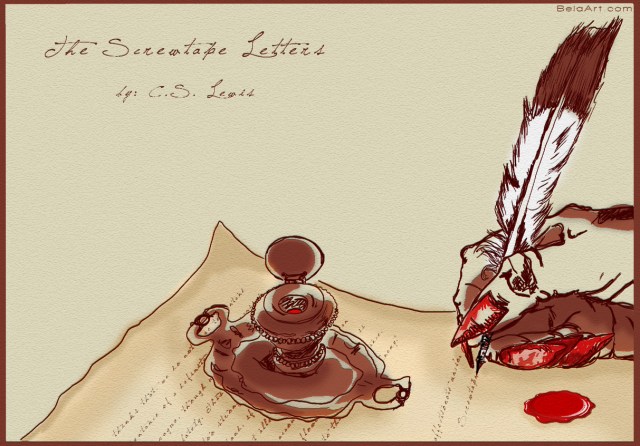 I get to present on my “Cosmic Find in The Screwtape Letters“, very briefly teasing out some of the implications for connecting Dr. Ransom of C.S. Lewis’ aptly misnamed “Space Trilogy” to The Screwtape Letters. Here are some ways you can prep for my 5-minute talk teaser:
 Pop-up Mini-Conference: The Screwtape LettersNot more than twenty minutes into the Inkling Folk Fellowship Screwtape marathon, it became obvious that the richness, profundity, and (sometimes) perplexing nature of C. S. Lewis’s 1942 masterpiece needed more than a read-aloud (although we wouldn’t have traded that experience for a ride on the #73 to the St. Pancras/British Library stop). Too many ideas, conversations, questions were flying back and forth in our minds and in the chat to just leave them suspended in the Zoomosphere. So. We abruptly switched our upcoming schedule (see the bottom of the page for that) and asked for proposals for five-minute response papers from various perspectives.And . . . here we go!Join the Inkling Folk Fellowship (aka, “Safe Place for Nerds”) via Zoom this Friday at 4 p.m. (EST) for our Pop-up Mini-Conference on The Screwtape Letters. The two-hour session will look something like this:
 Panel One: Reception and Context
 Panel Two: Screwtape as Theologian
 Panel Three: Problematizing The Screwtape Letters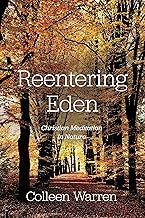















 A Pilgrim in Narnia